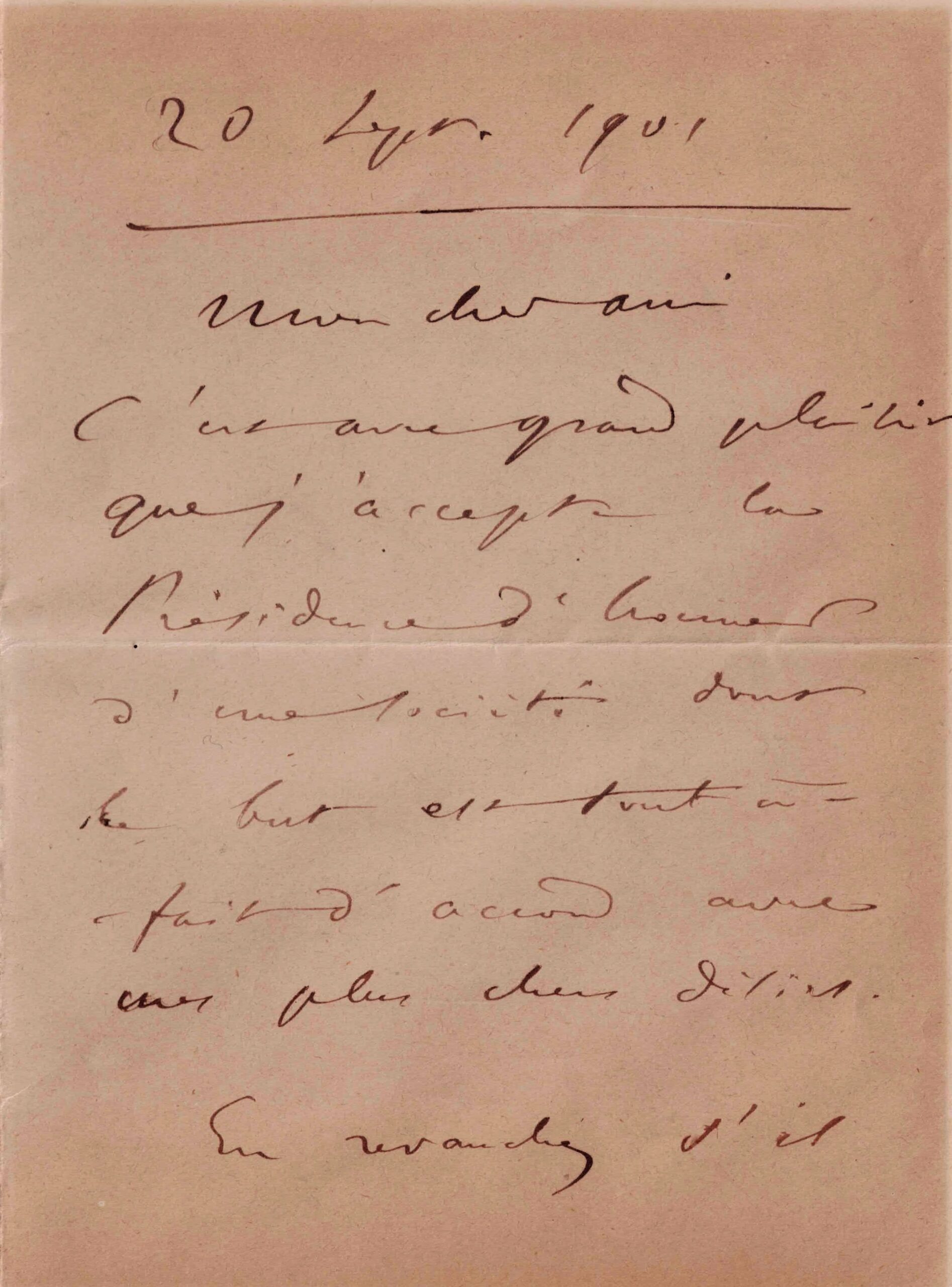
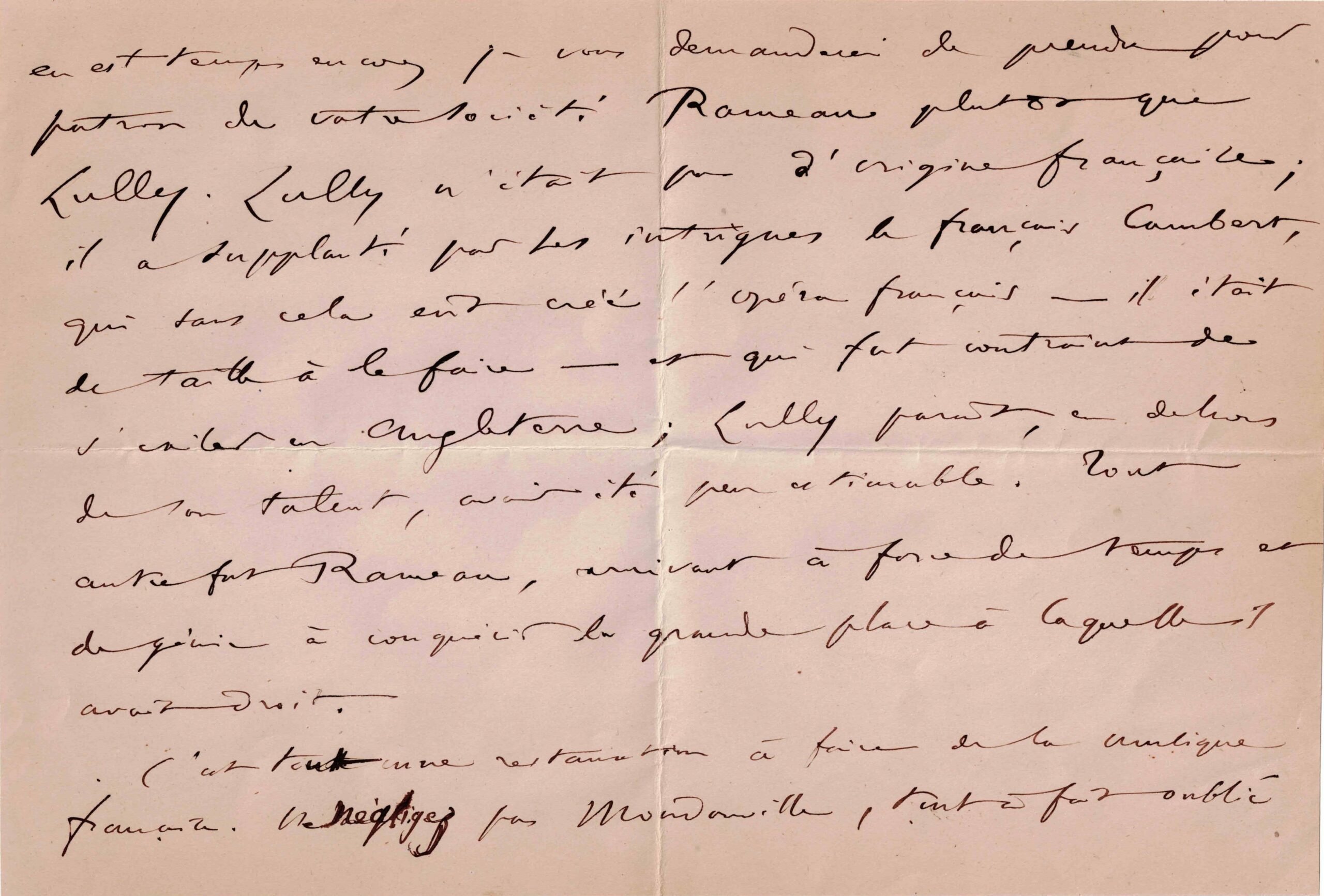
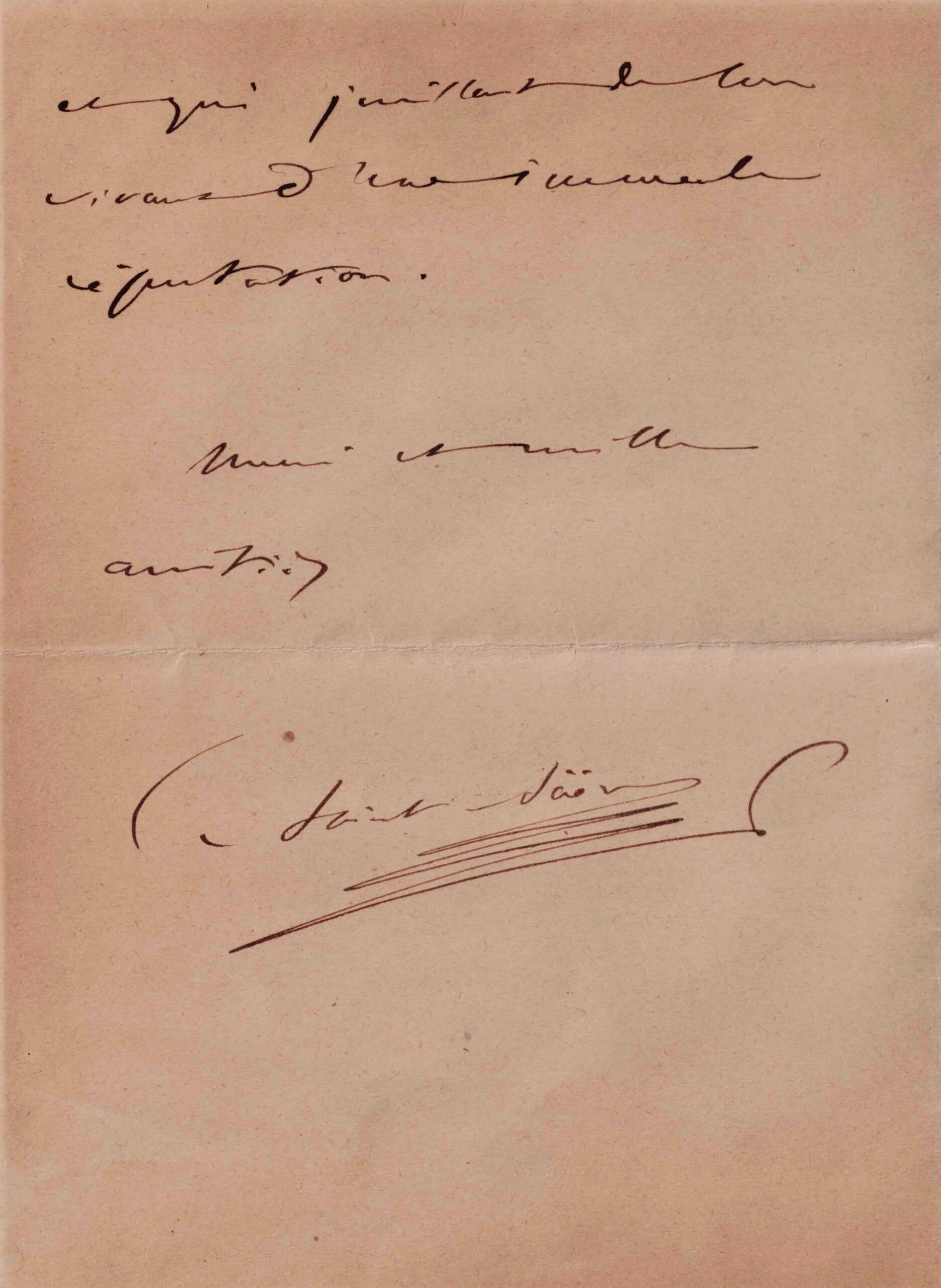

"I would ask you to choose Rameau as the head of your company rather than Lully."
550€
Camille SAINT-SAËNS (1835.1921)
Autographed letter signed to Henri Casadesus.
Four pages in-12°. Browning and slight sun fading in the margins
No place. September 20, 1901.
"I would ask you to choose Rameau as the head of your company rather than Lully."
A superb letter from the composer accepting the honorary presidency of the Society of Ancient Instruments, then being created by Henri Casadesus. Saint-Saëns, however, expressed strong reservations about the name of Jean-Baptiste Lully, whose symbolic patronage the Society was considering, and suggested Rameau as a replacement.
________________________________________
“My dear friend, it is with great pleasure that I accept the honorary presidency of a society whose purpose is entirely in accordance with my dearest wishes. However, if there is still time, I would ask you to choose Rameau rather than Lully as the patron of your society. Lully was not of French origin; he supplanted, through intrigue, the Frenchman [Robert] Cambert, who otherwise would have created French opera—he was perfectly capable of doing so—and who was forced into exile in England.”
Lully, apart from his talent, seemed to have been of little worthwhile esteem. Rameau was quite different, managing, through time and genius, to conquer the prominent place to which he was entitled. French music needs a complete restoration. Do not neglect [Jean-Joseph Cassanéa de] Mondonville, entirely forgotten, who enjoyed an immense reputation during his lifetime. Thank you and best regards. C. Saint-Saëns .
________________________________________
Founded by Henri Casadesus in 1901, the Société des Instruments Anciens was one of the very first ensembles specializing in performance on historical instruments. It predates by several decades the great "early music" movement that we now associate with Nikolaus Harnoncourt, Gustav Leonhardt, or William Christie.
The Society's mission was to find forgotten scores, rediscover the French and European masters of the 17th and 18th centuries and bring back into the spotlight Rameau, Couperin, Mondonville, Lully, Campra, etc.