Boris Vian (1920.1959)
Autographed letter signed to Roger Vincent.
Two quarto pages on graph paper. No place or date.
Two binder holes in the margin.
A very interesting document by Vian wishing to reorganize music criticism.
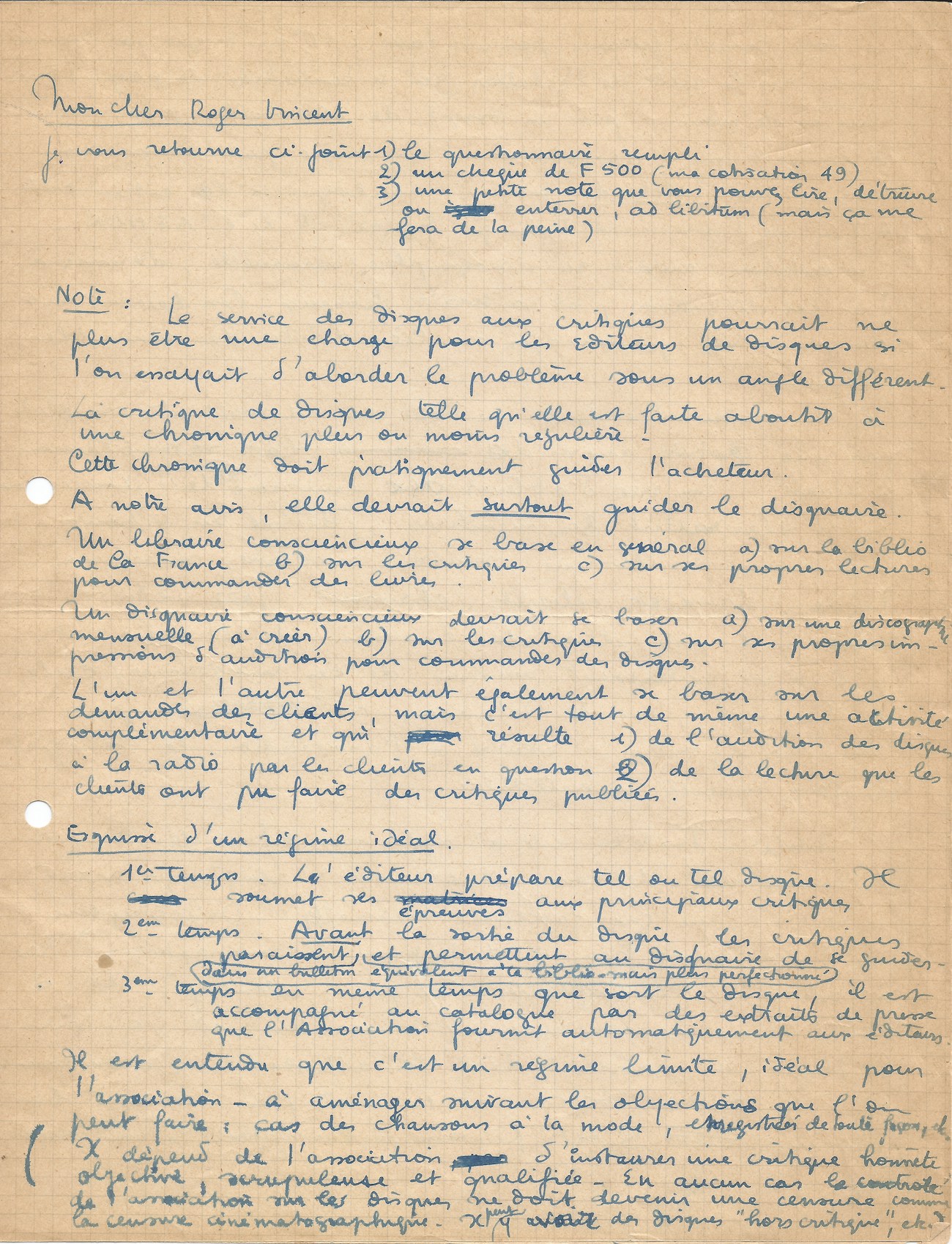
My dear Roger Vincent, I am returning to you enclosed: 1) the completed questionnaire, 2) a check for 500 francs (my 49th contribution), and 3) a short note that you may read, destroy, or bury as you wish (but it will sadden me).
Note : The service of record reviews could no longer be a burden for record labels if the problem were approached from a different angle. Record reviews, as they are currently written, result in a more or less regular column. This column is meant to guide the buyer. In our opinion, it should primarily guide the record store owner. A conscientious bookseller generally bases their book orders on: a) the French bibliography; b) reviews; and c) their own reading. A conscientious record store owner should base their orders on: a) a monthly discography (to be created); b) reviews; and c) their own listening impressions. Both can also rely on customer requests, but this is still a complementary activity resulting from: 1) customers hearing records on the radio; and 2) customers reading published reviews.
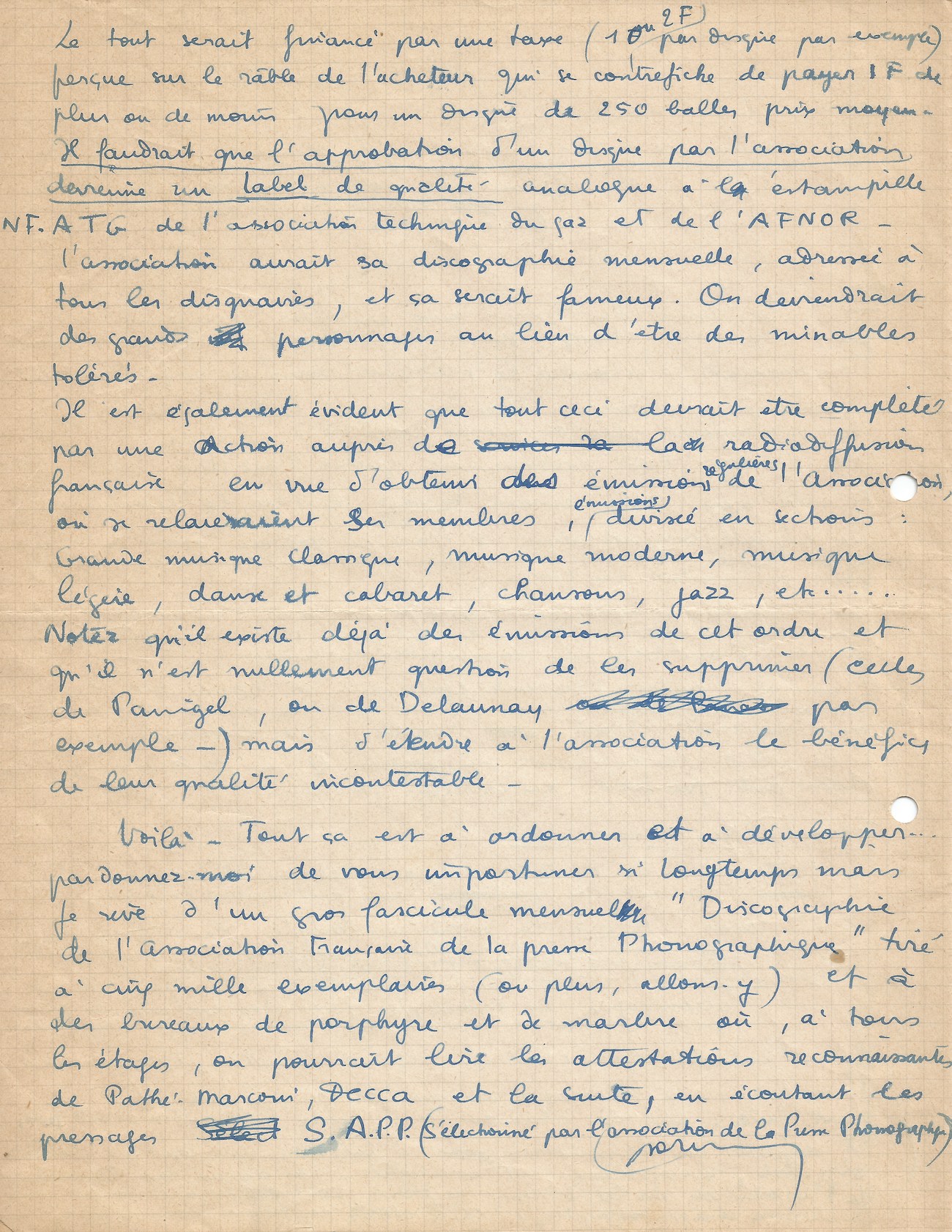
Outline of an ideal system . 1st stage. The publisher prepares a particular record. They submit proofs or key reviews. 2nd stage. Before the record's release, the reviews are published (in a bulletin similar to a bibliography but more sophisticated) to guide record store owners. 3rd stage. Simultaneously with the record's release, it is accompanied in the catalog by press excerpts that the association automatically provides to publishers. It is understood that this is a minimal system, ideal for the association – to be adapted according to any objections that may arise: for example, the case of popular songs, which are recorded anyway. It is up to the association to establish honest, objective, meticulous, and qualified criticism. Under no circumstances should the association's control over records become censorship like film censorship. There may be "unreviewed" records, etc. The whole thing would be financed by a tax (1 or 2 francs per record, for example) levied on the buyer, who couldn't care less about paying 1 franc more or less for a record costing an average of 250 francs. The association's approval of a record should become a quality label, similar to the NF ATG mark of the French gas technical association and AFNOR. The association would have its own monthly discography, sent to all record stores, and it would be quite something. We would become important figures instead of being tolerated nobodies. It's also clear that all this should be complemented by lobbying French radio to obtain regular broadcasts from the association, featuring its members taking turns, with the broadcast divided into sections: classical music, modern music, popular music, dance and cabaret, song, jazz, etc. Note that there are already programs of this kind and there is no question of removing them (those of Panigel or Delaunay for example) but of extending to the association the benefit of their undeniable quality.
So, all of this needs to be organized and developed. Forgive me for bothering you for so long, but I dream of a large monthly booklet, "Discography of the French Association of the Phonographic Press," printed in five thousand copies (or more, why not?), and of offices made of porphyry and marble where, on every floor, one could read the grateful testimonials of Pathé Marconi, Decca, and so on, while listening to the SAPP pressings (selected by the Association of the Phonographic Press).