Jules BARBEY D'AUREVILLY (1808- 1889)
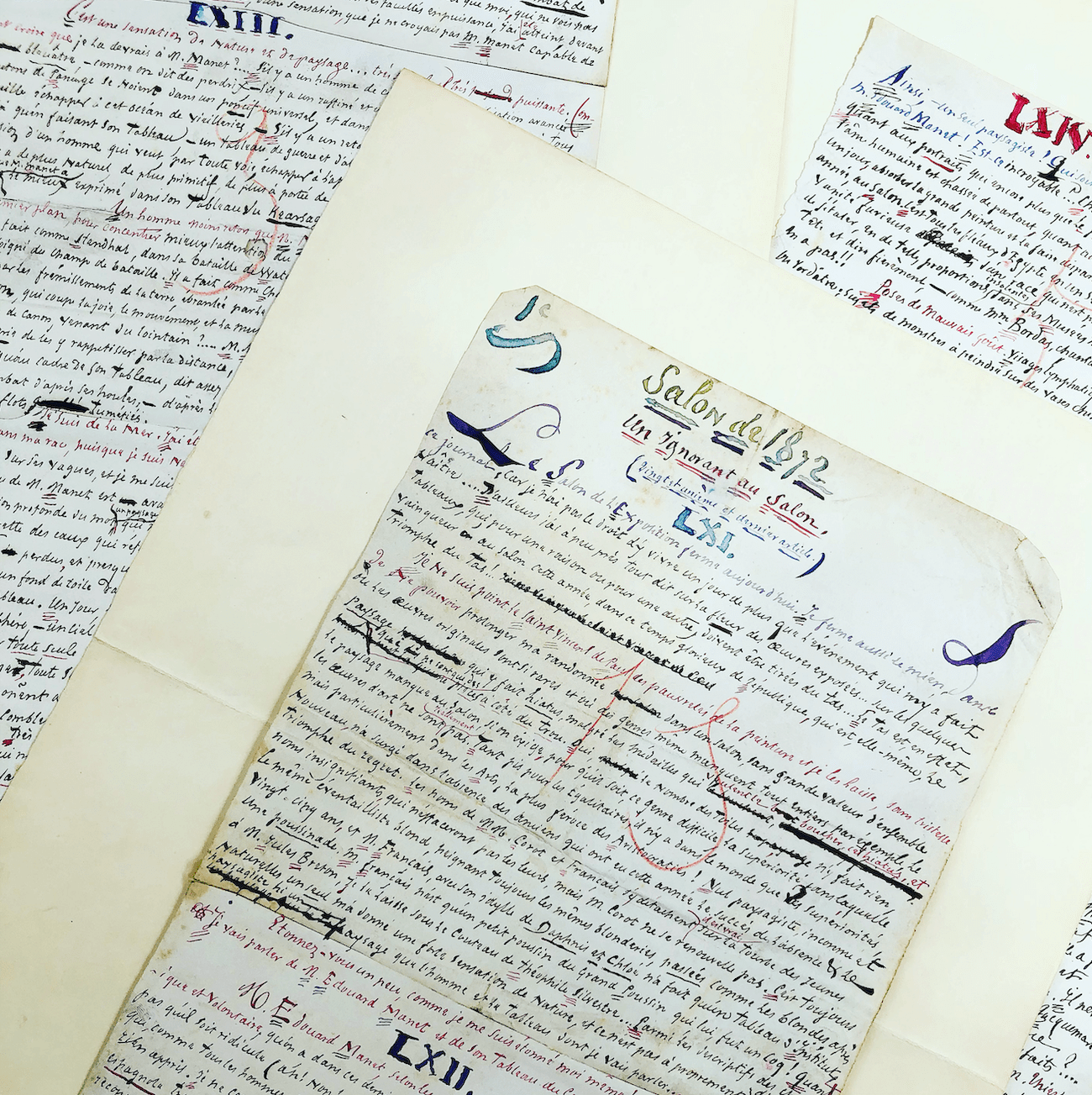
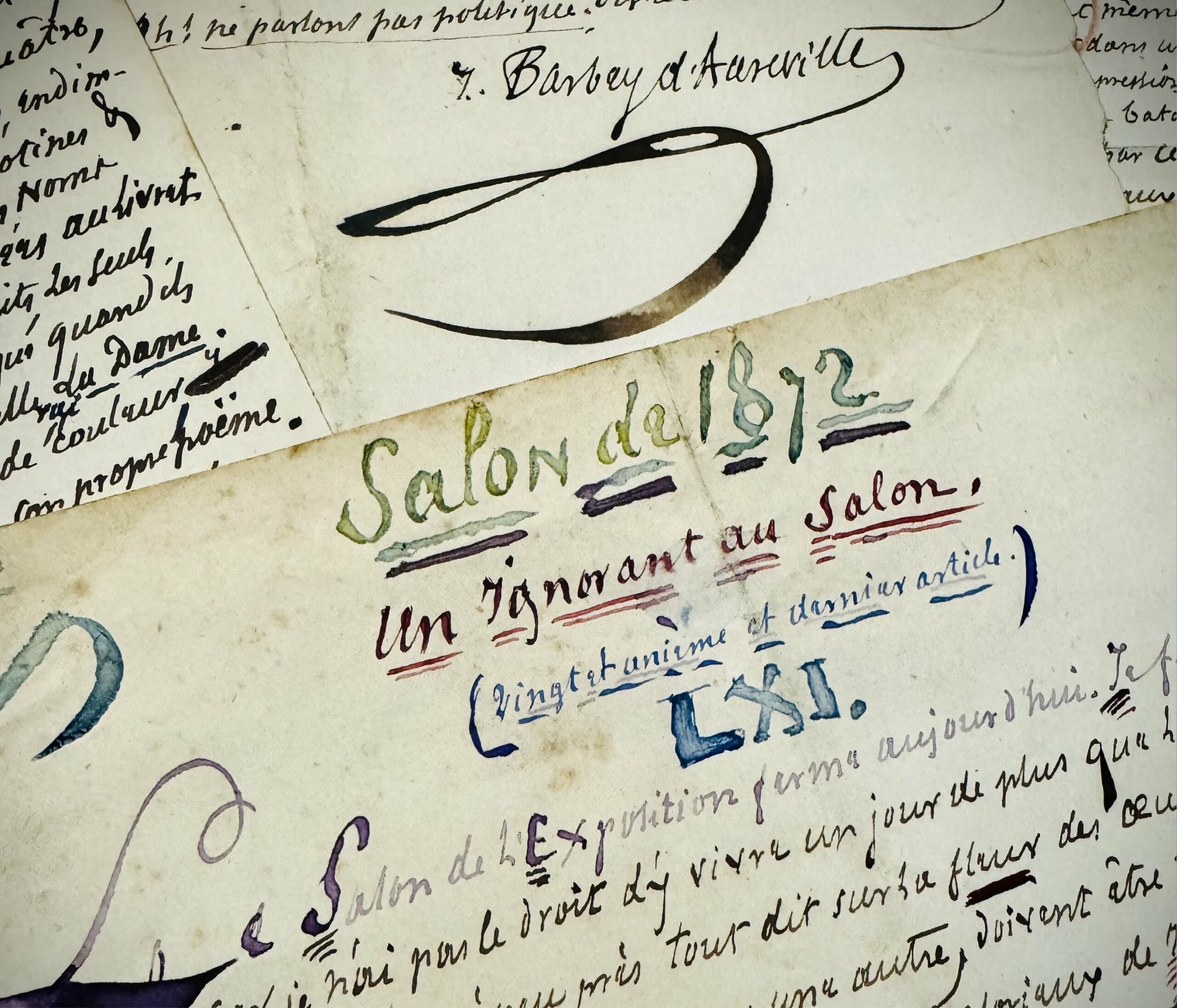
Autograph manuscript signed – Salon of 1872. An ignorant man at the Salon.
Three pages and two lines in folio mounted on heavy paper.
[Paris. Early July 1872]
“Finally, the last reason in favor of Mr. Manet: among the men who had high hopes for this young painter – and from his very beginning – was Baudelaire; and in art, Baudelaire is someone. He had a profound, sharp almost somnambulistic … He saw .”
A superb manuscript by Barbey d'Aurevilly, in polychrome ink, discussing the Salon of 1872 and praising the artistic qualities of Édouard Manet and the critical acumen of Charles Baudelaire. Strikingly beautiful, a veritable manuscript painting in itself, these four pages offer a formidable critique from a mind in search of "Sensations of Art.".
Barbey d'Aurevilly, who claimed to have developed an interest in art only rather late in life, had until then written a few scattered texts on the subject. In 1872, he agreed to review the Salon for the newspaper Le Gaulois , choosing to adopt an original tone, as he wrote to Armand Royer on April 17, 1872: "I have never done a Salon and I will do this one, in my own way which will not be that of my neighbor, I assure you, nor indeed that of anyone."
In this newspaper, from May 23 to July 3, he published twenty-one art reviews under the provocative title " Salon of 1872. An Ignorant Man at the Salon ." The present manuscript (the twenty-first and final article) is the French dandy's last review of the aforementioned Salon.
After mentioning his disappointment with Camille Corot's work, Barbey d'Aurevilly marvels at The Battle of the Kearsarge and the Alabama , exhibited at the Salon. Referencing Turner, Stendhal, Byron, and Chateaubriand, he praises the late Charles Baudelaire and his artistic analyses.
The Battle of the Kearsarge and the Alabama was painted by Manet in 1865, immortalizing the naval battle between the two American ships that took place off the coast of Cherbourg in June 1864. The two vessels, one Confederate and the other Union, clashed during the American Civil War, more than 6,000 kilometers from their homeland. Manet's painting was acquired in 1878 by Marguerite Charpentier (1848–1904), a salonnière and art collector, and is now housed in the Philadelphia Museum of Art.
________________________________________
Full text:
" The Salon de l'Exposition closes today. I also close mine, in this journal, for I have no right to live a day longer than the event that brought me into being there… Besides, I have said just about everything about the flower of the works exhibited… about the few paintings which, for one reason or another, must be pulled from the pile… The pile is, in fact, victorious at the Salon this year, in this glorious time of the Republic, which is, itself, the triumph of the pile!"
I am no Saint Vincent de Paul of the poverty of painting, and I leave them, without sadness, at not being able to prolong my stroll through a Salon of little overall value, where original works are so rare and where entire genres are even missing, for example, landscape, which creates a gap , despite the medals that attempt to fill it, merely pieces beside the void. Yes, the number of canvases is irrelevant; landscape is lacking at the Salon, if one demands, for it to exist, this difficult genre, the superiority without which works of art do not truly exist. So much the worse for the egalitarians; there are only superiorities in the world, but particularly in the Arts , the fiercest of aristocracies! No unknown and new landscape painter has emerged in the absence of the old masters who this year have enjoyed the success of absence and the triumph of regret. The names of Messrs. Corot and Français do stand out, it's true, from the throng of insignificant young names, which won't erase their own, but Corot doesn't reinvent himself . He's still the same blond fan-maker, still painting the same blondish scenes, faded like blondes after twenty-five, and Français, with his Daphnis and Chloe , has produced nothing more than an art-house painting, a chickadee . Français is but a little chick of the great Poussin , who was a rooster! As for Jules Breton, I'll leave him to the knife of Théophile Silvestre… Among the descriptions of natural things, only one gave me a strong sense of Nature, and it's not strictly speaking a landscape painter or a landscape that is the man and the painting I'm about to discuss. Be a little surprised, as I was myself! … I am going to talk about Mr. Édouard Manet and his painting of the Battle of the Kearsage and the Alabama .
Édouard Manet, according to some, has no talent whatsoever. He is a systematic and deliberate dauber, whom we have recently been mercilessly ridiculed , which does not imply that he is ridiculous (oh no, not at all!). According to others, he is a man of genius, no less! Who, like all men of genius, these gentlemen of art and thought, know everything without having learned anything. For my part, I know only one painting from Mr. Manet's oeuvre, his Spanish Dancer novel merits . But what I love more than all the paintings, what I leap for first, is the man, artist or thinker, who wants to trample common ideas underfoot and, dagger drawn, sweep over them the Initiative! On the other hand, good reputations, which have played their tune on me all my life, have instilled in me a bias in favor of bad ones, and I gladly overlook the insults, the ridicule, the insolent mockery with which they are tossed like peeled peaches in sugar, to judge the true nature of these bad reputations, sometimes as deceptive as good ones. Finally, the last reason in favor of Mr. Manet: among those who had high hopes for this young painter—from his very beginnings—was Baudelaire; and in art, Baudelaire is someone. He had a profound, sharp , almost somnambulistic gaze… He saw Aesthetic by painting, give a great idea of the faculties of the art critic he would have been, and whom death cut short. He loved audacity, and Manet's did not frighten him. What would he have said if he had lived and seen the Battle of the Kearsage and the Alabama ? I do not know, – but the fact remains that I, who do not see as clearly as Baudelaire in the future of a man and in his potential faculties, was struck, before this painting of the Kearsage and the Alabama , by a sensation that I did not think Mr. Manet capable of unleashing in me.
It is a feeling of nature and landscape… very simple and very powerful. How could I believe that I owe it to Mr. Manet?… If there is a man of civilization, of advanced and bluish – as one says of partridges – if there is a refined and disgusted man in this time, where all the sheep of Panurge are drowning in a cliché , and in this flock of sheep, a ram who wants to escape this ocean of old things – If there is a cunning and wily man of art , it is Mr. Manet. And so, in making his painting – a painting of war and boarding, which he conceived and executed with the retaliation of a man who wants, by any means, to escape the dreadful cliché that overwhelms us – it is what is most natural, most primitive, most within reach of any brush since the world began, that Mr. Manet best expressed in his painting of the Kearsage and the Alabama .
A less cunning man than Manet would have placed his warships in the foreground, to better focus the viewer's attention on the battle itself; but Manet did as Stendhal did in his Battle of Waterloo, seen from behind, and in a single small group, far from the battlefield. He did as Chateaubriand did, who received the impression of that terrible Waterloo through the tremors of the earth , shaken by the cannon fire, a few leagues from the battle, and even as Byron did, who interrupted the joy, the movement, and the music of a ball in Brussels with the sound of the first cannon shot, coming from afar! … Manet relegated his two ships to the horizon. He had the vanity to diminish them there by the distance. But the sea that he swells around, the sea that he extends and brings to the frame of his painting, says enough about the fight on its own, and it is more terrible than the fight… We judge the fight by its swells – by the deep upheaval, by the tearing from the abyss, of its swollen waves.
I am of the sea. I was raised in the sea foam. I have corsairs and fishmongers in my lineage, since I am Norman and of Scandinavian descent, and this sea of Mr. Manet's has taken me on its waves , and I told myself that I knew it. It is marvelous in its captured observation… Mr. Manet's painting is above all a marvelous seascape . It is a sublime landscape in the deepest sense of the word , a landscape that is neither the eternal crimson clearing in the woods towards evening, nor the eternal mirror of waters reflecting fallen trees, no! But a sea view – infinite – beneath lost and almost imperceptible ships on the horizon! … The sea, which should be only a detail, an accompaniment, a background in Mr. Manet's painting, becomes, by dint of being so successful, the main subject, the interest, the life of the painting . One day, the famous Turner painted a landscape with an atmosphere, nothing more than an atmosphere—a sky devoid of everything except light and color. Mr. Manet could have painted the sea alone all the greater. The sea alone, with its swell, turgid and green, stronger than the men who thrash about and bombard each other on its surface, whose cannonballs fall into its depths, never able to fill them!
Truly great—this—in execution and in concept! Mr. Manet, despite the adored and execrable civilization that corrupts us all, can become a painter of great Nature. Today, with his seascape of Alabama, he has wed Nature!… He has done as the Doge did in Venice and cast a golden ring into the sea!
So, only one landscape painter! who left the Salon this year! And it's Mr. Édouard Manet! Is that incredible? … Unheard of, but certain, undeniable for me. As for portraits , which, even more than landscapes —this genre so tempting in a materialistic age where the human soul is banished everywhere; as for portraits , which, even more than landscapes , are destined one day to absorb great painting and make it disappear, what can I say? They are raining down this year at the Salon. It's all the plagues of Egypt rolled into one… But only one who justifies the furious vanity of a race that is no longer beautiful or powerful, and that has no right to flaunt itself in such insolent proportions in its humiliated Museums, only one who makes you raise your head and say proudly—like Madame Bordas singing "La Canaille":—Well, I'm one of them! There aren't any!!
Bad-taste poses; lymphatic faces, hydrangea-pale, bluish or greenish; subjects of monsters to be painted on Chinese vases; types of rich bourgeois, dressed up in their Sunday best, beaten (they are a little, at the moment), content and… the rest; hammy outfits and notary attire, – that's what I saw all along the way, and I didn't, I confess, look up the names of all these rags that are not dear to me ! And I wouldn't have found them in the catalogue anyway, because vanity, defiant by virtue of being vanity itself, didn't dare write them there… Among these portraits, the only ones that interest me, the portraits of women—for men only hold any significance for me when they possess great wit, soul, and genius —I saw only one, which I will call the Blue Lady, inscribed with the initials of Madame LA by Monsieur Saint-Pierre in the catalogue. It is charming in its color, its arrangement, its artifice. That woman knows how to present herself. She is, to herself, her own poem. Is the poetry of women to be found elsewhere? All blue and white , with pearls around her neck and pearly reflections in her complexion; her blond hair falling, like a fringe of gold, in the folds of her dress. A rose—the only thing that is neither white nor blue in this azure and in this light—a rose arrests the gaze between the two breasts—it is the arrow! The eyes, as sapphire as the ring, but alas much less alive—waiting—will it come?—for the ray that the sapphire does not await, and which might perhaps make a human sapphire of these two insignificant blue stones!
And that's all there is to it, but there is one portrait above all others that I cannot dismiss , for these portraits were, for three days (only three days!), the event of the Salon! Among these portraits, I do not wish to omit that of M. Thiers, just as I do that of Marino Faliero, the decapitated one. I do not wish to, firstly for M. Thiers, who shares nothing with Marino Faliero but old age, but above all for Mlle Jacquemart, who provides yet another example of my opinion already expressed on the virile impotence of all the women who play the role of men in the arts . "She did what she could, after all, the poor devil!" Mme de Staël ended up saying of an actress whom she had praised with fervor, without being able to share her fervor with anyone. I am quite convinced that Mlle Jacquemart also did all she could; But she emerged neither from the dry, nor the common, nor the laboriously mediocre, and unfortunately, it's a good likeness, although Monsieur Thiers, in appearance, is better than that. He's neither so shriveled, nor so bruised, nor so mushy. Are Mademoiselle Jacquemart's aesthetic needs, which one day led her to choose Monsieur Duruy's head to convey the strength and transcendence of her ideal, satisfied? … It's quite likely, but my own still ask: What? A complete Monsieur Thiers just as he is… if I said so! One evening at Madame Récamier's, they were talking about the First Consul (the President of the Republic at the time), praising the beauty of his hands and even the splendor of his nails. "Ah! Let's not talk politics! said the Duke of Montmorency. Barbey d'Aurevilly.