Auguste Rodin (1840.1917)
Set of 5 autograph letters signed to Countess Greffulhe.
Nine octavo pages in total.
Between December 1905 and July 1913.
"I kiss your hands, Diana the huntress."
Interesting correspondence between the sculptor and Countess Elisabeth Greffulhe, testifying to their artistic connection at the dawn of the 20th century.
_______________________________________________
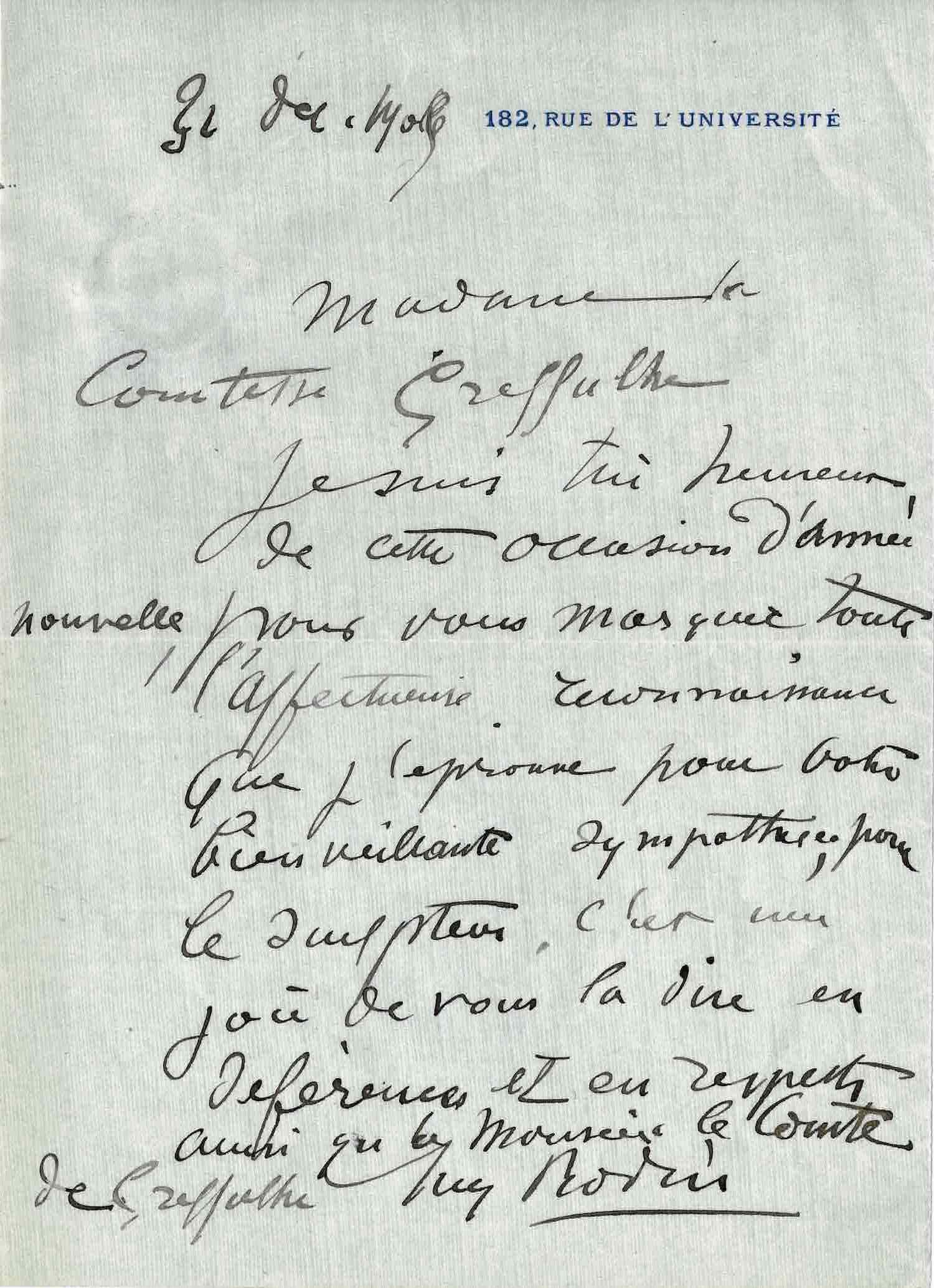
Letter No. 1.
[Paris] December 31, 1905.
An octavo page on paper with his address on rue de l'Université.
Rodin anticipates the new year to express his gratitude to the countess.
"Madame Countess Greffulhe, I am very happy to take this opportunity at the start of the new year to express to you all the grateful affection I feel for your kind sympathy towards the sculptor. It is a joy to convey this to you with deference and respect, as well as to Monsieur le Comte de Greffulhe. Auguste Rodin."
_______________________________________________
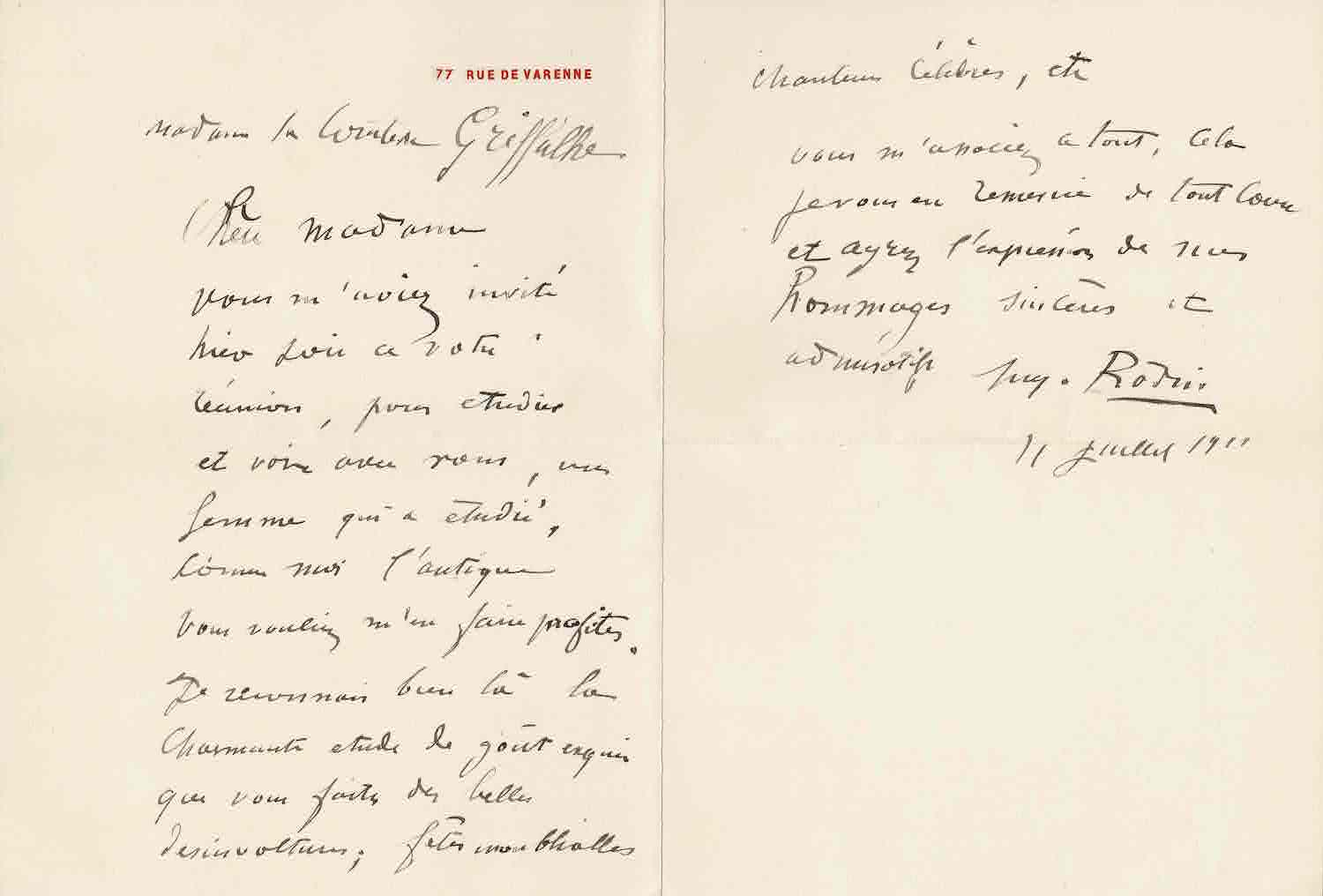
Letter No. 2.
[Paris] July 11, 1911.
Two octavo pages on paper with his address at the Hôtel Biron.
A charming letter from Rodin to Marcel Proust's muse, a testament to the Parisian literary and artistic salons of the early 20th century.
“Dear Madam, you invited me to your gathering last night to study and observe with you a woman who, like me, has studied antiquity, and you wished to share this knowledge with me. I recognize in this the charming study of exquisite taste that you make of beautiful, carefree pleasures : unforgettable parties, famous singers, etc. You include me in all of this, and I thank you from the bottom of my heart. Please accept the expression of my sincere and admiring respect. Aug. Rodin”
Built by the architect Jean Aubert, the Hôtel Biron – 77 rue de Varenne – was discovered in a state close to abandonment by Rodin in 1908. He rented the four rooms on the ground floor before occupying the entire residence from 1911. In these places, the sculptor prepared the layout of what would become, on August 4, 1919, the Rodin Museum.
_______________________________________________
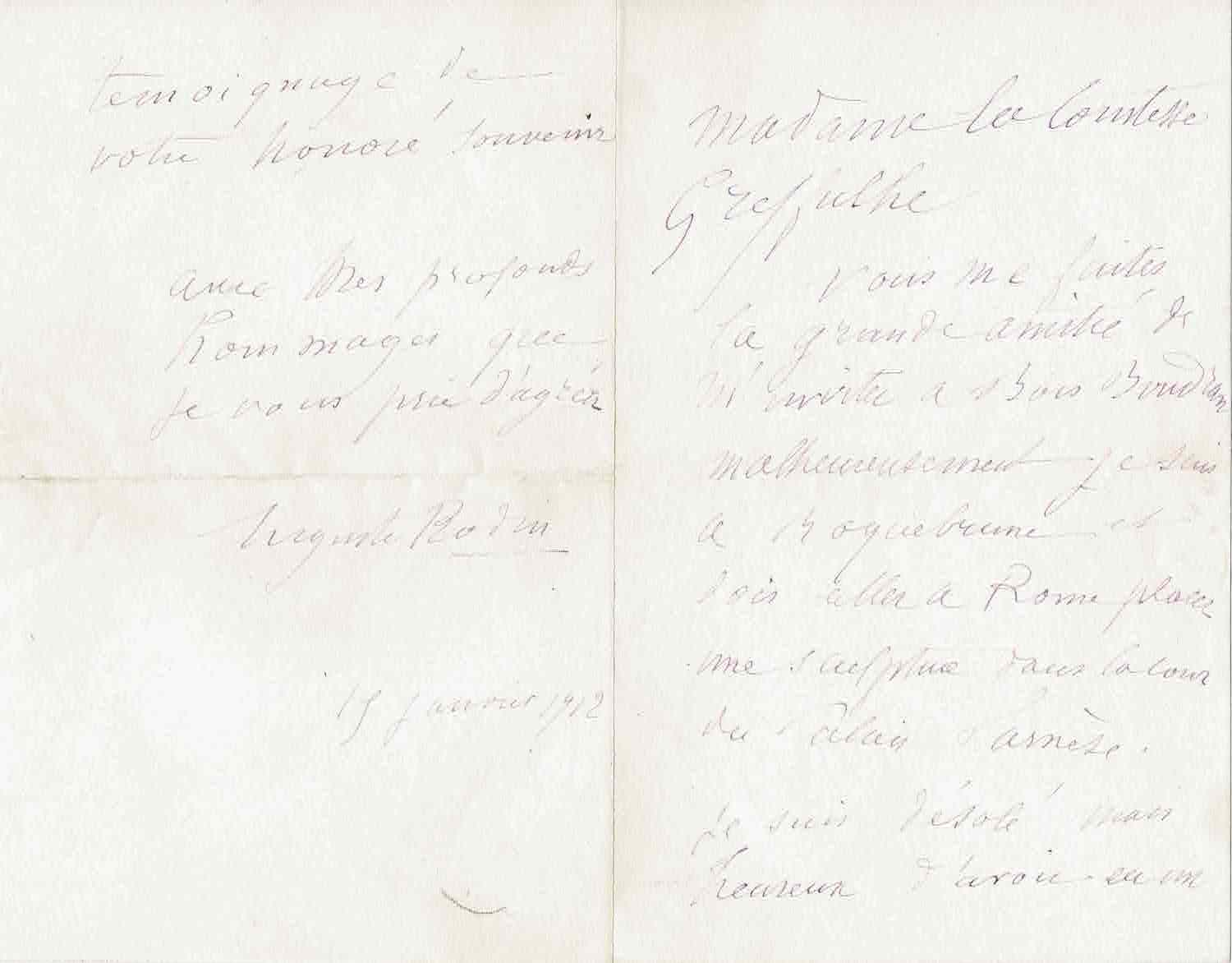
Letter No. 3.
[Roquebrune]. January 17, 1912. Two pages in-8°.
“[I] have to go to Rome to place a sculpture in the courtyard of the Palazzo Farnese.”
The French sculptor is leaving for the Palazzo Farnese where one of his greatest masterpieces, The Walking Man, is to be installed.
"Madame Countess Greffulhe, you have done me the great honor of inviting me to Bois-Boudran. Unfortunately, I am in Roquebrune and must go to Rome to install a sculpture in the courtyard of the Palazzo Farnese. I am sorry but happy to have received a token of your kind remembrance. With my deepest respects, which I ask you to accept. Auguste Rodin. January 17, 1912."
The Walking Man . At the end of the 19th century, Rodin revisited one of his studies of Saint John the Baptist , exhibited at the Salon of 1880, in order to rework it. Retaining the fragmentary appearance of the bust, the sculptor commissioned a plaster cast in 1900 and added two smoothly modeled legs. A master of contrast and balance, Rodin breathed life and movement into this colossal figure, devoid of head and arms.
Named The Walking Man by the sculptor's assistants, the work was presented at the Pavillon de l'Alma on June 1, 1900 , during his first major solo retrospective.
Twelve years later, the colossus was installed in the atrium of the Palazzo Farnese in Rome – the seat of the French embassy – where it would remain until after Rodin's death, before being returned to France.
From 1947 onwards, Alberto Giacometti took up this theme of man in motion. Several versions of his Walking Man were created until the dawn of the 1960s, thus giving sculpture, in the continuity of Rodin, its most beautiful and symbolic letters of nobility.
The Château de Bois-Boudran is located in the commune of Fontenailles in Seine-et-Marne. Acquired at the dawn of the 19th century by Count Jean-Henry-Louis Greffulhe, the château passed by descent to his grandson, Henry Greffulhe, husband of the Countess, and model for Marcel Proust for the character of the Duke of Guermantes.
_______________________________________________
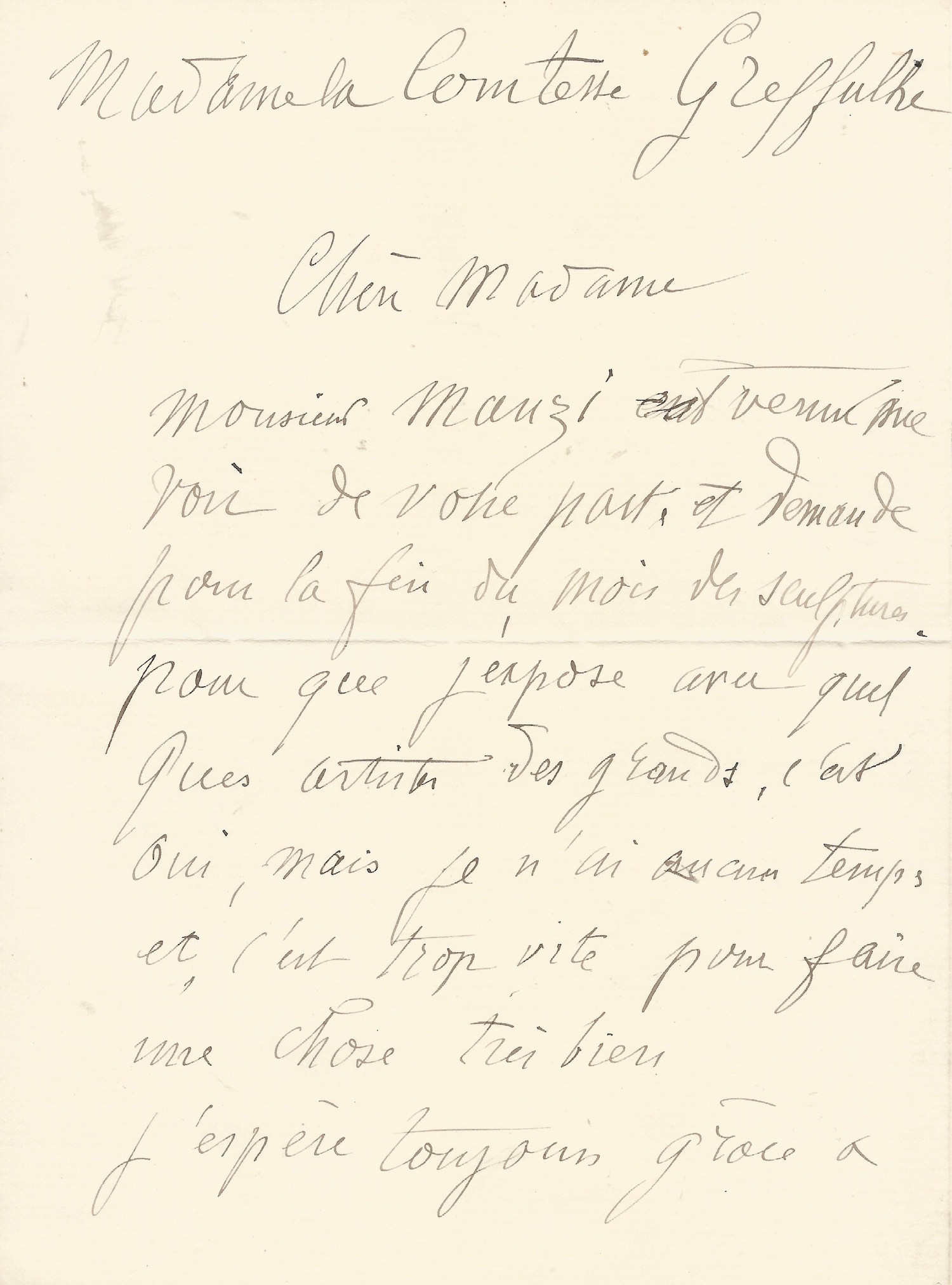
Letter No. 4.
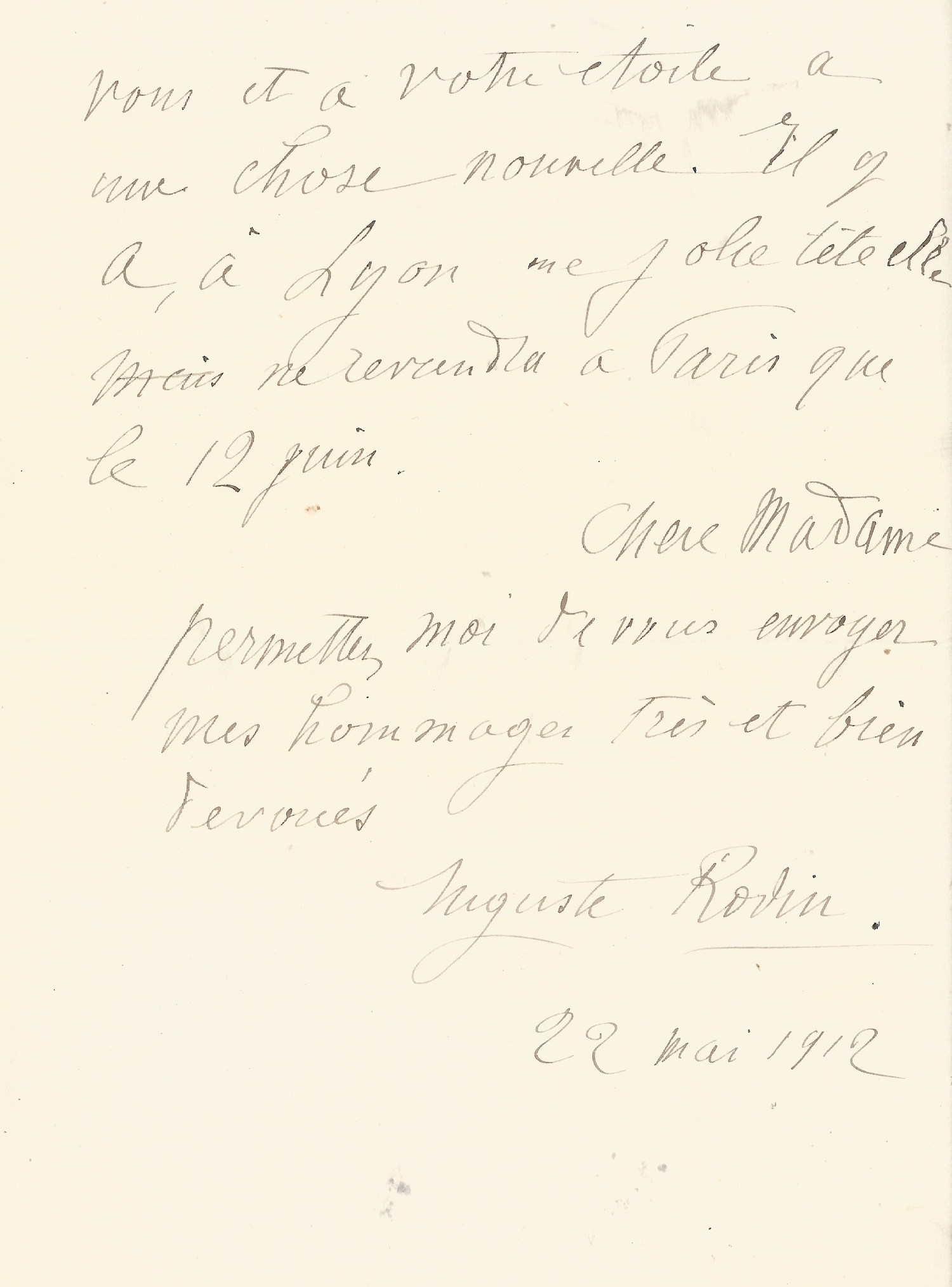
No place of publication. May 22, 1912. Two pages in-8°.
Rodin was approached for an exhibition of his sculptures.
“Countess Greffulhe. Dear Madam, Mr. Manzi [the publisher and art dealer Michel Manzi] came to see me on your behalf and requested some sculptures for me to exhibit with some of the great artists by the end of the month; he agreed, but I have no time and it's too soon to do a really good job. I still hope, thanks to you and your good fortune, for something new. There is a lovely head in Lyon; it won't return to Paris until June 12th. Dear Madam, please allow me to send you my most devoted and respectful regards. Auguste Rodin. May 22, 1912.”
_______________________________________________
Letter No. 5.
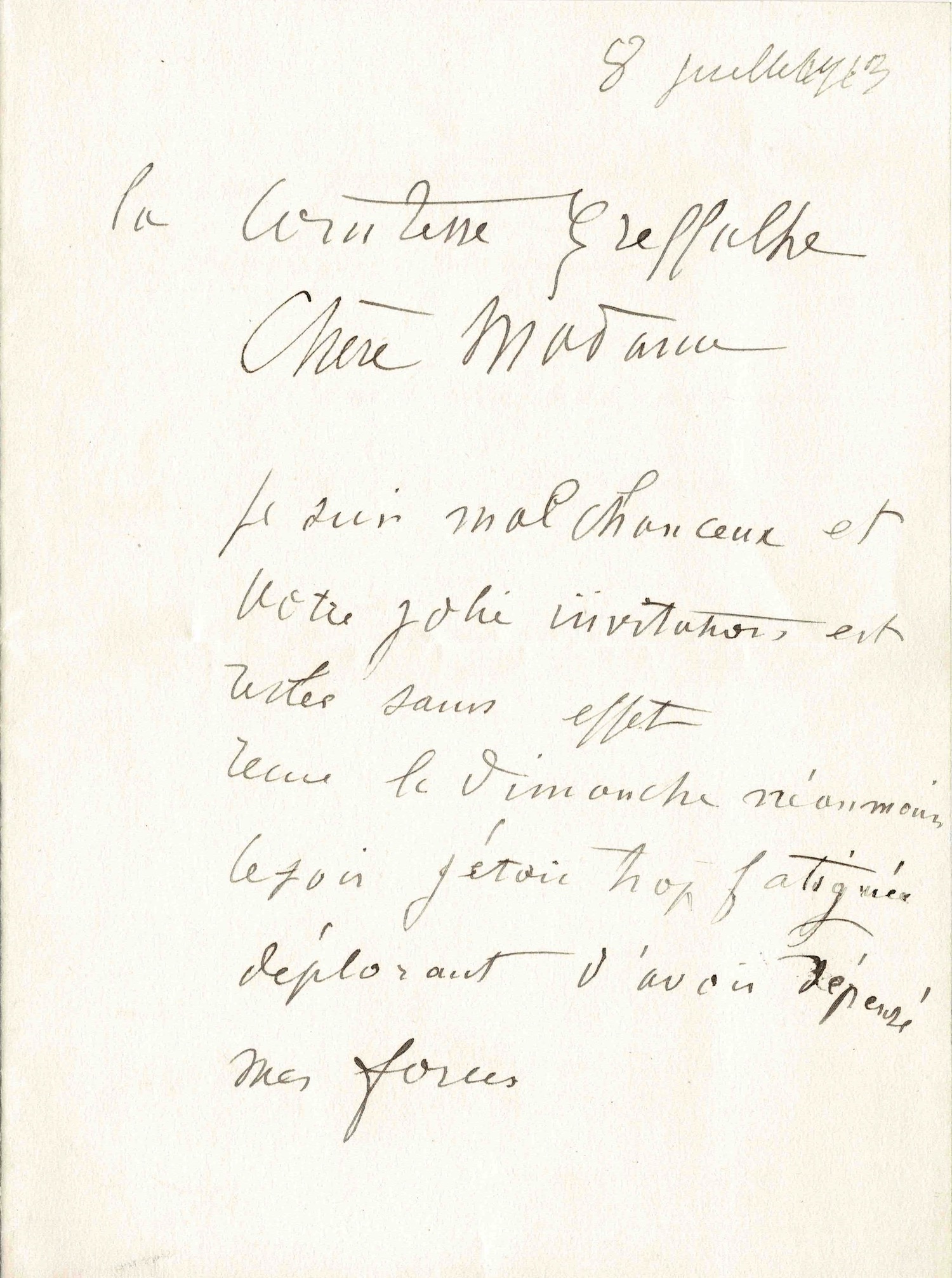
[Paris] July 8, 1913. Two pages in-8°.
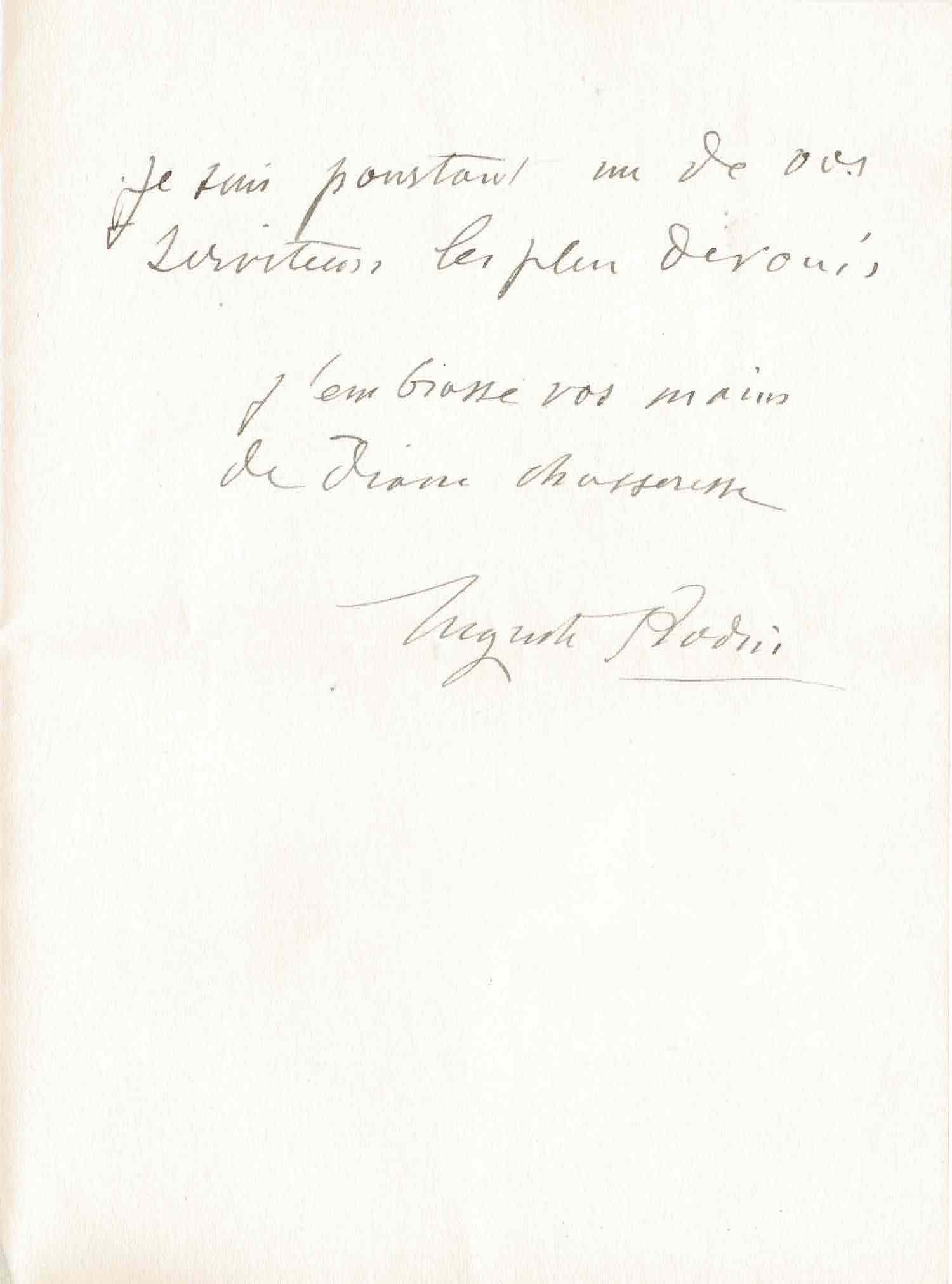
"I kiss your hands, Diana the Huntress". »
Rodin, exhausted, was unable to respond to the countess's lovely invitation.
"Countess Greffulhe. Dear Madam, I am unlucky and your lovely invitation has gone unanswered ; received on Sunday, however, by evening I was too tired, regretting having spent my strength. I am nevertheless one of your most devoted servants. I kiss your hands like Diana the Huntress . Auguste Rodin."
_______________________________________________
A socialite and lover of the arts, Elisabeth Greffulhe was a constant supporter of Rodin and the promotion of his sculpture. Over the years, she introduced the artist to numerous patrons, collectors, and statesmen, such as the King of Portugal, the King of Sweden, Grand Duchess Vladimir of Russia, the Argentine Minister Lainez, and the Minister of Public Instruction Léon Bourgeois, as well as Isadora Duncan, Edmond Rostand, Gabriele d'Annunzio, and others
In 1912, the Countess, then president of the French Decorative Art Committee, sought Rodin's collaboration for an exhibition organized to benefit domestic science schools and the central office of charitable works.
In 1913, Rodin contributed – with a mask of Dante – to the transatlantic exhibition organized by the Countess aboard the ocean liner France.
The following year, when organizing the exhibition Modern French Art: from Ingres to Cézanne in London, the Countess again invited Rodin to exhibit his sculptures alongside the works of the greatest French masters. The artist entrusted nineteen creations—including The Age of Bronze , the Bust of Victor Hugo , and a study of Balzac —and traveled across the Channel to attend the opening, then made a second trip to London to personally present his works to Queen Mary of England.
_______________________________________________
Bibliography: Countess Greffulhe and Rodin. Romances notes. J. Newton & M. Fol.