Arthur Rimbaud (1854.1891)
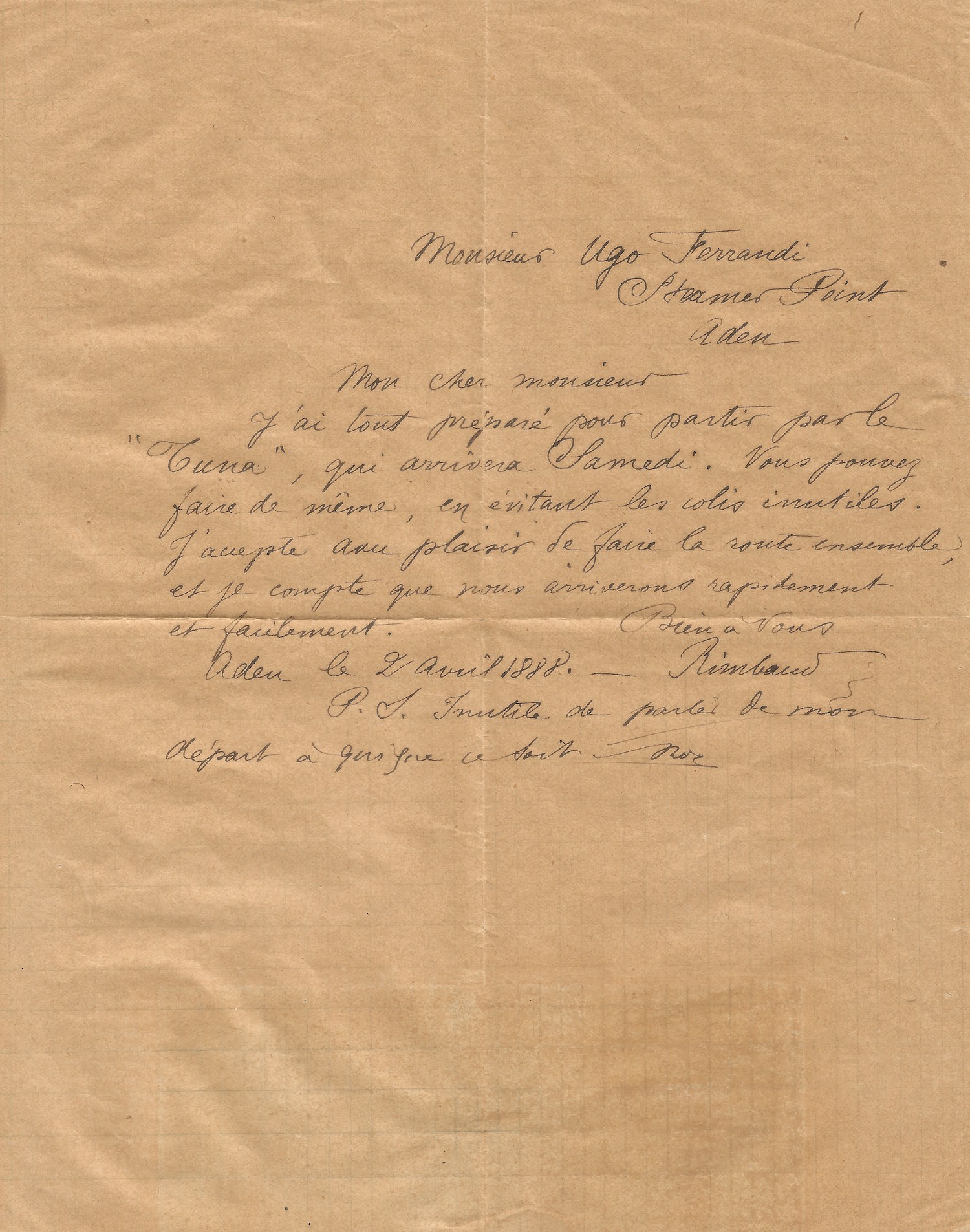
Autographed letter signed to the Italian explorer, Ugo Ferrandi.
One page, quarto. Browned paper. Aden. April 2, 1888.
Rimbaud Correspondence. Fayard. Page 601.
The man with soles of wind is preparing for his trip to Harar and his delivery of weapons to King Menelik.
______________________________________________
"My dear Sir, I have made all the necessary preparations to depart on the 'Tuna,' which will arrive on Saturday. You can do the same, avoiding unnecessary packages. I gladly accept the invitation to travel together and I expect we will arrive quickly and easily. Yours sincerely, Rimbaud. Aden, April 2, 1888. P.S. No need to mention my departure to anyone. R(im)b(au)d."
______________________________________________
In late 1887, more or less idle in Aden, and believing in a possible lifting of the Anglo-French embargo on the arms trade off the Somali coast, Rimbaud once again indulged his dreams of fortune by selling arms to King Menelik. He decided to partner with Armand Savouré to form a caravan of two hundred camels bound for Harar. Everything was to be conducted in the utmost secrecy. In mid-February 1888, Rimbaud made a round trip between Aden and Harar to prepare for the expedition and rediscovered a peaceful Harar. He considered settling there again as an independent merchant, dealing in traditional goods, as a correspondent for several Aden firms such as César Tian and Bardey.
On Friday, April 13, 1888, the English steamship Tuna set sail from Aden for the crossing of the Gulf. Rimbaud boarded it with the explorer Ugo Ferrandi, who was to carry out a geographical mission in Harar. After a stopover of about ten days in Zeila, Rimbaud arrived at his destination on May 3.
However, after several reversals, the Ministry of the Navy and Colonies finally informed Rimbaud on May 15th that arms trafficking to the Somali coast was definitively prohibited. Furious at the situation, Rimbaud abandoned the overly complex large-scale arms trade forever and turned to traditional commerce (coffee, gums, perfumes, fabrics, ivory, etc.), opening his own trading agency in Harar. This monotonous and disheartening activity would occupy him for the next two years.
On April 7, 1891, suffering from a severe right leg injury that left him unable to move or work, he arranged to leave and was transported by stretcher to Aden, a stopover before embarking for Marseille, where he arrived on May 20. His leg was immediately amputated, and the poet lived out his final months there. He died on November 10, 1891, at the Hospice de la Conception in Marseille.
Rimbaud seems to have met the Italian Ugo Ferrandi (1852-1928) in Aden in 1885. A captain in the sea, Ferrandi became an agent for the Bienenfeld company in Aden in 1884 and then an explorer for the Geographical Society.