André Breton (1896.1966)
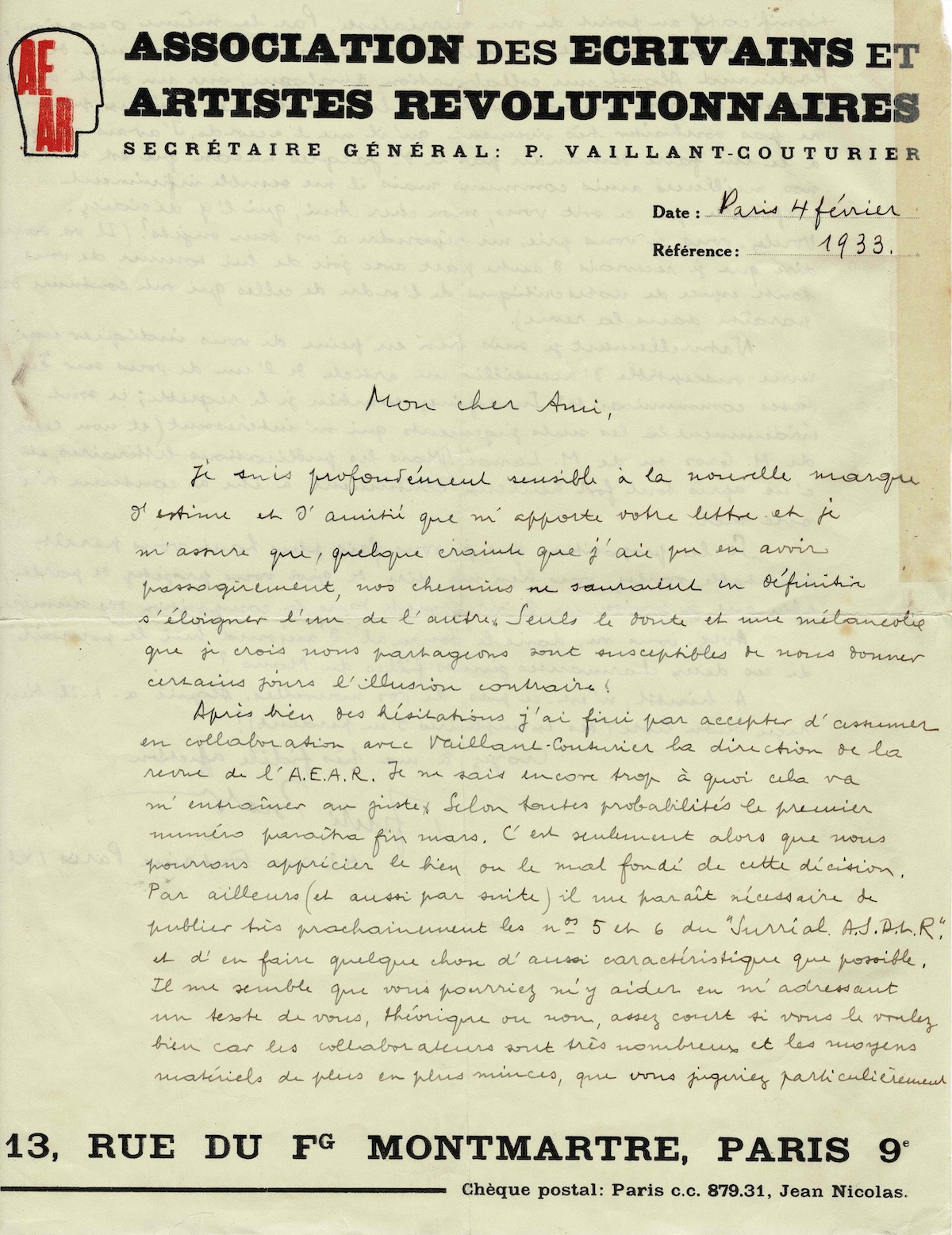
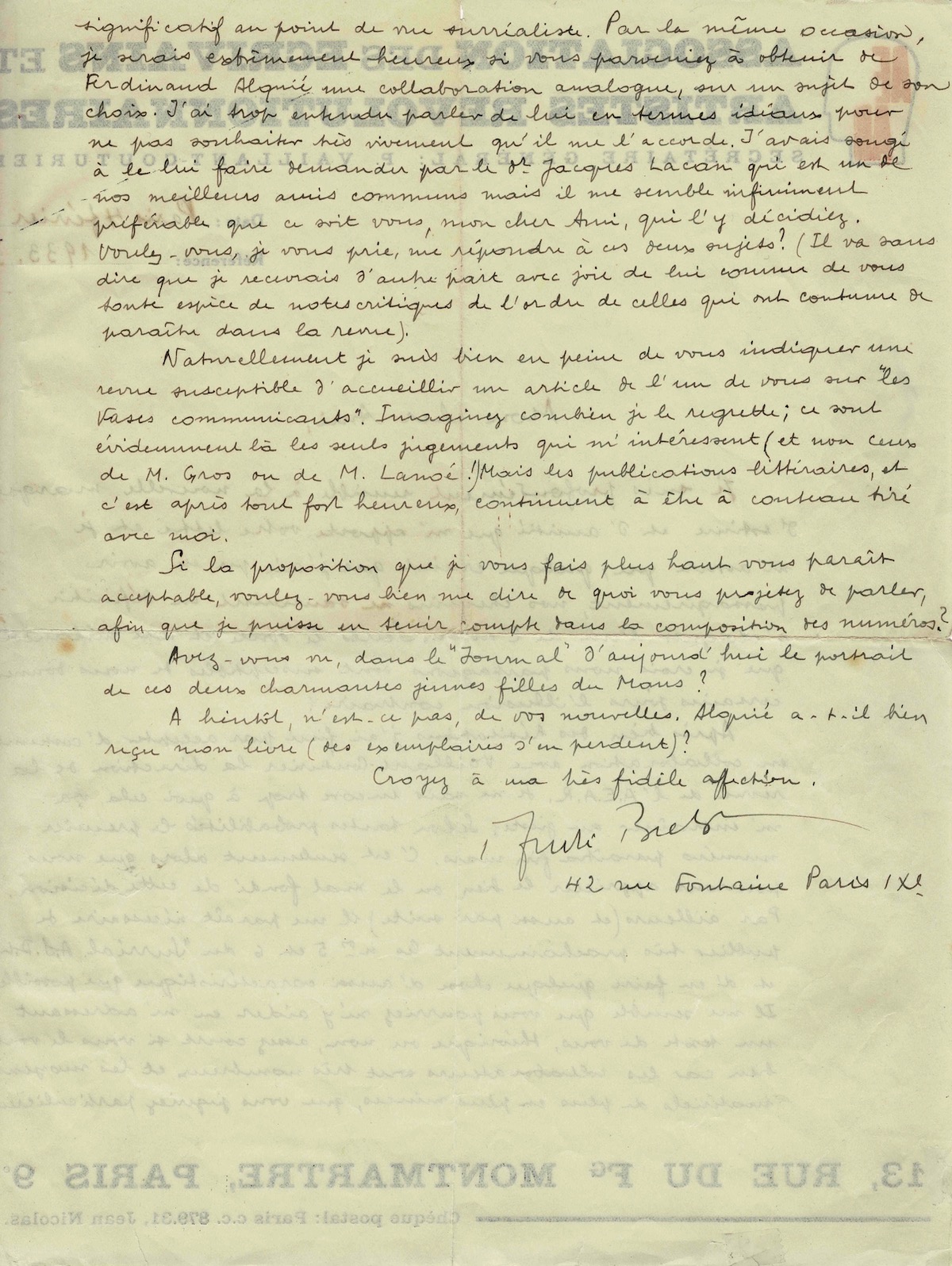
Signed autograph letter.
Two quarto pages on AEAR letterhead.
Traces of tape on the margin and fragility at the folds.
Paris. February 4, 1933.
"I finally agreed to take over the editorship of the AEAR journal in collaboration with Vaillant-Couturier."
André Breton had just accepted the leadership of the AEAR and hoped for a collaboration with the philosopher Ferdinand Alquié, whom he had planned to contact through his friend, the psychoanalyst Jacques Lacan. It was this same Alquié who, with his text published in May 1933 in the journal * Le Surréalisme au service de la révolution*, denouncing the "wind of systematic cretinization blowing from the USSR," would trigger the break between Breton and the French Communist Party.
___________________________________________
"My dear friend, I am deeply touched by the renewed mark of esteem and friendship that your letter brings me, and I am certain that, whatever momentary fears I may have had, our paths cannot ultimately diverge. Only doubt and a melancholy that I believe we share are capable of giving us the contrary illusion on certain days.".
After much hesitation, I finally agreed to take on the editorship of the AEAR [Association of Revolutionary Writers and Artists] journal in collaboration with Vaillant-Couturier. I'm still not entirely sure what this will entail. The first issue will most likely appear at the end of March. Only then will we be able to assess the merits of this decision. Furthermore (and consequently), it seems essential to publish issues 5 and 6 of "Surréal. ASDLR" [Surrealism in the Service of the Revolution] and to make them as representative as possible. I think you could help me with this by sending me a short text of yours, theoretical or otherwise, if you don't mind, as there are many contributors and increasingly limited resources, that you consider particularly significant from a surrealist perspective. At the same time, I would be extremely pleased if you could obtain a similar collaboration from Ferdinand Alquié , on a subject of his choosing. I have heard too many idealistic accounts of him not to fervently hope that he would grant it to me. I had considered having Dr. Jacques Lacan, one of our best mutual friends, request it, but it seems infinitely preferable that you, my dear friend, should make the decision. Would you be so kind as to reply to me on these two subjects? (It goes without saying that I would also gladly receive from him, as from you, any kind of critical notes of the sort that usually appear in the journal.)
Naturally, I am at a loss to recommend a journal that might publish an article from one of you on "Communicating Vessels." Imagine how much I regret this; these are obviously the only opinions that interest me (and not those of Mr. Gros or Mr. Lanoé!). But literary publications, and this is fortunate indeed, continue to be at odds with me.
If the proposal I made above seems acceptable to you, would you be so kind as to tell me what you plan to write about, so that I can take it into account when putting together the issues? Did you see, in today's "Journal," the portrait of those two charming young women from Le Mans? I look forward to hearing from you soon, won't I? Did Alquié receive my book (some copies keep getting lost)? Believe in my most faithful affection. André Breton. 42 rue Fontaine, Paris 9th arrondissement
___________________________________________
The Association of Revolutionary Writers and Artists (AEAR) was created in March 1932. Under the tacit authority of the Communist Party, its purpose was to develop the relationship between revolutionary commitment and national culture. The AEAR ceased to exist in 1939.