
« For half a century, no Marxist has understood Marx. »
2.500€
André Breton (1896.1966).
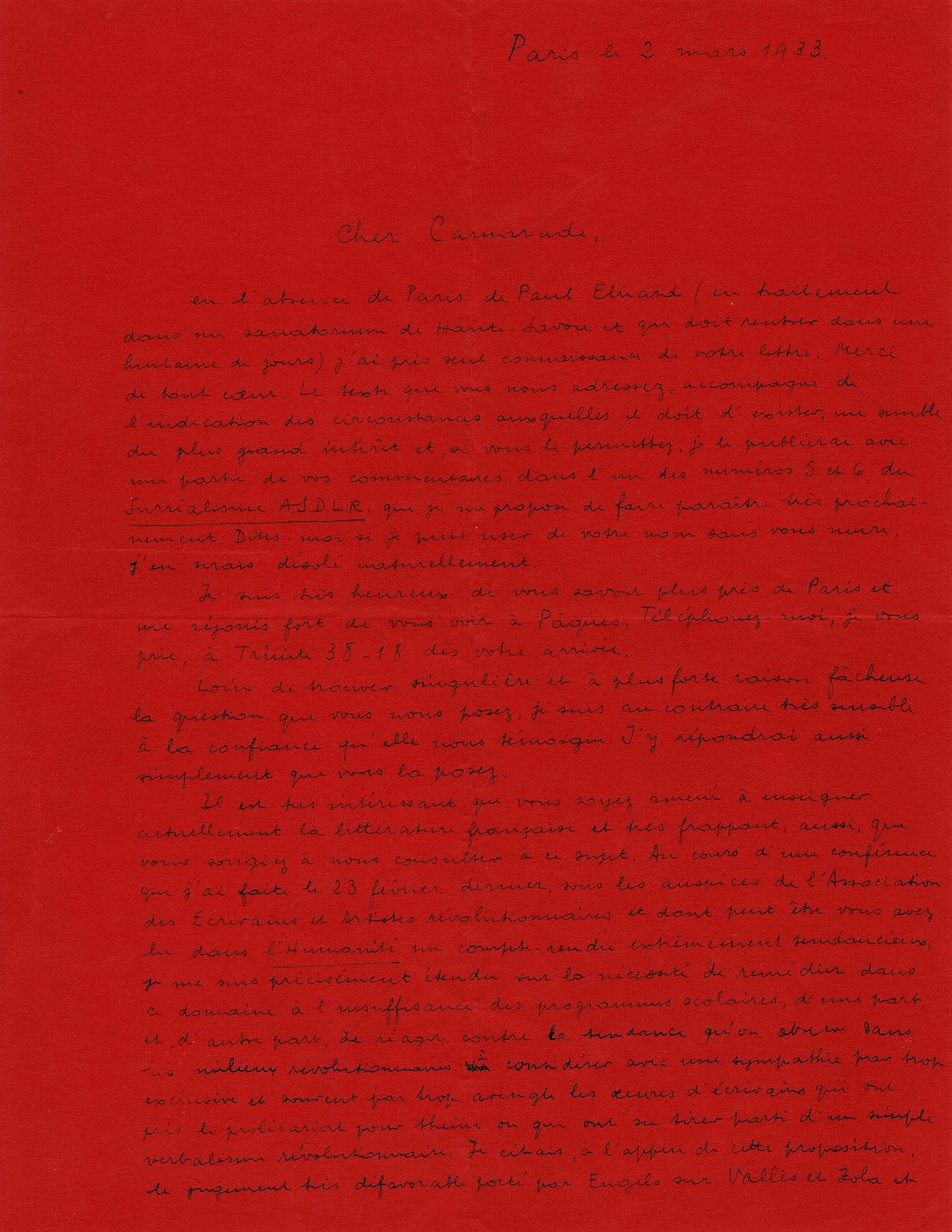
Autographed letter signed to a contributor to the Surrealist Review.
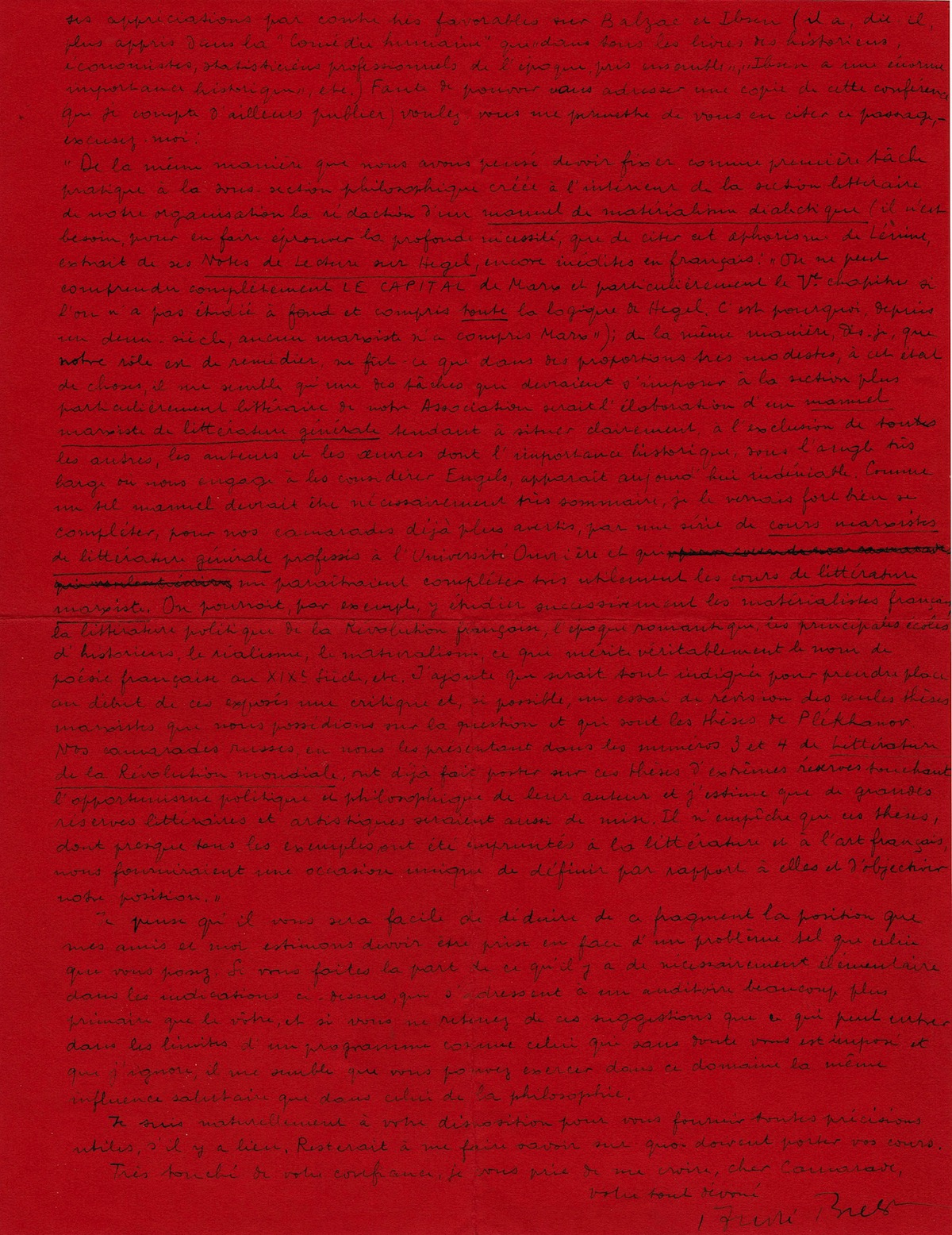
Two quarto pages on blood-red paper.
Paris. March 2, 1933.
« For half a century, no Marxist has understood Marx. »
A very dense letter from Breton to a comrade, seizing the opportunity of his contribution to Surrealism ASDL.R to share an excerpt from his lecture given a few days earlier at the Grand Orient of France, on proletarian literature and Marxism. Breton envisions the creation of a Marxist manual of general literature.
_________________________________________________________________________
“Dear friend, in Paul Eluard’s absence from Paris (he is receiving treatment in a sanatorium in Haute-Savoie and is due to return in about a week), I alone have read your letter. Thank you from the bottom of my heart. The text you sent us, along with the explanation of the circumstances that led to its creation, seems to me of the greatest interest, and, if you will allow me, I will publish it, along with some of your comments, in one of issues 5 and 6 of Surréalisme ASDLR [Surrealism in the Service of the Revolution], which I intend to publish very soon. Please let me know if I may use your name without causing you any harm; I would, of course, be very sorry.”
I am very pleased to know you are closer to Paris and I look forward to seeing you at Easter. Please call me at trinity 38-18 as soon as you arrive.
Far from finding your question peculiar, let alone unfortunate, I am, on the contrary, very grateful for the trust it shows us. I will answer it as simply as you ask it.
It is very interesting that you are currently teaching French literature, and also very striking that you are considering consulting us on this subject. During a lecture I gave on February 23rd [Breton had spoken on proletarian literature at the Grand Orient of France], under the auspices of the Association of Revolutionary Writers and Artists, and of which you may have read an extremely biased report L'Humanité , I elaborated precisely on the need to remedy the inadequacy of school curricula in this area, on the one hand, and, on the other hand, to react against the tendency observed in revolutionary circles to regard with an overly exclusive and often overly blind sympathy the works of writers who have taken the proletariat as their theme or who have been able to take advantage of simple revolutionary rhetoric. In support of this proposition, I cited Engels' very unfavorable judgment of Vallès and Zola, and his conversely very favorable assessments of Balzac and Ibsen (he said he learned more from "La Comédie humaine" than "from all the books of the professional historians, economists, and statisticians of the time, taken together," "Ibsen has enormous historical importance," etc.). Since I am unable to send you a copy of this lecture (which I intend to publish), would you allow me to quote this passage from it—excuse me:
“Just as we felt it necessary to set as the first practical task for the philosophical subsection created within the literary section of our organization the drafting of a manual of dialectical materialism ( to demonstrate its profound necessity, one need only quote this aphorism from Lenin , taken from his Reading Notes on Hegel , still unpublished in French: “One cannot fully understand Marx’s CAPITAL, and particularly Chapter V, if one has not thoroughly studied and understood whole logic of Hegel. This is why, for half a century, no Marxist has understood Marx ”) ; just as, I say, our role is to remedy, even if only to a very modest extent, this state of affairs, it seems to me that one of the tasks that should be imposed on the more specifically literary section of our Association would be the preparation of a Marxist manual of general literature aimed at clearly situating, to the exclusion of all the Others are the authors and works whose historical importance, from the very broad perspective Engels encourages us to consider them from, appears undeniable today. Since such a manual would necessarily have to be very concise, I could easily see it being supplemented, for our more knowledgeable comrades, by a series of Marxist courses on general literature taught at the Workers' University, which would seem to me to complement the courses on Marxist literature . One could, for example, study successively the French materialists, the political literature of the French Revolution, the Romantic period, the main schools of historians, realism, naturalism, what truly deserves the name of French poetry in the 19th century , etc. I would add that a critique and, if possible, an attempt at revising the only Marxist theses we possess on the subject, namely Plekhamov's theses, would be entirely appropriate to place at the beginning of these presentations. Our Russian comrades, in presenting them to us in issues 3 and 4 of Literature of the World Revolution has already raised serious reservations about these theses, concerning the political and philosophical opportunism of their author, and I believe that significant literary and artistic reservations would also be warranted. Nevertheless, these theses, almost all of whose examples have been drawn from French literature and art, would provide us with a unique opportunity to define and objectify our position in relation to them.
I think it will be easy for you to deduce from this fragment the position that my friends and I believe should be taken in the face of a problem such as the one you pose. If you take into account what is necessarily elementary in the indications below, which are addressed to a much more basic audience than yours, and if you retain from these suggestions only what can fall within the limits of a program like the one that is undoubtedly imposed on you and of which I am unaware, it seems to me that you can exert the same salutary influence in this field as in that of philosophy .
I am naturally at your disposal to provide any further information you may require. It would remain for you to let me know what your courses will cover. Deeply touched by your confidence, I remain, dear comrade, your most devoted André Breton
_________________________________________________________________________
The journal “Surrealism in the Service of the Revolution” or “Surrealism ASDLR” succeeded the journal “The Surrealist Revolution”. It ran for 6 issues from July 1930 to May 1933.