André Breton (1896.1966).
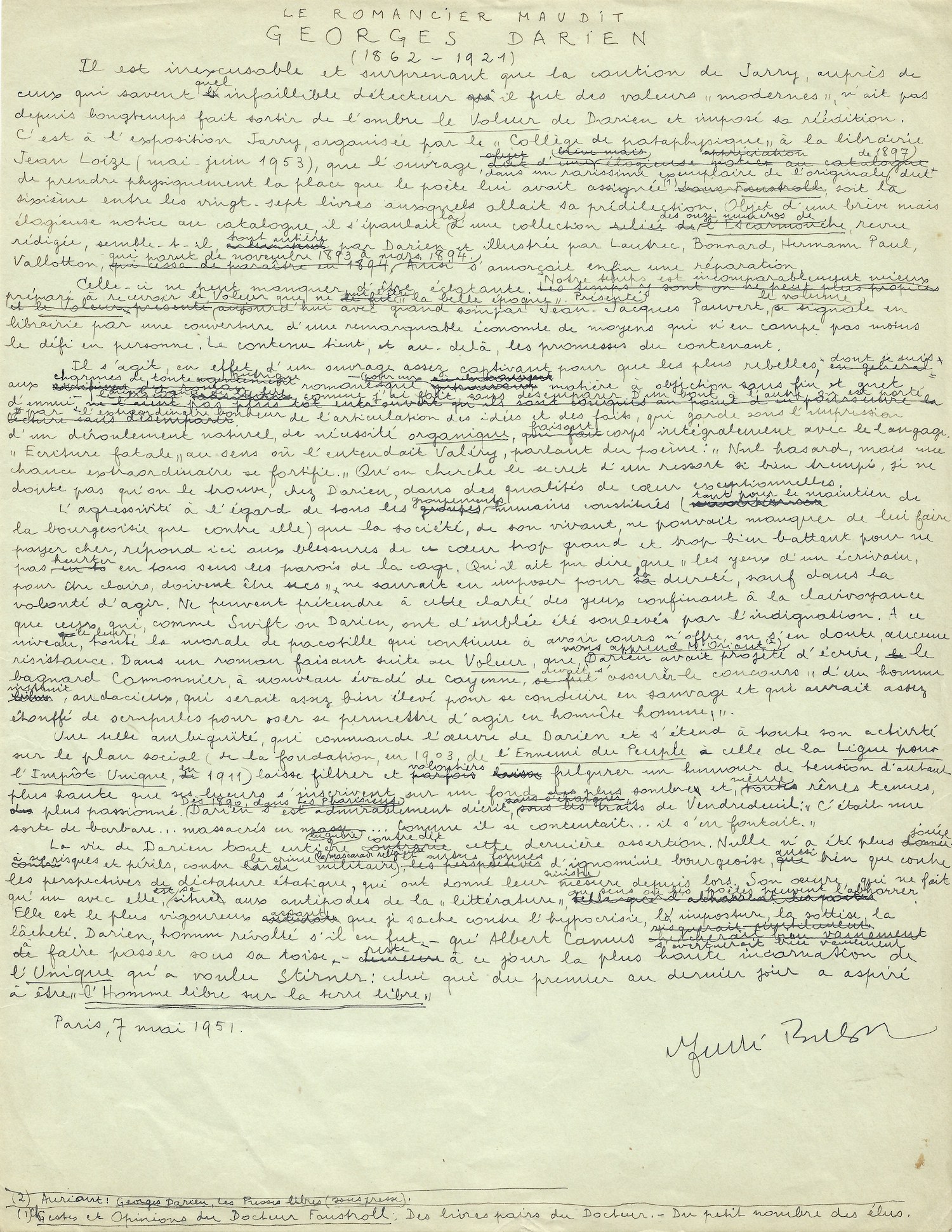
Autograph manuscript signed – “ The Cursed Novelist. Georges Darien ”
One page in-4°. Paris. May 7, 1951 (sic for 1955).
"Darien's work is the most vigorous assault I know against hypocrisy, imposture, foolishness, and cowardice.". »
A remarkable manuscript – a first draft – in praise of the anarchist writer. This text by Breton appeared in Arts in May 1955. It was later reprinted as the preface to the Julliard edition of The Thief in 1964, and then in Perspective cavalière in 1970.
Georges Darien, the cursed novelist: although the author of The Thief and La Belle France has regained a relative notoriety in our time, thanks in particular to his proven influence on Céline, he was in the purgatory of posterity for more than fifty years.
Breton pays him a strong tribute here, relaying in passing the endorsement of A. Jarry.
THE CURSED NOVELIST / GEORGES DARIEN (1862-1921)
It is inexcusable and surprising that Jarry's endorsement, among those who know what an infallible detector he was of modern values, has not long since brought The Thief of Darien out of obscurity and mandated its republication. It was at the Jarry exhibition, organized by the College of Pataphysics at the Jean Loize bookstore (May-June 1953), that the work, in a very rare copy of the original, owed its physical placement in the place the poet had assigned it ( Gestes et Opinions du Dr Faustroll ), namely the sixth among the twenty-seven books he favored. The subject of a brief but laudatory entry in the catalogue, it was complemented by a collection of the eleven issues of L' Escarmouche , a journal written, it seems, entirely by Darien and illustrated by Lautrec, Bonnard, Hermann Paul, and Vallotton, which ran from November 1893 to March 1894. Thus began a redress. This redress cannot fail to be brilliant. Our time is incomparably better prepared to receive Le Voleur than the Belle Époque ever was. Presented today with great care by Jean-Jacques Pauvert, the volume stands out in bookstores with a remarkably economical cover that nonetheless embodies the challenge itself. The content lives up to, and surpasses, the promises of the packaging.
This is indeed a captivating work, enough to win over even the most resistant readers—myself included—to the allure of novels, which are often endlessly objectionable. (…) From beginning to end, one is carried along by the extraordinary felicity in the articulation of ideas and facts, which maintains the impression of a natural unfolding, of organic necessity, becoming one with the language. “Fatal writing,” in the sense that Valéry meant it, speaking of the poem “No chance, but an extraordinary opportunity is strengthened.” If one seeks the secret of such a resilient spirit, I have no doubt that it will be found, in Darien, in exceptional qualities of heart. The aggression toward all established human groups (both in support of the bourgeoisie and against it), for which society, during his lifetime, inevitably made him pay dearly, corresponds here to the wounds of this heart, too large and beating too strongly not to strike against the walls of the cage in every direction. That he could say that " a writer's eyes, to be clear, must be dry " cannot be used to describe harshness, except in the will to act. Only those who, like Swift or Darien, were immediately stirred by indignation can claim this clarity of vision bordering on clairvoyance. At their level, all the cheap morality that continues to circulate offers, as one might expect, no resistance. In a novel following The Thief, Mr. Auriant tells us, which Darien had planned to write, the convict gunner, having once again escaped from Cayenne, was to secure the assistance of "an educated, audacious man, who would be well-bred enough to behave like a savage and who would have been sufficiently stifled by scruples to dare to act like an honest man."
Such ambiguity, which governs Darien's work and extends to all his social activity (from the founding of L' Ennemi du Peuple to that of the Ligue pour l'impôt unique in 1911), allows a humor of tension to filter through and readily flash, all the more intense for its glimmers against a darker backdrop. As early as 1890, in Les Pharisiens , Darien admirably described himself in the guise of Vendredeuil: "He was a kind of barbarian… massacred en masse… as if he were content… he didn't give a damn." Darien's entire life contradicts this last assertion (…) His work stands at the antipodes of literature, in the sense that poets might abhor it. It is the most vigorous assault I know against hypocrisy, imposture, foolishness, and cowardice . Darien, a rebel if ever there was one – whom Albert Camus tried in vain to bring under his thumb – remains to this day the highest incarnation of the Unique that Stirner envisioned: he who, from his first day to his last, aspired to be " the free man on a free earth ." André Breton. Paris. May 7, 1951.
André Breton (Edition published under the direction of Étienne-Alain Hubert with the collaboration of Philippe Bernier and Marie-Claire Dumas), “ Darien the Accursed ”, Cavalier Perspective, Complete Works , Volume IV, Writings on Art and Other Texts, Bibliothèque de la Pléiade, Paris, Gallimard, 2008, pp. 923-925, entry pp. 1411-1412