André Breton (1896.1966)
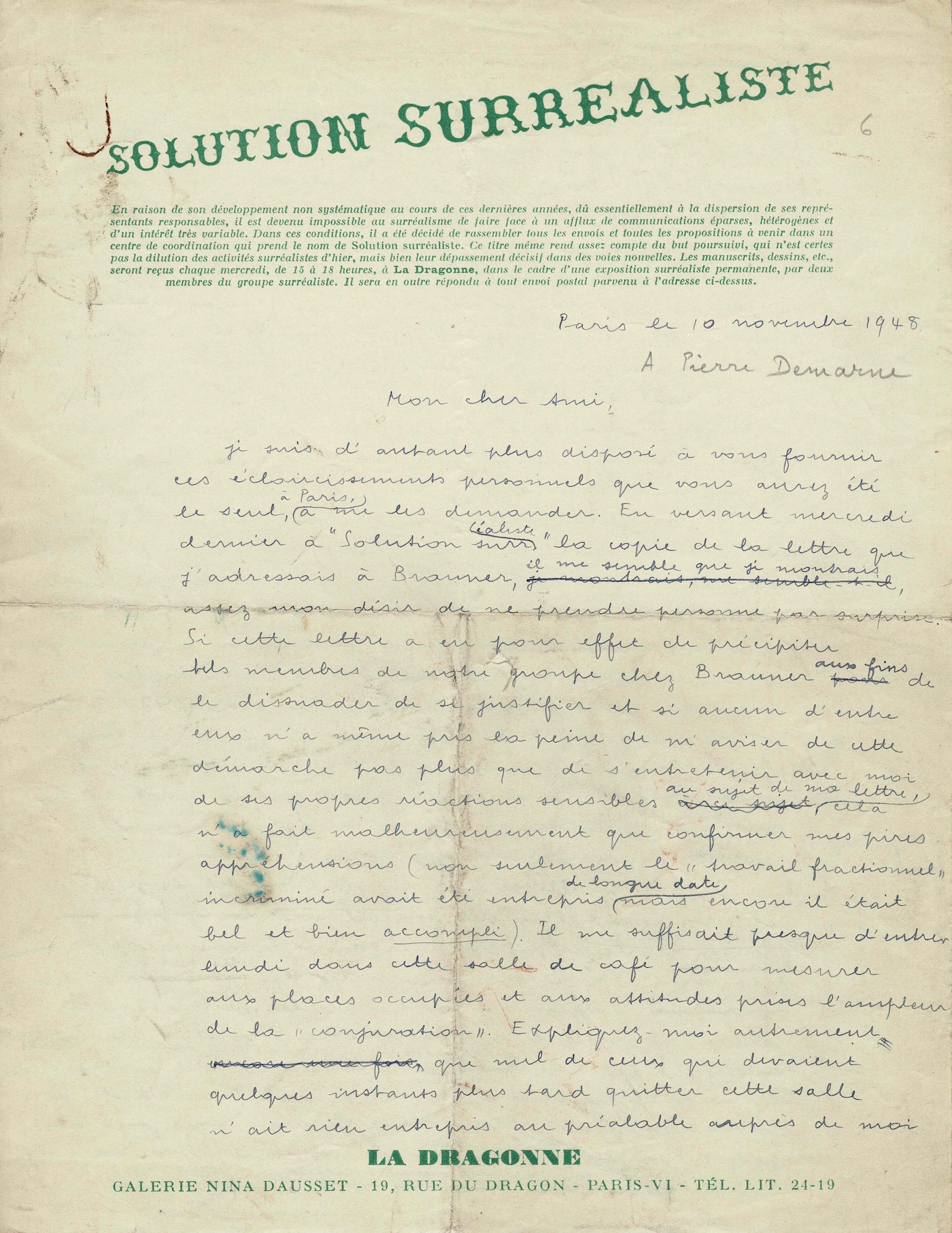
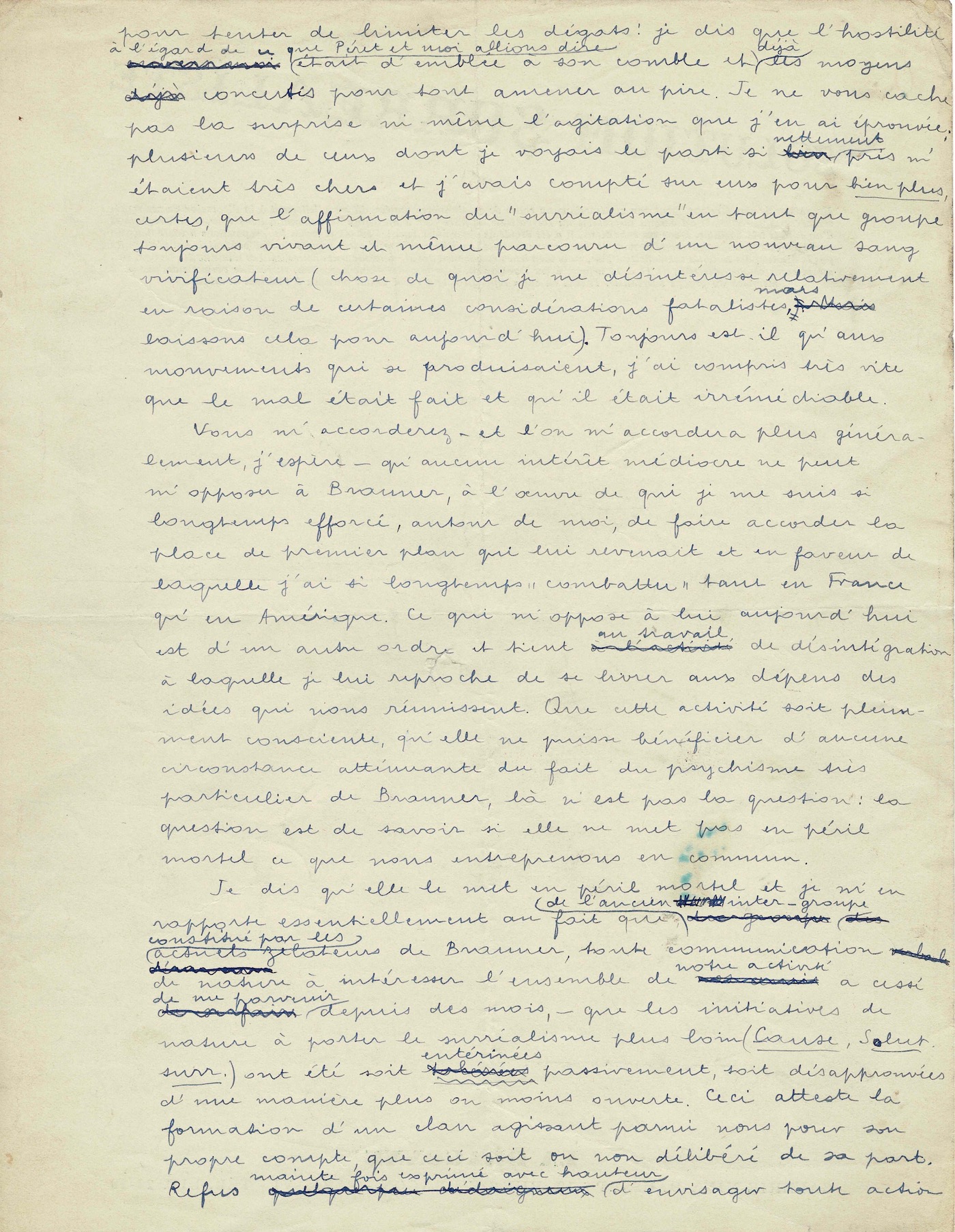
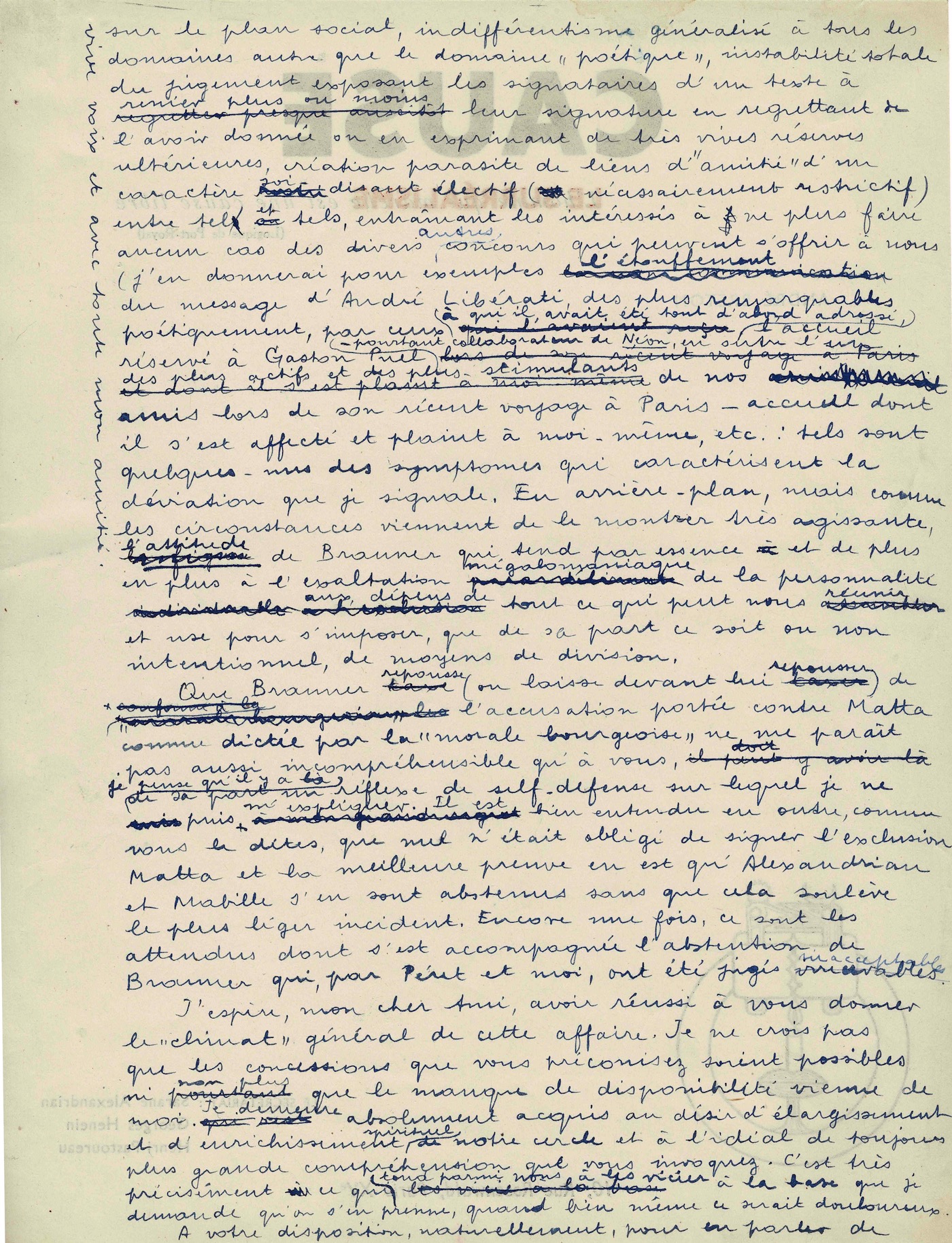
Autograph letter (draft) to Pierre Demarne.
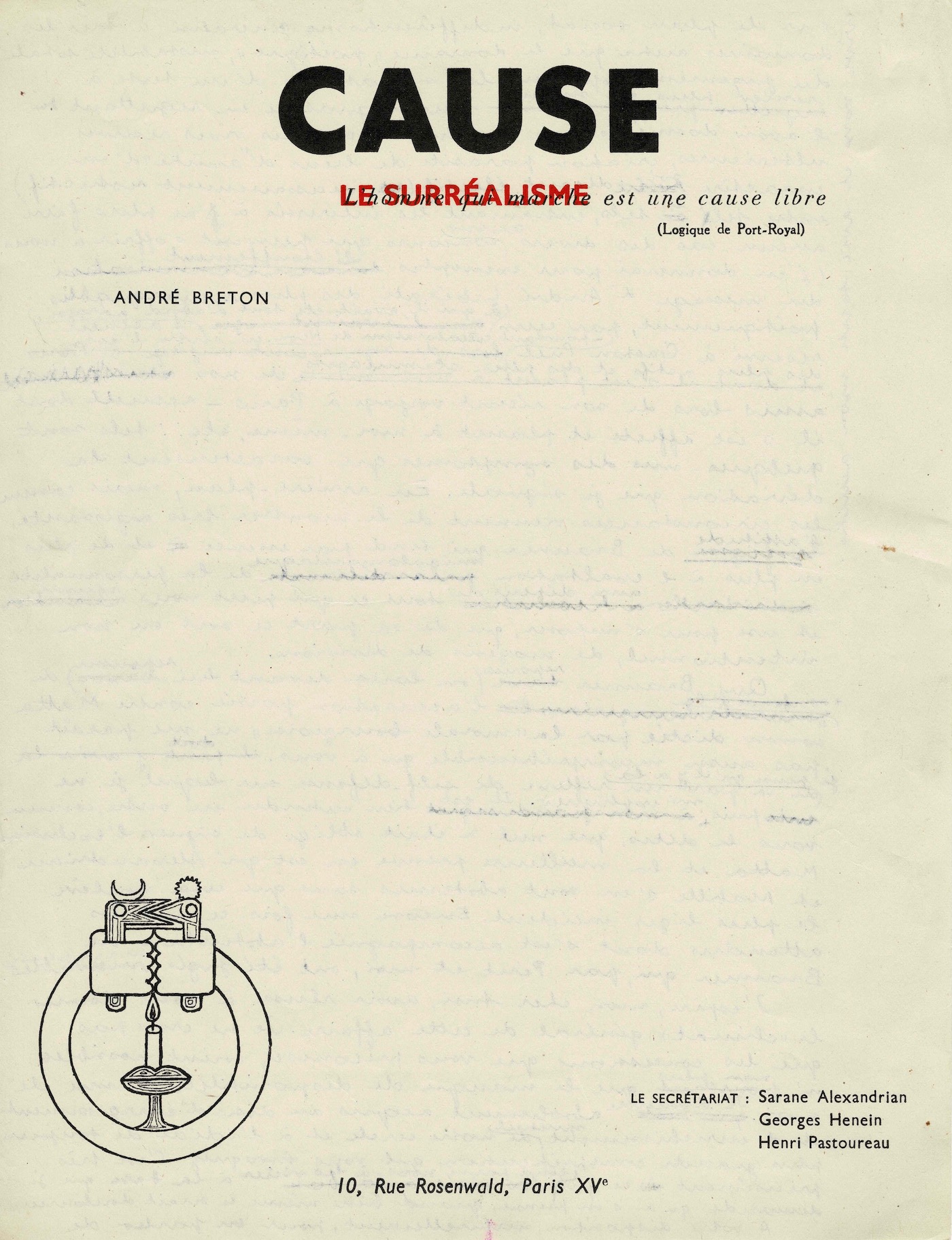
Three quarto pages on letterhead of Surrealist Solution and Cause.
Paris. November 10, 1948.
“No petty interest can set me against Brauner […] What sets me against him today is of a different order and relates to the work of disintegration which I accuse him of engaging in at the expense of the ideas that unite us.”
Brauner and Matta excluded – the surreal purge.
An important document by Breton attempting to justify the recent expulsion of Victor Brauner from the Surrealist group. Detailing the disagreements between him and the Romanian painter and revisiting the expulsion of the Chilean artist Roberto Matta, the Surrealist leader denounces the factions and considers his movement to be in mortal danger.
_________________________________________________________________________
“My dear friend, I am all the more willing to provide you with these personal clarifications since you were the only one in Paris to ask me for them. By submitting last Wednesday to ‘Solution surréaliste’ the copy of the letter I addressed to Brauner, it seems to me that I clearly demonstrated my desire not to take anyone by surprise . If this letter had the effect of rushing certain members of our group to Brauner’s in order to dissuade him from justifying himself, and if none of them even bothered to inform me of this action, nor to discuss with me their own personal reactions to my letter, this has unfortunately only confirmed my worst fears (not only had the incriminating ‘fractional work’ been undertaken long ago, but it was also well and truly completed ). It was almost enough for me to enter that café on Monday to gauge, from the seats occupied and the attitudes adopted, the extent of the ‘conspiracy.’” Explain to me in other words why none of those who were to leave this room a few moments later had done anything beforehand to try to limit the damage: I say that the hostility towards what Péret and I were about to say was immediately at its peak, and that concerted efforts were already underway to bring everything to a head. I won't hide from you the surprise, or even the agitation, that I felt: several of those whose side I saw so clearly taken were very dear to me, and I had counted on them for much more , certainly, than the affirmation of "surrealism" as a group still alive and even coursing with new, life-giving blood (something in which I am relatively uninterested due to certain fatalistic considerations, but let's leave that for today). In any case, from the reactions that were taking place, I quickly understood that the damage was done and that it was irreparable.
You will grant me—and I hope it will be granted more generally—that no petty interest can set me against Brauner, whose work I have so long striven to secure for those around me the prominent place it deserves, and in whose favor I have so long "fought" both in France and in America. What sets me against him today is of a different order and stems from the work of disintegration I accuse him of undertaking at the expense of the ideas that unite us. That this activity is fully conscious, that it cannot benefit from any mitigating circumstances due to Brauner's very particular psyche, is not the point: the point is whether it does not mortally jeopardize what we are undertaking together.
I say that it puts him in mortal danger, and I refer essentially to the fact that, from the former inter-group formed by Brauner's current zealots, all communication of a nature to concern our entire activity has ceased to reach me for months, that initiatives of a nature to take Surrealism further ( Cause , Salut . surr .) have been either passively endorsed or disapproved in a more or less open manner. This attests to the formation of a clan acting among us for its own benefit, whether or not this is deliberate on its part. Repeated and haughty refusal to consider any action on the social level, generalized indifference to all areas other than the "poetic" domain, total instability of judgment exposing signatories to the possibility of more or less disavowing their signature by regretting having given it or by expressing very strong subsequent reservations, parasitic creation of supposedly elective (necessarily restrictive) "friendships" between certain individuals, leading those involved to disregard the various other forms of support that may be available to us (I will give as examples the suppression of André Libérati's message, one of the most poetically remarkable, by those to whom it was initially addressed, the reception given to Gaston Puel—a contributor to Néon , and moreover one of our most active and stimulating friends during his recent trip to Paris—a reception which he was upset about and complained about to me, etc.: these are some of the symptoms which characterize the deviation I am pointing out. In the background, but as circumstances have just shown very active, is Brauner's attitude which tends by essence and increasingly towards the megalomaniacal exaltation of the personality at the expense of everything that can unite us and uses means of division to impose himself, whether intentionally or not on his part.
That Brauner rejects (or allows others to reject) the accusation against Matta as dictated by "bourgeois morality" doesn't seem as incomprehensible to me as it does to you; I think it's a reflex of self-defense on his part, which I can't explain. It's also clear, as you say, that no one was obliged to sign Matta's exclusion, and the best proof of this is that Alexandrian and Mabille abstained without it causing the slightest incident. Once again, it was the reasons given for Brauner's abstention that Péret and I deemed unacceptable .
I hope, my dear friend, that I have succeeded in giving you a general sense of the situation. I do not believe that the concessions you advocate are possible, nor that the lack of availability stems from me. I remain absolutely committed to the desire for the expansion and spiritual enrichment of our circle and to the ideal of ever-greater understanding that you invoke. It is precisely what tends to corrupt us at our very core that I ask we address, even if it is painful. I am, of course, at your disposal to discuss this further in person, and with all my friendship .
_________________________________________________________________________
On October 25, 1948, André Breton quickly voted to expel the Chilean painter Roberto Matta for "moral ignominy and intellectual disqualification." Opposed to this decision, which he refused to sign, Victor Brauner was in turn expelled.