Amedeo Modigliani (1884.1920)
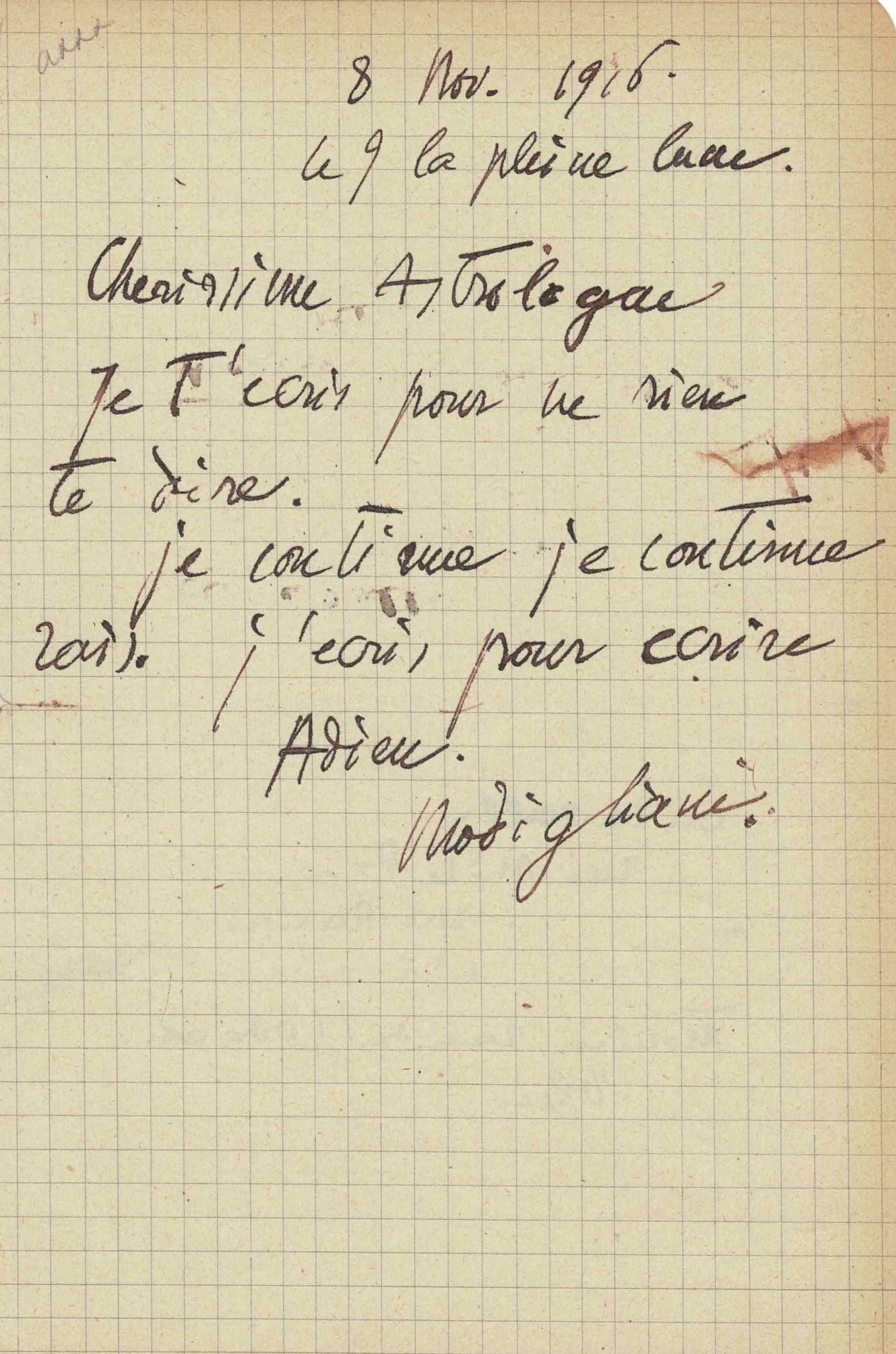
Autographed letter signed to the astrologer Conrad Moricand.
One page in-8° on graph paper. (Paris). November 8, 1916.
An extraordinary and moving letter from Modigliani, of graceful and melancholic poetry, writing for the sake of writing, conversing under the moon.
November 8, 1916.
The 9th, the full moon.
Dearest Astrologer
I'm writing to you to say nothing.
I'll continue, I will continue.
I write for the sake of writing.
Goodbye.
Modigliani.
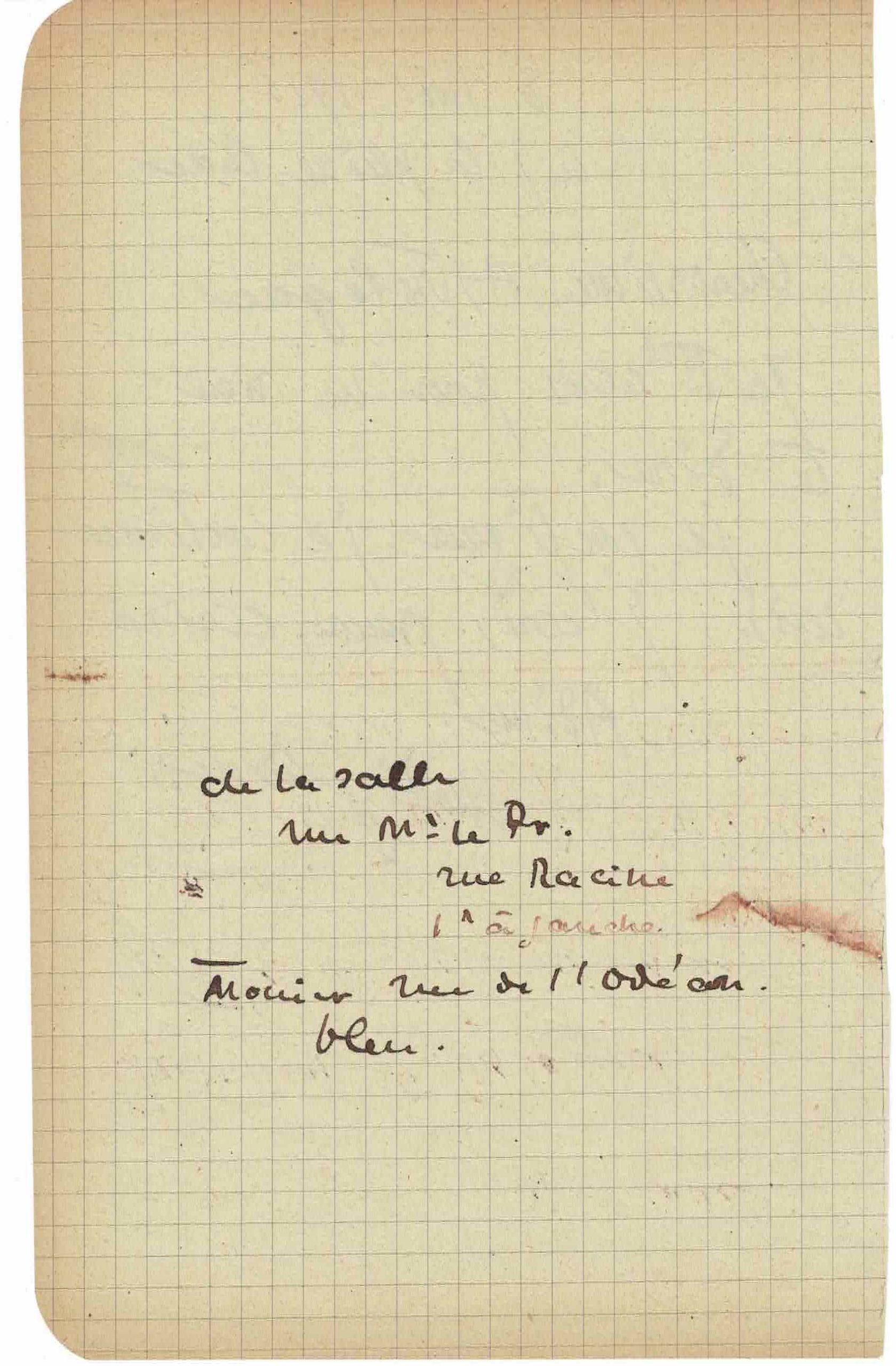
On the back of the letter, a note in Moricand's hand indicates the route to get to rue de l'Odéon, to Adrienne Monnier's bookshop, a regular refuge for Modigliani.
A bohemian aristocrat and astrologer of Montmartre, Conrad Moricand (1887-1954) held an open house at his Pigalle home, frequented by his painter and writer friends. Author of numerous treatises on Astrology and the Occult Sciences, leading a bohemian existence, Moricand befriended many Parisian artists, including Max Jacob (who wrote the preface to his book Les Interprètes ), Anaïs Nin, Blaise Cendrars, Henry Miller, and Modigliani.
Modigliani produced, between 1916 and 1918, several sketches of Moricand as well as two oil paintings on canvas depicting him in bust form.
This letter, which might at first appear to be the product of a delirium or a Modigliani-esque drunken night, nevertheless suggests a symbolic message from the artist, given the specialty of the recipient, Conrad Moricand.
Numerous drawings and testimonies confirm Modigliani's profound interest in symbols and the occult sciences. Olivier Renault, in his book * Ton devoir réel est de sauver ton rêve* (Éditions Mille et une nuits, 2020), elaborates on this subject: " Modigliani became interested in Hermeticism and mystical alchemy quite early on. According to his mother, at the age of fifteen, a slightly older friend initiated him into spiritualism. "
The precise lunar position indicated at the beginning of this letter is reminiscent of a similar note he wrote next to a portrait of Max Jacob in 1915: " the waxing moon ." Beyond a kinship between the two artists, undoubtedly strengthened by the fact that they were both born on the same day (July 12), Max Jacob was a crucial link between Modigliani and Conrad Moricand, as he wrote the preface to the astrologer's book, * Les Interprètes *, in 1919. Max Jacob, of course, also frequented, like Conrad Moricand (as confirmed by the back of this letter) the Maison des Amis du Livre , the bookstore opened by Adrienne Monnier in 1915, which would become a hub of the literary scene of that era.
More generally, the popular enthusiasm for space and astrological themes is not unrelated to the passage of Halley's Comet on May 19, 1910, which sparked a resurgence of superstitions worldwide. Modigliani even alluded to it the day before in a letter to his friend Paul Alexandre: " The comet (at least until ten minutes to 6) isn't coming. Terrible! "
On the other hand, the phrases used here by Modigliani, " I write to you to say nothing " and " I write to write " could just as well imply possible undertones from the painter implicitly encouraging Moricand to analyze his writing, in the hope of being able to read in it the promise of a more clement future, after a year which marks for the painter his break with Beatrice Hastings, British poet and art critic, whom he met in 1914.
It is these formulas that also give this letter its full poetic power, thus echoing the well-known passion of the man who knew Divine Comedy by heart and recited poems while walking in the streets or while working.
Modigliani did not yet know, at the time of writing this letter, that it was only about ten days later that he would meet Leopold Zborowsi, one of the greatest dealers of his time, who would become one of his faithful friends, on the occasion of the first exhibition " Lyre et Palette ", organised by Emile Lejeune and Blaise Cendrars, from 19 November to 5 December 1916 in Montparnasse.
This letter, behind an apparent veil of mystery, actually allows us to glimpse very rich aspects of Amedeo Modigliani and his work. It reveals all the poetry of a passionate and dreamy artist, whose very calligraphy seems to transcribe all his passion and audacity.