Alberto GIACOMETTI (1901.1966)
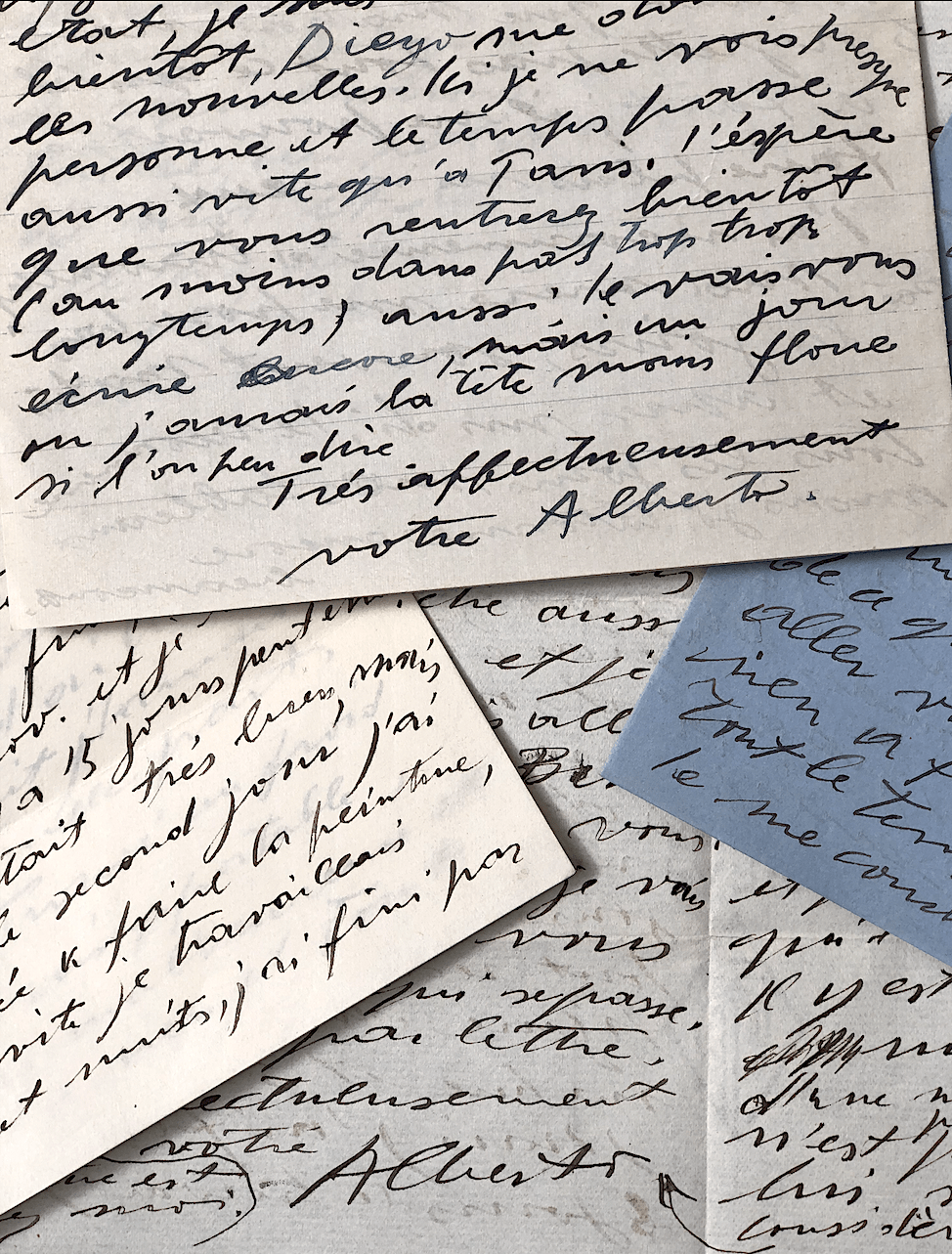
A set of eleven autograph letters signed to the artist Constant Rey-Millet.
That makes a total of 45 pages in-8° or in-4°, and 9 envelopes.
From January 2, 1947 to August 4, 1958. Unpublished correspondence.
"I hardly dare tell you that from the day I returned, I started all over again; 4 figures, one life-size, and 3 busts."
An extraordinary collection of manuscripts, completely unpublished in the sculptor's bibliography, covering twelve years of friendship between the two men.
These eleven letters, written in dense handwriting, offer a fascinating glimpse into Giacometti's artistic and personal world. He evokes his friends Picasso, Balthus, Derain, Sartre, Beauvoir, Gruber…; his mother, his wife Annette and his brother Diego; his gallerists Pierre Matisse and Aimé Maeght; his exhibitions in New York and Basel, and, always subtly, his endless creative quest: drawings, lithographs, paintings and sculptures; the work of a lifetime.
Throughout these pages, and during these twelve years of correspondence – certainly the densest of Giacometti's artistic career – we discover a passionate man, in search of the absolute, humble and persevering, entirely devoted to his work, to painting and sculpture, exhausting himself night and day to create beauty.
The correspondence begins on January 2, 1947, while Giacometti was working on his iconic Walking Man: “…I was miserable for days and I’m still not feeling well. Cahier d’Art came out with 16 pages of my own, 8 sculptures, and 8 drawings. I hardly dare tell you that the day I got back, I started all over again; 4 figures, including one life-size, and 3 busts. But I did in 5 days the work I used to do in 6 months, and that’s where I wanted to be first; so I’m feeling a bit better now, and I think I’ll finish them soon, but I really want to paint and I’m working on it a little every day. I’m starting to see how to go about it…” He informs his friend about the Parisian art scene: “ I didn’t see the Balthus exhibition, but it didn’t go very well, which is what I feared.” Very few reviews, mostly bad ones, very few sales, and not many people who like it (his painting)... He just needs to focus a bit more, it seems to me, on painting and less on the subject of little girls (...) The day before yesterday, Picasso was at Lipp's, where he's been eating quite often lately.
On February 4, 1948, Giacometti told his friend about the success of his exhibition at Pierre Matisse's gallery in New York: " I finally received news about the exhibition; it's been open since the 19th. Matisse says it's very good , and he sent me a beautiful catalog with many reproductions, Sartre's text, a short letter from me, and some drawings. He says the critics were idiotic, especially bothered by Sartre's presence (he wrote a long text that I like very much, and Matisse likes it too), too bad for the critics. He also says that the public doesn't yet know what to think of my work, which seems very understandable to me." He went on to discuss his endless work, blending paintings and sculptures: "I've started working again. My mother sits me down every day, often morning and afternoon. I start my paintings again every day, but I'm still experimenting a lot." I would like to continue this work for months, but at the same time I am eager to get back to my sculptures in Paris, and I will continue with the paintings as well… »
On February 14, 1950, the focus shifted from art to friendship and support. Constant Rey-Millet had just learned he had Parkinson's disease (which would claim his life in early 1959): "... I wouldn't dare tell you to be brave and endure all these diets and deprivations because you already have courage (...) I am saddened by your illness and the hard life you must lead, my dear Rey-Millet, and by the patience you must have, and I will only be happy the day I see you here again..."
In a long letter dated February 28, 1950, tormented by his work and his quest for creation – “ I have started too many things and I can no longer find a moment of respite, especially because I am always missing what I want” – Giacometti prepares his exhibition at the Kunsthalle Basel: “…We will go to my mother’s for a while, in May, passing through Basel where I will exhibit about ten sculptures at the same time as Masson .” and mentions his friends Sartre, Beauvoir, Braque, Zervos, Maeght, and Balthus: “Balthus, often absent, looking for houses and whom I see quite rarely, is doing the sets for Cosi Fan Tutte (…) We see Leiris and Sartre quite regularly; Sartre is leaving in a few days with Simone de Beauvoir for Timbuktu.” " He also confesses, in this now-famous sentence, to making an effort to reduce his alcohol consumption: '...For the past two months I haven't drunk a drop of alcohol and very little wine ...'"
The following summer, in August 1951, Giacometti was asked by his friend to create a lithograph for publication in a book initiated by Rey-Millet: “ Right away about the lithograph: I’ll do it with pleasure, and you shouldn’t be embarrassed by your ‘insistence,’ as you say, not at all. But what to do? I’d like you to give me a subject, or an idea of possible subjects…” He kept him informed of his works in progress: “ I’m working a lot, and since this afternoon I think I’ve made progress in drawing and painting, and that’s because I’ve been having Annette pose again for the last three days.”
A few weeks later, on October 2nd, Giacometti informed Rey-Millet that he had completed the requested works: " I took three lithographs to Mourlot to have proofs made." He also reported news of Picasso's amorous escapades and the painting of his friend Balthus. "Nothing new in this town. You know that Picasso, it seems, has left with a young (very pretty) girl for North Africa, and it seems that the quiet, rural, hard-working days are over. It was a very beautiful day today. Balthus has started two large paintings. I haven't seen them yet."
Having received the promised lithographs, Rey-Millet, writing from Stampa, was delighted by their shared appreciation of the print depicting the Swiss writer Charles Ferdinand Ramuz: “ I am very pleased with what you say about the lithographs, and it is the same one I prefer. I am having a few copies printed , so I ordered the other one for the book, and I think it has already been printed. Someone at Mourlot who knew Ramuz thought ours was a good likeness.” And of course, as in every letter, he mentions his work: “I have started to paint a little … I might go for a walk again or draw Annette, who is working over there .”
After a month and a half of vacation, back in Paris in December 1951, Giacometti was exhausted (!) and confessed to his friend that he was completely disoriented: “ I was all scattered, traveling, in different landscapes and other environments almost simultaneously. I would see the road in Stampa, the sea and the tree in front of our house, and then I would be on a coach towards Sisteron and having a coffee in St Rémy (…) I no longer knew who I was.” But he had to work, create, and keep working: “After a week, I had barely begun to work a little. But having completely emptied my studio, I couldn’t see anything of what I had left there. Seeing Balthus, who has made a lot of progress with his large painting, I think he will do very well. Tzara is always around…”
Nearly seven years passed until the next letter, dated February 27, 1958. Rey-Millet had just exhibited his works at the Galerie de l'Élysée, provoking Giacometti's enthusiasm: " I saw all the drawings at Maguy's Galerie de l'Élysée. Nothing in a long time has given me such pleasure, they are marvelous , marvelous , (...) Several will be at my home, and the homage to Mozart for Annette and the pencil drawing with the trees and the roof in the background, lightly colored like the meadow,..."
During the summer of 1958, from Stampa, Giacometti confided his fatigue and dismay: “ I was so tired that I was no longer capable of doing anything except lying down and reading more or less ‘Les Misérables’ (…) After all the last few months in Paris where I worked all the time without managing to do what I wanted and always sleeping too little, once here I completely collapsed. I had started a landscape with the trees I see from the house but discouraged, or rather finding it absurd to imagine being able to find myself in their ineffable complexity, I would have to start by trying to make a single isolated one. ”
The last letter, dated August 4, 1958, is imbued with all the friendship Giacometti felt for Rey-Millet. He knew the latter was suffering and weakened by Parkinson's disease, and expressed his affection and joy upon receiving his drawings: " I can only reiterate, dear Constant, the immense joy I felt when I first saw the drawings here (...) But I was especially happy to be at your home, sitting next to you, but the joy of the drawings is inseparable from this, from finding you again as you always were."
Rey-Millet died a few months later, on January 26, 1959, in his native land of La Tour en Faucigny.