(Paul VERLAINE ) – Eugénie KRANTZ (18-1897)
Autographed letter signed to Edmond Lepelletier.
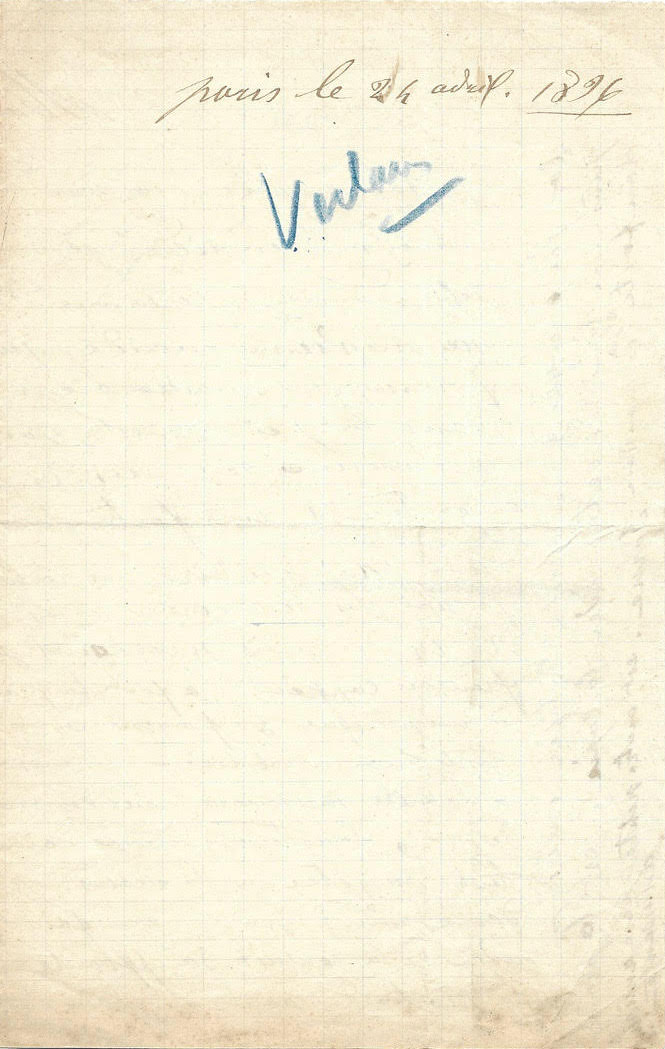
One oblong quarto page and one quarter octavo page. Paris. April 24, 1896.
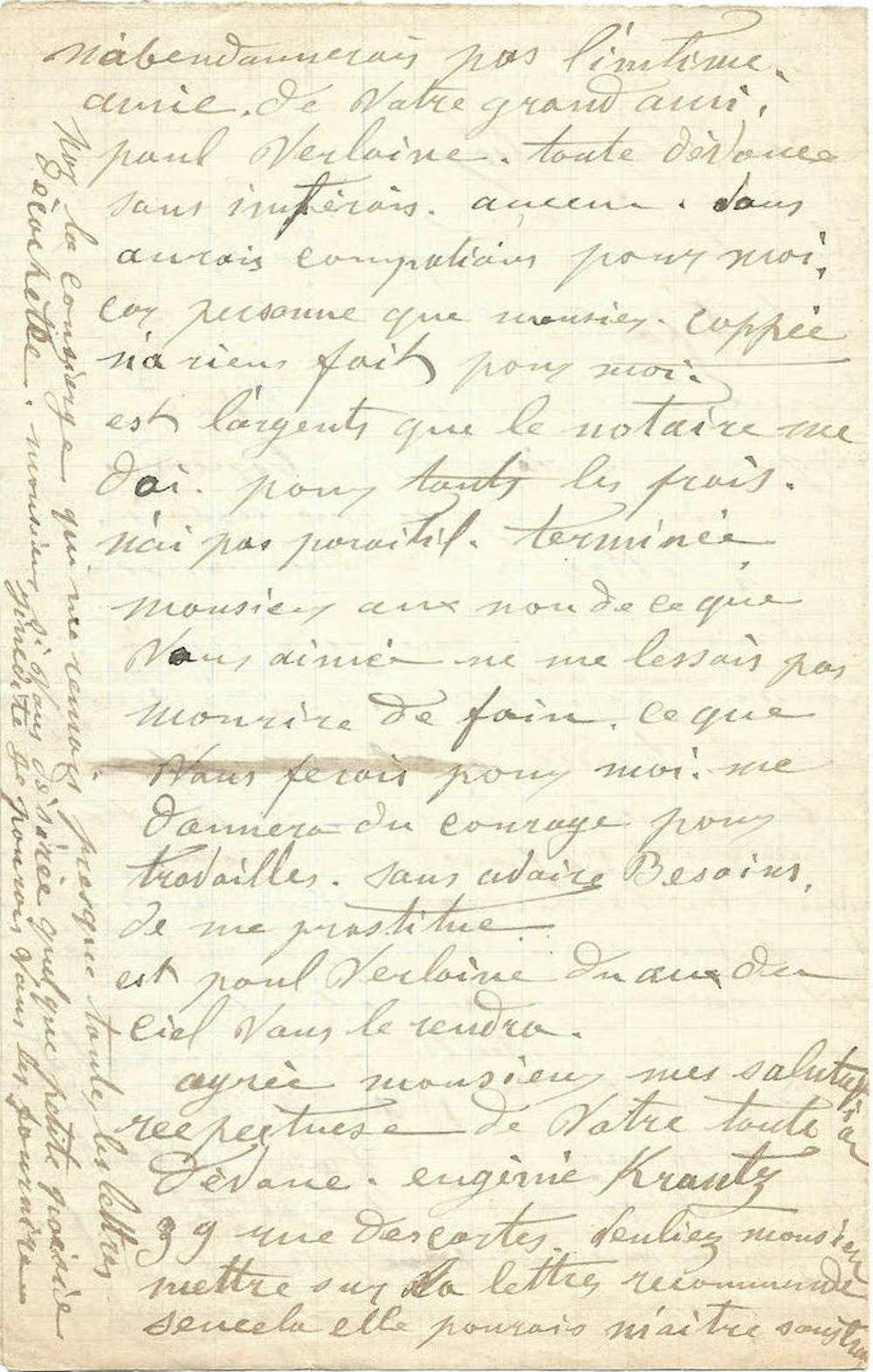
"In the name of those you love, do not let me starve. What you do for me will give me the courage to work without having to prostitute myself, and Paul Verlaine, from heaven above, will reward you ."
An extraordinary letter from Eugénie Krantz, the poet's last companion, begging Lepelletier to come to her aid.
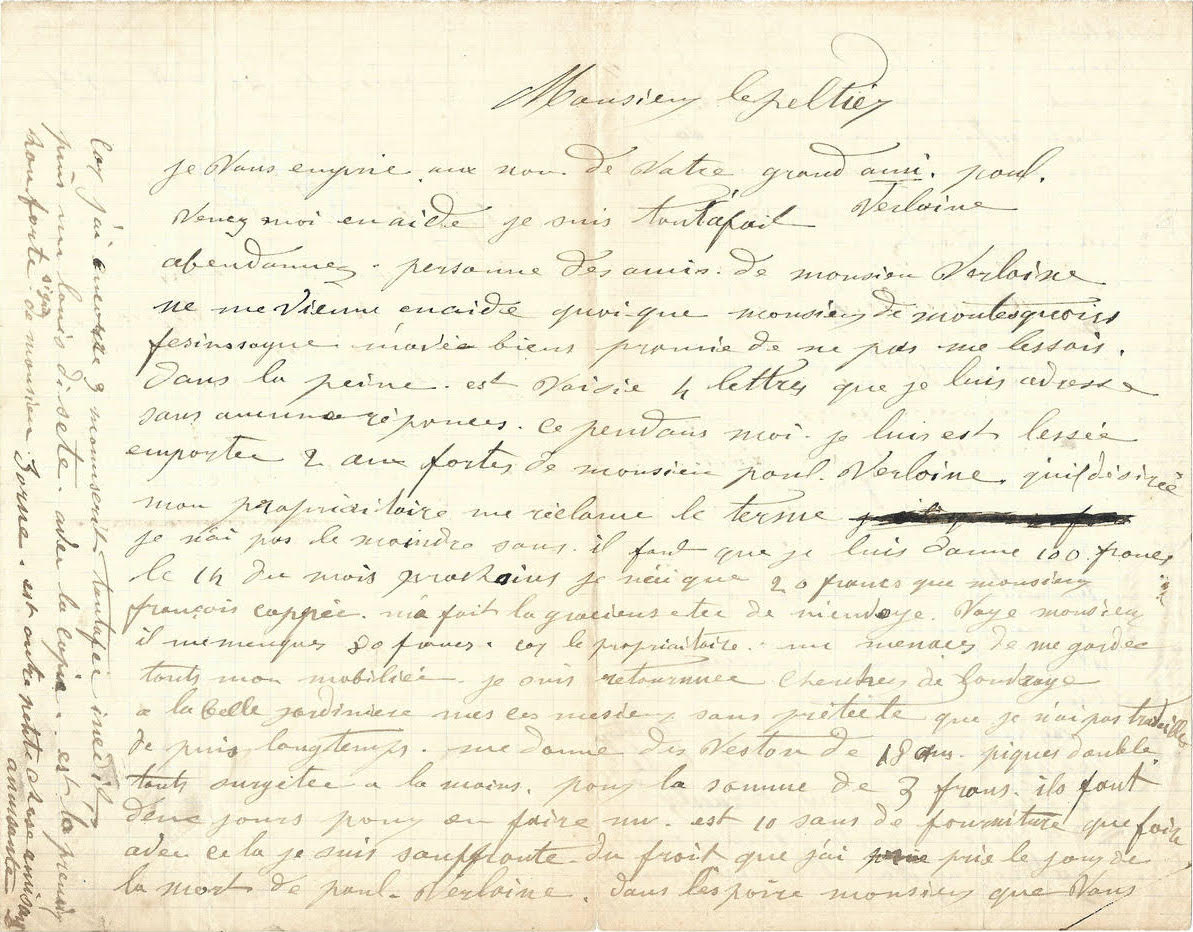
For easier reading, we have transcribed Krantz's letter—written in surprisingly phonetic French—with correct spelling. The original text is reproduced below.
_________________________________________________________
“Monsieur Lepelletier, I beg you, in the name of your dear friend Paul Verlaine, please come to my aid. I am completely abandoned. None of Monsieur Verlaine’s friends are helping me, even though Monsieur de Montesquiou-Fezensac promised not to leave me in distress, and here are four letters I have sent him without a single reply. However, I did let him take two etchings by Monsieur Paul Verlaine that he wanted. My landlord is demanding payment of the rent, and I don’t have a single penny. I must give him 100 francs by the 14th of next month, but I only have 20 francs, which Monsieur François Coppée was kind enough to send me. You see, sir, I am 80 francs short. For the landlord is threatening to keep all my furniture.” I went back to look for work at the garden center, but these gentlemen, under the pretext that I haven't worked for a long time, are giving me 18-year-old jackets, double-stitched and all hand-serged, for the sum of 3 francs; it takes two days to make one and 10 sous worth of supplies.
What am I to do with this? I am suffering from the cold I caught on the day Paul Verlaine died. I hope, sir, that you will not abandon the close friend of your great friend Paul Verlaine, so devoted and selfless. Everyone would have compassion for me. For no one but Monsieur Coppée has done anything for me. And the money the notary owes me for all the expenses is apparently not finished. Sir, in the name of those you love, do not let me starve. What you do for me will give me the courage to work without having to resort to prostitution, and Paul Verlaine, from heaven above, will reward you . Please accept, sir, my respectful greetings from your devoted Eugénie Krantz, 39 rue Descartes. Please, sir, mark the registered letter; otherwise, it might be taken from me by the concierge, who gives me almost all the unsealed letters. If you would like some unpublished poetry, I could provide it, as I still have three completely unpublished manuscripts, then a Louis XVII coin with a copy, and the first etching signed by Monsieur Zorn (Anders Zorn), and other such amusing little things.
_________________________________________________________
Verlaine met Eugénie Krantz, known as "Nini-Mouton," in 1891. Variously a seamstress, prostitute, and cabaret hostess, Krantz shared the poet's final years until his death on January 8, 1896. Penniless, a vagabond, and abandoned by all, she died in 1897. The posthumous account by St. Georges de Bouhélier of the Verlaine/Krantz relationship is quite striking:
“From the outset of this account, I mentioned that fifteen or twenty days before Verlaine’s death, I had the opportunity to meet him and that we had dinner together. During this last meal (about which Cazals and Gustave Le Rouge said a word, based on what Verlaine himself had told them), the conversation must have turned to Eugénie Krantz. That is why I am returning to her. To all those who have studied Verlaine’s life, his relationship with this woman appears inexplicable. In the years they were acquainted, Verlaine was obviously not a seductive man, nor even an attractive or acceptable one, but when I recall Eugénie Krantz, all I can remember is a rather unpleasant-looking woman, with a ruddy, wrinkled face and small, spiteful eyes. The impression she gave was far from suggesting anything of even the most basic sensual or physical power.” Despite the verses he dedicated to her, in which he spoke of their "nights," the woman was not to exert her influence on Verlaine through the allure of vice. ("I cannot do without her," he wrote in one of his letters.) Before moving in with her and publicly declaring her his "almost wife," he had taken her in on Rue Saint-Victor and had seemed content with their life together. However, he constantly complained of her violence. She was not a woman of easy peace. More often than not, she gave in to her hypochondriacal impulses. It reached the point where he had to leave her. The beloved home he so longed for became unbearable; he gathered his meager belongings, bundled his manuscripts, and resumed his wanderings, seeking shelter from anyone he could find. But, once the storm had passed, he always returned to Eugénie Krantz to ask for her forgiveness