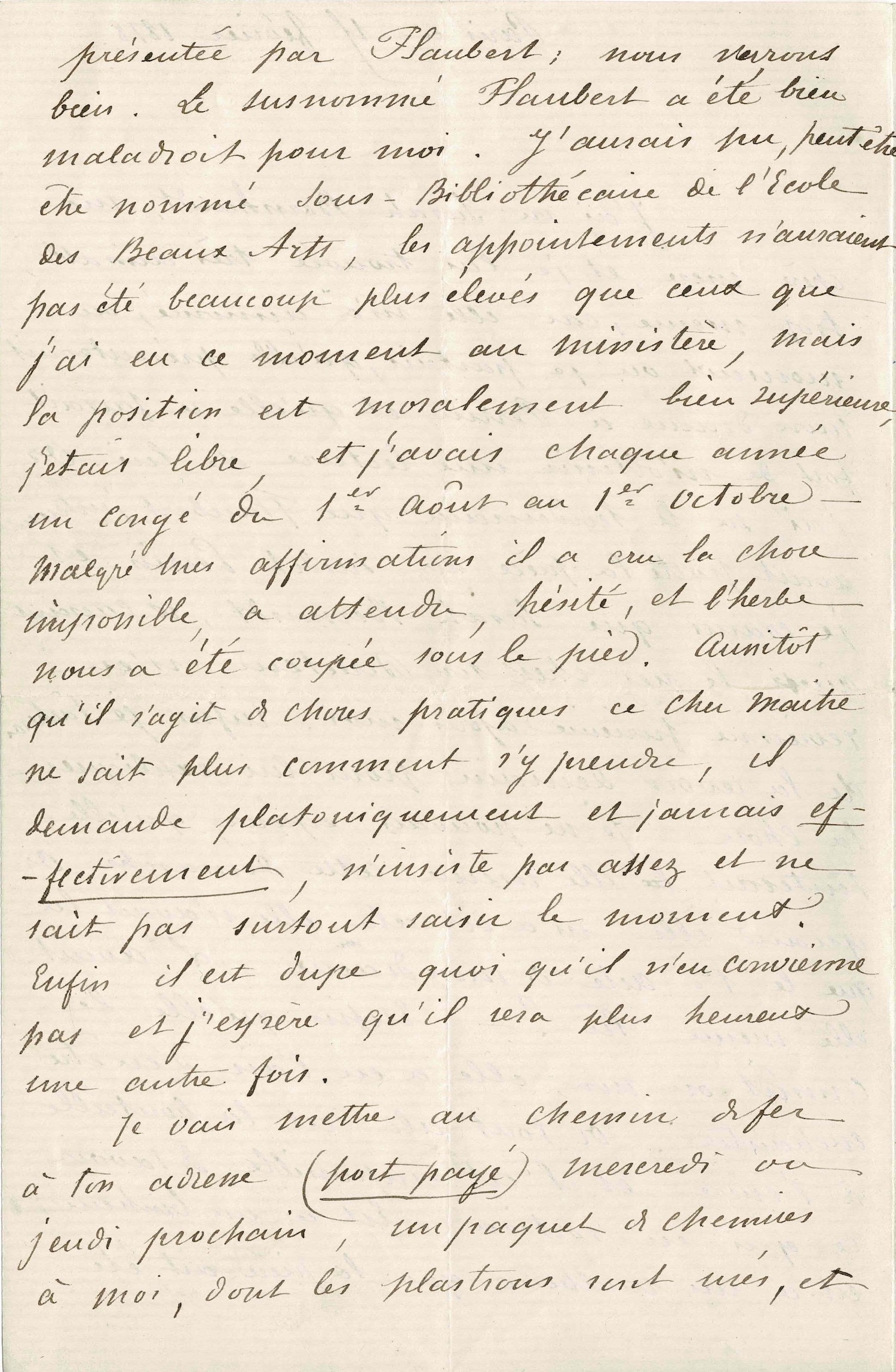

"The aforementioned Flaubert was quite clumsy in his dealings with me."
4.500€
Guy de Maupassant (1850.1893)
Autographed letter signed to his mother, Laure Le Poittevin.
Four octavo pages illustrated with two drawings.
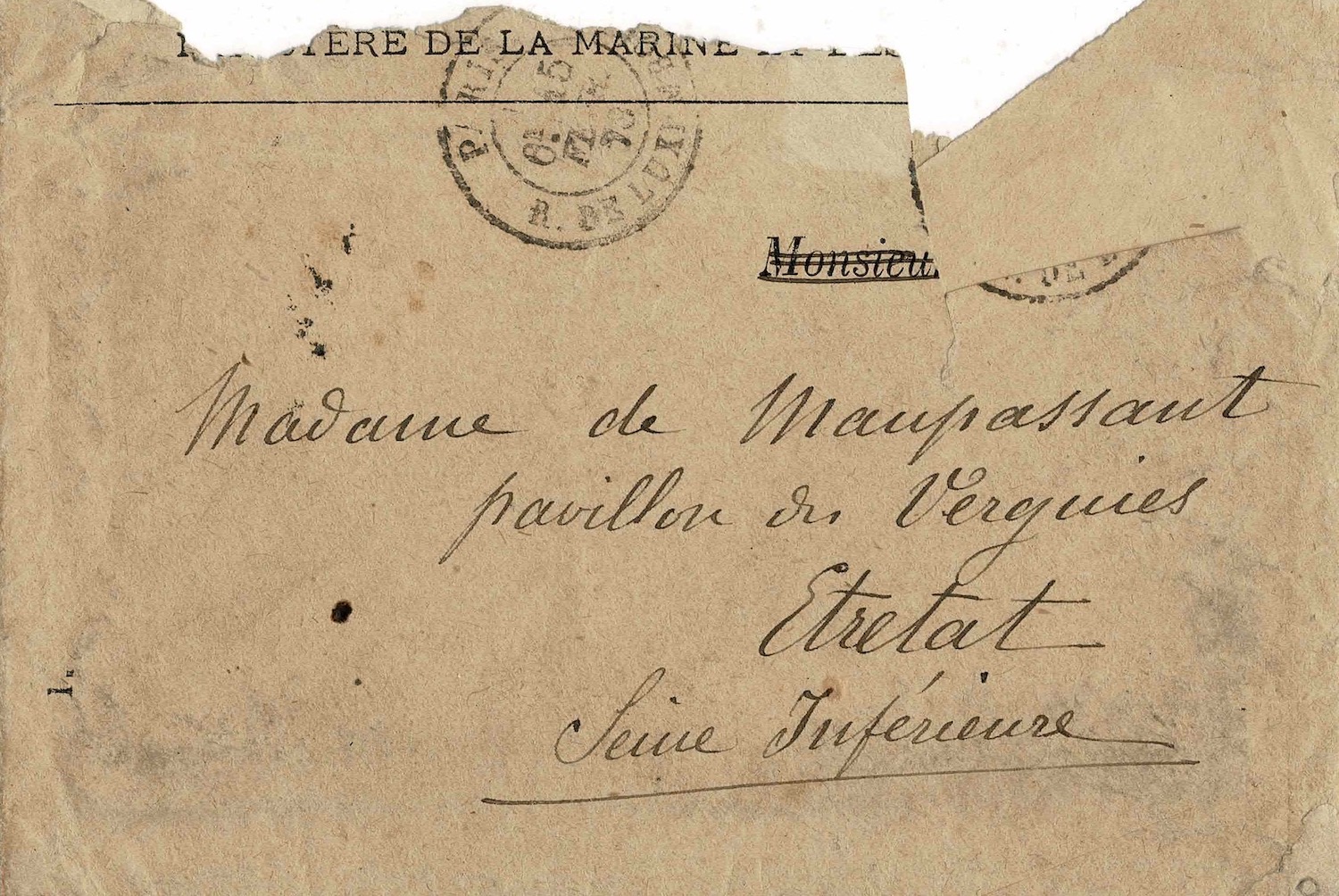
Paris. February 15, 1878. Autograph envelope.
"The aforementioned Flaubert was quite clumsy in his dealings with me."
Maupassant, eager to see his drama The Betrayal of the Countess of Rhune performed at the Comédie Française, finds himself trapped by his efforts with Sarah Bernhardt and his mentor and friend Gustave Flaubert.
After some logistical demands (illustrated by two small pen drawings) and a scathing critique from Caroline Commanville (Flaubert's niece), Maupassant confirmed to his mother that he was working on his first novel: Une vie.
_________________________________________________________
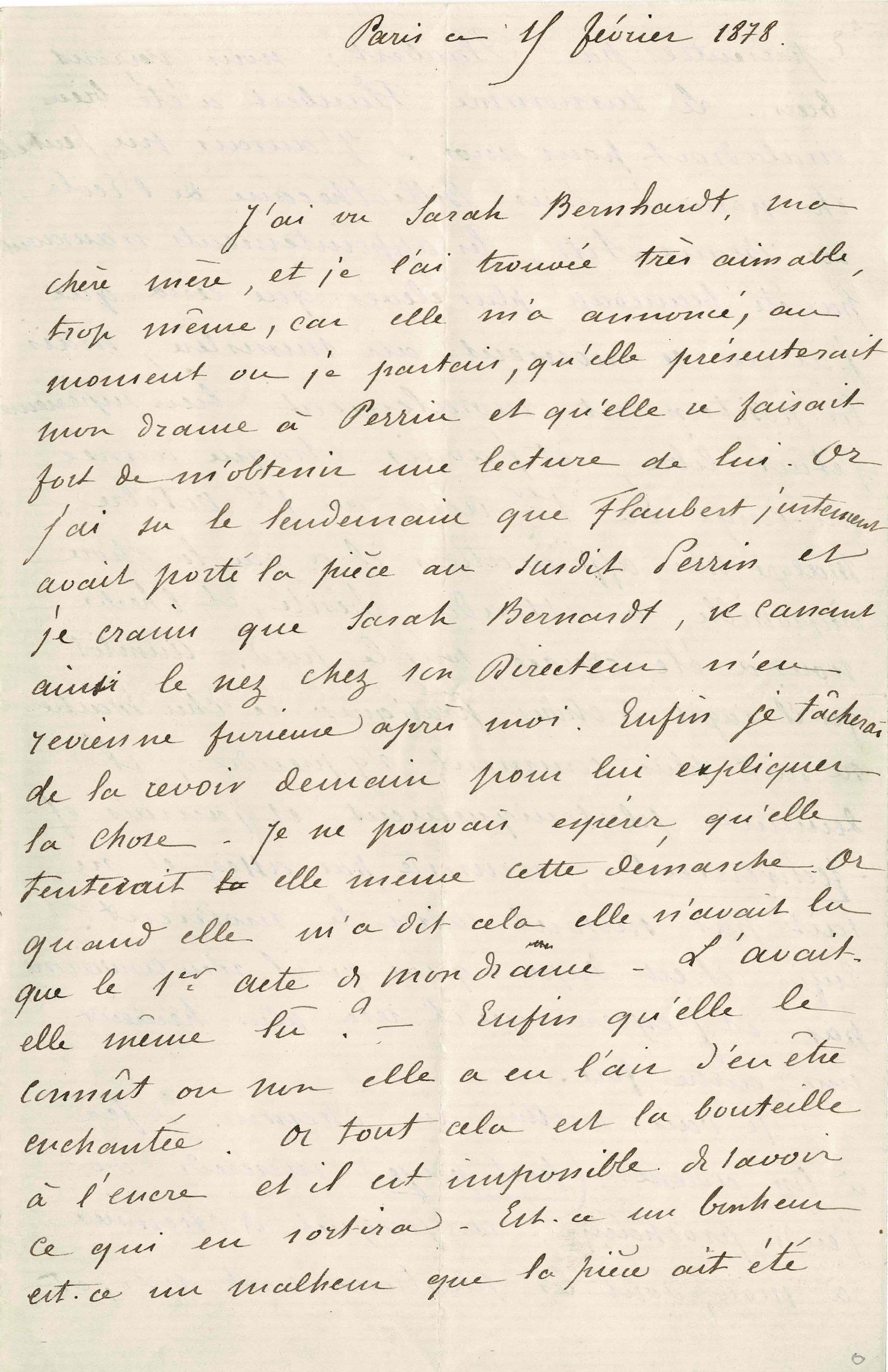
“I saw Sarah Bernhardt, my dear mother, and I found her very amiable , too amiable even, for she told me, just as I was leaving, that she would present my play to Perrin [Emile Perrin, administrator of the Comédie Française] and that she was confident she could obtain a letter from him for me. Now, I learned the next day that Flaubert had indeed taken the play to the aforementioned Perrin, and I fear that Sarah Bernhardt, having thus failed to impress her director, will return furious with me. In any case, I will try to see her again tomorrow to explain the situation.”
I couldn't have hoped she would attempt this herself. Yet, when she told me this, she had only read the first act of my play. Had she even read it? In any case, whether she knew it or not, she seemed delighted with it. But all of this is a mystery, and it's impossible to know what will come of it. Is it a blessing or a curse that the play was presented by Flaubert? We shall see.
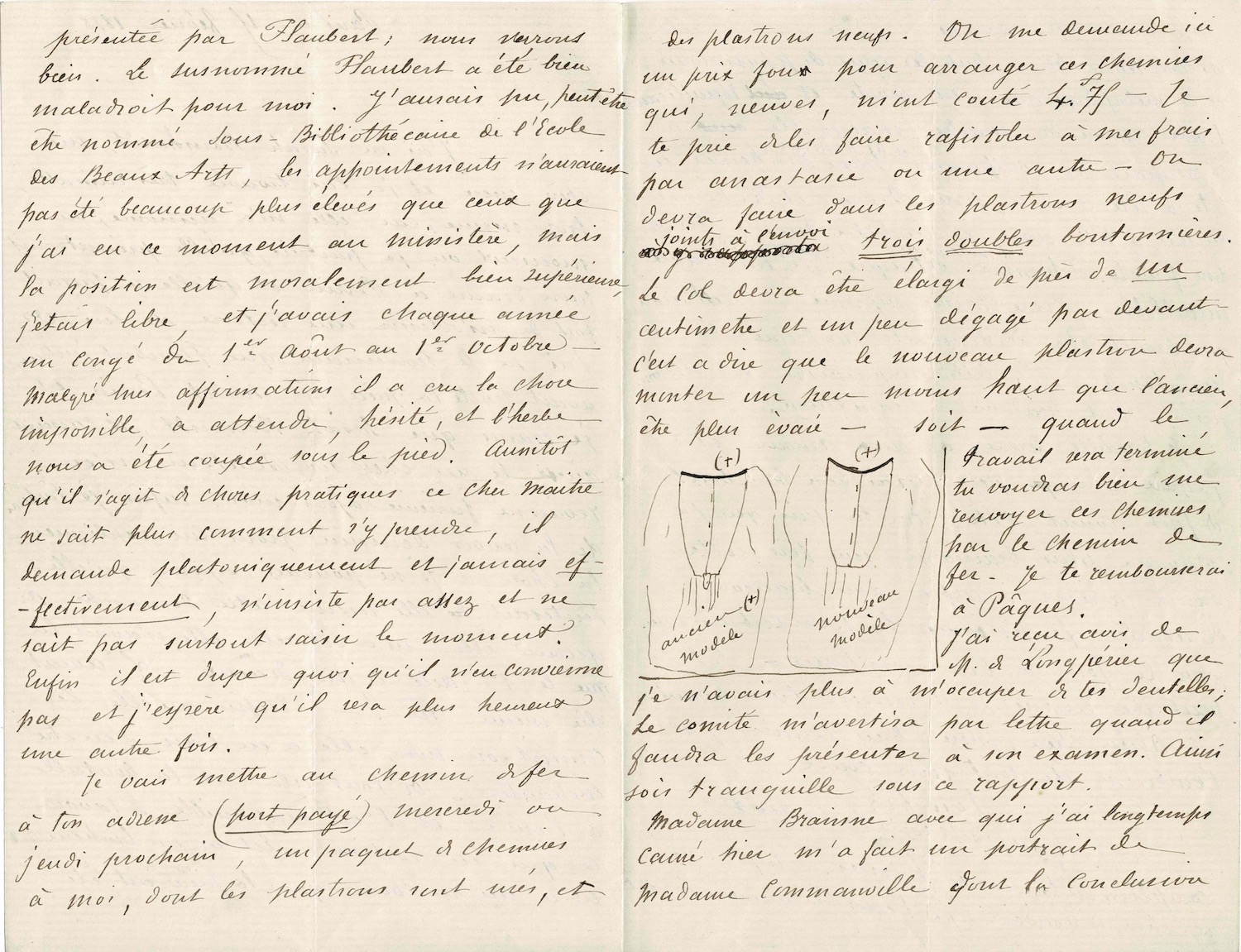
The aforementioned Flaubert was quite clumsy with me. I might perhaps have been appointed assistant librarian at the École des Beaux-Arts; the salary wouldn't have been much higher than what I currently receive at the Ministry. But the position is morally far superior, I was free, and I had a leave of absence every year from August 1st to October 1st . Despite my assurances, he believed it impossible, waited, hesitated, and the rug was pulled out from under us. As soon as practical matters are involved, this dear Master no longer knows how to proceed; he asks platonically and never actually does anything, doesn't insist enough, and above all, doesn't know how to seize the moment. In short, he's a fool, though he won't admit it, and I hope he'll have better luck next time.
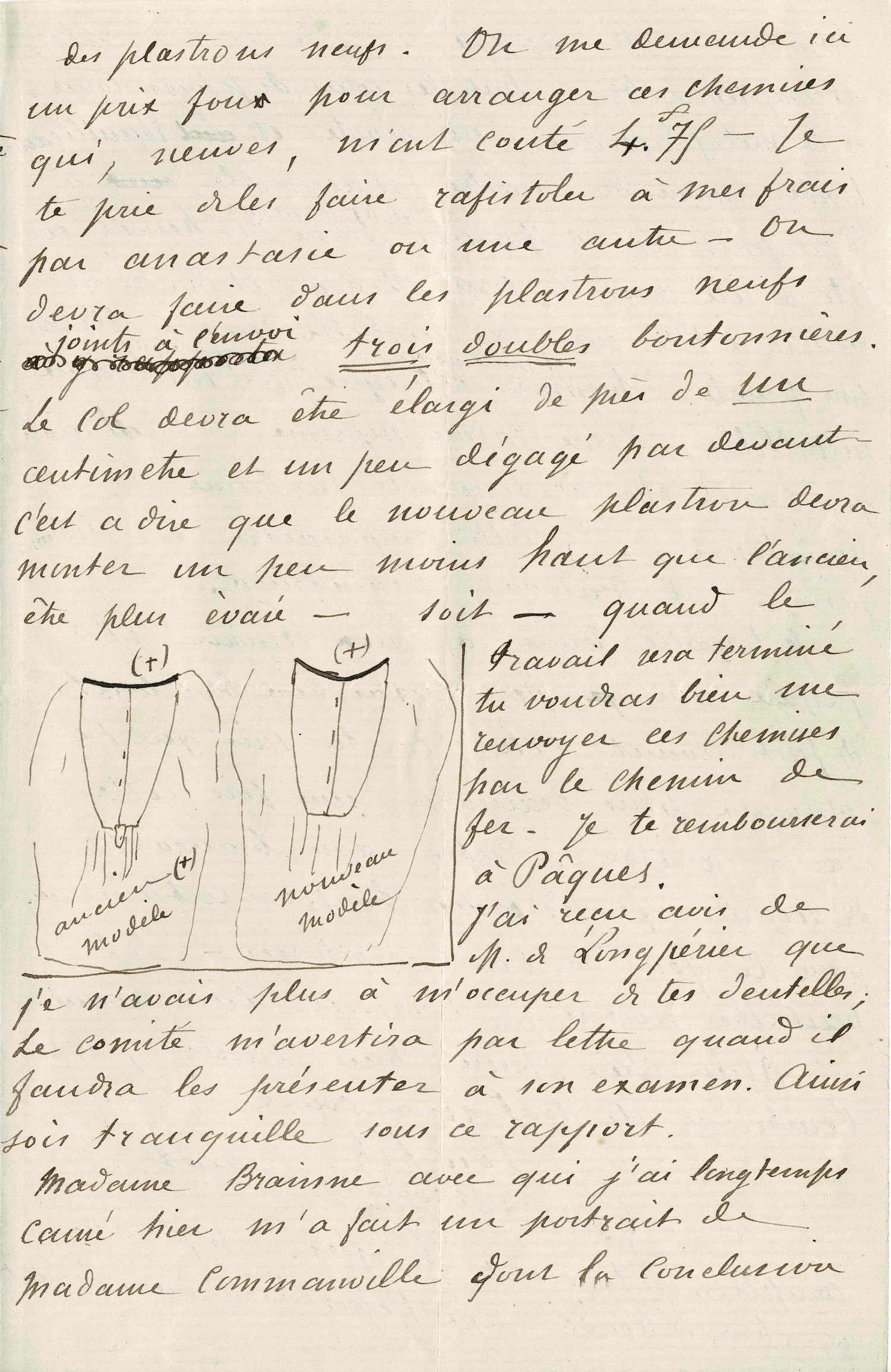
I will send a package of my shirts, some with worn fronts, and some new ones, to your address by mail (postage paid) next Wednesday or Thursday. They are asking an exorbitant price to repair these shirts, which cost me four francs seventy-five new. I ask you to have them mended at my expense by Anastasie or someone else. The new fronts enclosed with the package will need three double buttonholes.
The collar will need to be widened by almost a centimeter and not as high in the front—that is to say, the new front panel will need to be slightly shorter than the old one and more flared— [In the margin, two sketches representing the old and new shirts indicate the requested alterations]. When the work is finished, please send these shirts back to me by train. I will reimburse you at Easter.
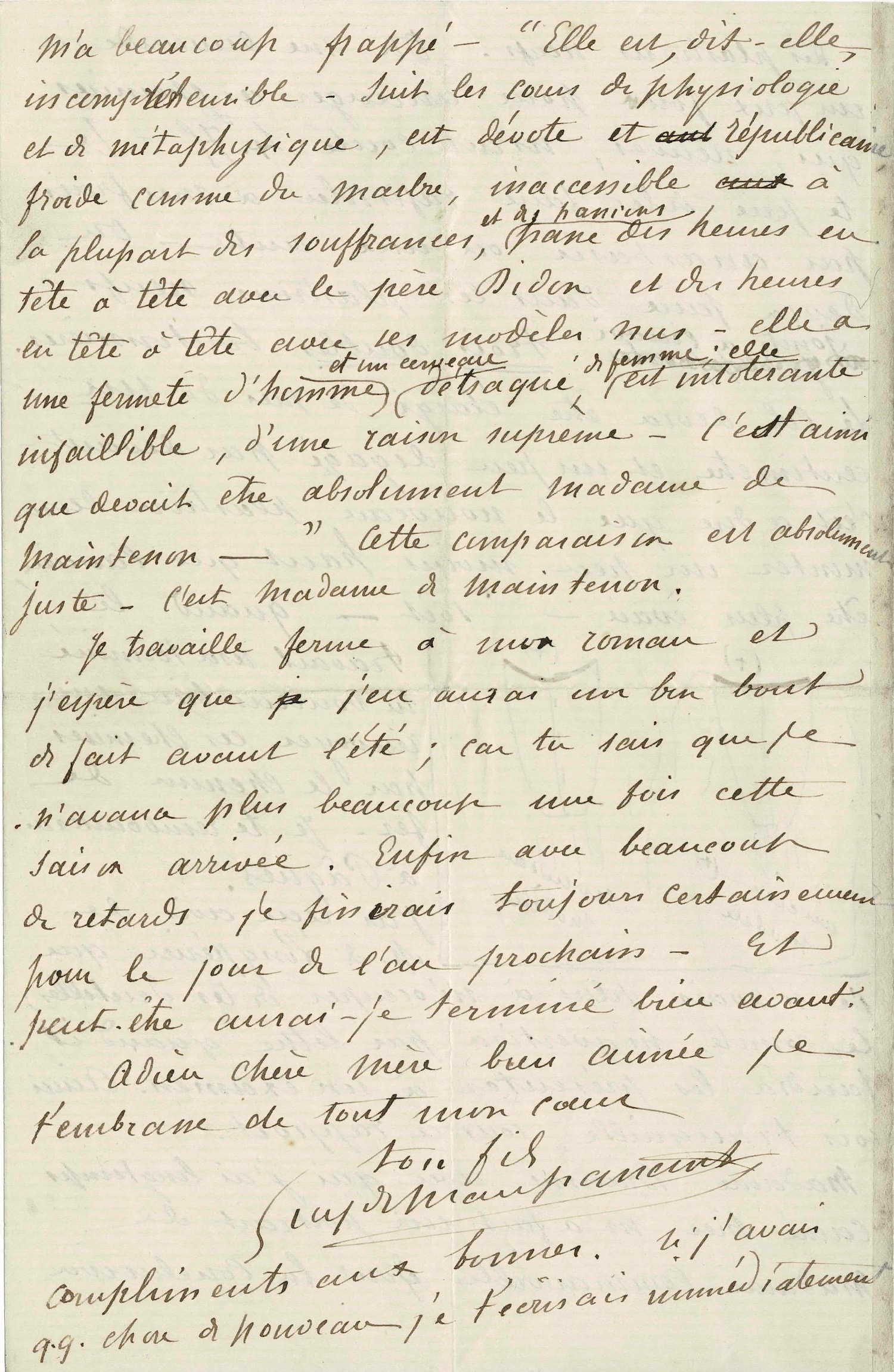
I received word from Monsieur de Longperrier that I no longer need to concern myself with your lace; the committee will notify me by letter when it is time to submit it for examination. So rest assured on that point. Madame Brainne, with whom I spoke at length yesterday, gave me a portrait of Madame Commanville, the conclusion of which struck me greatly — she is, she says, incomprehensible —attends courses in physiology and metaphysics, is devout and republican, cold as marble, impervious to most suffering and passions, spends hours in private with Père Didon and hours in private with her nude models—she is intolerant, infallible, and supremely rational. This must have been exactly how Madame de Maintenon must have been. This comparison is absolutely apt. It is Madame de Maintenon.
I am working hard on my novel and I hope to have a good portion of it finished before summer ; for you know I don't make much progress once that season arrives. Anyway, with many delays, I will certainly still finish by New Year's Day. And perhaps I will have finished well before then. Farewell, dear beloved mother, I embrace you with all my heart. Your son, Guy de Maupassant. Compliments to the maids; if I had anything new, I would write to you immediately.
__________________________________________________________
The tragedy.
The dramatic play The Betrayal of the Countess of Rhune was composed by Maupassant at the end of 1876. Submitted to Flaubert for advice and corrections in February 1877, the play (based on the War of the Breton Succession and on the playful loves of the Countess of Rhune) was completed at the dawn of 1878.
Rejected by the Comédie Française, the play never met the public and was only published in 1927 by Pierre Borel and Léon Fontaine in the work Le Destin tragique de Guy de Maupassant , published by Éditions de France.
The first novel.
On December 10, 1877, Maupassant wrote to Flaubert: “…I will have finished rewriting my drama (completely revised) — around January 15. Finally, I will submit it to you shortly after your return. I have also made the outline of a novel which I will begin as soon as my drama is finished.”
This is the very first mention of A Life . Encouraged by his mentor, he confided to his mother in a letter dated January 21, 1878: “Flaubert […] was very enthusiastic about the novel project I read to him. He said to me: ‘Ah! yes, that’s excellent, that’s a real novel, a real idea.’ Before I get down to it definitively, I’m going to work on my plan for another month or six weeks.”
Likely influenced by the romantic flair of his naturalist friends, Maupassant felt compelled to fully enter the literary world with the publication of his first novel. He did not, however, foresee that his work would not appear for another five years.
Considered one of his masterpieces, Une vie initially appeared as a serial in the pages of Gil Blas and then as a book published by Victor Havard in 1883.
_________________________________________________________
Guy de Maupassant. Correspondence, Volume I, pp. 151-153. Jacques Suffel, The Bibliophile's Circle, Évreux, 1973.
Guy de Maupassant. Marlo Johnston. Fayard Publishers.