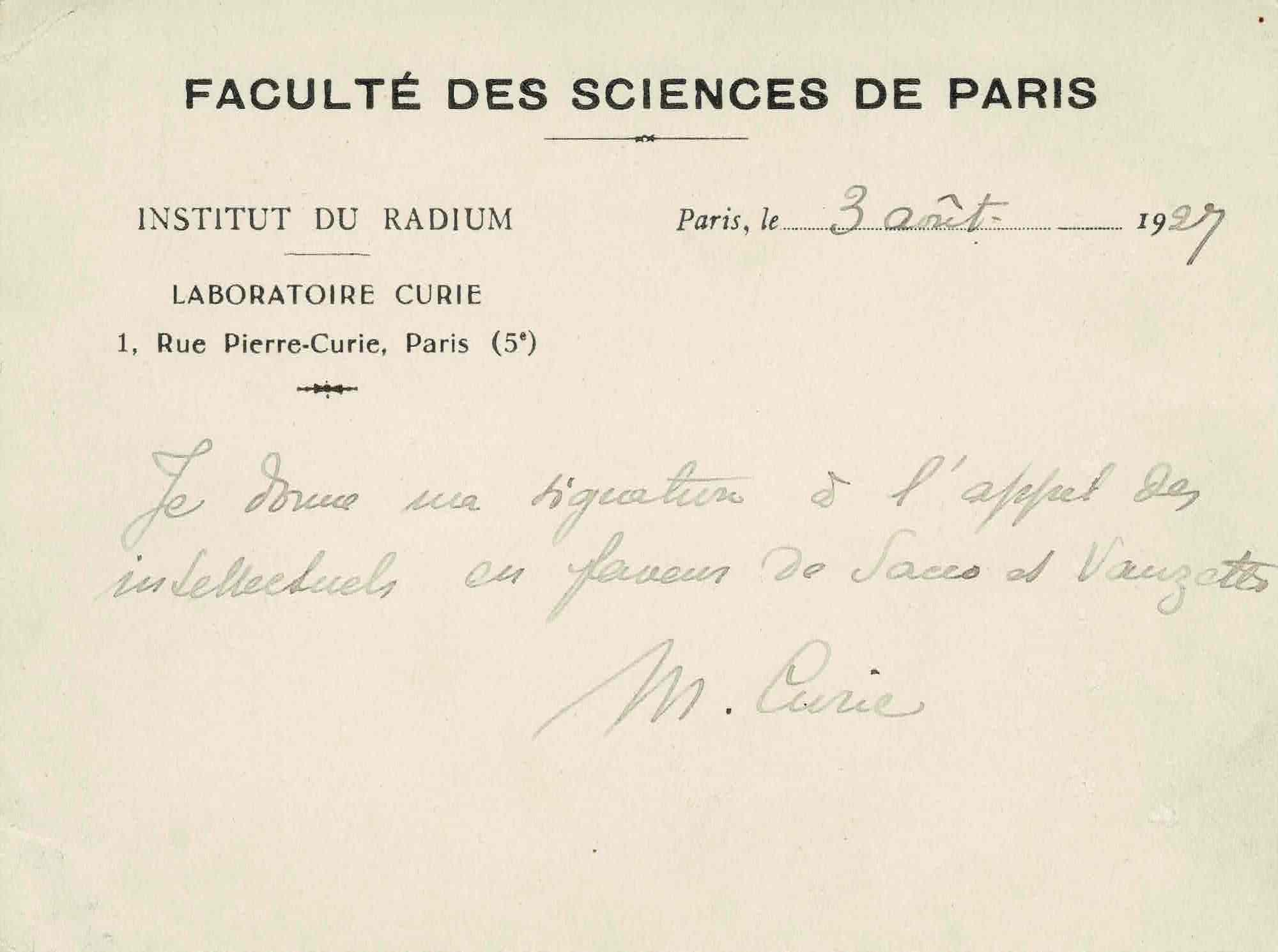
Marie Curie (1867.1934)
Autographed card signed.
One oblong octavo page on letterhead of the Radium Institute at the Faculty of Sciences of Paris.
Paris. August 3, 1927.
"I sign the appeal by intellectuals in support of Sacco and Vanzetti. Mr. Curie."
__________________________________
A true 20th-century icon, Marie Curie left her mark on history with the giant strides she made in modern science. Her discoveries on radioactivity and polonium earned her the Nobel Prize in Physics in 1903, and then in Chemistry in 1911. If Marie Curie remains in our memories, it is also because, behind the distinguished scientist, stood a woman of commitment whose actions and stances were models of integrity and courage.
Marie Curie rarely broke her silence, and her modesty prevented her from expressing her opinions on public affairs outside her family circle. However, her voice was heard in 1921. At the request of her colleague, the physicist Herta Ayrton, Curie joined a protest against the imprisonment of the leaders of the suffragist movement in London.
In France, she waged the same battle for women's suffrage, deciding to publicly refute Louis Barthou, who had claimed in the Senate that she was opposed to this right. In July 1932, she wrote to Louis Martin, president of the parliamentary group advocating for women's rights: "It is true that I usually abstain from any political discussion, whether on this issue or others that are not within the realm of science. However, without commenting on the specifics of granting political rights to women, I believe that the principle is fundamentally just and that it must be recognized."
Another exception to this rule of discretion occurred in 1927 (the subject of the document we are presenting here). While her opposition to the death penalty was well known, Marie Curie no longer wished to speak publicly on the subject. However, alerted by her daughter Irène Joliot-Curie, she agreed to lend her support to the Italian anarchists Nicola Sacco and Bartolomeo Vanzetti, who had been unjustly condemned in the United States.
Indeed, on July 3, 1927, Irène wrote to her mother: “Speaking of newspapers, haven’t you been asked to participate in the appeal by French intellectuals in favor of Sacco and Vanzetti? It’s something you could do, given that the appeal is directed against the death sentence that has hung over two men for six years, without prejudging their innocence or guilt; as you rarely lend your signature, and as you are a member of the Commission for Intellectual Cooperation, a word from you might be of some use. If the death penalty is ever to be abolished, it will be, after all, when it becomes clear that it doesn’t have everyone’s approval, and since you have a very firm opinion on this matter, I think there would be no harm in making it known.”
Marie thus signed the appeal by French intellectuals demanding a review of the sentence pronounced against the two men.
The appeal and international mobilizations remained in vain; Sacco and Vanzetti were executed in the electric chair at Charlestown prison, near Boston, on the night of August 22-23, 1927.