Pierre-Joseph PROUDHON publishes War and Peace.
"Should I withdraw, abandon my revolutionary speculations, and break my pen?"
2.500€

"Should I withdraw, abandon my revolutionary speculations, and break my pen?"
2.500€
Pierre-Joseph PROUDHON (1809.1865)
Autographed letter signed to Auguste Rolland.
Five pages, octavo. Brussels, July 7, 1861
"Should I withdraw, abandon my revolutionary speculations, and break my pen?"
Exiled in Belgium, Proudhon wonders, with doubts, about the reactions aroused by his work published a few weeks earlier by Michel Levy , research on the principle and constitution of the law of nations.
__________________________________________________
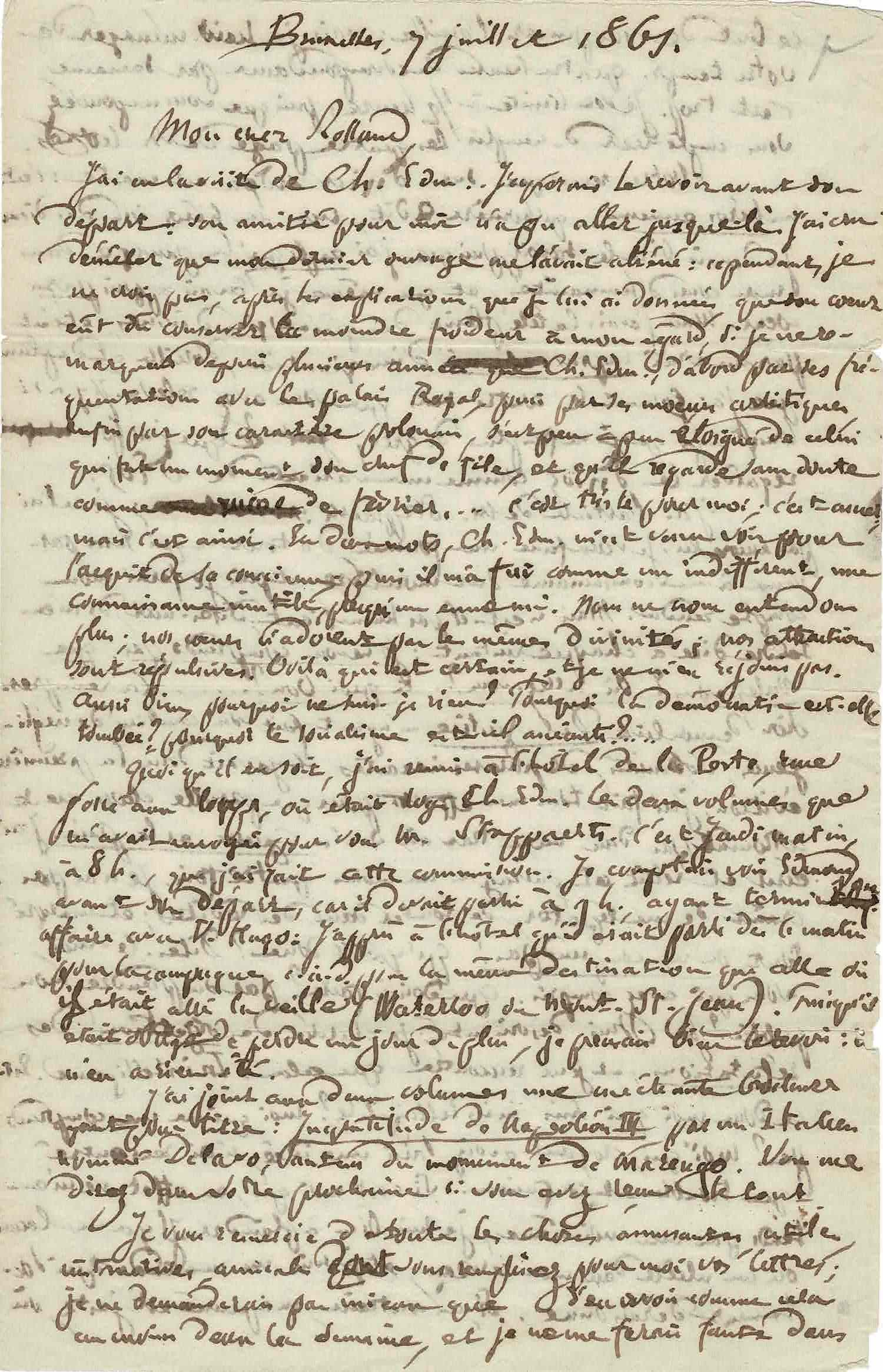
“My dear Rolland, I had a visit from Ch. Edm. I had hoped to see him again before his departure: his friendship for me could not extend that far. I thought I understood that my last work had changed him: however, I do not believe, after the explanations I gave him, that his heart should have remained the least cold towards me, if I had not noticed for several years that Ch. Edm., first through his association with the Palais Royal, then through his artistic habits, and finally through his Polish character, has gradually distanced himself from the one who was for a time his leader, and whom he no doubt regards as a ruin of February… It is sad for me; it is bitter, but it is so. In short, Ch. Edm. came to see me to settle his conscience; then he fled from me as if I were indifferent, a useless acquaintance, almost an enemy. We no longer understand each other; Our hearts do not worship the same gods; our attractions are repulsive. That much is certain, and I take no pleasure in it. So why am I nothing? Why has democracy fallen? Why has socialism been destroyed?…
In any case, I delivered to the Hôtel de la Poste, on Rue Fossé aux Loups, where Ch. Edm. was staying, the two volumes that Mr. Stappaerts had sent me for you. I made this errand Thursday morning at 8:00 a.m. I intended to see him before his departure, as he was due to leave at 9:00 a.m., having finished his business with Victor Hugo. I learned at the hotel that he had left that very morning for the countryside, that is to say, for the same destination he had gone to the day before (Waterloo du Mont-Saint-Jean). Since he was obliged to lose another day, I fully expected to see him again: but it was not to be.
I enclosed with the two volumes a nasty pamphlet entitled: " The Ingratitude of Napoleon III" by an Italian named Delavo, the author of the Marengo monument . Let me know in your next letter if you received everything. Thank you for all the amusing, useful, instructive, and friendly things you fill your letters with; I would ask for nothing more than at least two like that a week, and I wouldn't hesitate to pinch your ear to that end: but I know how to manage your time. Four hours of correspondence a week is too much. I'm limiting you to half an hour, since you can't help but fill all four pages of your letters.
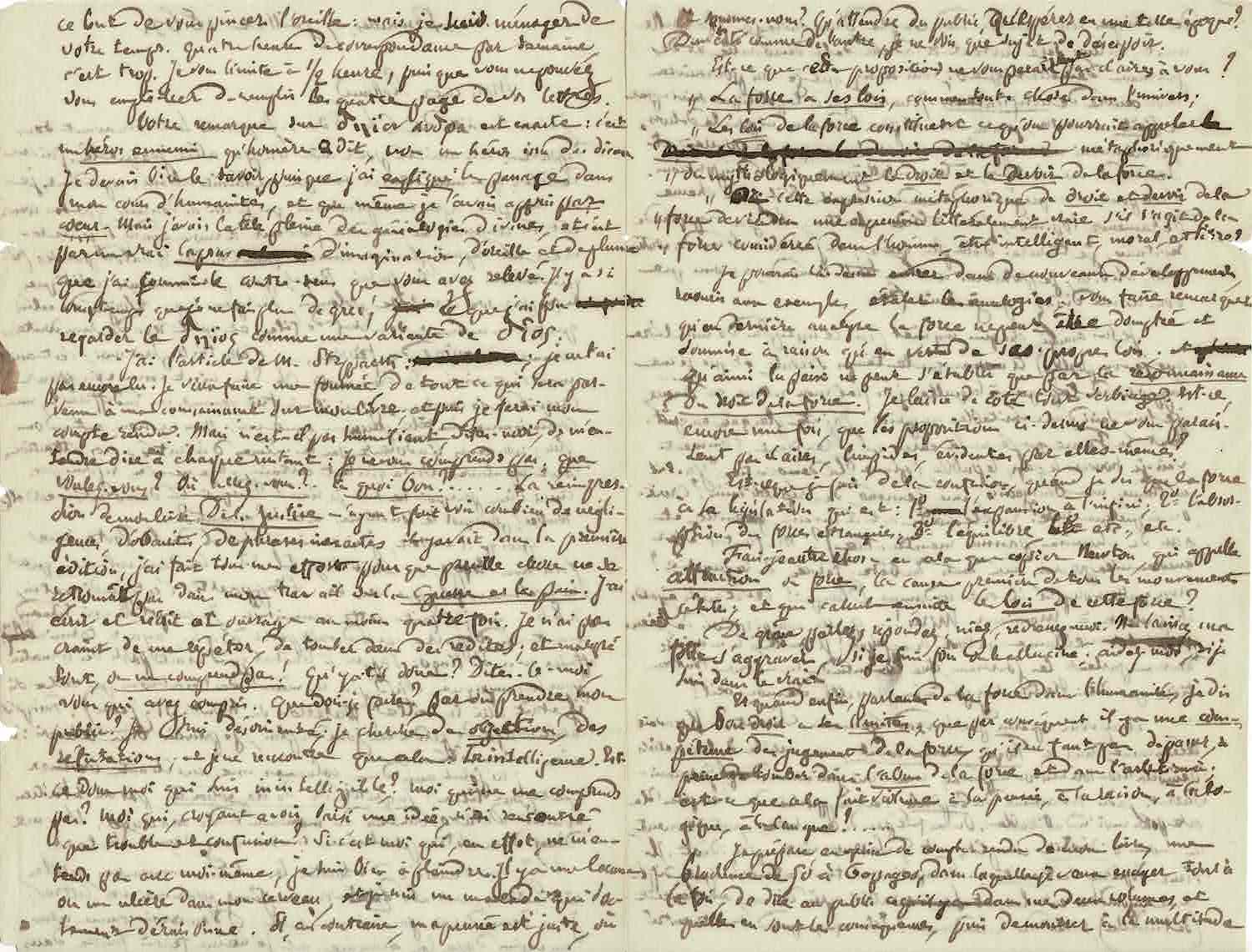
Your observation about [Greek reference] is correct: Homer referred to an enemy hero, not a hero descended from the gods. I should have known this, since I explained the passage in my humanities course, and I had even memorized it. But my head was full of divine genealogies, and it was through a genuine lapse of imagination, ear, and pen that I committed the misinterpretation you pointed out. It has been so long since I studied Greek that I could have considered [Greek reference] a variant of [Greek reference].
I have Mr. Stappaerts' article; I haven't read it yet. I want to gather everything I've heard about my book , and then I'll write my review. But isn't it humiliating, tell me, to hear myself constantly asked: " I don't understand you; what do you want? Where are you going with this? What's the point?"... The reprinting of my book *On Justice* showed me how many oversights, obscurities, and inaccuracies there were in the first edition, so I made every effort to ensure that such things wouldn't reappear in my work on * War and Peace* . I wrote and rewrote this work at least four times. I wasn't afraid of repeating myself, of falling into redundancies; and yet, people still don't understand! What's the problem? Tell me, you who have understood. What should I do? How should I approach my audience? I'm disoriented; I seek objections, refutations; and I find nothing but this: incomprehension. Is it I who am unintelligible? I who do not understand? I who, believing I had grasped an idea, have encountered only confusion and turmoil? If it is indeed I who cannot understand myself, I am truly to be pitied. There is a gap or an ulcer in my brain, and I am a sick man who utterly irrationalizes. If, on the contrary, my thought is correct, where do we stand? What can we expect from the public, what can we hope for in such times ? On either side, I am nothing but a cause for despair.
Do these propositions not seem clear to you? “Force has its laws, like everything else in the universe ; the laws of force constitute what one might metaphorically or mythologically call the right and duty of force. Now, this metaphorical expression of the right and duty of force becomes a literally true expression if it concerns force considered in man, an intelligent, moral, and free being.” I could elaborate further on this, resort to examples, and elaborate on analogies, to point out that, in the final analysis, force can only be tamed and subdued by reason by virtue of its own laws. And that, therefore, peace can only be established through the recognition of the right of force. I will leave aside all further verbiage. Is it still not clear, limpid, or self-evident to you that the above propositions do not seem clear, transparent, or self-evident?
Am I being mistaken when I say that force has its own laws, which are: 1) infinite expansion; 2) the absorption of enemy forces; 3) equilibrium, etc., etc.? Am I doing anything other than copying Newton, who calls attraction or force the first cause of all celestial movements ; and who then calculates the laws of this force? Please, speak, answer, deny, correct me. Do not let my madness worsen, if I am mad or delusional; help me, if I am right. And when, finally, speaking of force in humanity, I say that its right has its limits; that consequently there is a competence in judging force that must not be exceeded, lest one fall into the abuse of force and arbitrariness. Does this violate thought, reason, logic, language?
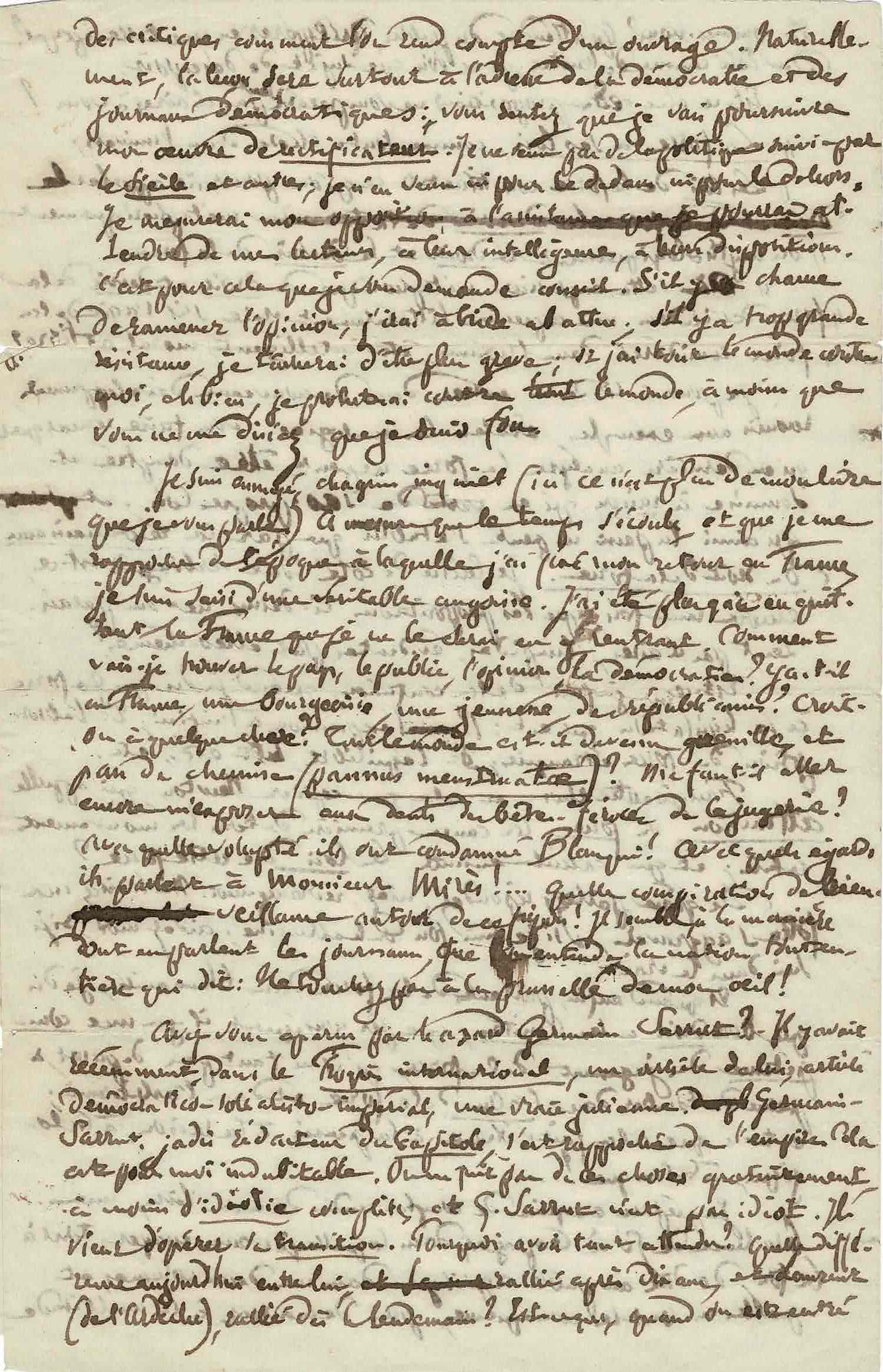
I am preparing, as a review of my book, a pamphlet of 50 to 60 pages, in which I intend to explain to the public what is contained in my two volumes and what the consequences are, and then ask the multitude of critics how one reviews a work. Naturally, the lesson will be primarily addressed to democracy and democratic newspapers: you understand that I am going to continue my work of correction. I do not want the policies pursued by Le Siècle and others; I want them neither for domestic nor foreign purposes. I will gauge my opposition by the support I can expect from my readers, by their intelligence, by their disposition. That is why I am asking for your advice. If there is a chance of swaying public opinion, I will proceed with full force. If there is too much resistance, I will try to be more serious; If I have everyone against me, well, I'll protest against everyone, unless you tell me I'm crazy.
I am bored, saddened, worried (here I am no longer speaking of my book) as time passes and I approach the period in which I have set my return to France; I am seized by a genuine anguish. I was more cheerful leaving France than I will be returning. What will I find the country, the public, public opinion, democracy? Is there a bourgeoisie in France, a youth, republicans? Does anyone believe in anything? Has everyone become a rag, a piece of their shirt (pannus menstruate)? Must I once again expose myself to the teeth of the ferocious beasts of the judiciary?
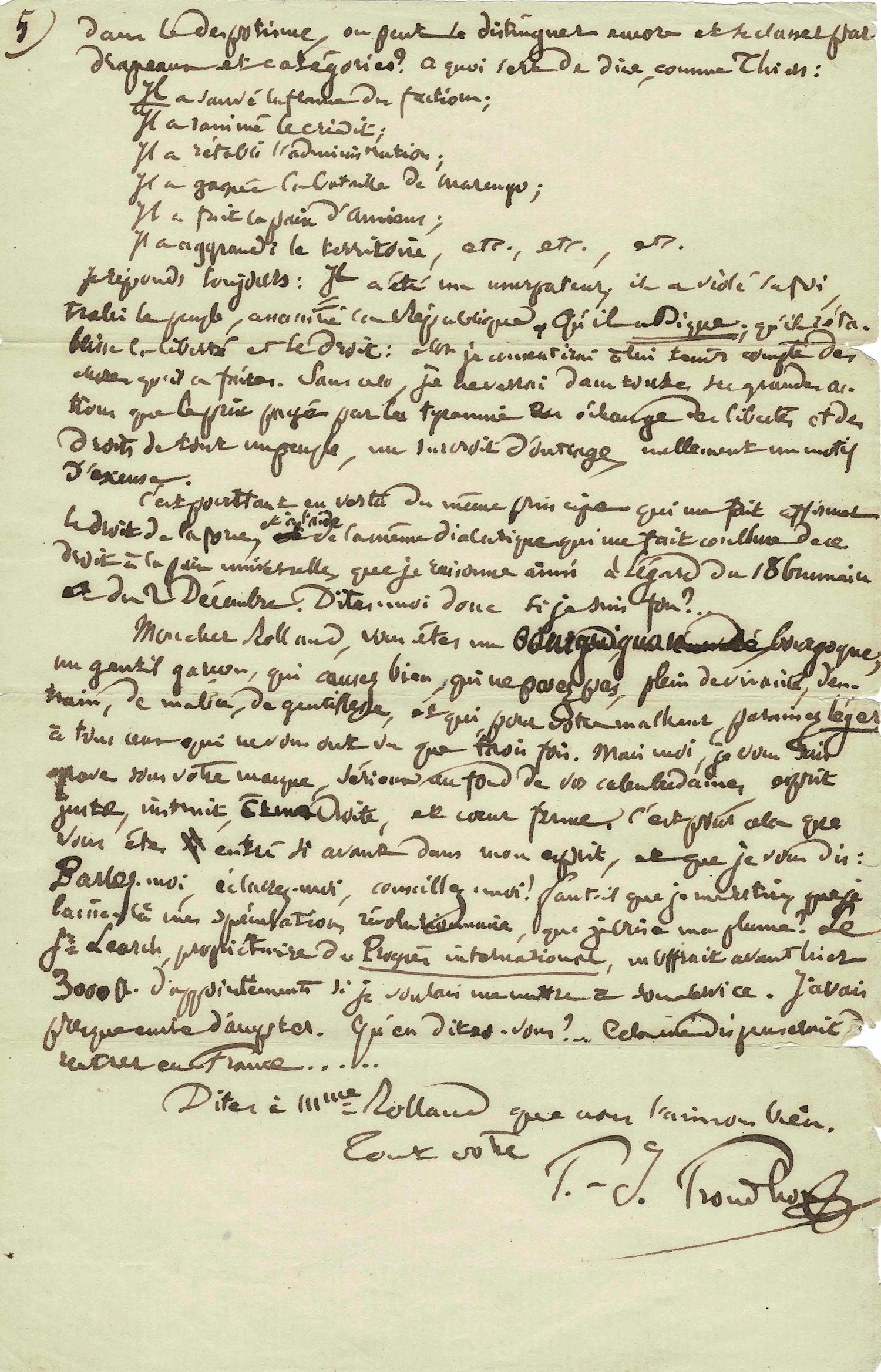
With what relish they condemned Blanqui! With what deference they speak to Monsieur Mirès!… It seems, from the way the newspapers report it, that, to hear the whole nation say: Don't touch the apple of my eye! Have you by chance seen Germain Sarrut? There was recently, in Le Progrès International, an article by him, a democratic-idealistic-imperial article, a real rant. Germain Sarrut, formerly editor of Le Capitole, has moved closer to the empire. This is undeniable to me. One doesn't do such things for nothing, unless one is completely idiotic, and G. Sarrut is not an idiot. He has just made the transition. Why wait so long? What difference is there today between him, having rallied after ten years, and Laurent (from the Ardèche), who rallied the very next day? Once one has entered despotism, can one still distinguish it and categorize oneself by flags and groups? What is the point of saying, like Thiers: "He saved France from factions; he revived credit; he restored the administration; he won the Battle of Marengo; he made the Peace of Amiens; he enlarged the territory," etc., etc., etc.? My answer is always: "He was a usurper; he violated his faith, betrayed the people, and murdered the Republic. Let him abdicate; let him restore liberty and justice : then I will agree to acknowledge the things he has done. Otherwise, I will see in all his great deeds only the price paid by tyranny in exchange for the liberties and rights of an entire people, an added insult, by no means a reason for excuse. Yet it is by virtue of the same principle that leads me to affirm the right of force, and with the aid of the same dialectic that leads me to conclude from this right to universal peace, that I reason thus with regard to the 18th Brumaire and the 2nd of December . Tell me, am I crazy?
My dear Rolland, you are a Burgundian from Burgundy, a charming fellow who speaks well, who doesn't put on airs, full of vivacity, enthusiasm, wit, and kindness, and who, unfortunately for you, seems frivolous to all those who have only seen you three times. But I know you to be serious beneath your mask, earnest in your nonsense, a fair and learned mind, an upright soul, and a steadfast heart. That is why you have penetrated so deeply into my thoughts, and why I say to you: Speak to me, enlighten me, advise me! Must I withdraw, abandon my revolutionary speculations, and break my pen? Mr. Learch , owner of *Le Progrès International*, offered me 3,000 francs in salary the day before yesterday if I would enter his service. I was almost tempted to accept. What do you say to that?... It would spare me from returning to France... Tell Madame Rolland that we like her very much. All your P.-J. Proudhon.
__________________________________________________
Tutor at the college in Bourges under the July Monarchy, democratic propagandist, Auguste Rolland (1822-1905) was commissioned by Félix Pyat, commissioner of the Republic in Bourges in 1848, to give lectures at the republican club of the city.
Appointed professor at the lycée in Mâcon, he was elected deputy to the Legislative Assembly in May 1849, on the Montagnard list. He was sentenced to five years in prison and a fine of four thousand francs by the Côte-d'Or Assize Court on March 11, 1849, for speeches delivered on February 27 and March 9, 1849, at the Brotteaux Club, founded in Mâcon on February 6, 1849. He took part in the insurrection of June 13, 1849. The High Court of Versailles sentenced him in absentia to deportation. He first went into exile in Geneva, which he was forced to leave, then in Nyon, where he arrived without papers on October 2, 1849, with Charles Cœurderoy. A few days later, he went to Lausanne, where he met up with François Jannot and about fifteen other activists from Saône-et-Loire, including Sinaï-Combet. He signed, along with the defendants from Lausanne on June 13, their response of October 9 to the defendants in London who refused to appear, at the trial of October 10, which they had hoped to attend.
He signed an appeal to the socialist democrats of the Seine department , dated February 18, 1850, from Lausanne, in which the refugees announced they had formed a "Provisional Relief Committee." Also in Lausanne, on March 17, 1851, he and sixteen other exiles signed a protest against the expulsion from Switzerland of the Venetian patriot Varé. A week later, he and his friends were themselves expelled.
In March 1857, while in Brussels, he wrote to the president of the legislative assembly: “ Citizen President, having some business to attend to, I was unable to immediately make myself available to the judicial authorities. My failing health also requires some care, which is why my friends have urged me to temporarily withdraw from the proceedings against me. But on the day of judgment, I will appear. There will be plenty of time, for I do not wish to defend myself before the High Court. However, I believe that after having had the singular honor of representing the people, I can have no greater honor than to suffer for them; this is yet another way of representing them, and their cause requires martyrs. ”
A regular correspondent of Proudhon, he was one of the latter's six executors of his will.
__________________________________________________
A writer and journalist of Polish origin, connected to George Sand, Alexander Herzen, and Proudhon, Charles Edmond Chojecki (1822-1899) long supported revolutionary ideas. Expelled from Poland in 1844 because of his political activism, he was also forced to leave France in 1850 and sought refuge in Egypt. Returning to Paris and naturalized as a French citizen, he sought closer ties to power. Prince Napoleon took him to Iceland as an interpreter and granted him a position as librarian at the Senate in 1862, which he held until his retirement in 1896.
__________________________________________________
The Ingratitude of Napoleon III. An appeal to public opinion by Jean Delavo, founder of the Marengo monument. Brussels, Ch. Vanderrauwera Printing House, 1861. Octavo, 163 pp. “My name is Jean Delavo. I was born in Alexandria, Piedmont, on December 26, 1806” (page 9).
__________________________________________________
Writer and politician, Georges Sarrut (1800-1883) was involved in the struggle against the July Monarchy, often prosecuted and sometimes imprisoned: he distanced himself from Louis-Napoleon Bonaparte after the coup d'état of December 2, 1851.
__________________________________________________
Proudhon, War and Peace, research on the principle and constitution of the law of nations, Michel Levy Frères, 1861.