New hieroglyphs deciphered by Jean-François CHAMPOLLION.
“…I so rarely have the opportunity to discuss hieroglyphs with someone who listens with interest…”
70.000€

“…I so rarely have the opportunity to discuss hieroglyphs with someone who listens with interest…”
70.000€
Jean-François CHAMPOLLION (1790.1832)
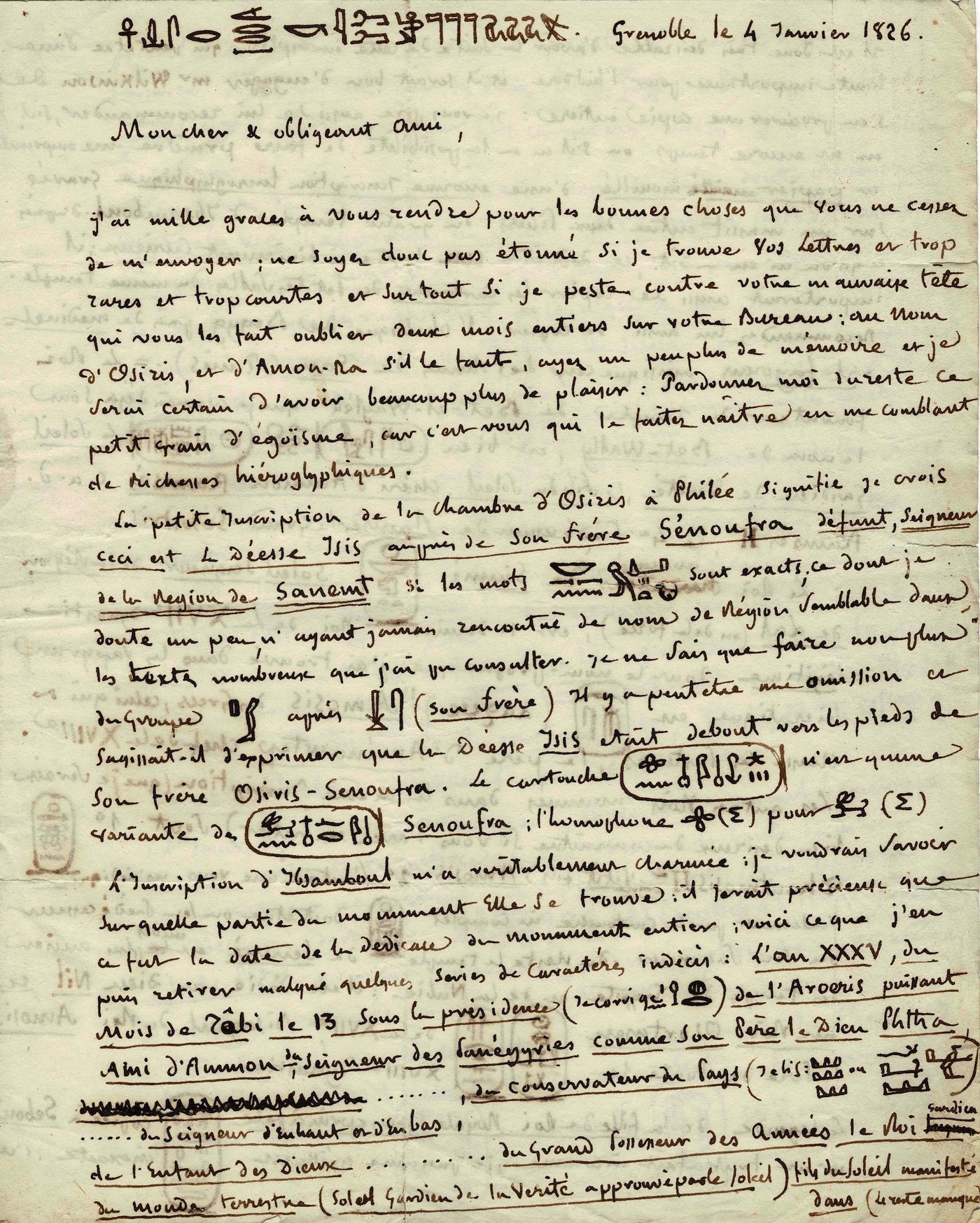
Autograph letter signed to Sir William Gell, in Rome.
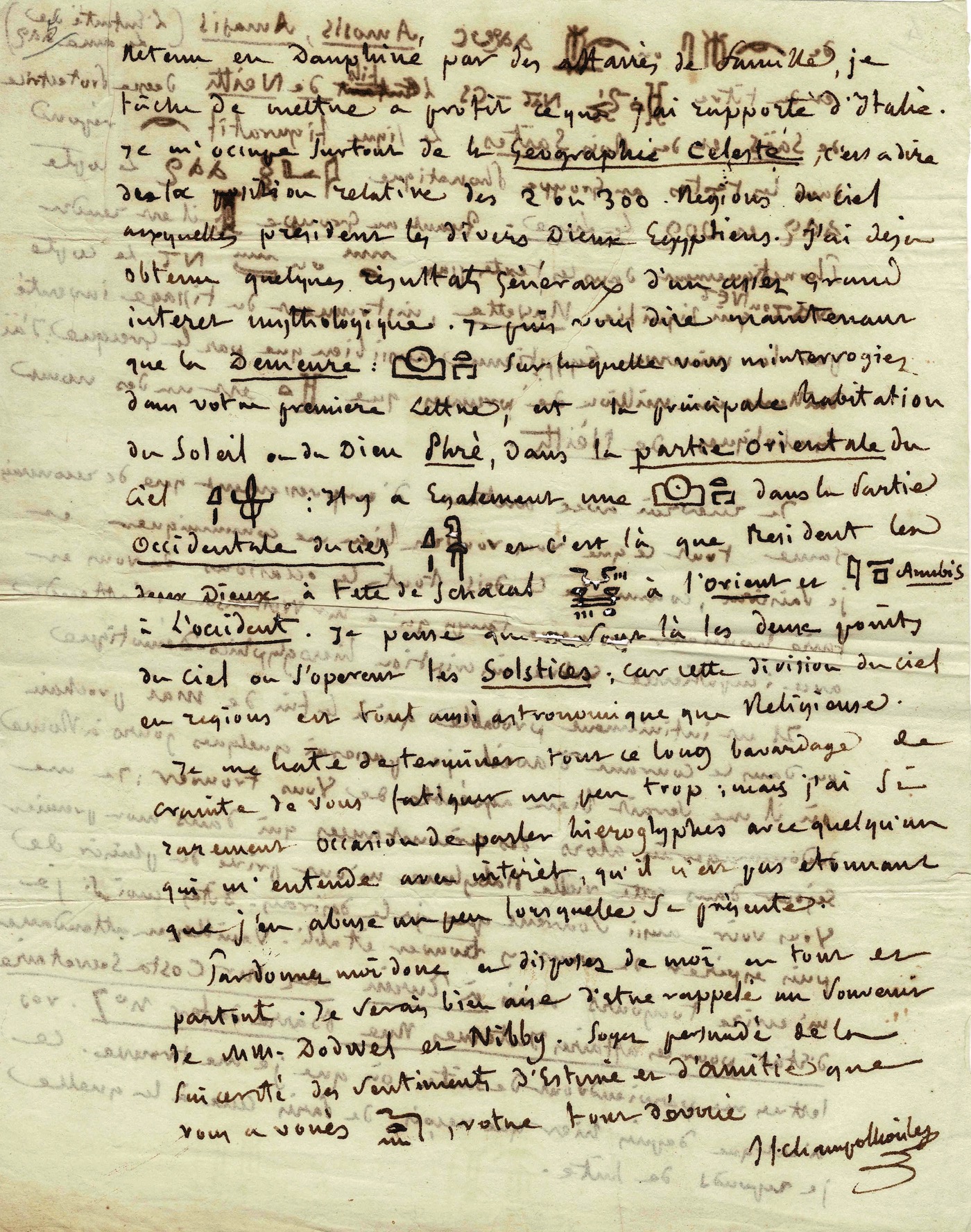
Five quarto pages illustrated with about thirty hieroglyphic inscriptions.
Autographed address and postal markings. Unpublished letter.
Grenoble, January 4, 1826.
“…I so rarely have the opportunity to discuss hieroglyphs with someone who listens with interest…”
An extraordinary and lengthy letter from the father of Egyptology – previously unpublished – to the archaeologist William Gell, enthusiastically deciphering all the hieroglyphic inscriptions entrusted to his analysis.
____________________________________________________
Life, health, and strength to my (beloved) friend Gell, beloved of the gods
My dear and obliging friend, I have a thousand thanks to give you for the good things you keep sending me ; so do not be surprised if I find your letters too rare and too short, and especially if I curse your bad head which makes you forget them for two whole months on your desk: in the name of Osiris, and of Amun-Ra if need be, have a little more memory and I will be certain to have much more pleasure : Forgive me, moreover, this little grain of selfishness, for it is you who give birth to it by filling me with hieroglyphic riches.
The small inscription in the Chamber of Osiris at Philae (1) means, I believe, this is the Goddess Isis beside her deceased Senufra brother, Lord of the region of Sanemt (2) , if the words [Hieroglyphs] are correct; which I somewhat doubt, having never encountered a similar regional name in the numerous texts I have consulted. I also don't know what to make of the group [H] after [H] ( her brother ). Perhaps there is an omission, and it was meant to express that the goddess Isis was standing near the feet of her brother Osiris-Senufra. The cartouche [H] is simply a variant of [H] (3) Senufra ; the homophone [H] for [H] .
The inscription of Ibsamboul (4) truly charmed me; I would like to know on which part of the monument it is located: it would be precious if it were the date of the dedication of the entire monument; here is what I can glean from it despite some series of indecisive characters: In the year XXXV, of the month of Tabi the 13th under the presidency (I correct [H]) of the powerful Aroeris friend of Ammon of the lord of the Panegyries like his father the God Phtha ……, of the preserver of the land (I read [H]) …… of the lord of above and below , of the child of the gods …… of the great possessor of the years the King guardian of the earthly world (sun guardian of the truth approved by the sun) son of the sun manifested in (the rest is missing).
It is therefore highly desirable to have the continuation of this inscription, which may be of great historical importance ; and it would be good to encourage Mr. Wilkinson to obtain a complete copy of it. I also ask you to recommend to him, if there is still time or if he is able, that he have a wet paper of an enormous hieroglyphic inscription engraved on a massive block between two pillars of the great temple of Ibsamboul (5) . From what I have been told, it must be an extremely curious text. It would also be important to copy the cartouches of the smaller rooms of the same temple. Also recommend that he copy the obelisk of Begyg near Medinet el-Fayoum (6) as well as those of the ruins of San (Tanis). The King who founded the temple of Bet-el-Wayléh (7) which I already know under the name of Bet-Wally , is indeed [H] (8) The Sun guardian of Truth, the son of the Sun, beloved of Ammon Ramses i.e. Ramses II e , the 4th predecessor of Ramses-the-Great-Sesostris.
The king named at Semné [H] (9) Sun lord of the region of Lal (or of strength), is the last king of the legitimate XVII dynasty whose proper name which I found in the hieratic papyri is [H] (10) ( [H] ) the Amosis of the Greeks, he who drove out the shepherds, the father of Amenowtep chief of the XVIIIth .
The other kings named in the same inscription (which I would be very interested to know if you have it in its entirety) are: 1) [H] (11) Thutmose II , great-grandson of Ahmose; 2) the other one you indicate to me only by the incomplete cartouche [H] must be either his predecessor or his successor. Moreover, the temple of Semne is one of the oldest temples in Egypt and Nubia: it is dedicated to the Nile god and to King Osortasen [H] (12) of the 17th Dynasty , great-grandfather of King Ahmose, the father of the entire 18th Dynasty .
The legend of the daughter of the royal king, principal wife [H] (13) copied at Sebouâ (14) is completely unknown to me, I presume that it is inaccurate: it is probably the name of Berenice -Evergete I : but I would not dare to assure it, I am confused by the two B [H] (BB) and by the final [H] [H] characters in the middle of this name.
The cartouches from the Adytum of Dakke (15) , those of King Arkemen (or Argemen), ever-living, beloved of Isis, whose life Ammon tasted, have been my despair for four years. I know not to whom to attribute them except to a king of Ethiopia named Ergamenes by Diodorus Siculus: but was this Ergamenes (16) King of Nubia ? That is what must be decided. [H] is an abbreviated synonym of [H] approved by the sun , very common on scarabs. You would do me the greatest favor by sharing with me all that you have of the great Ptolemaic inscription from year XXIV at Philae.
I believe that the sign [H], abbreviation of the group [H] , or (gap), expresses Nubia , the land above the cataracts; I find the title [H] , which is (worshipped) in Nubia , given only to the gods of the temples of that land. It is a purely local title, like those of [H] which is in Manlak at Philaeus, [H] which is in Sne at Esne, [H] which is in Pselk at Dakke (ancient Pselcis), etc., etc.
The inscription from the temple of Aesculapius at Philae would interest me greatly if you had it in its entirety: what you have been kind enough to communicate to me contains only the titles of the King, without the name of the god which must be [H] Imouthoh son of Phtah , as I see from a portion of this same inscription engraved in Mr Salt's book.
I am absolutely certain of the royal name of Pharaoh Amasis or Amosis of the 26th Saite Dynasty : his proper name is written [H] or abbreviated [H] and is composed of [H] or [H] Amosis , Amasis (the child of the moon [H] ) and the title [H] the son of Neith, the protective goddess of Sais Saite kings . The figurative sign [H] corresponds in the texts to the phonetic group [H] in the Coptic [H] for Moon . As for the group [H], it is rendered phonetically in the texts as [H] or [H] NT, the Coptic [H] or [H] which means Shuttle , a weaving tool invented by Minerva, both Egyptian and Greek. Moreover, I have a million pieces of evidence that [H] is one of the symbolic names of Neith .
I will receive with both eagerness and gratitude anything you wish to communicate to me, and I will seize, as I should, every opportunity to honor you as well as Mr. Wilkinson. I eagerly await your hieroglyphic-demotic inscription.
It is highly probable that at the end of May or during April I will spend a few days in Rome, where I would be delighted to find you. I would then be able to make up for the circumstances that, during my first stay in that ancient Babylon, deprived me of the pleasure of seeing you as often as I wished. Please tell me if I can hope to find you settled there. In the meantime, please continue to write to me, but at Turin, to Mr. Costa, Secretary of State for Internal Affairs, 7 rue Barre de Fer . Your letters will reach me promptly, wherever I may be. It is only since yesterday that I have received the one from Paris to which I am replying immediately.
Detained in Dauphiné by family matters, I am trying to make good use of what I brought back from Italy. I am mainly concerned with celestial geography, that is to say, the relative position of the 200 or 300 regions of the sky presided over by the various Egyptian gods. I have already obtained some general results of considerable mythological interest. I can now tell you that the House [ H] about which you inquired in your first letter is the principal dwelling place of the Sun or of the god Phre , in the eastern part of the sky [H] : there is also a [H] in the western part of the sky [H] , and it is there that the two jackal-headed gods reside: [H] in the East and [H] Anubis in the West . I believe that these are the two points in the sky where the solstices : for this division of the sky into regions is as much astronomical as religious.
I hasten to finish all this long chatter for fear of tiring you a little too much: but I so rarely have the opportunity to talk hieroglyphs with someone who listens to me with interest , that it is not surprising that I abuse it a little when it presents itself.
Forgive me then, and dispose of me in all things and everywhere. I would be glad to be remembered by Messrs. Dodwell (17) and Nibby (18) . Be assured of the sincerity of the feelings of esteem and friendship that [H] (19) , your most devoted JF Champollion the young .
____________________________________________________
"I've got this!"
On September 14, 1822, Champollion, overcome with enthusiasm, announced to his brother Jacques-Joseph that, after fifteen years of research, he had deciphered the hieroglyphic system. His certainty was unshakeable and led him to present, immediately afterward, to the Academy of Inscriptions and Belles-Lettres, on September 27, the foundational text of his discovery: Letter to Mr. Dacier relating to the alphabet of phonetic hieroglyphs used by the Egyptians to inscribe on their monuments the titles, names and surnames of Greek and Roman sovereigns .
Champollion was no longer in doubt; nevertheless, his discoveries needed to be tested. To this end, he visited the Turin Museum in 1824, which had just acquired the collection of Egyptian antiquities belonging to the French consul Bernardino Drovetti. During this first stay in Italy, after spending several months in Turin, Champollion decided to continue his journey and travel to Rome.
In a letter dated May 3, 1825, he informed his elder brother of his meetings: " The Dukes of Blacas and Montmorency put me in contact with all the distinguished scholars here. I received a very special welcome from Monsignor Maï, Professor Nibbi, Monsignor Testa, and the excellent Mr. Cancellieri. I saw Mr. Dodwell, the famous traveler in Greece, and Sir Gell, an amateur hieroglyphist, as amiable as he was learned. "
It was in Rome, through the Duke of Blacas d'Aulps, his patron, that Champollion met the British archaeologist William Gell (1777-1836). Gell, a friend of the English Egyptologist Thomas Young, Walter Scott, and Lord Byron, was passionate about Egyptian hieroglyphs. Having become friendly with Champollion, Gell shared with him valuable inscriptions recorded and copied at Karnak by his compatriots Wilkinson and Cooper, who had traveled throughout Egypt from 1821 onwards, as Champollion explained to his brother in a letter dated May 22, 1825: “ Chevalier Gell has given me some large hieroglyphic inscriptions copied at Karnak by an Englishman named Wilkinson. They relate to offerings made to the gods and are dated to various years of Kings Sesonchis and Takellothis of the 22nd Dynasty.” I made copies of them despite the numerous flaws they contain.
During his first trip to Italy, Champollion went to Livorno in July 1825 to appraise the Salt collection, which was being sold by the Santoni bankers. This collection would later be acquired by France and displayed at the Louvre Museum. (To oversee the shipment of the Salt collection, Champollion would return to Italy a second time in 1826.)
On January 4, 1826, from Grenoble, upon returning from his first trip to Italy, Champollion wrote this long and enthusiastic letter to Gell in response to the latter's letter. In this missive, which has remained unknown to this day, Gell had sent transcriptions and copies of Egyptian inscriptions. The hieroglyphic texts analyzed here by Champollion, with Gell's assistance, come primarily from southern Egypt and northern Sudan and contain royal formulas and cartouches of kings of foreign origin.
Champollion also expressed his desire to have access to the text of Ptah's decree displayed in the great temple of Abu Simbel: " It is therefore highly desirable to have the continuation of this inscription, which may be of great importance for history; and it would be good to encourage Mr. Wilkinson to obtain a complete copy of it. I also ask you to recommend to him, if there is still time or if it is possible, to have a wet paper of an enormous hieroglyphic inscription engraved on a massive block between two pillars of the great temple of Ibsamboul." He studied it with his own eyes during his only trip to Egypt in 1828 and 1829.
Finally, aware of the celestial connections of Egyptian inscriptions, Champollion asked Gell for surveys of the ceilings and walls of temples and tombs containing representations of the sky, decans, and signs of the zodiac. (" I am mainly concerned with celestial geography , that is to say, the relative position of the 200 or 300 regions of the sky presided over by the various Egyptian gods." )
____________________________________________________
Bibliography:
Champollion, a life of enlightenment , Jean Lacouture, Grasset, 1988
The Harvest of the Gods , Jean-Jacques Fiechter, Julliard, 1994
Ancient Egypt at the Louvre , Andreux, Rutschowscaya, Ziegler, Hachette, 1997
Descriptive notice of the Egyptian Monuments of the Charles X Museum , Champollion.
Champollion, the scholar deciphered, Alain Faure, Fayard, 2020.
The Salt collection arrives in Paris. Marie Grillot.
François Artaud and the Champollion brothers , by Karine Madrigal.
____________________________________________________
(1) Following Bonaparte's scholars, Champollion called a small chapel dedicated to the god Osiris, located on the roof of the temple of Philae, the "chamber of Osiris".
(2) Probably Snem, the island of Biggeh, located next to Philae. Osirian legend says that Osiris's leg was buried on the island of Biggeh.
(3) Cartouche "Ounnefer". One of the names of the god Osiris, meaning "perfect being". The god's regnal name on earth (Osiris is considered one of the first Egyptian kings).
(4) Abu Simbel.
(5) This is probably the stele bearing the decree of Ptah.
(6) Champollion was familiar with this obelisk, notably through the plates in his Description of Egypt. Drawings of this obelisk are found among the papers of Nestor L'Hôte, one of the "Argonauts" on Champollion's expedition to Egypt. https://gallica.bnf.fr/ark:/12148/btv1b525045086/f687.image
(7) Temple of Beit el Ouali dedicated to Amun. Nubian temple, south of the Aswan Dam, erected at the beginning of the reign of Ramses II.
(8) Cartouches of Ramses II.
(9) Coronation name of King Ahmose, first king of the 18th Dynasty .
(10) Cartouche, birth name of King Ahmose.
(11) Cartouche bearing the coronation name of Thutmose II.
(12) Left cartouche: coronation name of King Sesostris III of the 12th Dynasty . Right cartouche: name of Sesostris III's son, Ra.
(13) Cartouche of Princess Bentanat, daughter of Ramses II.
(14) The temple of Wadi es-Sebua was built between the 35th and 50th years of the reign of Ramses II. Alongside the representations of the king is depicted his Great Royal Wife, Bentanat (Ramses having married his own daughter). Champollion is correct about the copy of the cartouche, which is inaccurate.
(15) Temple of Dakka in Sudan.
(16) Ergamene of Diodorus Siculus is the Nubian king Arkamani or Arkamaniqo, contemporary of Ptolemy II.
(17) Edward Dodwell (1767-1832): archaeologist, traveler, draftsman, painter.
(18) Antonio Nibby (1792-1839): historian, professor of archaeology at the University of Rome.
(19) Djet = eternally