Alexander Graham BELL / Alfred NIAUDET
The invention of the telephone and its first demonstration in France in 1877.
"You will have seen from the small printed materials of the Physical Society, which I had the pleasure of showing there on November 2nd last, the first two telephones that were introduced in France."
One of the most prodigious inventions in human history, told by two of its key figures: Alfred Niaudet and Alexander Graham Bell.
__________________________________________________________________
An extraordinary collection of two signed autograph letters relating to the revolutionary work of Alexander Graham Bell and the first use of the telephone in France, in Paris, in November 1877.
In August 1877, at the request of the illustrious British scientist Sir William Thomson, Alexander Graham Bell was invited to present his invention at the annual meeting of the British Association for the Advancement of Sciences in Plymouth. Among the audience, the physicist Alfred Niaudet, a collaborator of Antoine Breguet, was captivated by Bell's invention and easily convinced the latter to entrust him with two telephones to demonstrate in Paris, at the Academy of Sciences and the French Physical Society.
A year earlier, at the Centennial Exposition of American Independence in Philadelphia in June 1876, Alexander Graham Bell unveiled his invention to the astonishment of Emperor Dom Pedro II of Brazil and Sir William Thomson. The revolution had begun, and the inventor was inundated with requests for lectures.
We present here two letters, testimonies of this exceptional adventure.
The first was written by Alfred Niaudet on November 8, 1877, a few days after the first demonstration of a telephone in France; the second was written by Alexander Graham Bell the following day, November 9, to Alfred Niaudet.
We are also including the original booklet (10 pages in-8°) published by the Society of Civil Engineers, giving an extract of the Session of December 2, 1877, and of the communication by Alfred Niaudet on telephones.
__________________________________________________________________
Alfred NIAUDET (1835- 1883)
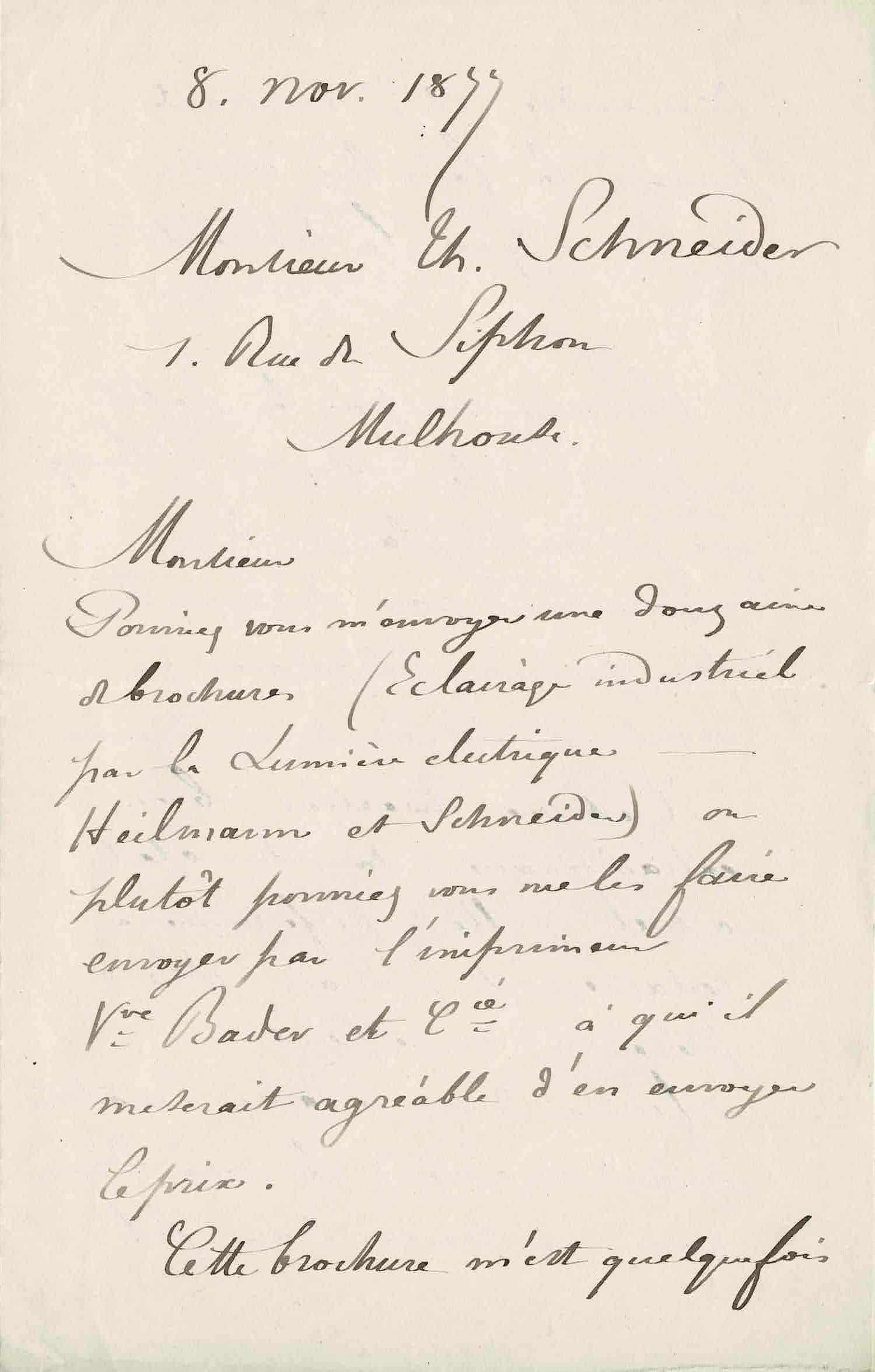
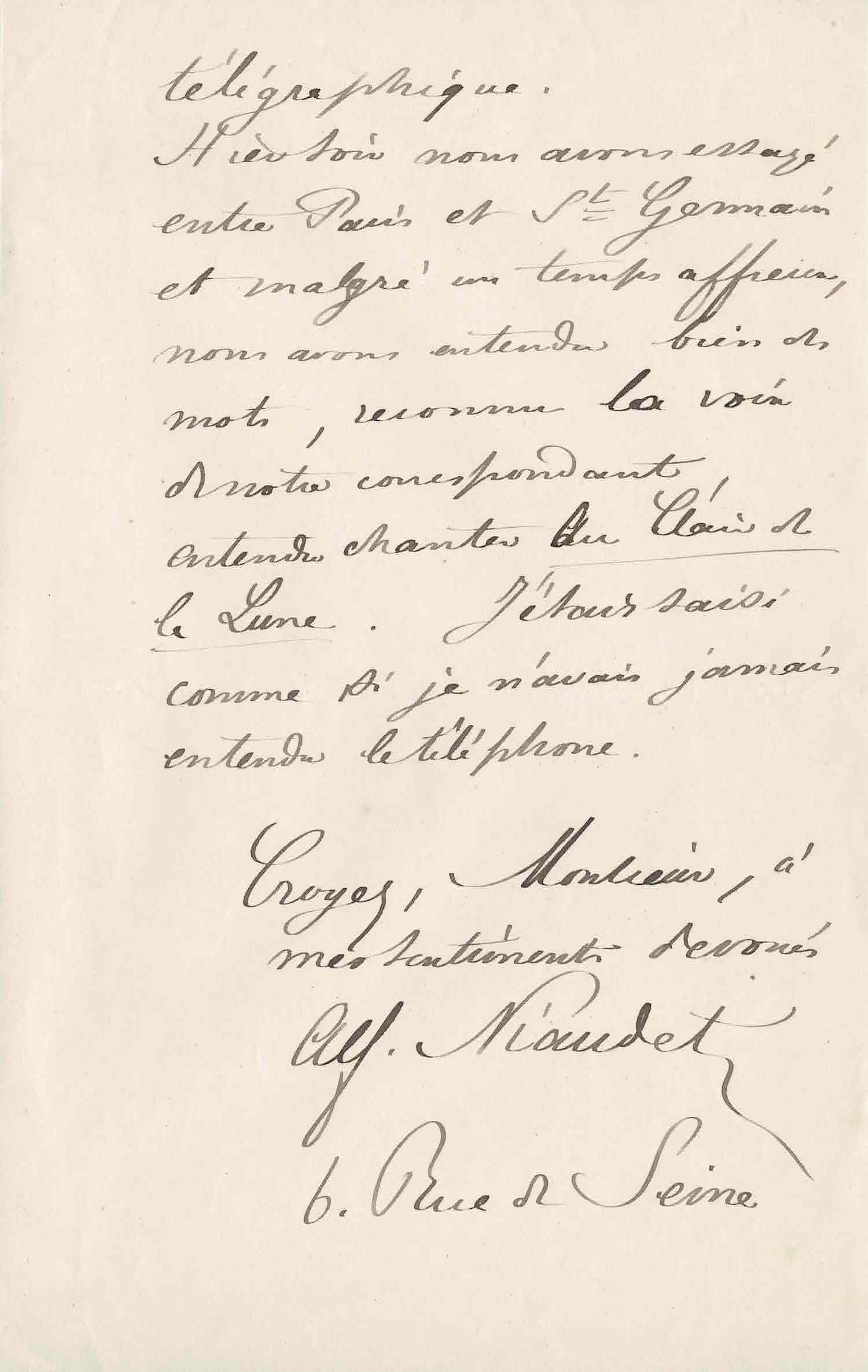
Autographed letter signed to the physicist Théodore Schneider.
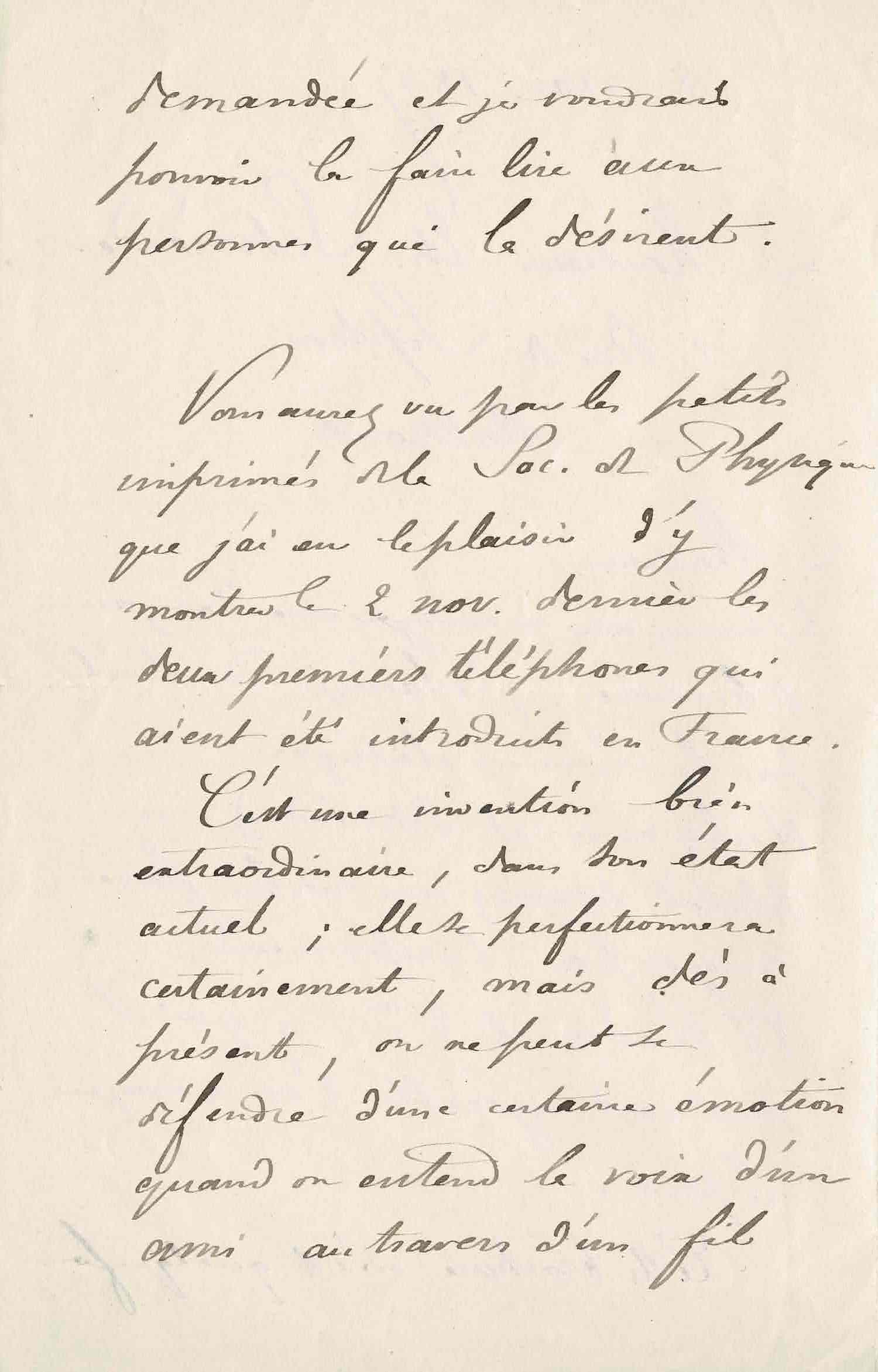
Three pages in-8°. [Paris] November 8, 1877.
"It's a truly extraordinary invention."
"Sir, Could you please send me a dozen brochures (industrial lighting using electric light – Heilmann and Schneider), or rather, could you have them sent to me by the printer Vve Bader et Cie, to whom I would be pleased to send the price? This brochure is sometimes requested of me, and I would like to be able to make it available to those who wish to read it.".
You will have seen from the small prints of the Soc. de Physique that I had the pleasure of showing there on November 2nd, the first two telephones that were introduced in France.
It is a truly extraordinary invention in its present state; it will certainly be perfected, but even now, one cannot help but feel a certain emotion when one hears the voice of a friend through a telegraph wire.
Last night, we tried calling between Paris and Saint-Germain, and despite the dreadful weather, we heard many words, recognized our correspondent's voice, and heard " Au Clair de la Lune" . I was as if I had never heard the telephone before. Believe me, sir, in my devoted sentiments. Alf. Niaudet, 6 rue de Seine.
__________________________________________________________________
Alexander Graham Bell (1847- 1922)
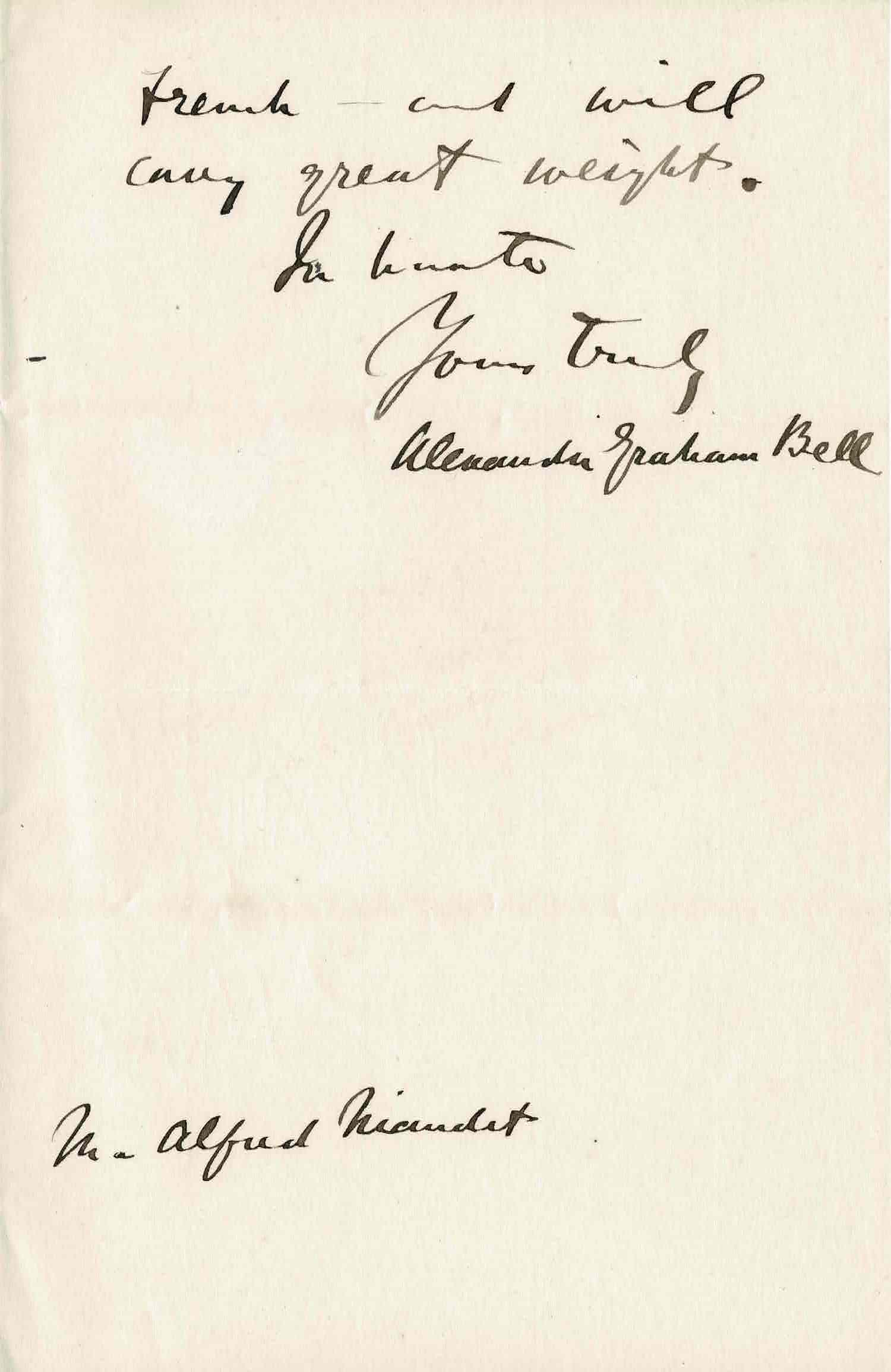
Autographed letter signed to Alfred Niaudet.
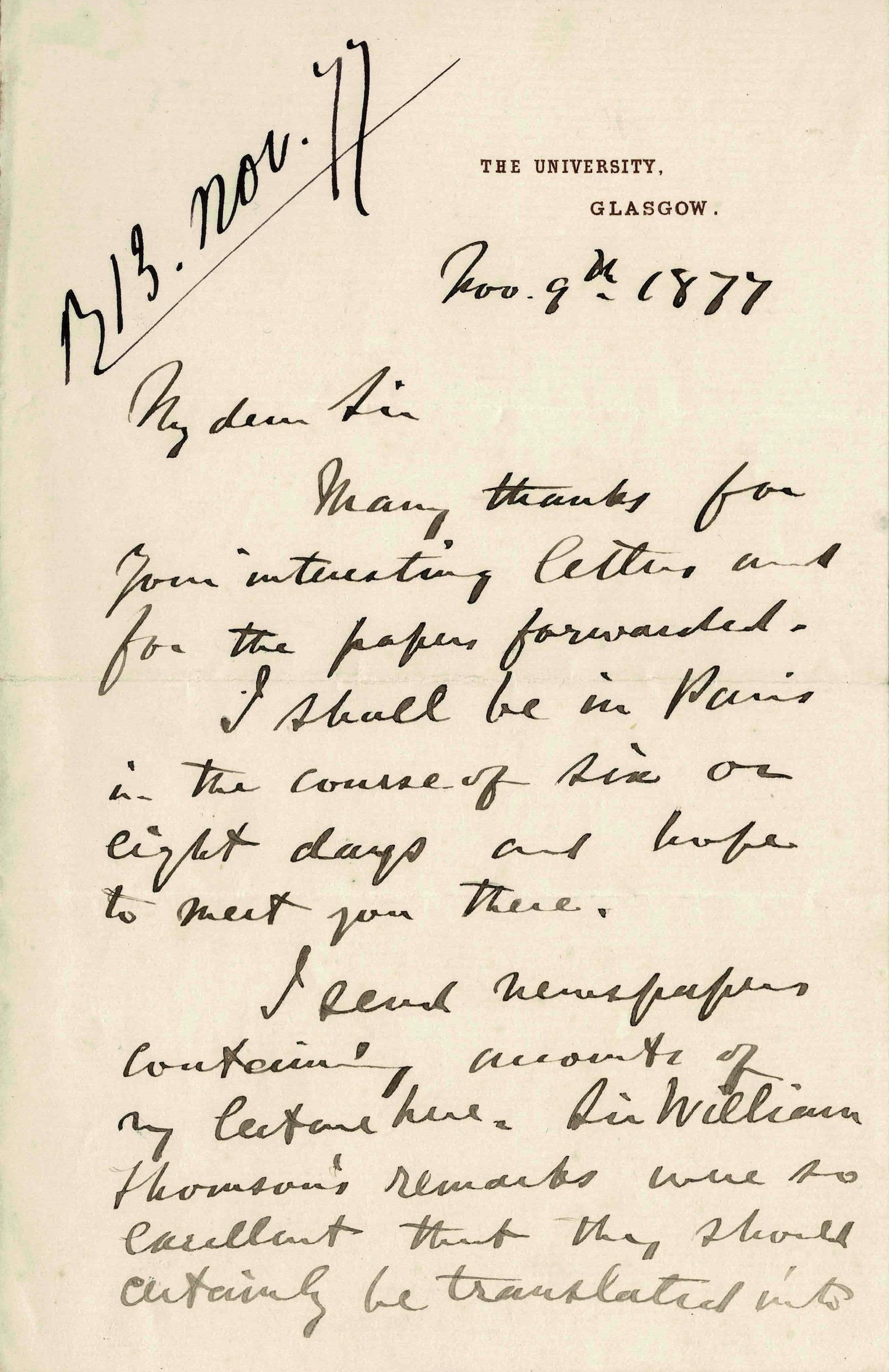
Two pages in-12° on University of Glasgow letterhead.
[Glasgow] November 9, 1877.
Niaudet's annotation at the top indicates that he replied on November 13, 1877.
“Sir William Thomson's remarks were so excellent that they […] will carry great weight.”
“My dear Sir, many thanks for your interesting letter, and for the papers forwarded. I shall be in Paris in the course of six or eight days and hope to meet you there. I send newspaper containing accounts of my lecture here. Sir William Thomson's remarks were so excellent that they should certainly be translated into French– and will carry great weight. In haste. Yours truly. Alexander Graham Bell.”
French transcription:
“Dear Sir, thank you most sincerely for your interesting letter and for the newspapers you sent me. I will be in Paris for six to eight days and hope to meet you there. I am sending you a newspaper containing the proceedings of my lecture here. Sir William Thomson’s remarks were so brilliant that they should certainly be translated into French – and will carry great weight. Hastening, yours sincerely, Alexander Graham Bell.”
__________________________________________________________________
Although today the collective unconscious only remembers Alexander Graham Bell as the inventor of the telephone, this societal revolution was a human adventure with several factors and the real paternity of the invention still gives rise to many controversies today.
The Frenchman Charles Bourseul (1829-1912) appears to have been the first – in an article entitled Electrical Transmission of Speech, published in L'Illustration on August 26, 1854 – to propose a mechanism capable of transmitting the voice over a distance via an electric wire.
the German scientist Johann Philipp Reis (1835-1874) developed a device which he named "telephone" and which allowed – although very imperfectly – the transmission of sounds and voice over a distance, thanks to an electric current.
It was the Italian-American Antoni Meucci (1808-1889) who first filed a descriptive patent for a telephone device in December 1870. Not having the financial means to extend the said patent, Meucci let it expire in 1874 and a certain Alexander Graham Bell filed it in turn, improved, in 1876.
Meucci's major influence in the history of the telephone was officially validated by the United States House of Representatives on June 11, 2002, which recognized in its resolution No. 269 that " if Meucci had been able to pay the $10 fee to maintain his patent promise after 1874, no patent could have been issued to Bell " and thus making Meucci an official inventor of the telephone.
Another key figure in this saga was the inventor Elisha Gray (1835-1901), who filed a patent application with the U.S. Institute of Industrial Property for an invention concerning " the electrical transmission and reception of the human voice " on February 14, 1876, just hours after Graham Bell. Bell's patent was reportedly examined immediately at the request of his lawyer, while Gray's was not reviewed until the following day. Despite numerous lawsuits, Gray was unable to establish the priority of his work.
Finally, it was David Hughes and Thomas Edison who, from 1877 onwards, proposed the most significant developments in microphone technology (Edison had developed, in 1877, the first device capable of recording and reproducing sounds: the phonograph).
“Mister Watson, come here, I want to see you!”
"Mr. Watson, come in, I want to see you!" This is what history remembers as the first words exchanged, from one room to another, by Bell with his assistant Thomas Watson (1854-1934). The voice coming from a reel connected by two wires launched an extraordinary scientific revolution, still ongoing nearly 150 years later.
__________________________________________________________________
Bibliography: Alexander Graham Bell. Jean-Serge Bernault.