The erotic influence of the Marquis de Sade according to André Malraux. 1969.
"The fact remains that all sadism – and Sade himself demonstrates this better than Laclos – seems to be the delusional desire for an impossible possession."
Sold

"The fact remains that all sadism – and Sade himself demonstrates this better than Laclos – seems to be the delusional desire for an impossible possession."
Sold
André Malraux (1901.1976)
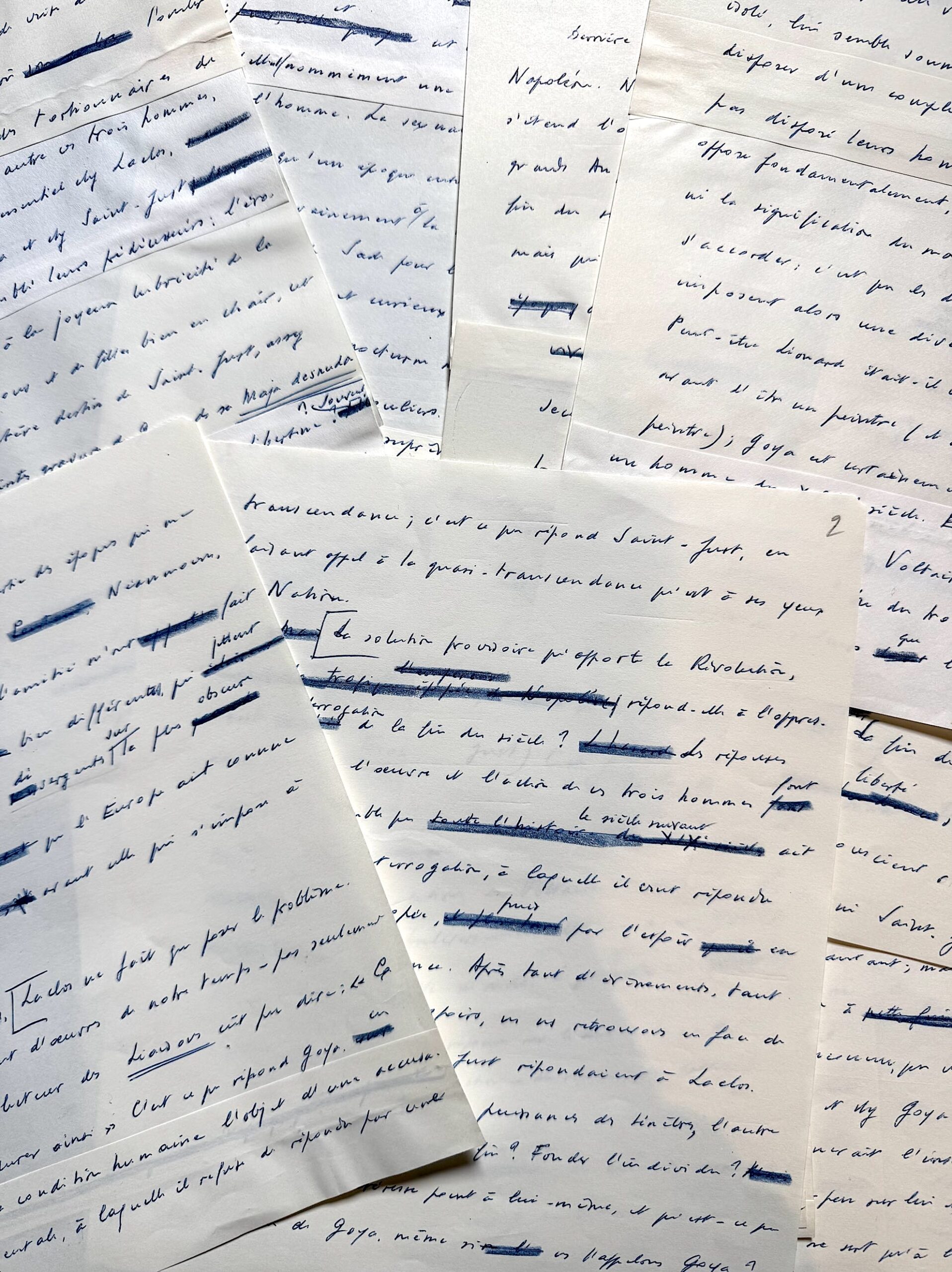
Autograph manuscript – The Black Triangle. 1969.
Fourteen quarto pages with cutouts and montages.
We are attaching the corrected typescript (eight pages), with numerous handwritten corrections and additions, and revisions by pasting.
"The fact remains that all sadism – and Sade himself demonstrates this better than Laclos – seems to be the delusional desire for an impossible possession."
A remarkable first draft manuscript, constituting the preface to his work Le Triangle noir , published by Gallimard in 1970, and including three texts published in 1939, 1947 and 1954, on Pierre Choderlos de Laclos, Francisco de Goya and Louis-Antoine de Saint-Just.
Malraux puts the fate of these three 18th-century figures into perspective by what, according to him, unites them: eroticism and the influence of the divine Marquis de Sade.
__________________________________________
" Does the end of the 18th century belong to the periods that hold my attention? It doesn't seem so. Nevertheless, in thirty years, chance and friendship have led me to reflect on three very different figures who cast their divergent lights on the most obscure crisis of the individual that Europe had known before the one that is now upon us.
Laclos merely poses the problem. As with so many works of our time—not only literary ones—the reader of Les Liaisons dangereuses might have said, “This cannot go on.” This is Goya’s response, making the human condition the object of a fundamental accusation , to which he refuses to respond with transcendence; this is Saint-Just’s response, appealing to the quasi-transcendence that, in his eyes, the Nation represents. And after so many events, so many deaths, so many hopes, we find ourselves confronted with what Goya and Saint-Just answered to Laclos.
[…] Behind Saint-Just, it seems that the shadow of Napoleon rises. We shall see that this is debatable. Before Goya, the shadow of Sade extends . There is an 18th century that stretches from the great English and French figures to Napoleon; and a semi-clandestine fin de siècle, which goes nowhere but which calls humanity into question. […] Perhaps Leonardo was a master of the Renaissance before being a painter (and he was not only a painter); Goya is certainly a painter before being a man of the 18th century. And which 18th century? The one of Montesquieu, Voltaire, and Rousseau, of the Reason they proclaimed?
However foreign these three men may be to one another, they share a domain essential in Laclos, strangely accidental in Goya and Saint-Just, and which would not have united their predecessors: eroticism. This eroticism, so foreign to the joyful lust of the Renaissance, a battle of pillows and voluptuous women, this intrusive eroticism in the austere destiny of Saint-Just, quite sadistic in Les Liaisons dangereuses, in many of Goya's engravings, in his Maja Desnuda about to be raped…
A legacy of libertine literature? Often, it was not itself without sadism : When it was, what did it have in common with Goya? This eroticism would not be worth dwelling on if it were merely a continuation of bawdiness; but it is the eroticism of which Sade would write the rhetorical, manic epic, and which had no precedent. Now, eroticism poses to the individual the questions posed by any intoxication; and this particular eroticism poses those which, in Sade, explicitly call for an eternal questioning of God, and therefore of man.
Sexuality is too profound a domain for an entire era, across almost all of Europe, to vainly link it to cruelty, or at least to coercion. Sade's efforts to legitimize eroticism through Reason are comical and curious ; Goya's attempts to legitimize his nocturnal world through Reason are not comical, but they are certainly singular. The fact remains that all sadism—and Sade himself demonstrates this better than Laclos—seems to be the delusional will to an impossible possession.
If General de Laclos is ambitious in his own way, Goya finds wilder fodder to whip; and Saint-Just is ambitious only in the manner of Muhammad. It is beneath the vast net of ambition that the late 18th century extends its tentacles. It will never quite cover them, neither in Napoleon nor even in Balzac. The French Revolution, the wars of the Empire, the birth of "social individualism," have overshadowed many creations of the end of the century (not only in France) as if the witches of Goya, or even that of Laclos, were prophesying Austerlitz and the Council of State; but Romanticism will rediscover these witches, and a century later, literary history will rediscover Sade
__________________________________________
We are also including 7 handwritten working notes: "The starting point of the preface to The Black Triangle is undoubtedly: a civilization that does not want to survive as a civilization is condemned to death. Goya and Laclos as witnesses, Saint-Just as a desperate attempt (of what?)."
Bibliography: Complete Works (Pléiade), vol. VI, pp. 525-529.