André Breton (1896.1966).
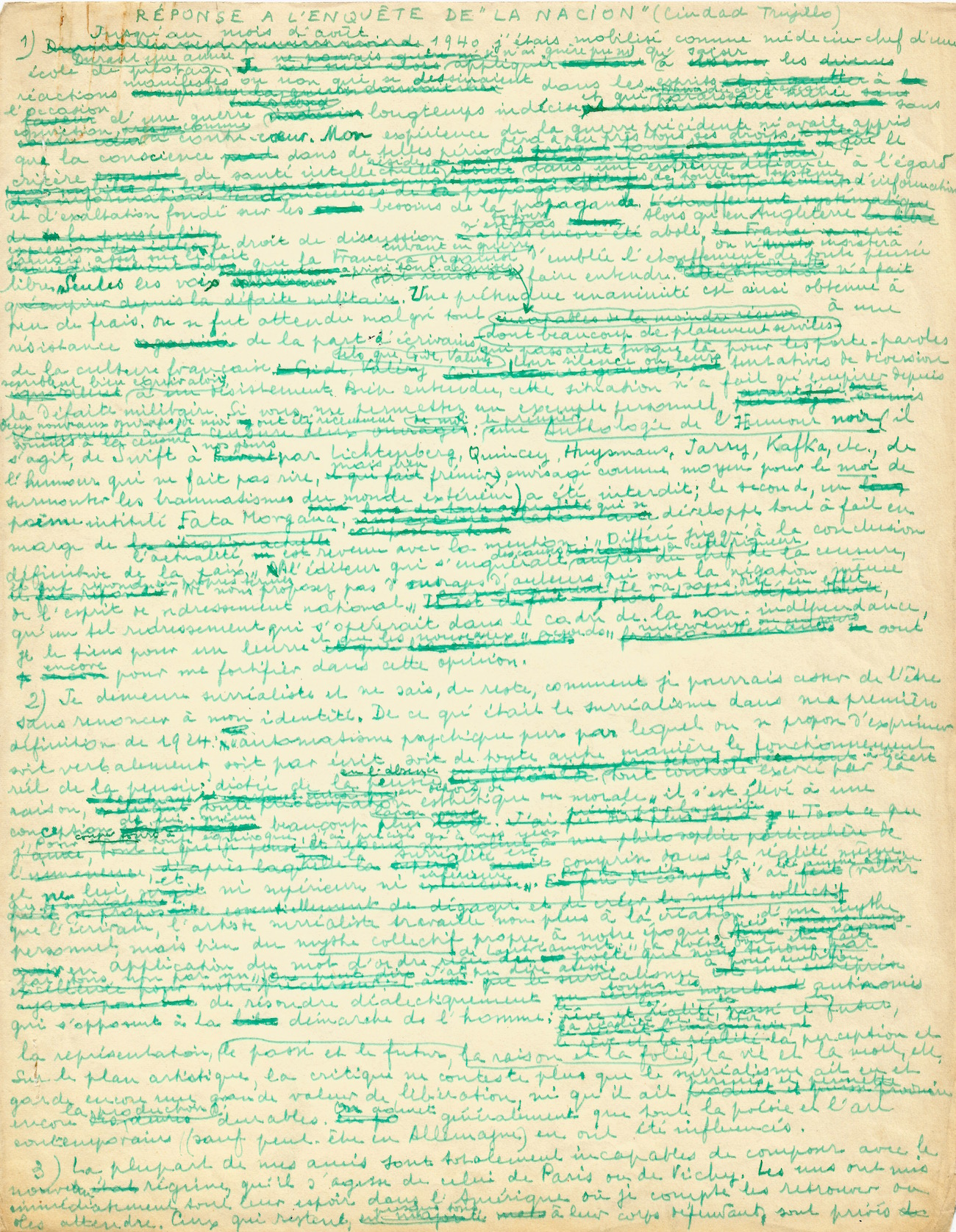
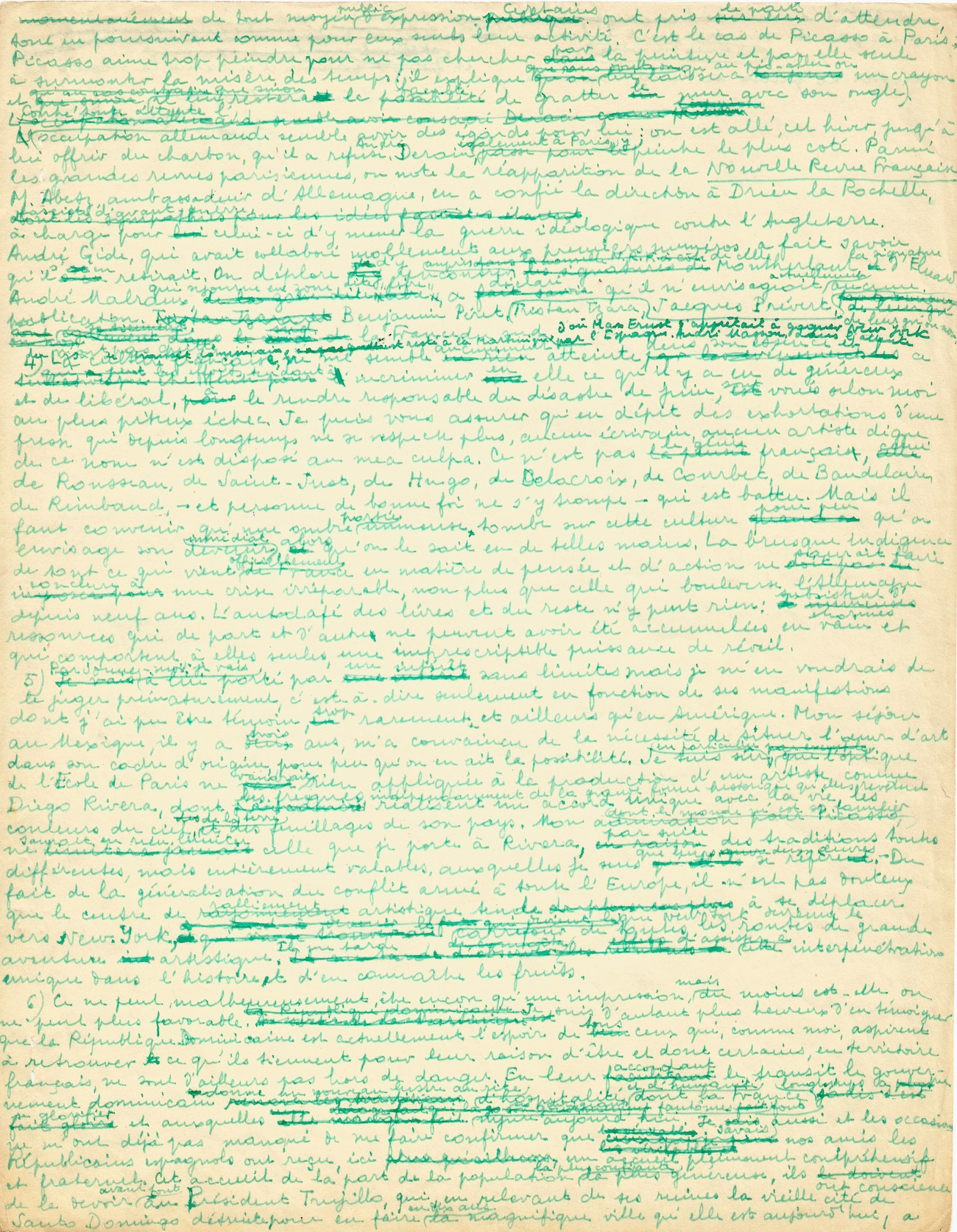
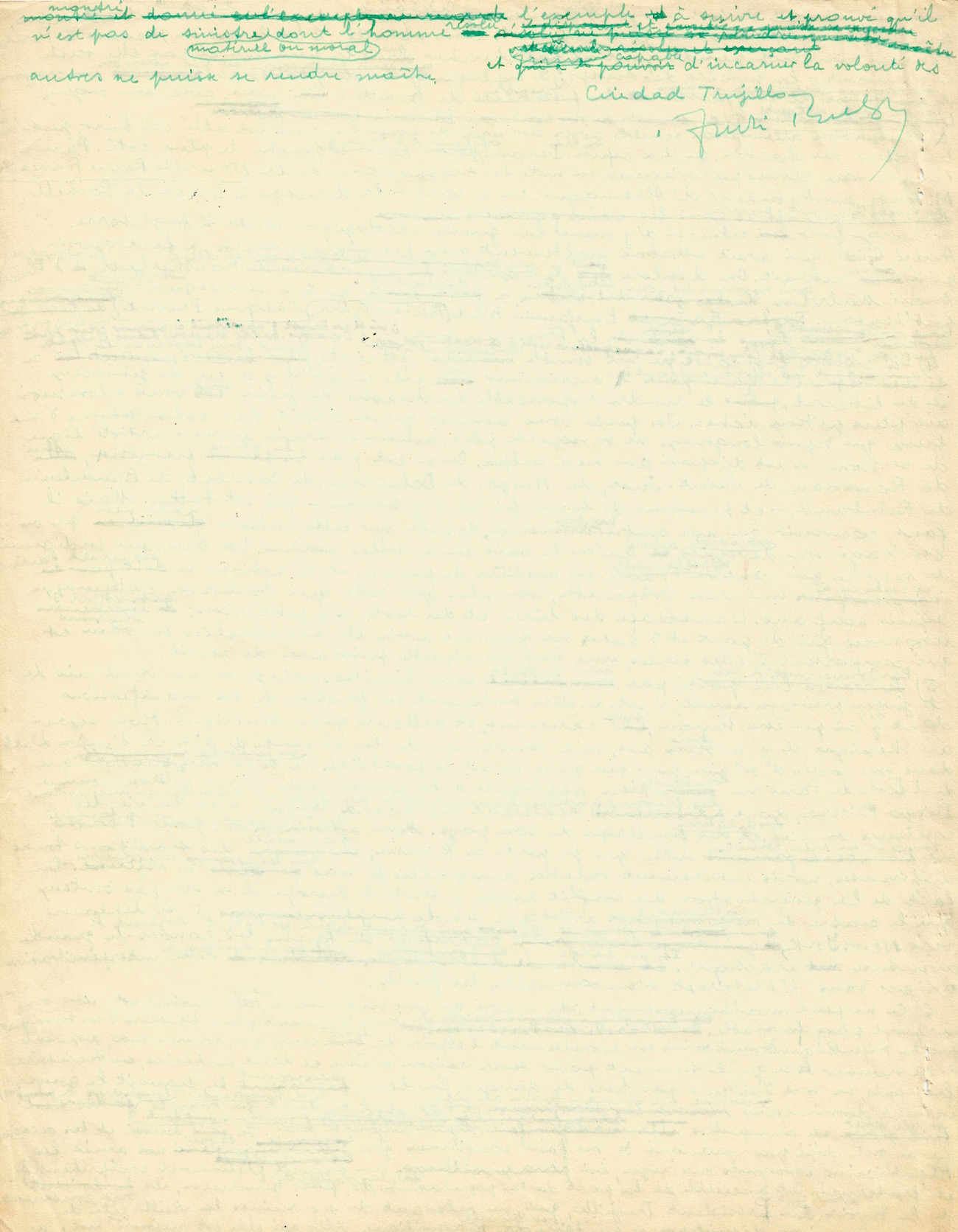
Autograph manuscript signed.
Two pages ¼ in-4° in green ink. Ciudad Trujillo (May 1941).
"I remain a surrealist and, moreover, don't know how I could cease to be one without renouncing my identity."
Important manuscript about the situation of the surrealist movement, and the artists who compose it, during the German occupation.
Breton analyzes the artistic situation arising from the first years of the war: Pablo Picasso takes refuge in his art while Prévert, Tzara, Péret struggle, and Max Ernst flees the country.
In discussing surrealism, Breton does not fail to offer a sharp, implicit criticism of Salvador Dali, who claimed to embody the movement in his own name.
He also testifies to his faith in the survival of French genius, citing Rousseau, Hugo, Delacroix, Baudelaire and Rimbaud, while prophesying an artistic migration to New York.
_________________________________________________
RESPONSE TO THE NACION INVESTIGATION (Ciudad Trujillo)
1) Until August 1940, I was mobilized as the chief medical officer of a flight school. For a year, I could do little more than observe the overt and covert reactions taking shape in people's minds during a war that had been indecisive for a long time and seemed to be waged without conviction and reluctantly. My experience in the previous war had taught me that conscience, in such times, loses almost all its rights. While in England the right to free speech was not abolished, it cannot be stressed enough that France, upon entering the war, immediately organized the suppression of all free thought. (…) One would have expected, despite everything, some resistance from writers such as Gide and Valéry, who until then had been considered the spokespeople for French culture. Their silence or attempts at diversion seemed tantamount to a withdrawal. Of course, this situation has only worsened since the military defeat. If you'll allow me a personal example, two new works have recently been censored. The first, an Anthology of Black Humor (from Swift to the present day, by Lichtenberg, Quincy, Huysmans, Jarry, Kafka, etc.; humor that doesn't make you laugh but rather makes you shudder, considered as a means for the self to overcome the traumas of the outside world), was banned; the second, a poem entitled Fata Morgana, which unfolds entirely outside the realm of current events, was returned with the note: "postponed until the final conclusion of peace"...
2) I remain a Surrealist and, moreover, do not know how I could cease to be one without renouncing my identity. From what Surrealism was in my first definition of 1924: pure psychic automatism by which one proposes to express, either verbally, in writing, or in any other way, the real functioning of thought dictated by thought outside of all control exercised by reason. Surrealism has risen to a much broader conception of itself (…) Surreality is contained within reality itself, and is neither superior nor inferior to it. I have been led to argue that the Surrealist writer, the artist, works not on the creation of a personal myth, but rather on the collective myth proper to our time, in application of Lautréamont's motto : “Poetry must be made by all, not by one.” “ I was also able to say that Surrealism aims to dialectically resolve all the antinomies that oppose the human endeavor: representation, past and future, reason and madness, life and death, etc. On an artistic level, critics no longer dispute that Surrealism had and still retains a great liberating value (…) It is generally accepted that all contemporary poetry and art (except perhaps in Germany) has been influenced by it.”
3) Most of my friends are completely unable to come to terms with the new regime, whether it be that of Paris or Vichy. Some immediately placed all their hopes in America, where I intend to find them or wait for them. Those who remain, almost all against their will, are deprived of any public means of expression. Some have chosen to wait while continuing their work as if it were for themselves alone. This is the case with Picasso in Paris. Picasso loves painting too much not to seek, through painting and painting alone, to overcome the misery of the times. He explains that, as a last resort, they will let him have a pencil, and if not, he will still have the option of scratching the wall with his fingernail. The German occupation seems to show him some consideration . This winter, they even went so far as to offer him coal, which he refused. André Derain, also in Paris, is considered the most highly regarded painter. Among the major Parisian journals, Nouvelle Revue Française has reappeared . Mr. Abetz, the German ambassador, entrusted its editorship to Drieu La Rochelle, tasking him with waging ideological warfare against England. André Gide, who had contributed half-heartedly to the first issues, announced his withdrawal. It was regrettable to find Éluard's signature alongside Montherlant's. André Malraux, residing in the so-called "free zone," declared that he was not currently planning any publications. Benjamin Péret, Jacques Prévert, and Tristan Tzara remained in southern France, from where Max Ernst was preparing to depart for New York.
4) French culture does not seem to me to be affected in its essence (…) I can assure you that, despite the exhortations of a press that has long since lost all self-respect , no writer, no artist worthy of the name, is inclined to admit their mistake. It is not the French genius—that of Rousseau, Saint-Just, Hugo, Delacroix, Courbet, Baudelaire, Rimbaud —and no one in good faith is mistaken about this— that is being defeated . But it must be admitted that a vast shadow falls over this culture if one considers its immediate future, knowing that it is in such hands. The sudden poverty of everything that officially comes from France in terms of thought and action cannot lead to the conclusion of an irreparable crisis, any more than the one that has been shaking Germany for the last nine years. The burning of books and other things is of no use : enormous resources remain which, on both sides, could not have been accumulated in vain…
5) My stay in Mexico three years ago convinced me of the necessity of situating a work of art within its original context, whenever possible. I am certain, in particular, that the perspective of the School of Paris would be worthless when applied to the work of an artist like Diego Rivera , whose murals, quite apart from their grand historical form, achieve a unique harmony with life, the colors of the sky, the earth, and the foliage of his country. My admiration for Picasso in no way diminishes my admiration for Rivera… Given the spread of armed conflict throughout Europe, there is no doubt that the center of artistic activity is shifting toward New York, that New York is becoming the crossroads of all paths of great artistic adventure. I eagerly anticipate witnessing this unique interpenetration in history and seeing its fruits .
6) Unfortunately, this can still only be an impression, but at least it is extremely favorable. I am all the more pleased to attest to this because the Dominican Republic is currently the hope of all those who, like me, aspire to rediscover what they consider their reason for being, and some of whom, even in French territory, are not out of danger (…) There is no disaster, material or moral, that a resolute person, capable of embodying the will of others, cannot overcome. ”
_________________________________________________
André Breton left Marseille on March 24, 1941, bound for New York. On his way, he stopped in Martinique, Guadeloupe, and then Ciudad Trujillo in the Dominican Republic, where he was interviewed by the Spanish painter Fernandez Granell. The interview was published in the Dominican newspaper La Nación on May 28, 1941.