
"Forgetting their sorrow, forgetting the coal, the girls will fly away to paradise."
30.000€
Serge Gainsbourg (1928.1991)
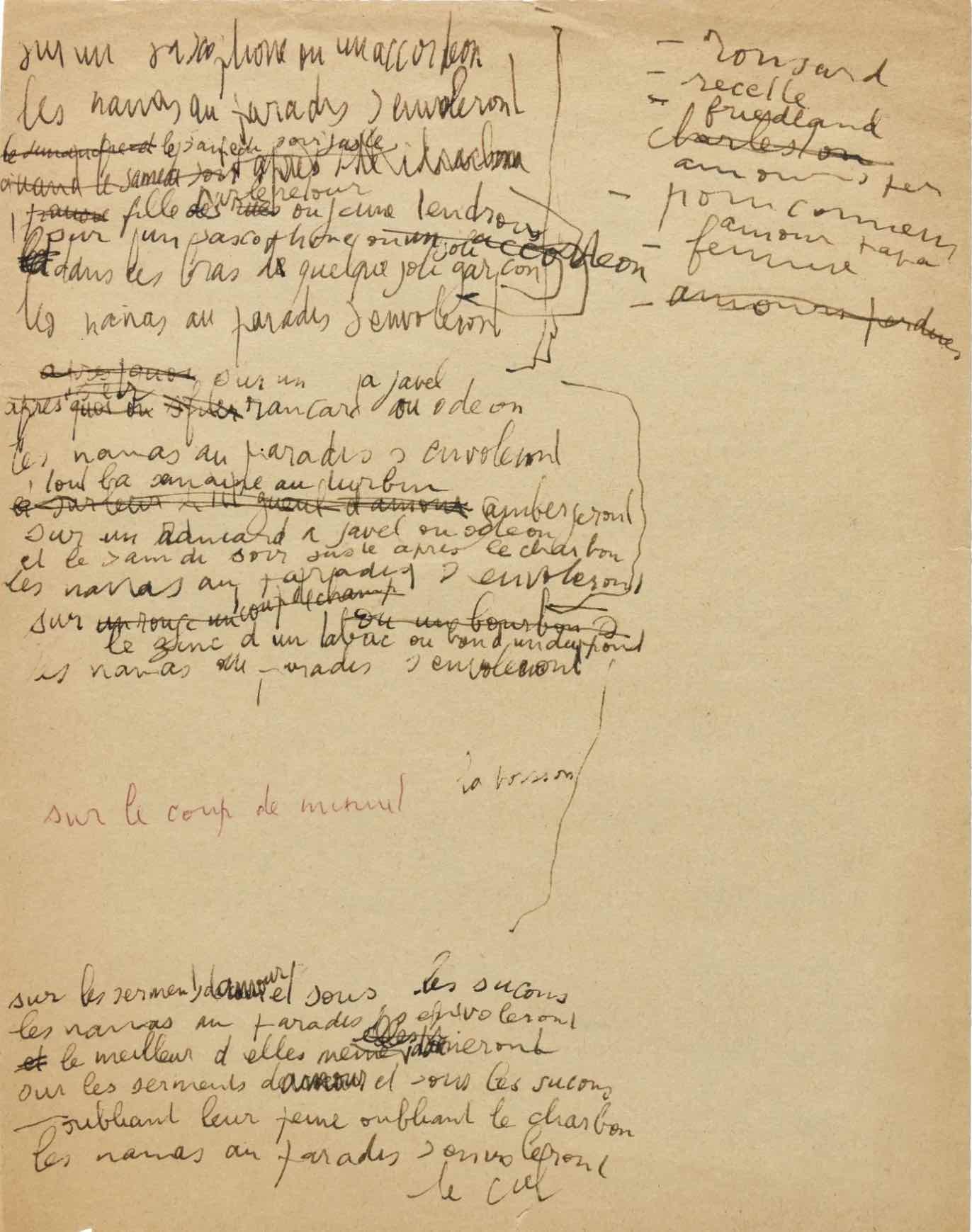
Autograph manuscript – The Nanas in Paradise.
A folio page on the back of a bifolium of the printed score of his song La nuit d'octobre , with an autograph note "do".
Slnd [Paris. November 1959]
"Forgetting their sorrow, forgetting the coal, the girls will fly away to paradise."
Gainsbourg wrote for Marlene Dietrich. Rare and precious early career manuscript, first draft, of this mythical song initially intended for the icon Marlene Dietrich, Les Nanas au paradis.
A highly polished preparatory version, consisting of about twenty lines with erasures, variants, and corrections. Many passages of the text were not retained in the version finally recorded by Catherine Sauvage in January 1960. The work remained unpublished for a long time, only being released commercially in 1996, after the author's death.
In the top right corner of the sheet, Gainsbourg also lists eight songs corresponding to the program of his performance at the Milord l'Arsouille (or the College Inn), at the end of 1959: “– Ronsard [58] – Recipe [of mad love] – Friedland – Charleston [of the piano movers] – Lost Loves – Ticket Puncher [of Lilas] – Daddy Love [Daddy's Love] – Woman [The Woman of some under the body of others]”
_______________________________________________________
On a saxophone or an accordion
The girls in paradise will fly away
Sunday and Saturday evenings just
when on Saturday night after the coal
poor street girl on her way back or young tender
for a saxophone or a nice accordion
in the arms of some handsome boy
The girls in paradise will fly away
after which, on a date at Javel or Odeon
The girls in paradise will fly away
and on their cute little faces
They'll be at work all week, brooding
on a date at Javel or Odeon
and on Saturday evening right after the coal
The girls in paradise will fly away
over a red wine, a shot of champagne or a bourbon
the zinc of a tobacconist or a Dupont voucher
at the stroke of midnight – the drink
on vows of love and under the lollipops
The girls in paradise will fly away
and they will give their best.
on vows of love and under the lollipops
forgetting their pain, forgetting the coal
The girls in paradise will fly away
the ass
_______________________________________________________
In the autumn of 1959, the Théâtre de l'Étoile was to host Marlene Dietrich's recital. The event was significant: the Blue Angel had not performed on a Parisian stage since 1945. Jacques Canetti was in charge of organizing the operation, which also involved promoting the Marlène , a luxurious French pressing of the album Dietrich in Rio (orchestrated by Burt Bacharach), which Philips was preparing for release.
In New York, where negotiations began, he suggested that the singer perform a few songs in French, praising the songwriters in the Tutti catalog. Back in Paris, he prepared for the star's arrival and commissioned songs from Serge Gainsbourg for the upcoming recital. The press reported in early November on two songs written by Gainsbourg for Dietrich: "Le Cirque" and "Les Nanas au paradis.".
Gainsbourg clearly demonstrates his skill in composing for others. For the painter he is first and foremost, inspiration arises from his vision of the intended recipient of his song, sketching the outline of what he knows or senses about their personality, exaggerating the features until their identity can be discerned. And when he hasn't met the performer, he does his research—a record, a newspaper article, or, as a last resort, a photograph.
For Marlene Dietrich, Gainsbourg turned to the Berlin cabaret scene, of which she was a muse. The title itself, "Les Nanas au paradis" (The Girls in Paradise), immediately situates the song within a blend of worlds: the purest Berlin cabaret of Kurt Weill and Bertolt Brecht, and the French cinema of Marcel Carné and Jacques Prévert. Serge Gainsbourg takes hold of "Nanna's Lied," a melancholic prostitute's song, and adds a distinctly French flavor—that of the lighthearted romances of a fantasized Paris—as well as his own personal touch of pessimism and misogyny.
As for "The Circus," it's Madame Arthur's cabaret, reminiscent of The Threepenny Opera and all those femme fatales Dietrich portrayed on screen. Musically, a certain kinship, blending humor and jazz, links "The Circus" to "The Woman of One Under the Body of Another." The melodies of "The Circus" and "Nanas in Paradise" adhere to the conventions of Berlin cabaret: the often haunting theme occupies a fairly limited range, allowing Marlene Dietrich's charisma to carry the lyrics.
Had the actress-singer chosen them, the two songs would have been orchestrated by Burt Bacharach. Unfortunately, Marlene Dietrich's arrival in Paris on November 20th sparked such a media frenzy that the star, besieged by requests from all sides, remained indifferent to the attention she received. She dismissed the idea of singing the two Serge Gainsbourg songs on the stage of the Théâtre de l'Étoile—perhaps she didn't even know who this young songwriter was.
Contractually obligated to perform two songs in French, she preferred songs already in her repertoire: "Déjeuner du matin" (Jacques Prévert and Joseph Kosma) and "Je tire ma révérence" (Pascal Bastia). One can imagine the disappointment of the young Serge Gainsbourg.
However, a performer from the Canetti label would take hold of her two songs. Just as meticulous as Juliette Gréco in her choice of songwriters, Catherine Sauvage was preparing for her recital at the ABC in January 1960. Defining herself primarily as an actress, she led a dual career in theater and song. In the latter, she was a devoted champion of Léo Ferré's songs, whom she helped introduce to the public in the late 1940s. For a Philips-Réalités album, produced in 1958 by Boris Vian, she showcased the full range of her talent in Kurt Weill's songs, revealing herself by turns as passionate, cynical, rebellious, or profoundly moving.
It was by chance that Catherine Sauvage discovered the songwriter Gainsbourg, hearing "Indifférente" on the radio: "In your eyes I see my eyes, you're lucky / They give you glimmers of intelligence." "I thought to myself, this one, I mustn't miss out on him," she recounted in 1993. "At the end, I heard 'That was Serge Gainsbourg.' And I also learned that it was with Canetti. So I yelled at Canetti: 'What?! You have this in your drawers and you didn't tell me about it?'"
Since the two songs rejected by Dietrich were now in the catalog of original works available from Tutti, Jacques Canetti quickly offered them to Catherine Sauvage. Supported by her new accompanist, pianist Jacques Loussier, she soon began rehearsing them with a view to including them in her setlist. It was during one of these rehearsals that a demo was recorded on an acetate disc: it included "Le Cirque" and "Les Nanas au paradis," as well as "Il était une oie," "L'Amour à la papa," and "La Recette de l'amour fou." (Text taken from the book * Le Gainsbook*. Sébastien Merlet. Ed. Seghers.)