"Brown or red algae, moving beneath the wave, the seaweed"
60.000€
Serge Gainsbourg (1928.1991)
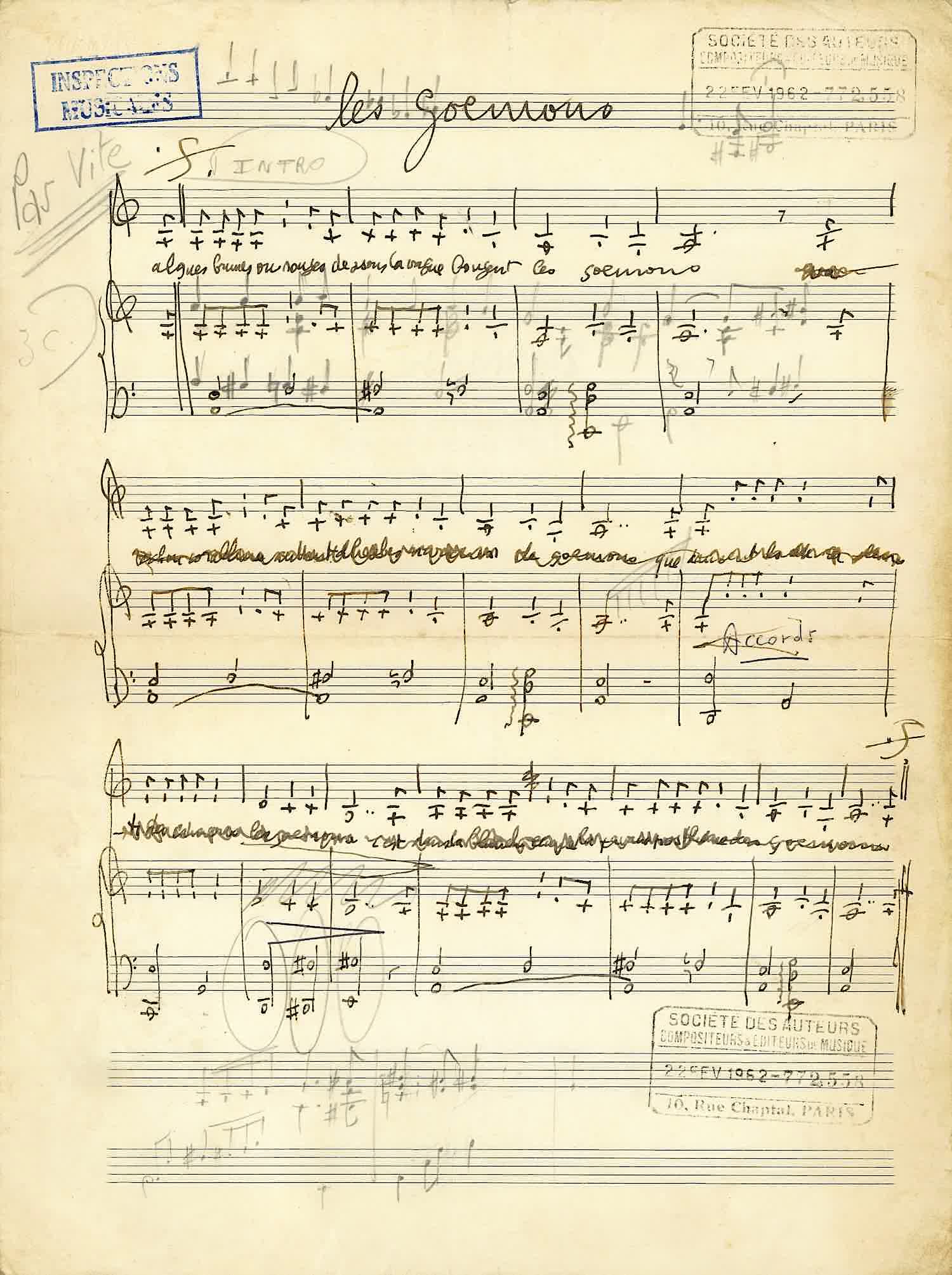
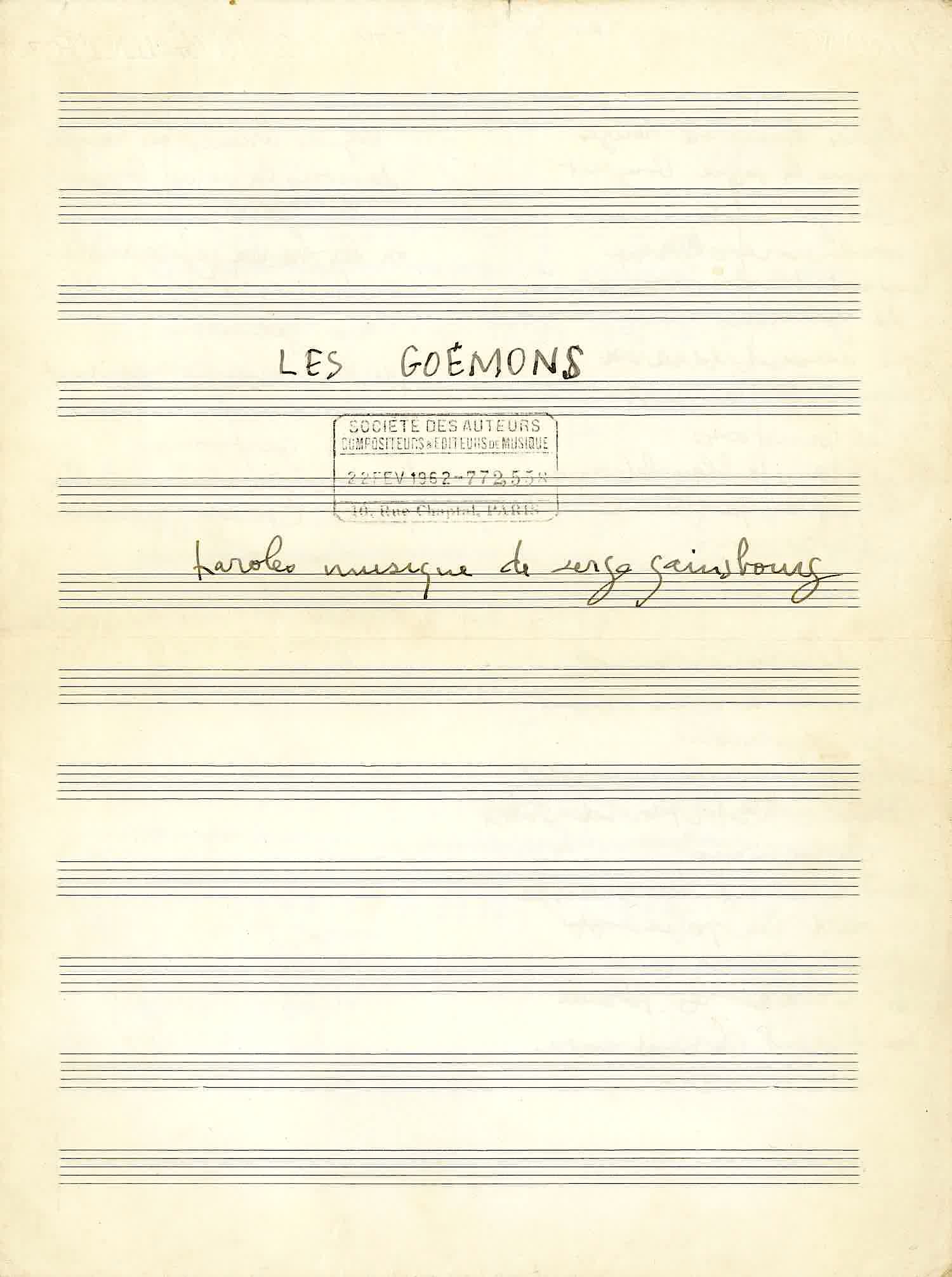
Autograph manuscript signed – Les Goémons.
Three folio pages on paper with musical staves.
Sacem stamps.
[Paris. February 1962]
"Brown or red algae, moving beneath the wave, the seaweed"
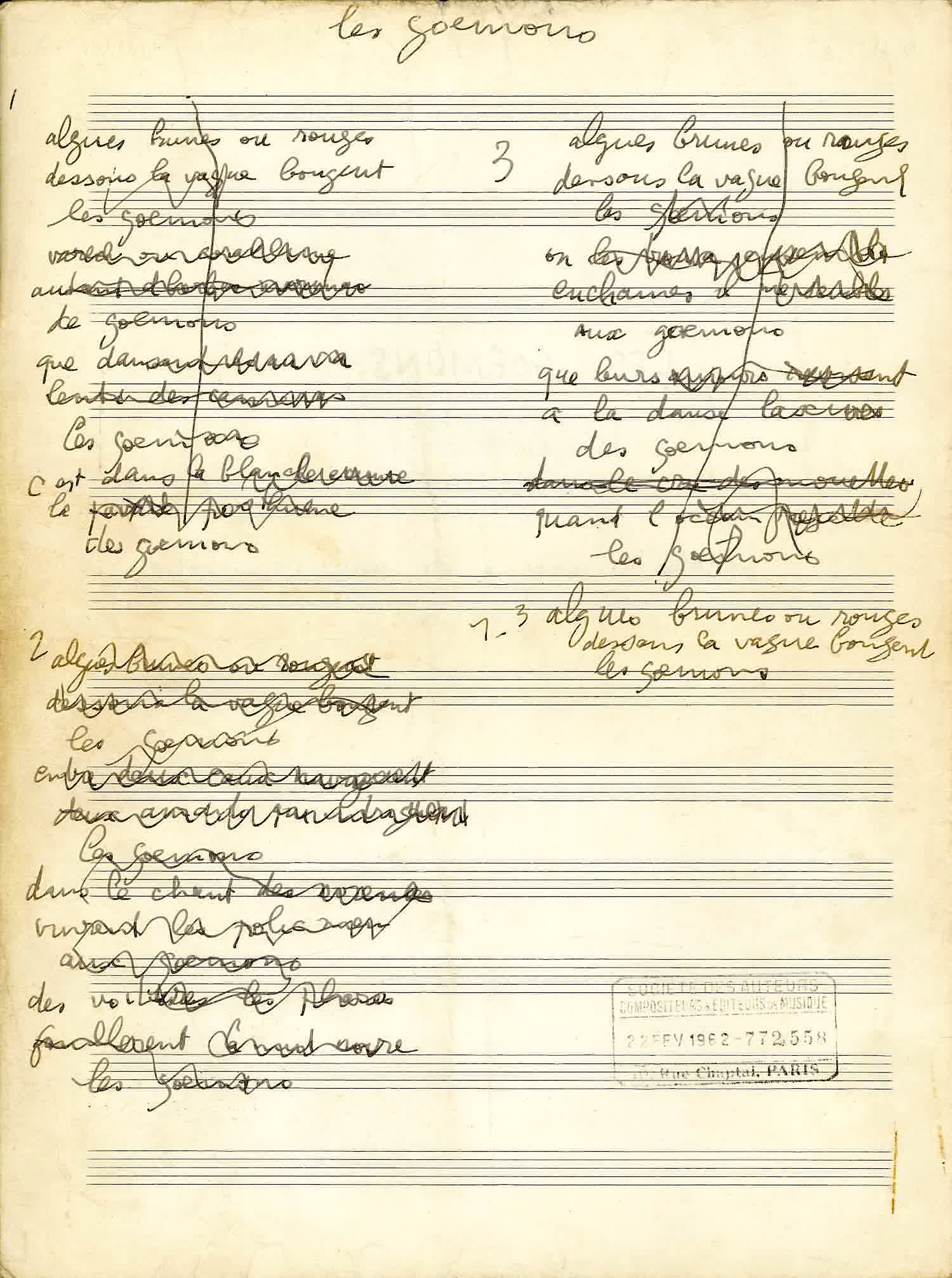
Exceptional manuscript titled in black ink, on the first sheet, LES GOÉMONS lyrics music by Serge Gainsbourg and bearing on the second and third sheets the original lyrics in first draft (ultimately not retained and partially crossed out) as well as the original score.
Les Goémons , recorded at the Blanqui studio on March 16, 1962, would be the introductory track of the artist's fourth album entitled Serge Gainsbourg n°4 .
______________________________________________
seaweed
Brown or red algae
move beneath the wave, along
with seaweed
, kelp, or coralline
algae, all of which are marine plants
.
What are they dancing in the
slow motion of the cameras
, the seaweed?
It's in the white foam,
the posthumous pavane
of the seaweed.
Brown or red algae
move beneath the wave;
seaweed
sails between the two waters;
two lovers intrigue
the seaweed.
In the song of the sirens
came the policemen,
their cars' headlights
scouring
the seaweed through the black night.
Brown or red algae
move beneath the wave;
the seaweed
was found together
, chained, it seems to me,
to the seaweed.
May their love be rekindled
in the lascivious dance
of the seaweed,
in the cries of the seagulls
when the ocean casts up
the seaweed.
Brown or red algae
beneath the wave move
the seaweed
______________________________________________
At the beginning of 1962, Catherine Sauvage decided to dedicate an entire EP to Gainsbourg's songs, just as Juliette Gréco had done three years earlier. The underlying rivalry between the two singers and the recent success of " Accordéon" encouraged her in this decision. Still seeking recognition, Gainsbourg nevertheless approached the commission with caution, wary of Catherine Sauvage's Left Bank leanings, which leaned more towards poetry set to music than commercial pop.
"Les Goémons" (The ), a title with a maritime feel, whose origin was revealed by Gainsbourg, who came to present the acetate of his freshly mixed album No. 4 on April 22, 1962, during the "Avant-premières" program: "It was when I heard Damia. A while back, she was singing 'Les Goélands' (The Seagulls)." This somber lament in memory of sailors lost at sea was, in 1912, the first hit of the great Damia, the audacious tragedienne of realist song. Beyond a nearly identical meter, we find here in this first handwritten draft of "Les Goémons " the image of souls (those of sailors in Damia's version, of lovers in Gainsbourg's) reincarnated as seagulls, while their corpses are carried by the waves—an idea that would disappear in the final text.
Narrative and cinematic, this first version plays on the double meaning of the word "siren," already used in " Ballade d'un fat majeur " ("I would do everything like Ulysses / To the police sirens / Turning a deaf ear […]"). Catherine Sauvage actively contributed to the modification of the text and the final version, completed just three days before the playback recording for Gainsbourg's LP. The final version focuses primarily on following the hypnotic movement of seaweed in the waves, like that of bodies entwined in ecstasy.
“Seaweed possesses the science of movement. And it’s also an erotic image, if you will,” Gainsbourg observed to Luc Bérimont on the radio program “Avant-premières.” The image would find its way into Gainsbourg’s work: in 1967, with “ Je t’aime moi non plus” (“Like the irresolute wave / I come and go…”) and then, in 1984, in “ Love on the Beat” ( “But you already, already are swaying / To the ebb and flow of the tides”). Catherine Sauvage will record “Les Goémons” in a version transposed to a female voice on April 6, along with the three other tracks from her EP. (Quoted in Le Gainsbook. S. Merlet. Éditions Seghers. 2019).
______________________________________________
Provenance: Lucien Merer (1927-2019), pianist, composer and arranger who accompanied Gainsbourg from his earliest days. Merer collaborated with several other big names in the music scene: Boby Lapointe, Jean Ferrat, Cora Vaucaire, Édith Piaf, Léo Ferré and Charles Aznavour, sometimes assisting them during their beginnings or their performances in cabarets and concert halls.
Bibliography: . The Complete Works and So Forth . YF Bouvier, Bartillat Publishers, 2005. / . The Gainsbook. S. Merlet. Seghers Publishers, 2019