Salvador Dalí (1904.1989)
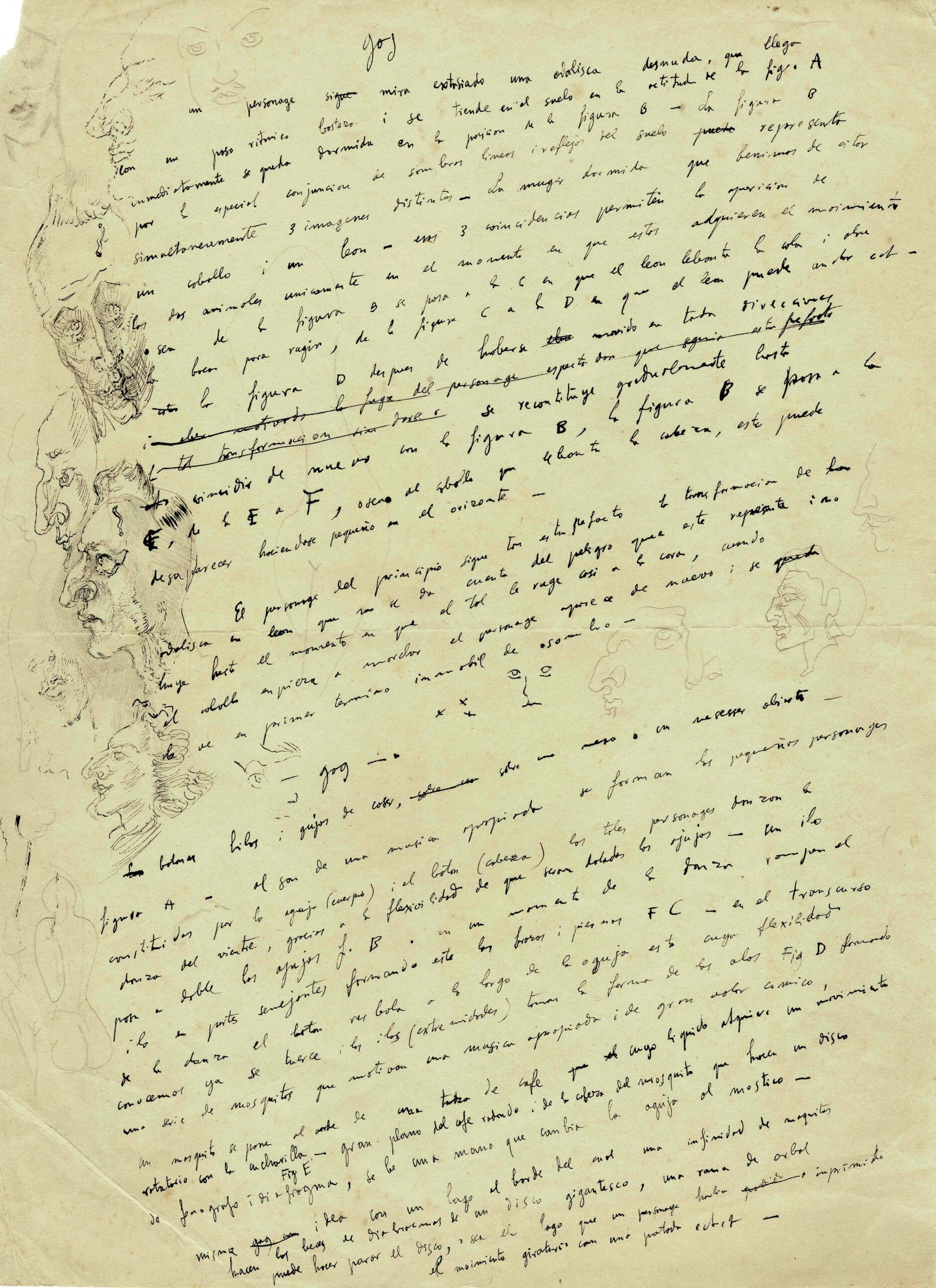
Illustrated autograph manuscript.
A large quarto page (19.90 x 27.30 cm) taken from a notebook.
In Catalan. [1930]
« Recently, through a distinctly paranoid process, I obtained the image of a woman whose pose, shadows, and morphology, without altering or distorting her actual appearance in any way, are simultaneously those of a horse
A remarkable manuscript that appears to be the preparatory sketch for his painting " Sleeping Woman, Horse, Invisible Lion" , created in 1930 and now kept at the Centre Pompidou.
The surrealist painter, in a very deliberate process, stages the structure of his work which develops for the first time the process of appearance of double, triple, and multiple images: the entanglement of forms delivering to the spectators' eyes the appearance of an odalisque metamorphosed into a lion and a horse.
In the second part of the manuscript, Dalí imagines a mosquito landing on the north side of a cup of coffee with swirling liquid.
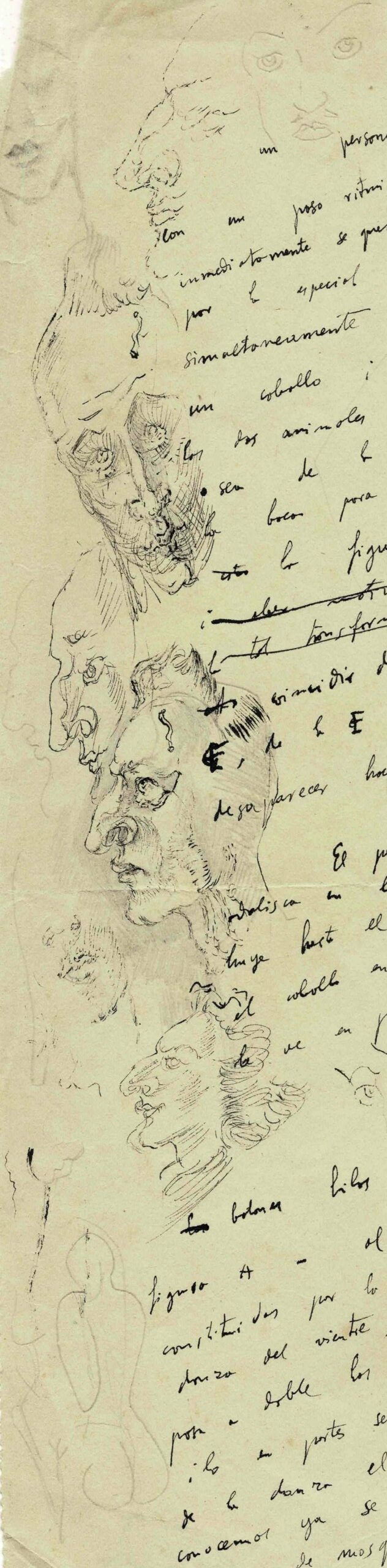
The manuscript is illustrated in the margins with fourteen sketches of faces, a woman's back, and the mythical Dalinian crutch, drawn from life by Dalí. Gala's profile can be discerned in the lower margin, and what appears to be a self-portrait is at the top of the manuscript.
___________________________________________
Original version: Un character (sigue) miraculously extasiado una odalisca desnuda, que llega con un poso vítrico bostezo i se de el suelo en la retitud de la fig. A. immediately slept in the position of figure B. Figure B for the special combination of dark lines and reflections from the spot simultaneously represents 3 separate images. The muger slept that blessed to sing a horse and a lesson. These 3 coincidences allowed the appearance of the animal backs only at the moment when they acquired the movement where the sea of figure B arose in C when the lesson lebanta la cola; abre la boca para roar, de la figura C al D en que leon can enter etc.
Fig. The character of the principio is amazed at the transformation of the odalisca into a lesson that does not appear in the peligro that is represented in no time until the moment when the horse rushes into the car, when the caballo bites the character that appears from the beginning and falls in love at the first end of the story. asombro.
hilos buttons; Gujas de coser, sobre una mesa o un necesser abierto.
Figura A. Al son de una a propiado a propiada se manda des pequeños contiguidos par la aguja (cuerpo) y le botón (cabeza). The tales of the characters dancing in the dance of the future are thanks to the flexibility they have with the needles. Un ilo posed a double las agujas f. B. At a moment of the dance the island breaks into seminal parts forming the arms and legs FC. In the course of the dance, the button rests at the length of the needle and is flexible enough to kill the islands (extremities) when the shape of the alas Fig D forms a series of mosquitoes that motivate music suitable for great comic value, a mosquito is placed on top of a cup of liquid coffee Adquiere movimiento rotatorio con la cuccharilla. Grand plano del café redondo et de la cabeza del mosquito que hacen un disco de fonografo i diafragma, se be una mano que cambia la aguja al mostico. Is my idea with a lake on the edge of the lake that has an infinity of mosquitoes that kill their teeth? From a gigantic disco, a tree blade can be played by the disco, or sea and lake that a character has imprinted on the rotating movement with a foot.
Translation :
An ecstatic figure gazes at a naked odalisque, who arrives with a calm, glassy yawn. He lies down on the ground in a straight line relative to figure A, and immediately falls asleep in the position shown in figure B. Figure B, through the special conjunction of shadows, lines, and reflections on the ground, simultaneously represents three distinct images: the sleeping woman we just mentioned, a horse, and a lion. These three coincidences allow the two animals to appear only at the moment they begin to move—that is, from figure B to figure C, at the moment the lion raises its tail and opens its mouth to roar; from figure C to figure D, where the lion can return, and so on.
Figure D, after moving in all directions, gradually reconstitutes itself until it coincides again with figure B. Figure B then rests on E, from E to F, or the breast of the horse that raises its head. The horse may disappear, becoming tiny on the horizon. The main character from the beginning is still astonished by the odalisque's transformation into a lion, unaware of the danger it represents and not fleeing until the sun roars in his face. When the horse begins to bite, the character reappears and is seen in the foreground, motionless and awestruck.
buttons, threads; sewing needles, on a table or an open sewing kit.
Figure A. To the sound of appropriate music, small characters formed by the needle (body) and the button (head) appear. These characters perform a belly dance thanks to the flexibility of the needles. A thread touches the needles twice (fB). At one point in the dance, they break the thread into equal parts, forming the arms and legs (FC). During the dance, the button slides along the needle, whose flexibility twists, and the ends take the form of wings. Figure D shows a series of mosquitoes, which justifies appropriate and very comical music. A mosquito is positioned at the front of a cup of coffee, the liquid of which begins to rotate with the spoon. A close-up shows the roundness of the coffee and the mosquito's head, which together form a phonograph record and a diaphragm. A hand transforms the needle into a mosquito. Could the same idea be applied to a lake on the shore of which countless mosquitoes act as a soundboard? in a gigantic discotheque, a tree branch can stop the record, or it could be the lake whose gyratory motion is imparted by a character with a blow.
___________________________________________
Provenance: Captain Peter Moore's collection (stamp on the back)
Sleeping Woman, Horse, Invisible Lion . Oil on canvas. 50.20 x 65.20 cm. Centre Pompidou, Inv. AM-1993-26.