Charles-Augustin SAINTE-BEUVE (1804.1869)
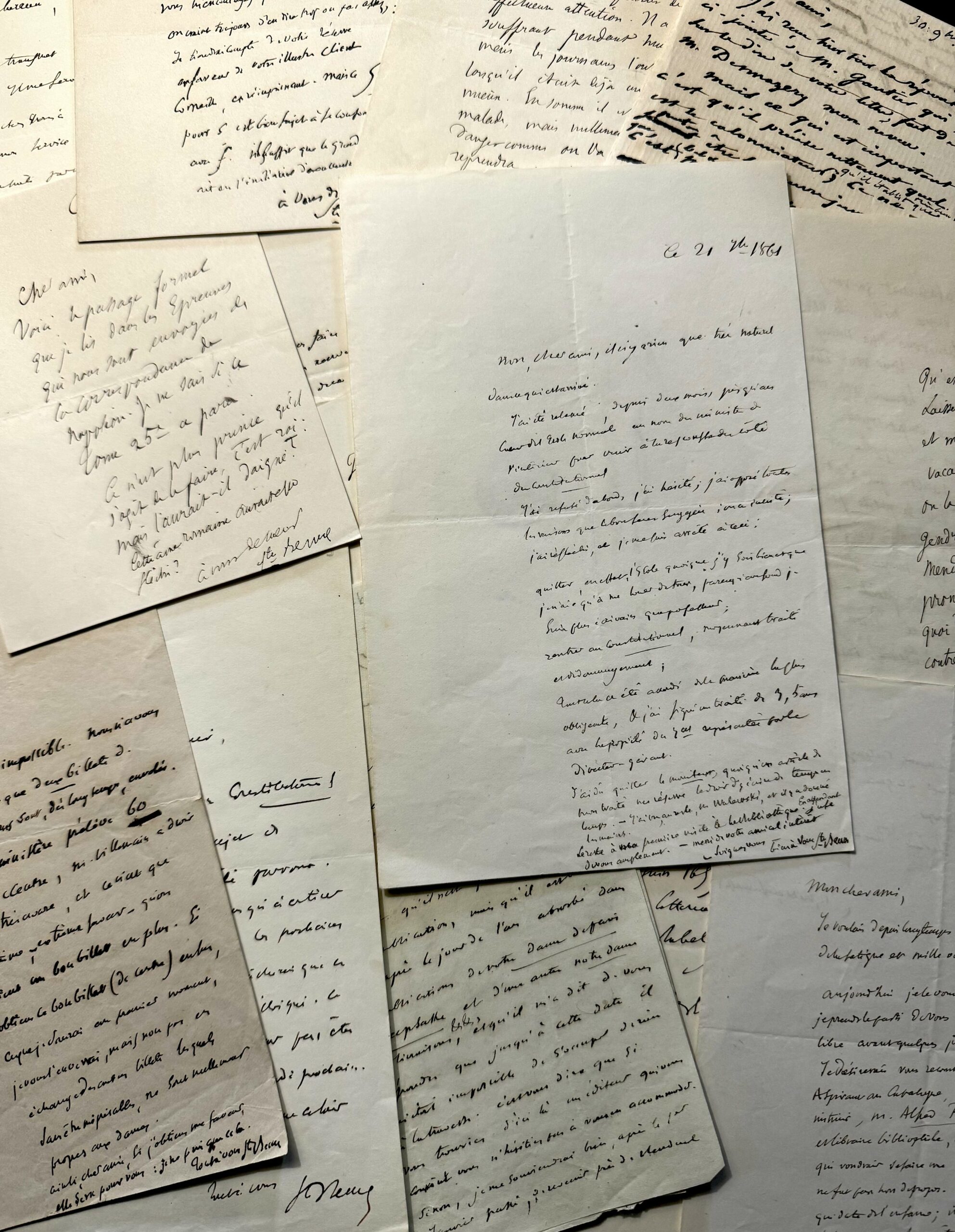
A collection of 27 autograph letters signed to Jules Taschereau
November 20 [1835] – August 25, 1868 .
With an autograph letter signed and addressed to the Count of Laborde, May 27, 1850 , and a note in the hand of Jules Troubat, signed, to the publisher Charpentier, July 26, 1869 .
35 pages in-8, in-12 or in-16, 4 letters with address on the back of the second sheet and 5 envelopes (3 with postal markings, only one of which has the stamp preserved).
Interesting correspondence between two scholars, both literary editors and holding positions as curators or administrators, one at the Bibliothèque Mazarine and the other at the Bibliothèque Impériale.
___________________________________________
It was with an article published in Le Globe about Taschereau's work on Corneille that Sainte-Beuve began his career as a critic in 1829. Although their relationship became somewhat distant during the years when Taschereau pursued a political career as a deputy for Indre-et-Loire, it resumed very regularly when Taschereau took up his post at the Imperial Library, the two men providing each other with mutual assistance for their research and writings. For example, it deals here with information on Corneille, Mazarin, the playwright Théodore Leclercq, the Abbé de Marolles, the correspondence of Grimm and Diderot (which Taschereau had edited in 1829), various publications of the Revue rétrospective (historical collection of memoirs and unpublished documents which Taschereau founded and directed between 1833-1837, then for a few more years at the beginning of the 1840s) or even a case concerning Catulle-Mendès, embarrassed because of a youthful publication.
___________________________________________
The first letters concern a study on Guy-Patin that Taschereau wishes to have published.
– November 20 [1835]. Sainte-Beuve approached the publisher Renduel who is, at the moment, too absorbed by the publication of Notre-Dame de Paris , in the illustrated edition known as "keepsake" and in installments.
– Tuesday, February 2 [1836]. Despite the arguments presented in favor of his friend, he is forced to inform him that Renduel does not wish to engage in such a scholarly publication, which he considers not profitable enough and too expensive.
– May 22 [1836]. Sainte-Beuve sends a reference to a letter from Guy Patin in Lettres choisies “ where is the rather lighthearted passage about the people of Tours ,” concerning a Franciscan friar “ who wasn’t quite Rabelais .” [This letter, addressed to Charles Spon and dated June 27, 1659, in which Patin mocks the monks’ demonic tendencies, can be consulted in the online edition of Guy Patin’s Correspondance complète et autres écrits .]
Correspondence did not resume until 1848.
– April 5, 1848. Sainte-Beuve is worried to learn that his name [under the initials "S.-B"] is allegedly implicated in a document originating from the secret archives of the Ministry of the Interior, a document that La Revue Rétrospective is preparing to publish. He has already protested this in the newspapers and is demanding an investigation that would clear him of all suspicion, but he is reluctant, despite the advice of some friends, to contact M. de Lamartine, " whom I knew and admired as a poet, whom I set aside when I saw him become a politician and ambitious […] I do not want to owe him the slightest personal obligation ."
– Monday evening [1848?]. He wishes to obtain a copy of the Retrospective Review which his neighbor [Antoine Rochebillière, librarian attached to the National Library and then to the Sainte-Geneviève Library] could bring to him.
– Monday, March 24 [1851]. “ This time I am definitely going to do Théodore Leclercq .” Sainte-Beuve is to talk to Louis Véron [director of Le Constitutionnel ] about this and he needs Taschereau’s help to gather documents on the playwright, looking for Le Château de Duncan , of which the Bibliothèque Mazarine does not have a copy [this novel, published under only the initial of its author in 1800, is still missing from Parisian libraries today].
– January 11, 1853. Regarding a meeting that was cancelled due to his required presence at the funeral of Mrs. Armand Bertin [the wife of the director of the Journal des Débats , née Marie-Anne-Cécile Dollfuss, who died on January 6].
– January 23, 1854. It is in the second volume of Port-Royal, p. 463 of the 1842 edition, that Taschereau could read an anecdote supposedly "discovered" by Victor Cousin in 1843, concerning Corneille and the poet Jacqueline Pascal, a nun and sister of the philosopher [who had been congratulated by Corneille for stanzas on the Immaculate Conception]. " He [Cousin] prefers not to read and to forget, so that he can later shout that he was the first to find it and sometimes be mistaken ."
– January 12 , Friday [1855]. He has read and finds very good the report that Taschereau submitted to him [on the Catalogue of the Imperial Library], adding a few remarks and suggestions regarding its format. For his part, he is working on his first lecture [for the Collège de France, which he will give on March 9, 1855; letter filed under the date of March 12, 1858 in the General Correspondence , with a note mentioning another inaugural lecture, the one given at the École Normale on April 12, 1858].
– October 14, 1857. Interested in Michel de Marolles, " the quintessential amateur, the collector ," a native of Tours like Taschereau, Sainte-Beuve asked his friend what he possessed on this abbot [archivist and erudite historian, known today primarily for his impressive collection of prints, a large part of which was acquired by Colbert for Louis XIV and which formed the initial core of what is now the Prints Department of the Bibliothèque nationale de France]. In two further letters, dated October 23 and December 28, he thanked him for the precious volumes lent, " Marolles treasures ." Thanks to these "loans," Sainte-Beuve published an article in Le Moniteur on December 21 and 28, 1857.
– November 27, 1857. When Taschereau asked him for information about an Eulogy of Vauvenargues by Adolphe Thiers, Sainte-Beuve believed it had never been printed, only partially quoted. " I don't think you'll get any more precise information by talking with Mr. Thiers; he himself couldn't tell me anything in the past. Perhaps asking Mr. Mignet would yield a better answer? " This refers to a text presented by Adolphe Thiers in 1820 to the Academy of Aix-en-Provence, the details of which are recounted in the notes of his Correspondence .
– March 19, 1858. He would like his friend to lend him the main pamphlets that have appeared “ for or against ” Le Cid : “ I have to give a lesson on this and your Life of Corneille whets my appetite and I say: give me some more .”
– February 11, 1859. Recommendation in favor of Alfred Poupel, “ born collector and bibliographer ”, a former bookseller who is looking for a job “ where his love of books was not out of place ”, perhaps at the Catalogue of printed works of the Imperial Library? Poupel is also recommended by his former teacher, the historian Adolphe Chéruel.
– September 21, 1861. He explains why and how he decided to leave the École Normale: “ For two months, I have been summoned back to the heart of the École Normale in the name of the Minister of the Interior to come to the aid of the Constitutionnel. […] I have settled on this: to leave, indeed, the École, although I am happy there and have nothing but praise for everyone, because deep down I am more of a writer than a professor; to join the Constitutionnel , in exchange for a contract and compensation .”
– May 4 [1865]. Thanks for Taschereau's unfailing friendly support, especially " from the somewhat difficult beginnings of the affair now so happily crowned " [his election as senator, on April 28, 1865].
– March 13, 1866. He asks him to receive Adolphe Pichon du Gravier, who needs to consult medieval manuscripts for a work in progress on weapons of war in France. Sainte-Beuve specifies that Mr. Gravier's father is the author of the portrait adorning the edition of the Letters of Mademoiselle Aïssé , prepared by Ravenel and himself in 1846.
– April 7, 1867. He asks her to take in the young Jules Dietz whose brother [Herman Dietz, a former student of the École Normale, a qualified teacher of German and then stationed in Berlin] has found " beginnings (manuscripts) of [the] Literary Correspondence which join the first published part of Grimm. You might perhaps be able to help him clarify and answer [the] question with papers of Abbé Raynal who is supposed to be the author ."
– October 26, 1867. New recommendation, this time for Jules Zeller, “ wise and steadfast historian ,” who wishes to borrow certain works. [Jules-Sylvain Zeller taught notably at the Sorbonne and the École Polytechnique].
November 28–30, 1867. Three letters concerning Catulle-Mendès, Théophile Gautier's son-in-law, who is vying for a position in the Fine Arts administration. Sainte-Beuve, who supports the young man, is outraged by a denunciation that reminded the minister [Marshal Jean-Baptiste Philibert Vaillant] that Mendès had been sentenced to a month in prison and a fine after the publication of his novel, *Roman d'une nuit *, six years earlier. He suspects Taschereau of being behind it in order to favor a nephew: “ Honest man, you have wielded a poisoned blade. […] Let an honest young man, guilty only of a press offense for some overly risqué ode written at the age of 20, obtain a meager job that allows him to support his family .” Taschereau having vigorously protested against this accusation and having forwarded to him the letters he had addressed to the minister and Princess Mathilde on the subject, Sainte-Beuve congratulated him on November 30th on his tone and firmness, but still wondered about the identity of the slanderer. " Allow me to remain uncertain of the conclusion; I hope that some explanation will confirm the odiousness of the matter ." Enclosed are two handwritten drafts by Taschereau addressed to his friend, forwarding him the letter from Alphonse Gautier [Secretary General of the Ministry of the Emperor's Household and Fine Arts], a letter which suggests that it was Count Nieuwerkerke [then Director of Museums] who had slandered Catulle Mendès: " I reserve the right to throw this… chamber pot back at his head one of these mornings at the Marshal's ."
– March 4, 1868. He states that, in reprinting, he will take into account Taschereau's reservation regarding the spelling to be adopted for the letters "s" and "f," according to Corneille. " It is enough that the great man had the initiative of excellent ideas ." [This refers to an article by Sainte-Beuve, published in Le Moniteur on Firmin-Didot's book, Observations sur l'orthographe française, which will be reprinted in Les Nouveaux Lundis .]
– August 25, 1868. Note relating to a passage from volume XXV of Napoleon's Correspondence [published by order of Emperor Napoleon III] of which he received proofs: " It is no longer a question of doing it as a prince as a king : but would he have deigned? Would this Roman soul have yielded? "
Two undated letters concern the French Academy [where Sainte-Beuve was elected in 1844]:
– This Thursday, the 6th . He has to decline an invitation, being tied up with his duties at the Bibliothèque Mazarine [Sainte-Beuve has been curator there since 1840] and with a commission from the Academy.
– May 22. He fears he will not be able to get the seat his friend requests: “ Since the ministry has been taking 60 center tickets, Mr. Villemain [permanent secretary of the Academy] has the right to be very stingy and it is only by extreme – extreme favor – that one obtains an extra good ticket .”
With :
– May 27 [1850]. Autograph letter signed [addressed to Count Léon de Laborde]. “ My dear Sir, the editors of Le Constitutionnel have approved the subject of Mazarin treated by you .” It was in the July 1, 1850 issue of Le Constitutionnel that a long article by Sainte-Beuve appeared, devoted to Laborde’s work on Cardinal Mazarin and his palace on the rue de Richelieu (where the collections of the Royal Library were transferred at the beginning of the 18th century): Le Palais Mazarin et les grandes habitations de ville et de campagne au XVIIe siècle (1 p. in-8).
– July 26, 1869. A note in Jules Troubat's handwriting, signed in pencil by Sainte-Beuve with an autograph postscript " with warmest regards ," addressed to the publisher Charpentier to inform him of his health, as the newspapers had reported that he was unwell. " Mr. Sainte-Beuve […] is still ill. But by no means in danger, as has been said, and will soon resume his twice-weekly work after a period of rest " (1 p. in-16). Sainte-Beuve died at his home three months later, on October 13.
___________________________________________
Jules-Antoine Taschereau (1801-1874) was appointed assistant administrator at the Imperial Library in 1852. Appointed administrator general in 1858, he continued the publication of the Catalogue of Printed Books, oversaw the library's expansion by the architect Henri Labrouste, and safeguarded the collections during the Franco-Prussian War of 1870 before leaving Paris during the Commune. Upon his return, he resumed his duties at the Library, which had once again become a national library, until his retirement in September 1874.
Provenance: Archives of Mrs. Taschereau-Comte
References: General Correspondence , Stock, 1935-1983 and Rediscovered Letters, Champion 2006.