Alfred JARRY (1873.1907)
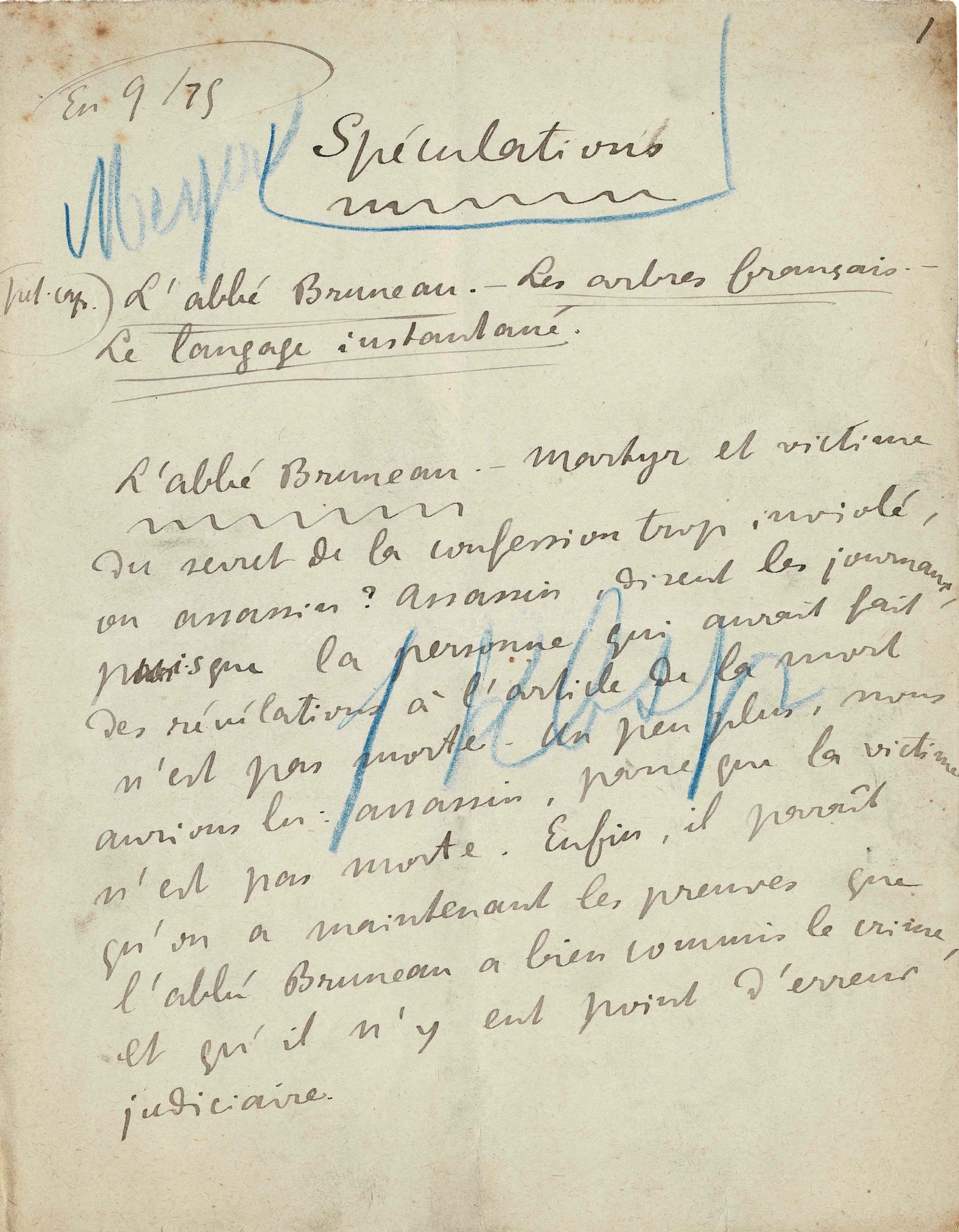
Autograph manuscript signed – Speculations.
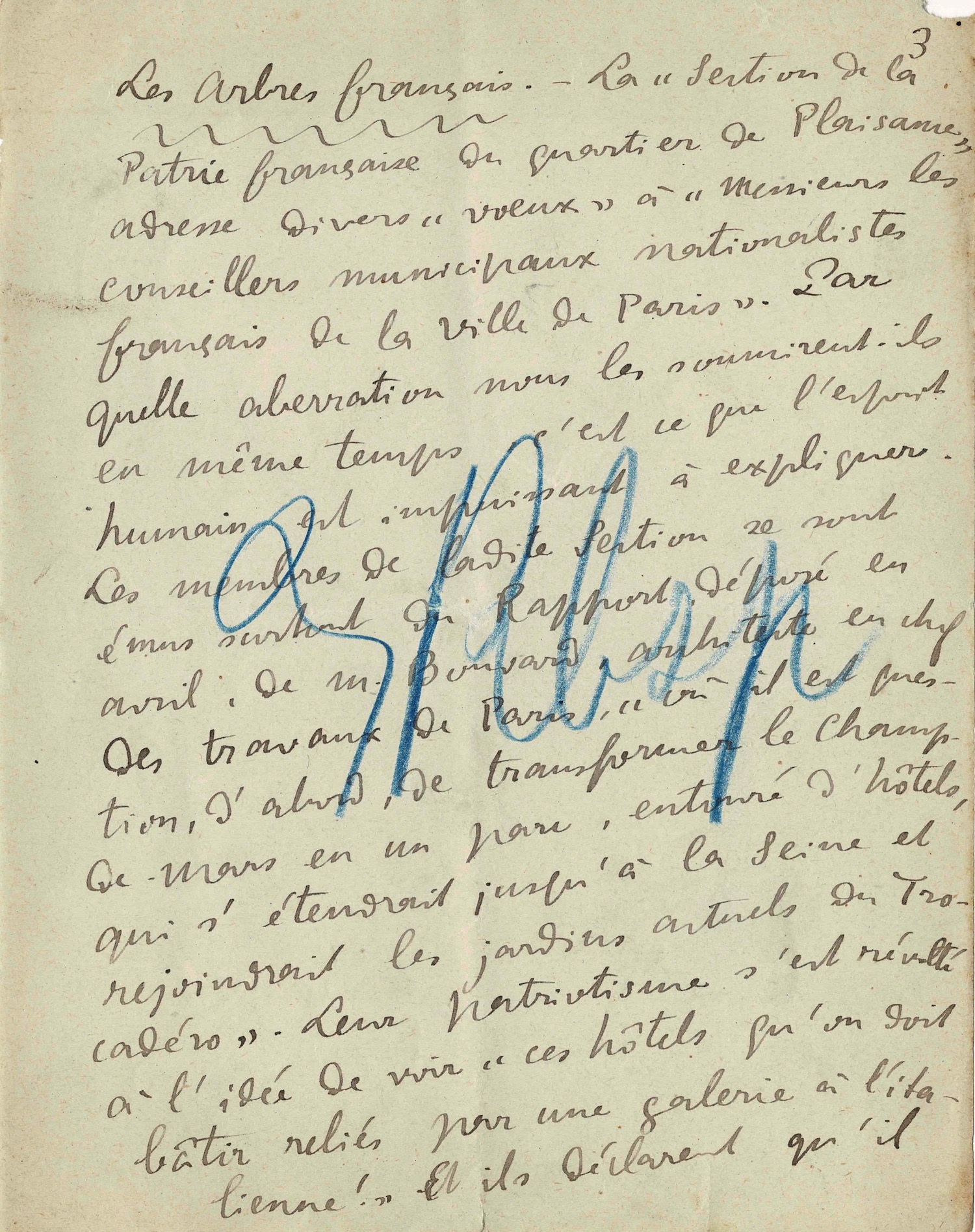
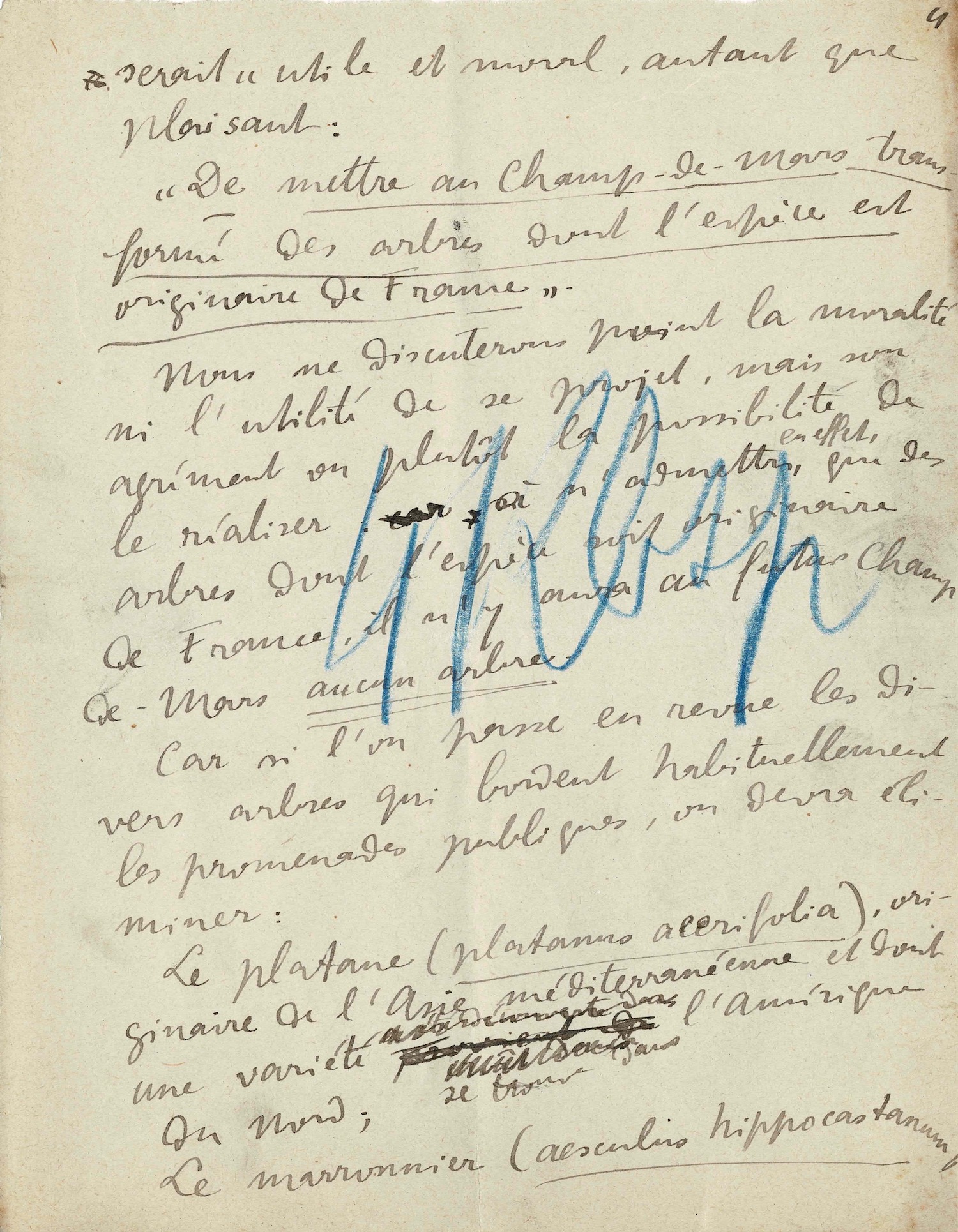
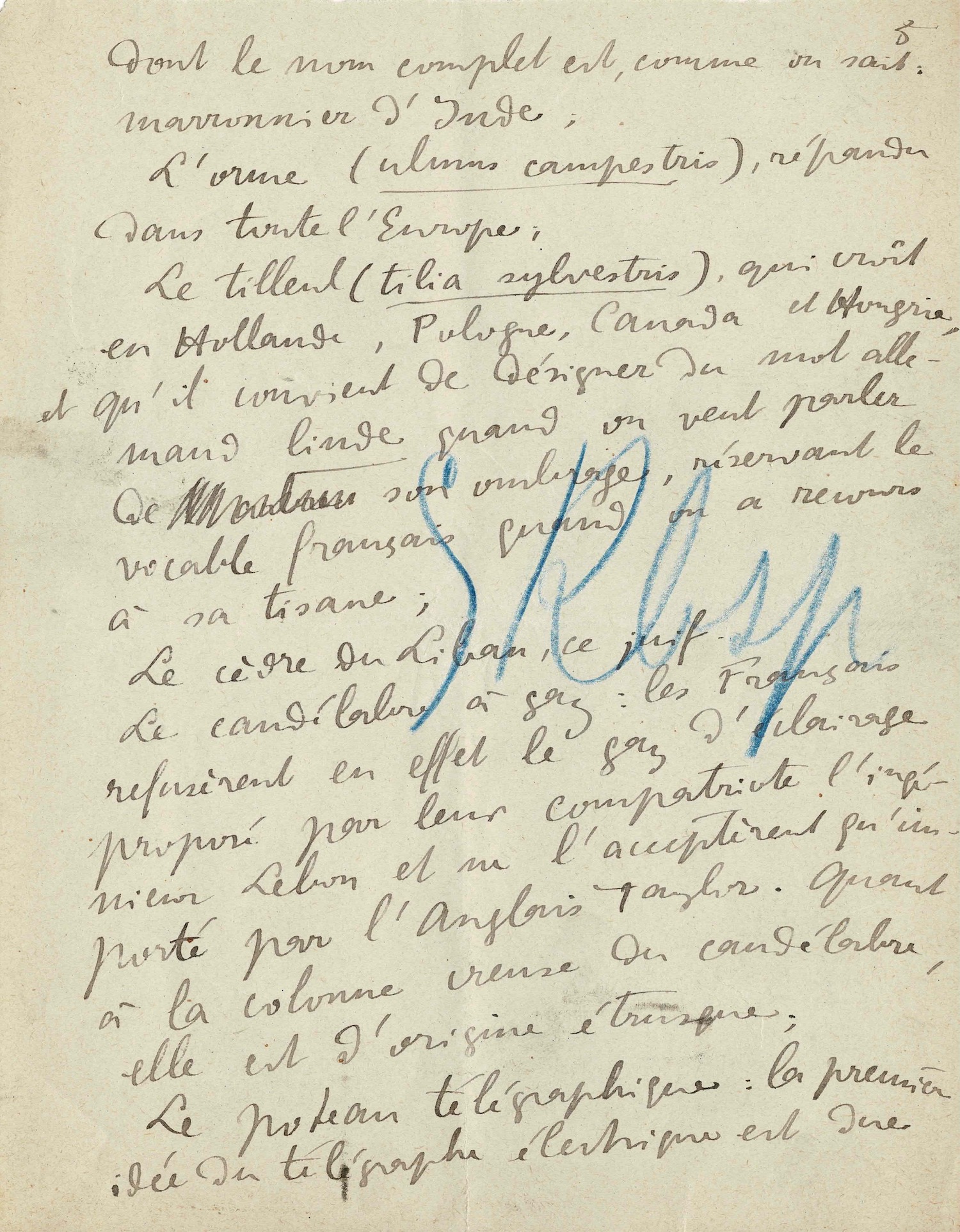
Eight quarto pages taken from a notebook.
Typographer's instructions in blue pencil.
Slnd [1901]
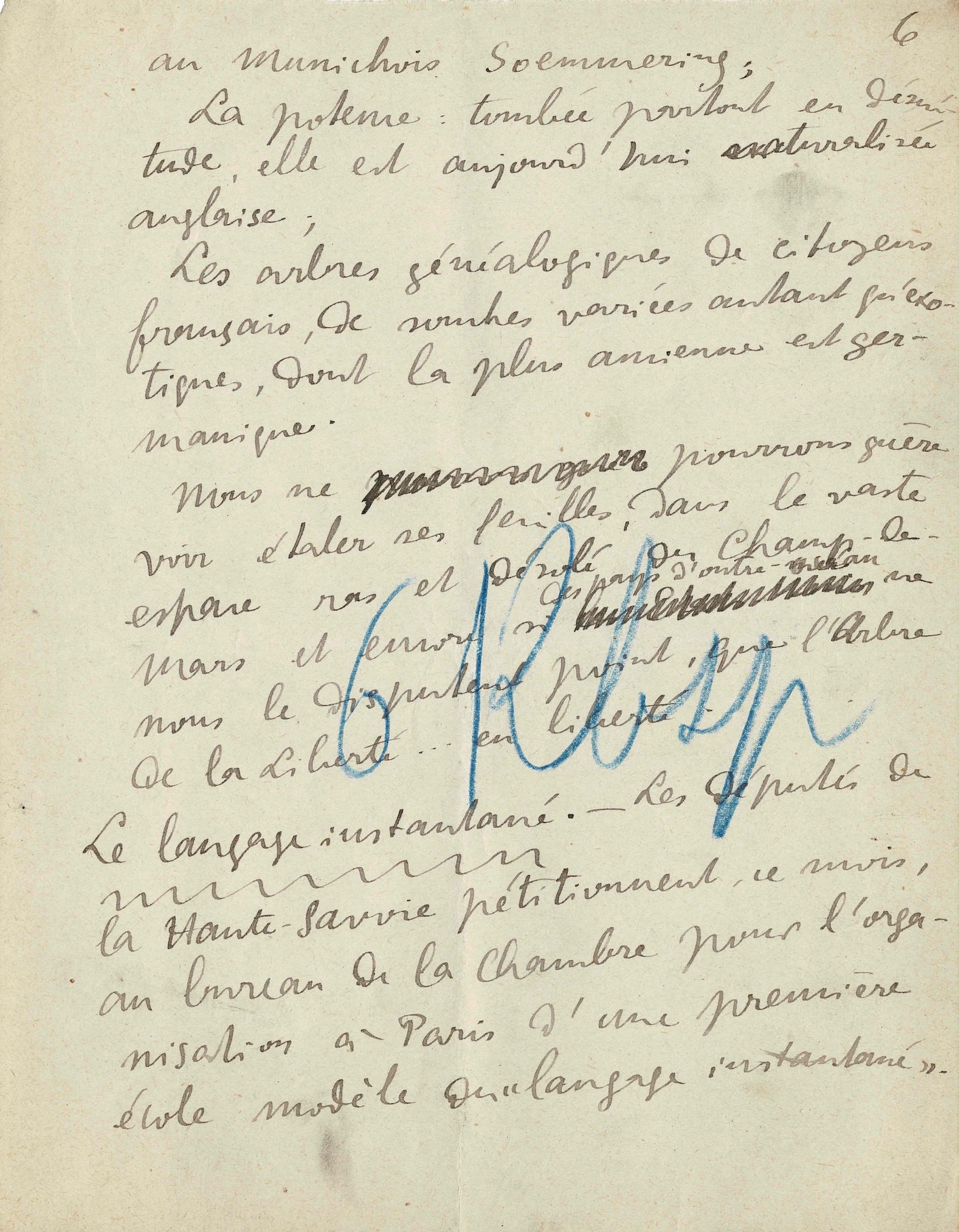
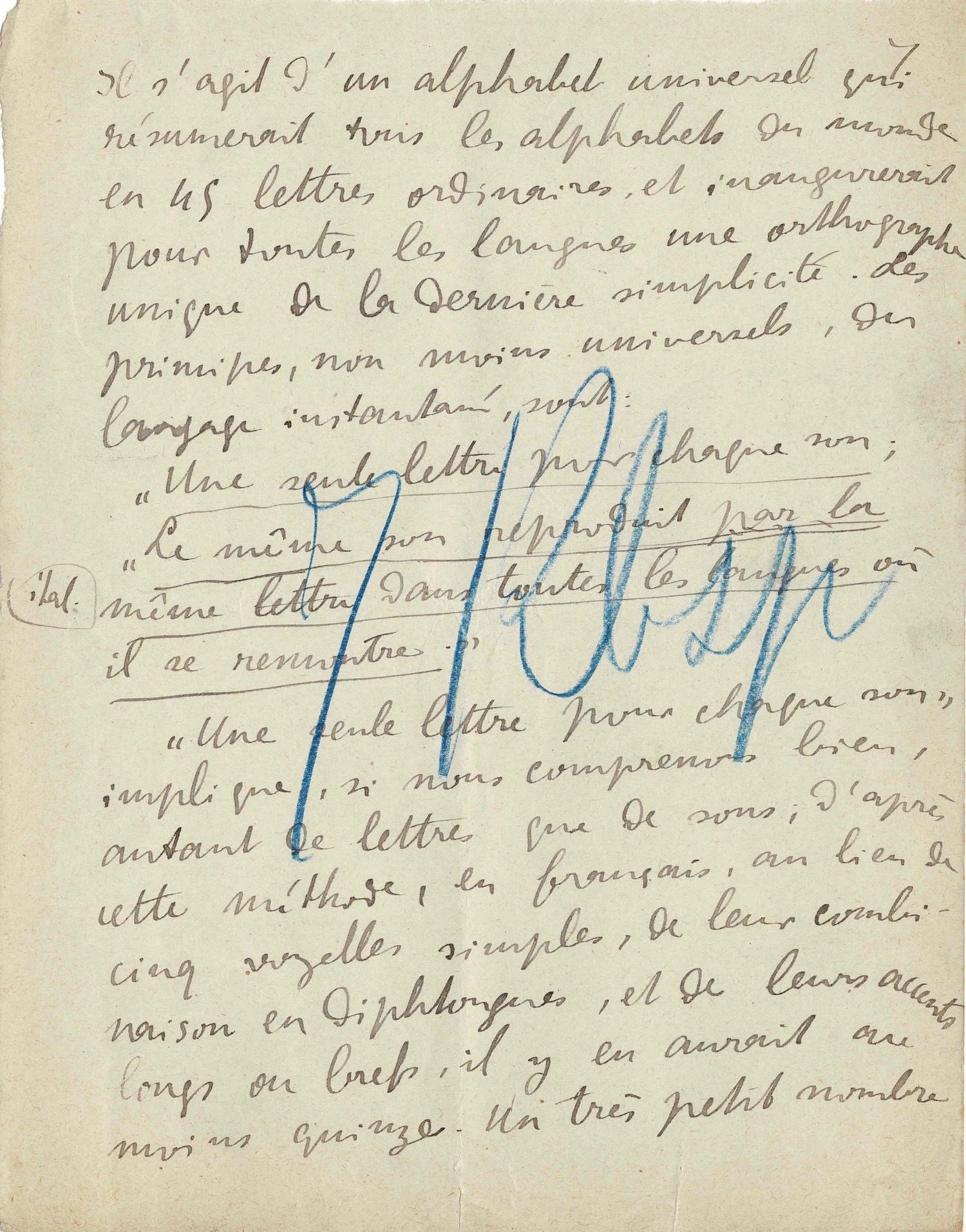
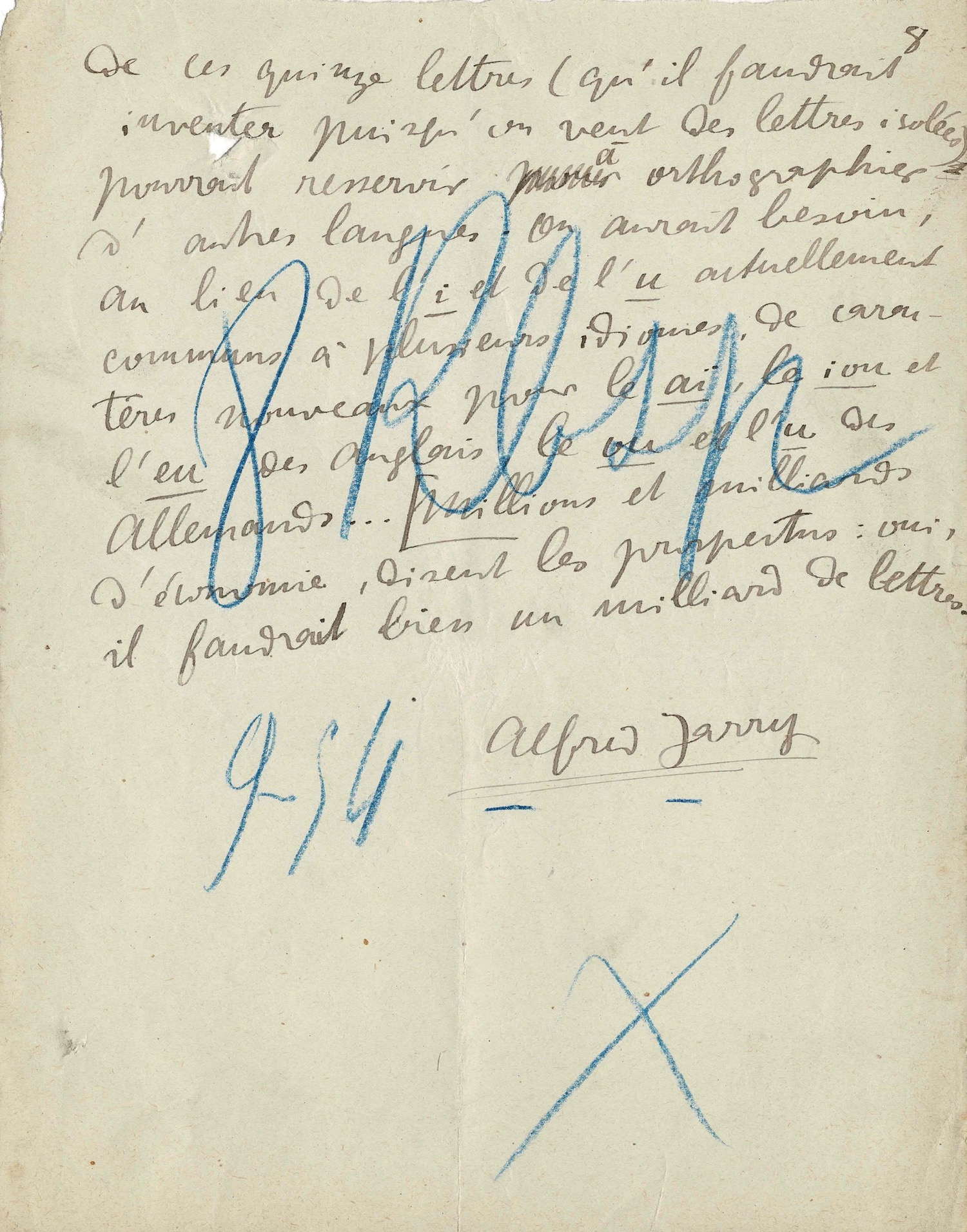
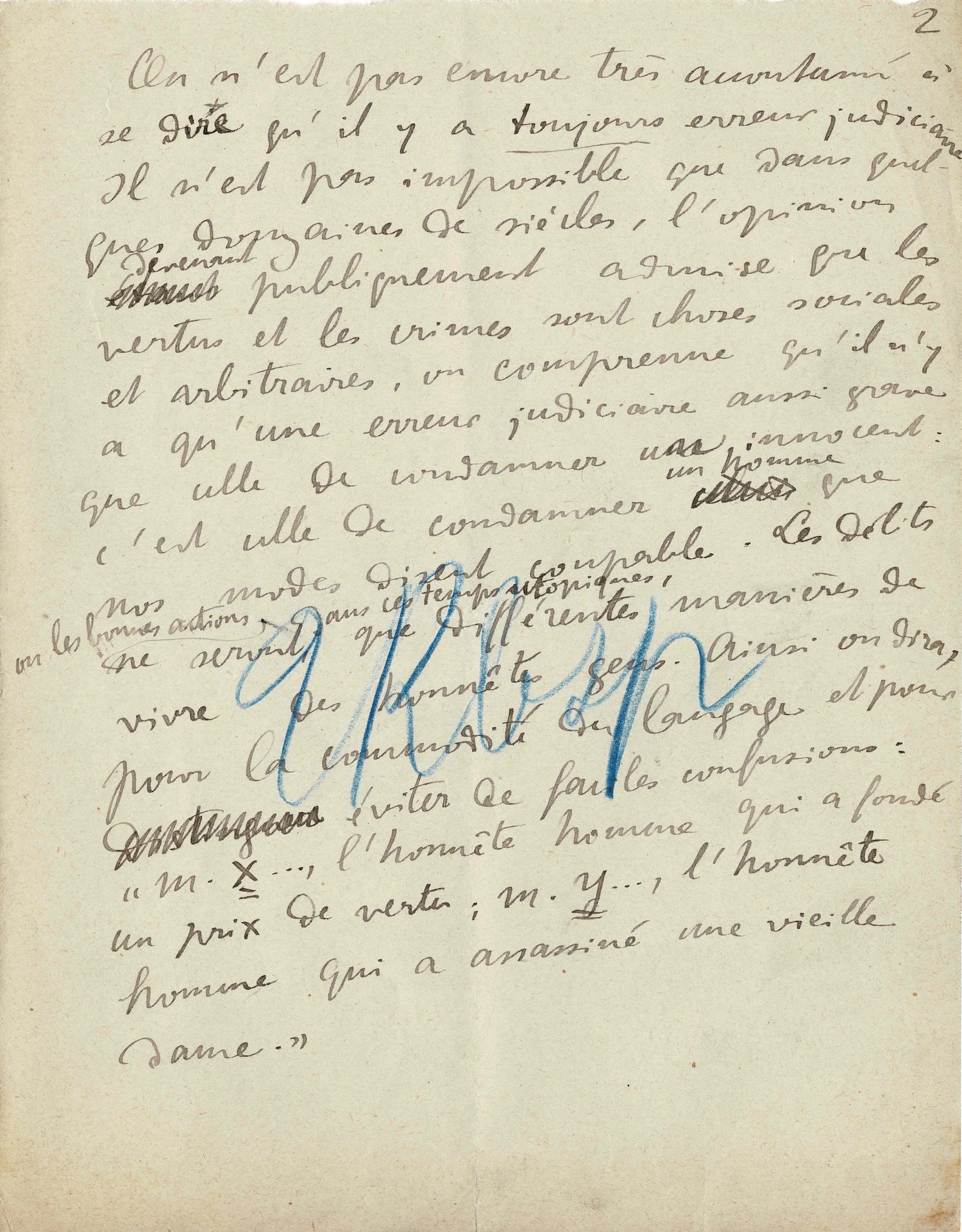
A very rare first draft manuscript by Jarry, with erasures and corrections, of a column from La Chandelle verte entitled " Speculations " and containing three texts: " Abbé Bruneau. – Les Arbres français. – Le Langage instantané. "
Jarry's formidable and amusing "speculations" – published in issue no. 192 of La Revue blanche on June 1, 1901 – demonstrate by absurdity the aberrations of the judicial system and the justice of the future ( Abbé Bruneau ); the stupidity of "nationalist" considerations in matters of naturalism ( Les arbres français ); and the unforeseen and ridiculous disadvantages of universal language ( Le langage instantané ).
_____________________________________________________________
Abbé Bruneau . Martyr and victim of the unbroken seal of confession, or murderer? Murderer, say the newspapers, since the person who supposedly made revelations on his deathbed is not dead. A little further on, we would have read: murderer, because the victim is not dead. Finally, it seems that we now have proof that Abbé Bruneau did indeed commit the crime, and that there was no miscarriage of justice. We are not yet very accustomed to the idea that there is always a miscarriage of justice. It is not impossible that in a few dozen centuries, when the opinion becomes publicly accepted that virtues and crimes are social and arbitrary, we will understand that there is only one miscarriage of justice as serious as condemning an innocent person: that of condemning a man whom our customs deem guilty. Crimes or good deeds will, in those utopian times, be nothing more than different ways of living for honest people. Thus, for the sake of convenience and to avoid easy confusion, we will say: "Mr. X..., the honest man who founded a virtue prize; Mr. Y..., the honest man who murdered an old lady."
French Trees . The "Section of the French Fatherland of the Plaisance district" sends various "greetings" to "the French nationalist municipal councilors of the City of Paris." By what aberration did they submit them to us at the same time? The human mind is powerless to explain. The members of the said Section were particularly troubled by the report, submitted in April, by Mr. Bouvard, chief architect of works for Paris, "which proposes, first of all, transforming the Champ-de-Mars into a park, surrounded by mansions, extending to the Seine and joining the current Trocadéro gardens." Their patriotism revolted at the idea of seeing "these mansions that are to be built linked by an Italian-style gallery!" And they declare that it would be "useful and moral, as well as pleasant, to plant trees of a species native to France in the transformed Champ-de-Mars."
We will not discuss the morality or usefulness of this project, but its suitability, or rather, the possibility of its realization: if we only allow trees of species native to France, there will be no trees . For if we examine the various trees that usually line public promenades, we will have to eliminate:
The plane tree ( Platanus acerifolia ), native to Mediterranean Asia and of which a variety is found in North America;
The horse chestnut tree ( Aesculus hippocastanum ), whose full name is, as we know: horse chestnut tree;
The elm ( ulmus campestris ), widespread throughout Europe;
The linden tree ( tilia sylvestris ), which grows in Holland, Poland, Canada and Hungary, and which should be designated by the German word Linde when one wants to speak of its shade, reserving the French term when one uses its herbal tea;
The cedar of Lebanon, that Jew;
The gas candelabra: the French, in fact, refused the lighting gas proposed by their compatriot, the engineer Lebon, and only accepted it when imported by the Englishman Taylor. As for the hollow column of the candelabra, it is of Etruscan origin;
The telegraph pole: the first idea for the electric telegraph is attributed to Soemmering from Munich;
The gallows: having fallen into disuse everywhere, it is now naturalized as English;
The family trees of French citizens, of varied and exotic origins, the oldest of which is Germanic.
We will hardly be able to see its leaves spread out in the vast, flat and desolate space of the Champ-de-Mars, and even then, if countries across the ocean do not contest it, the Tree of Liberty… in freedom.
Instant Language . This month, members of parliament from Haute-Savoie are petitioning the Chamber of Deputies for the establishment in Paris of a model school for "instant language." This involves a universal alphabet that would summarize all the world's alphabets into 45 ordinary letters, and would inaugurate a single, extremely simple orthography for all languages. The equally universal principles of instant language are: "One letter for each sound; The same sound reproduced by the same letter in all languages where it is found."
“One letter for each sound” implies, if we understand correctly, as many letters as there are sounds; according to this method, in French, instead of five simple vowels, their combinations into diphthongs, and their long or short accents, there would be at least fifteen. A very small number of these fifteen letters (which would have to be invented, since we want isolated letters) could be reused to spell other languages. We would need, instead of the i and the u , currently common to several languages, new characters for the ai , iou and eu , the ou and u … Millions and billions in savings, the brochures say: yes, we would need a billion letters.