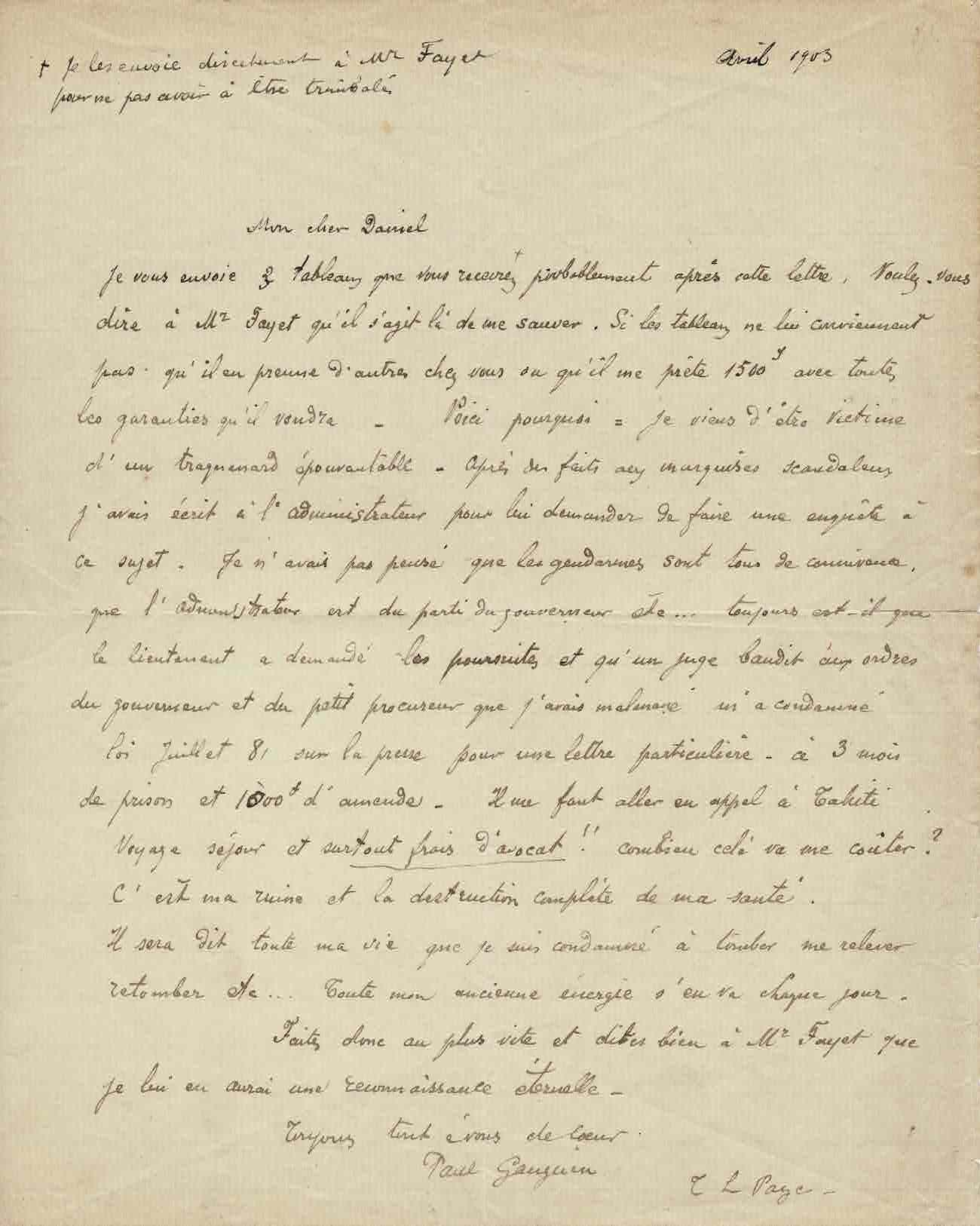

"It will be said all my life that I am condemned to fall, get up, fall again, etc..."
45.000€
Paul Gauguin (1848-1903)
Autograph letter signed (twice) to Daniel de Monfreid.
One and a half pages, quarto. [Hiva-Oa] April 1903
"It will be said all my life that I am condemned to fall, get up, fall again, etc..."
One of Gauguin's very last letters, poignant, written a few days before his death.
This is the last letter Gauguin wrote to his friend Daniel de Monfreid; Gauguin was already bedridden and had been convicted of slander. He died on May 8, 1903, at the age of 54, completely demoralized, before he could even defend himself against the accusation. It is very likely that Gauguin was already dead when Monfreid received this letter.
__________________________________________________________________________________________________
"My dear Daniel, I am sending you three paintings which you will receive—I am sending them directly to Mr. Fayet so they don't have to be transported—probably after this letter. Please tell Mr. Fayet that this is to save me. If the paintings don't suit him, he can take others from you or lend me 1500 francs with any guarantees he desires. Here's why: I have just been the victim of a terrible trap."
After some scandalous events in the Marquesas Islands, I wrote to the Administrator asking him to launch an investigation. I hadn't considered that the gendarmes were all in cahoots, that the Administrator was on the Governor's side, etc. In any case, the lieutenant ordered the prosecution, and a corrupt judge, acting on the orders of the Governor and the petty prosecutor I had roughed up, sentenced me—under the July 1981 press law—to three months in prison and a 1,000 franc fine for a single letter. I have to appeal to Tahiti.
Travel, accommodation, and especially lawyer's fees!! How much is this going to cost me? It's ruining me and completely destroying my health. People will say all my life that I'm condemned to fall, get up, fall again, etc… All my former energy is draining away every day. So please act as quickly as possible and tell Mr. Fayet that I will be eternally grateful. Yours sincerely, Paul Gauguin.
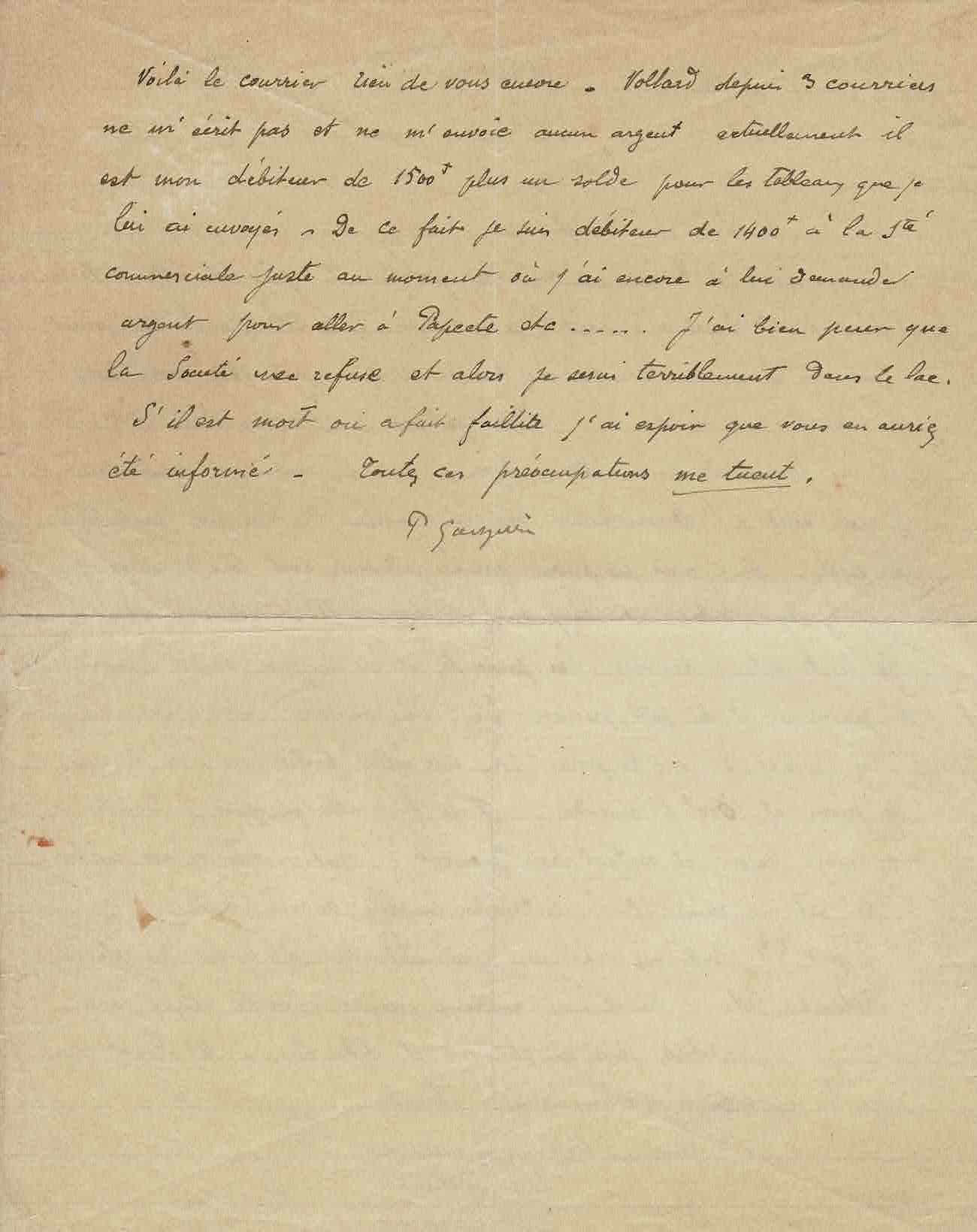
Here's the letter, still nothing from you – Vollard hasn't written to me in three letters and hasn't sent me any money. Currently, he owes me 1500 francs plus the balance for the paintings I sent him. As a result, I owe the trading company 1400 francs, just when I need to ask him for money to go to Papeete, etc. I'm afraid the company will refuse me, and then I'll be in dire straits. If he's dead or gone bankrupt, I hope you would have been informed. All these worries are killing me. P. Gauguin .
__________________________________________________________________________________________________
This letter from Paul Gauguin, written just days before his death, is addressed to Georges-Daniel de Monfreid (1856-1929), a close friend, painter and sculptor, and Gauguin's correspondent and representative in France during his stays in Tahiti and the Marquesas Islands. Monfreid defended Gauguin's interests with Ambroise Vollard (1866-1939), an art dealer, gallery owner, publisher, and writer.
Gauguin's remoteness, having settled in the Marquesas Islands in 1901, made correspondence difficult, with some letters arriving months late. Gauguin was in dire straits. He wrote that he was sending three paintings to Gustave Fayet (1865-1925), a painter and collector: “Will you tell Mr. Fayet that this is about saving me? If the paintings don't suit him, he can take others from you or lend me 1500 francs with any guarantees he wants .” The tone was desperate, as Gauguin, already struggling with heart disease, syphilis ravaging his body, and eczema-covered legs, was living miserably in his house, Le Jouir.
Gauguin is overwhelmed. His natural despair is here accentuated by the recent conviction (by the gendarme Guichenay) that strikes him. Indeed, a month before writing this letter, on March 31, 1903, he was convicted as he explains in the letter: “I have just been the victim of a dreadful trap (…) A bandit judge on the orders of the governor and the petty prosecutor whom I had mistreated has sentenced me under the July 1881 press law for a particular letter, to 3 months in prison and a fine of 1000 francs” .
Gauguin was always particularly critical of the colonization of the Marquesas Islands and regularly defended the inhabitants, for whom the administrative system was completely incomprehensible. On March 10, during the exceptional visit of two colonial inspectors on an official tour, Gauguin wrote a report for them, mentioning unjustified taxes, excessive fines, smuggling, the Catholic school, etc. He added: “For reasons of economy, justice is sent to us approximately every eighteen months. The judge therefore arrives in a hurry to pass judgment (…) he takes up residence at the gendarmerie, eats his meals there, seeing no one other than the brigadier who presents him with the file and his assessments.”.
In this letter, he goes even further: “After scandalous events in the Marquesas Islands, I wrote to the Administrator asking him to conduct an investigation. I hadn't considered that the gendarmes were all in cahoots .” It was the report written by one of these two inspectors, André Salles, upon his return from his official tour, that particularly damaged Gauguin's reputation: “The painter Gauguin has sought to undermine all established authority in the minds of the natives, encouraging them not to pay taxes and to stop sending their children to school.” Following this, the governor denounced Gauguin, calling him a “bad Frenchman.” Gauguin had filed a complaint against the gendarme Guichenay of Tahuata. The governor therefore seized upon this pretext to authorize the commander of the gendarmerie to prosecute the painter for defamation, “ I have to go to Tahiti to appeal. Travel, accommodation and especially lawyer's fees!! How much will this cost me? It is my ruin and the complete destruction of my health” .
Failing health and contrary justice overwhelm Gauguin, forcing him to resign himself to fate: “ It will be said all my life that I am condemned to fall, get up, fall again, etc…” or “I am very afraid that Society will reject me and then I will be terribly in the lake” (possible allusion to the terrible cyclone of January 7, 1903, which flooded his hut up to the first floor: “The torrent also swept away the bridge built by Gauguin over the Makemake. He thus found himself completely isolated in the middle of a lake”).
“All these worries are killing me,” the artist concluded. Indeed, he died a few days later, on May 8, 1953, at the age of 54. Upon learning of Gauguin's death, Vollard immediately wrote to Monfreid in a letter dated August 29: “Very sad news. I have just been informed of Gauguin's death. Have you heard anything similar? The news comes from Mr. Ary Leblond, who received it from the Ministry of Colonies. This will only hasten my sending you a copy of Gauguin's account.”
Daniel de Monfreid, the recipient of our letter, was officially notified six days before Vollard by FV Picquenot, administrator in the Marquesas Islands, on August 23rd, nearly four months after Gauguin's death. Mette Gauguin, the painter's wife, was still unaware of her husband's passing almost five months later; it was Monfreid who informed her. She asked him to continue managing her late husband's affairs: "I know that for years now you have been taking care of Paul's affairs, and I would be very grateful if, for the sake of the one who is no more, you would be so kind as to continue."
__________________________________________________________________________________________________
Bibliography:
Gauguin in Tahiti and the Marquesas Islands , Bengt Danielsson, Editions du Pacifique.
Gauguin. David Haziot, Editions Fayard. 2017.
. Letters from Gauguin to Georges Daniel de Monfreid . Cres, 1918. LXXXIII.