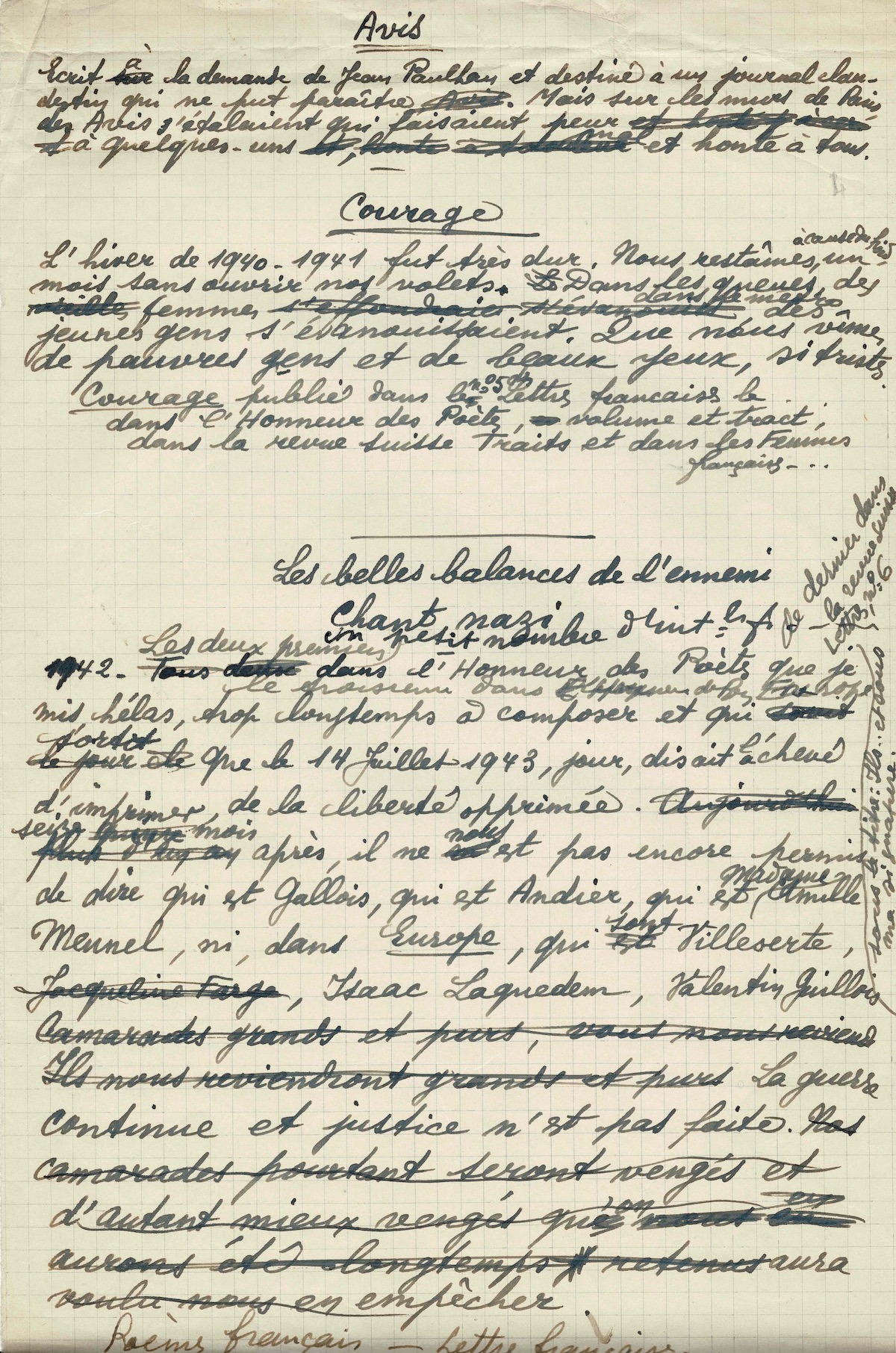
Paul Éluard describes his poetry and the Resistance during wartime. 1945.
"The winter of 1940-1941 was very harsh. Because of the cold, we went a month without opening our shutters."
Sold

"The winter of 1940-1941 was very harsh. Because of the cold, we went a month without opening our shutters."
Sold
Paul Éluard (1895.1952)
Autograph manuscript.
One folio page, first draft, on graph paper.
Slnd [late 1944 or early 1945]
Moving lines from the poet testifying to his commitment to the national Resistance during the Second World War. Éluard reflects on the context in which three of his most moving poems were written.
______________________________________________________
Notice.
Written at the request of Jean Paulhan and intended for an underground newspaper that was never published. But on the walls of Paris, notices were plastered that frightened and shamed everyone.
Courage.
The winter of 1940-1941 was very harsh. Because of the cold, we didn't open our shutters for a month. In the queues on the metro, women and young people fainted. How many poor people we saw, with beautiful eyes, so sad. This piece, " Courage," was published in issue no. 5 of Lettres françaises, in the book and pamphlet "L'honneur des poètes," in the Swiss journal Traits, and in Les Femmes françaises.
The enemy's beautiful scales. Nazi song.
The first two, in small numbers, appear in *L'Honneur des poètes*, which I unfortunately took far too long to compose and which was only published on July 14, 1943, the day, as the colophon stated, of oppressed liberty. Today, sixteen months later, we are still not permitted to say who Gallois is, who Andier is, who is Madame Camille Mennel, nor, in * Europe* , who are Villeserte, Isaac Laquedem, Valentin Guillois, great and pure comrades. They will return to us great and pure . The war continues, and justice is not yet done. Yet our comrades will be avenged, and all the more so because we have been held back from them for so long …
______________________________________________________
The poems "Avis ," " Courage," and "Les belles balances de l'ennemi" were written by Éluard in 1943, during the occupation. These poems, odes to the Resistance and national perseverance, illustrate the suffering caused by the German occupation.