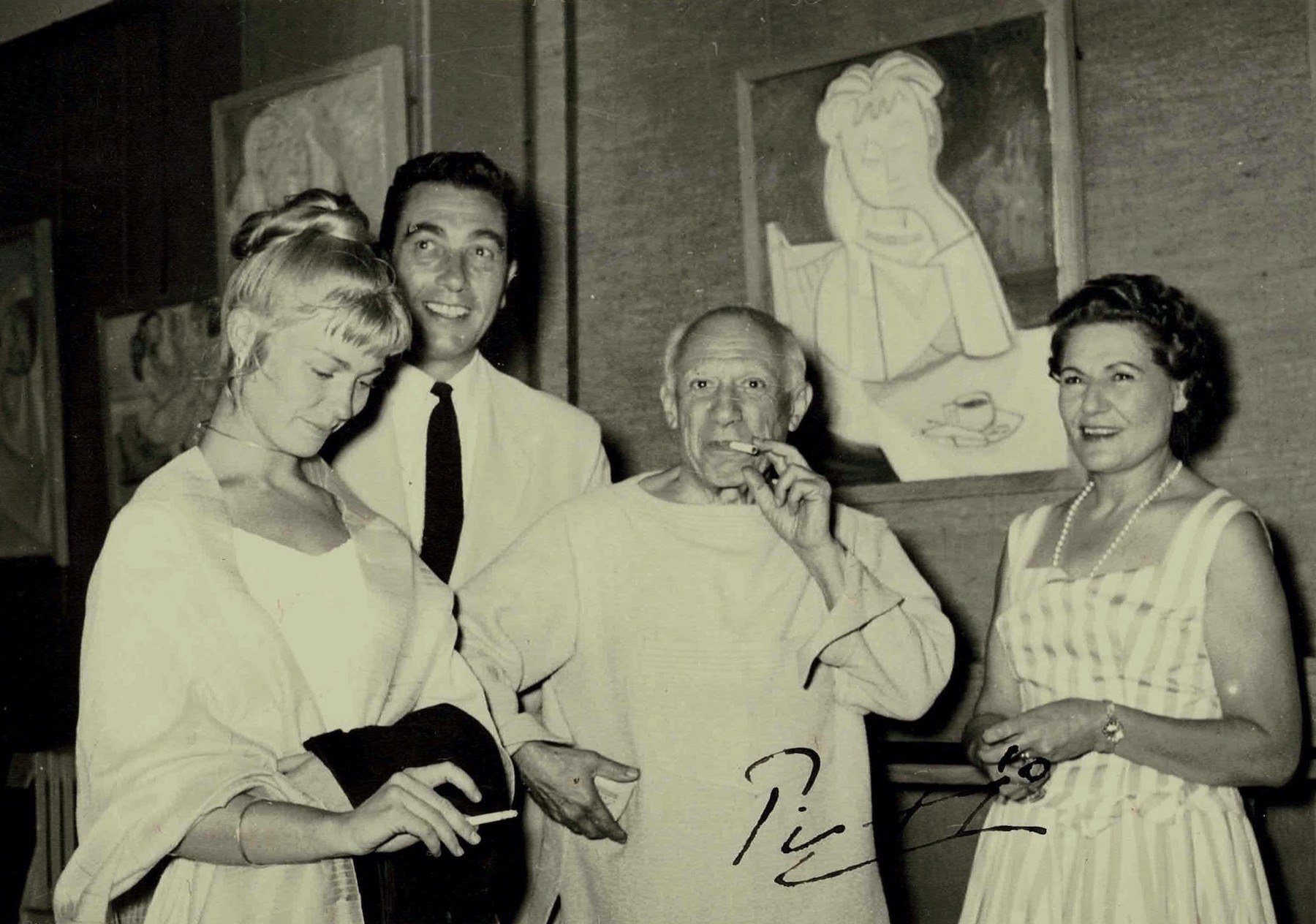
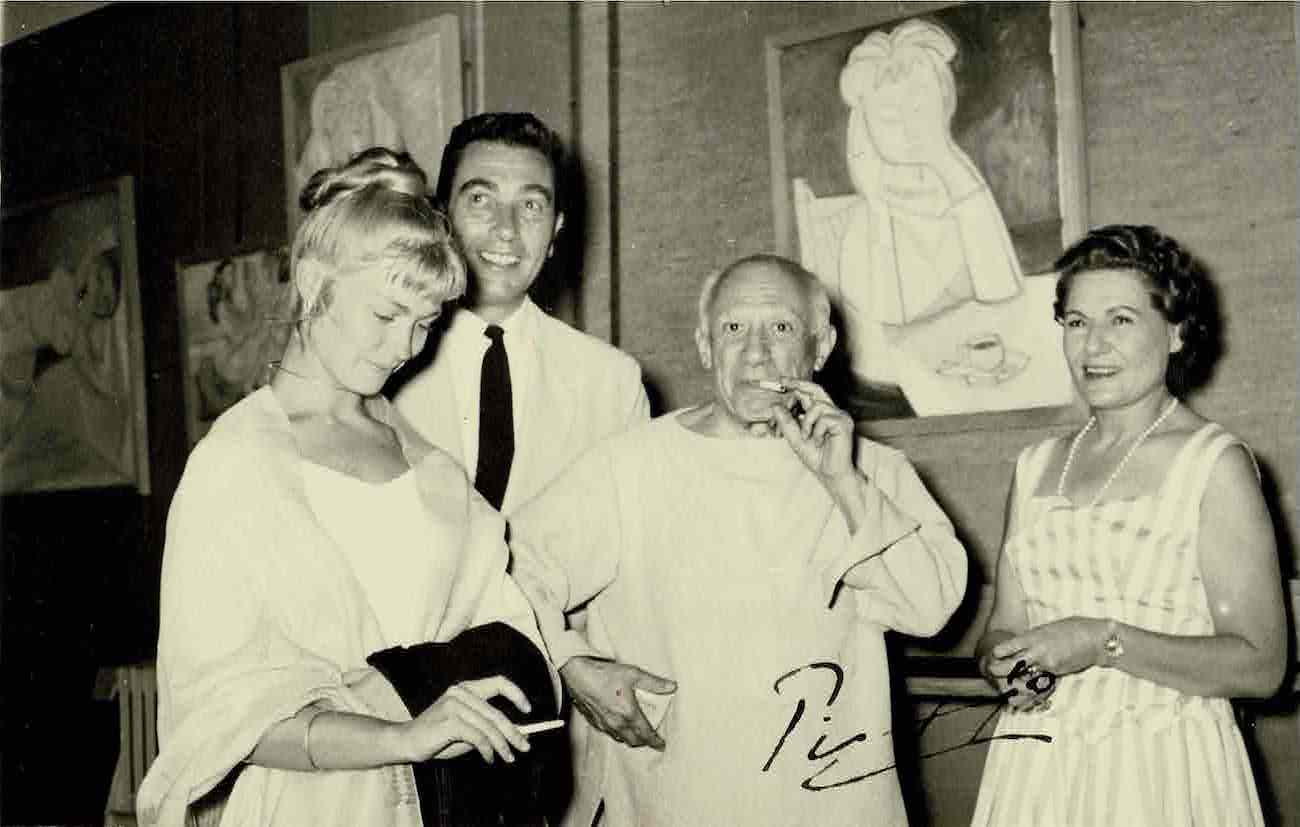
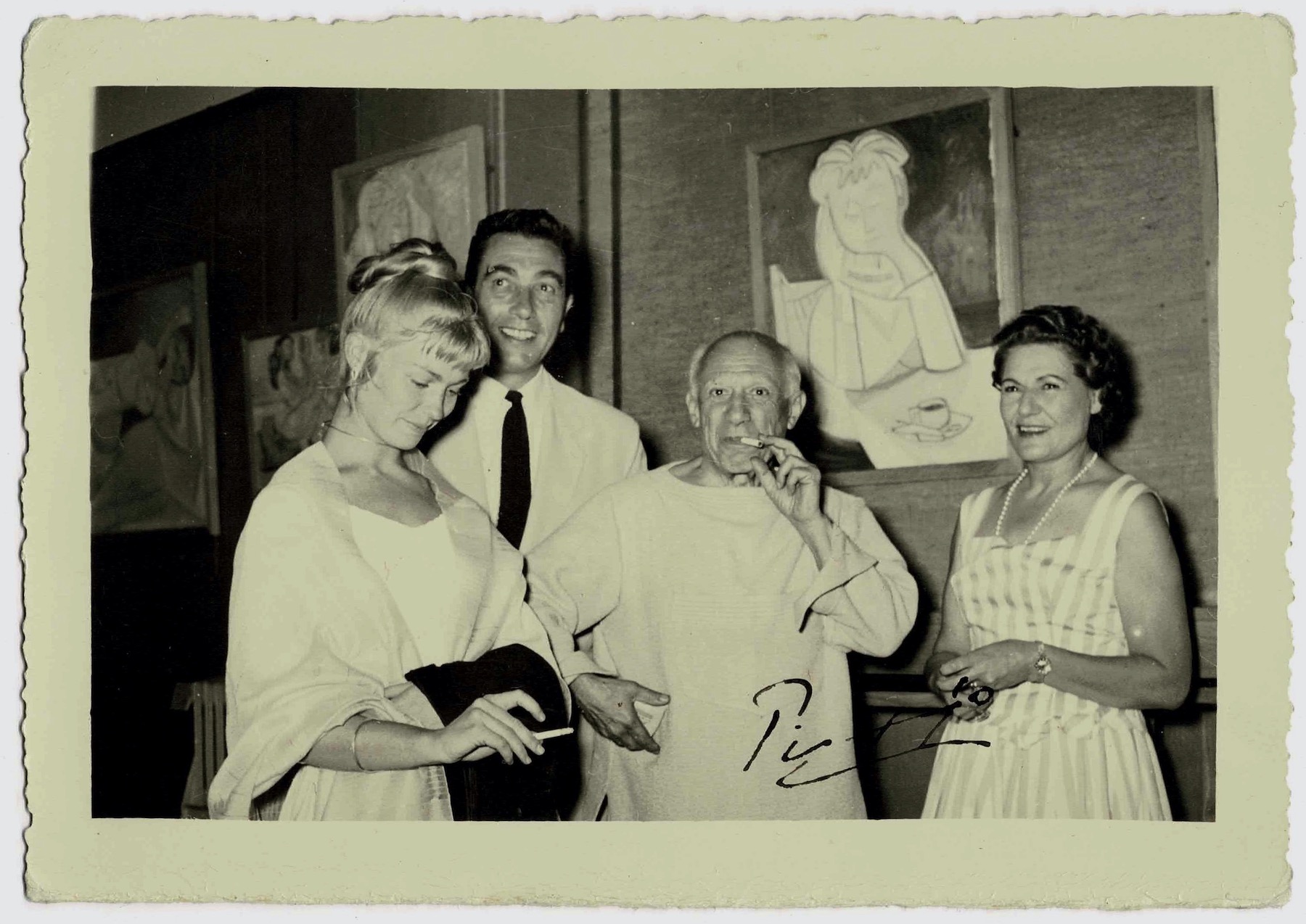

Picasso with his model Sylvette posing in front of his canvases, in Cannes, in 1957.
Sold
Pablo Picasso (1881.1973)
Original signed photograph.
Vintage silver gelatin print, probably unique.
Cannes – 1957.
________________________________________________
Picasso, with a laughing, smoking eye in front of his canvases, poses surrounded by gallery owners and his young model Sylvette David, during his exhibition at Galerie 65.
Behind Picasso, a work by the master depicting Sylvette sitting in front of a cup of coffee.
Image enhanced with Picasso's signature in black ink, in the lower margin.
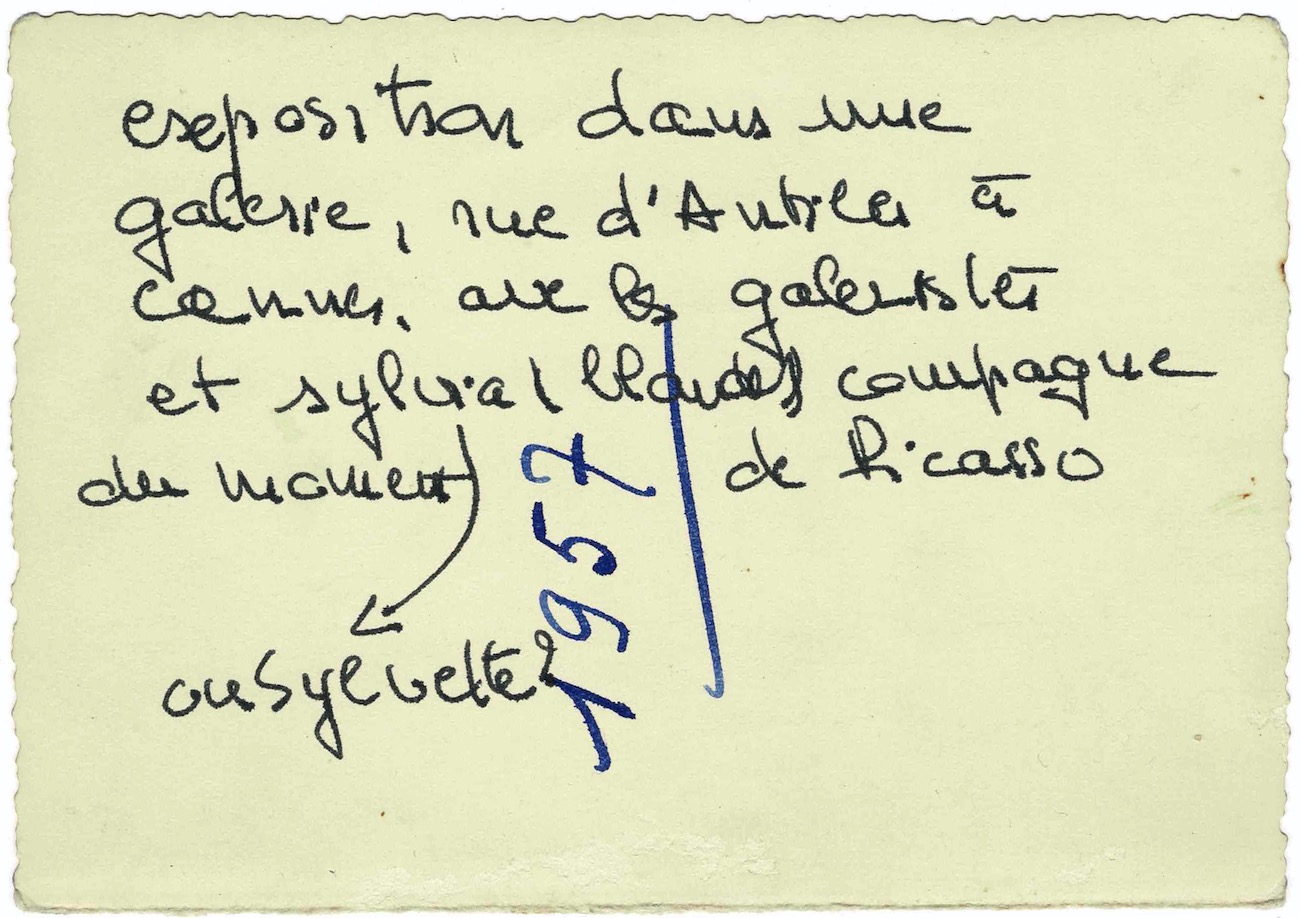
On the back, a handwritten caption reads: Exhibition in a gallery, rue d'Antibes in Cannes, with the gallery owners and Sylvette (blonde), Picasso's companion at the time.
Sylvette David, also known by her married name Lydia Corbett, was working in a pottery workshop near Picasso's in Vallauris in the summer of 1953. She was 19 years old at the time. With her serious beauty and her blond hair tied in a ponytail, she attracted the master's attention in 1954 and, for three months, became his muse and the subject of more than 40 works by Picasso.
Photograph with frayed edges. Oblong format: 9 x 12.50 cm.
________________________________________________
Sylvette Roux on Picasso : I was an extremely shy 19-year-old girl. I was afraid of everything, even speaking. When the famous painter asked me to pose for him in April 1954, I arrived at his studio, terrified, wearing a gray coat, tightly laced up to my neck. He wanted to pay me, but I refused, fearing he would ask me to undress.
I live in Vallauris with my mother. She's a painter, works in a pottery studio, and rents a small house in the village. At 19, I'm afraid of everything, including working. I've never had an education. My English fiancé, Toby, lives with us and earns a living by making wrought-iron furniture. My mother knows the Ramiés, owners of the Madoura pottery, well and asks them if they can show Picasso, who comes to their studio to make his ceramics, a very original chair by Toby. Toby and I stop by one evening, around 7 p.m., to see if Pablo liked his chair. Suzanne Ramié tells us that he bought it. Toby's face lights up with pride, and a few minutes later, Picasso arrives, beaming, a cigarette in his hand. His smile is beautiful, genuine, and you can see everything he's thinking in his eyes. I turn bright red, I'm so intimidated. He warmly congratulated Toby and asked us to deliver the object to La Galloise, his villa. A few days later, I was with a group of friends under the awning of a terrace piled high with old pottery that had been left out to dry. A simple wall separated us from Pablo's studio. Suddenly, we heard shouts of "Ooh ooh!" and above the wall, a huge canvas unfurled: it was my portrait, in profile, with my long ponytail. Picasso had drawn me from memory, in charcoal. We couldn't see the painter because he was quite small, but we could tell it was him. Picasso beckoned us over, opened the gate, and the tour of his studio began.
He was showing us his ceramics and paintings when he turned to me and asked me to pose for him. I was very surprised because I was with a friend who was much more beautiful than me. I replied, "I'll ask my mother." Who immediately said yes.
The next morning, late in the morning of that April 1954, dressed in a gray coat with a collar sewn by my mother and fastened up to my neck with five-franc buttons made by my fiancé, I arrived at the studio. Picasso kissed me on each cheek. He smelled good and was clean-shaven. He kindly asked me to sit in a rocking chair by a window and, above all, to remain in profile. The painter was smoking Gitanes cigarettes, and a pyramid of empty packs lay on the floor. He wanted to pay me. I refused. Because I thought that if I accepted, I would then have to pose nude. I was completely wrong: he never asked me to. After one sitting, he showed me my portrait in a navy blue turtleneck sweater and asked, "Do you like it?" I whispered, "Yes, Mr. Picasso." The next day, when I arrived at his studio, I discovered that he had removed the sweater from the canvas and painted me nude. “Sylvette, you’re not angry?” Without even blushing this time, I replied, “No, I think it’s fine, it doesn’t bother me at all.” Picasso often insisted, “Tell me if you need money. I know what it’s like not to have any.” Since I didn’t want to, he bought chairs from Toby. Sometimes he took me to visit Madoura. One day he led me into a large shed where his beautiful black Hispano-Suiza was parked. He said, “Get in.” We sat in the back, and he told me all sorts of stories about his life, his past, but I was so young, I didn’t understand much. As he left, he kissed me like a father on both cheeks.
I posed for him for about three months. At the end, he thanked me: “Sylvette, thank you for being there when I was in trouble. I was going through a rough patch in my love life, and your presence helped me.” In June, he called me to his studio and led me into a room: “Look, Sylvette, you need to choose a painting.” There were all my portraits there, about forty of them, both canvases and drawings. I chose the most lifelike and the largest one, dated May 5, 1954.
Overnight, thanks to his paintings, I became a star. I no longer dared to go out in the streets of Vallauris; people asked me for autographs. I was a little overwhelmed by it all.
Later, Toby fell ill and we needed money. I had to sell the portrait Picasso had given me. An American bought it, and I cried my eyes out; deep down, I so wanted to keep it. I sold it to him for 10 million old francs. That allowed me to buy an apartment in Paris, pay for Toby's medical treatment, and then marry him. I found my portrait again in England last year. The new owner, who had acquired it at auction for several million dollars, kindly agreed to see me. You can imagine, fifty-four years later, the emotion was overwhelming, and I wept.
Recently, I was invited to the San Antonio Museum in Texas. They have a portrait of me, and the curator asked me why Picasso had painted me without a mouth. A bit like Bécassine. I simply replied, "Because I was so shy I didn't speak." I owe it to him that I became a painter myself. For me, he was a key that opens all doors.