Oscar WILDE (1854.1900)
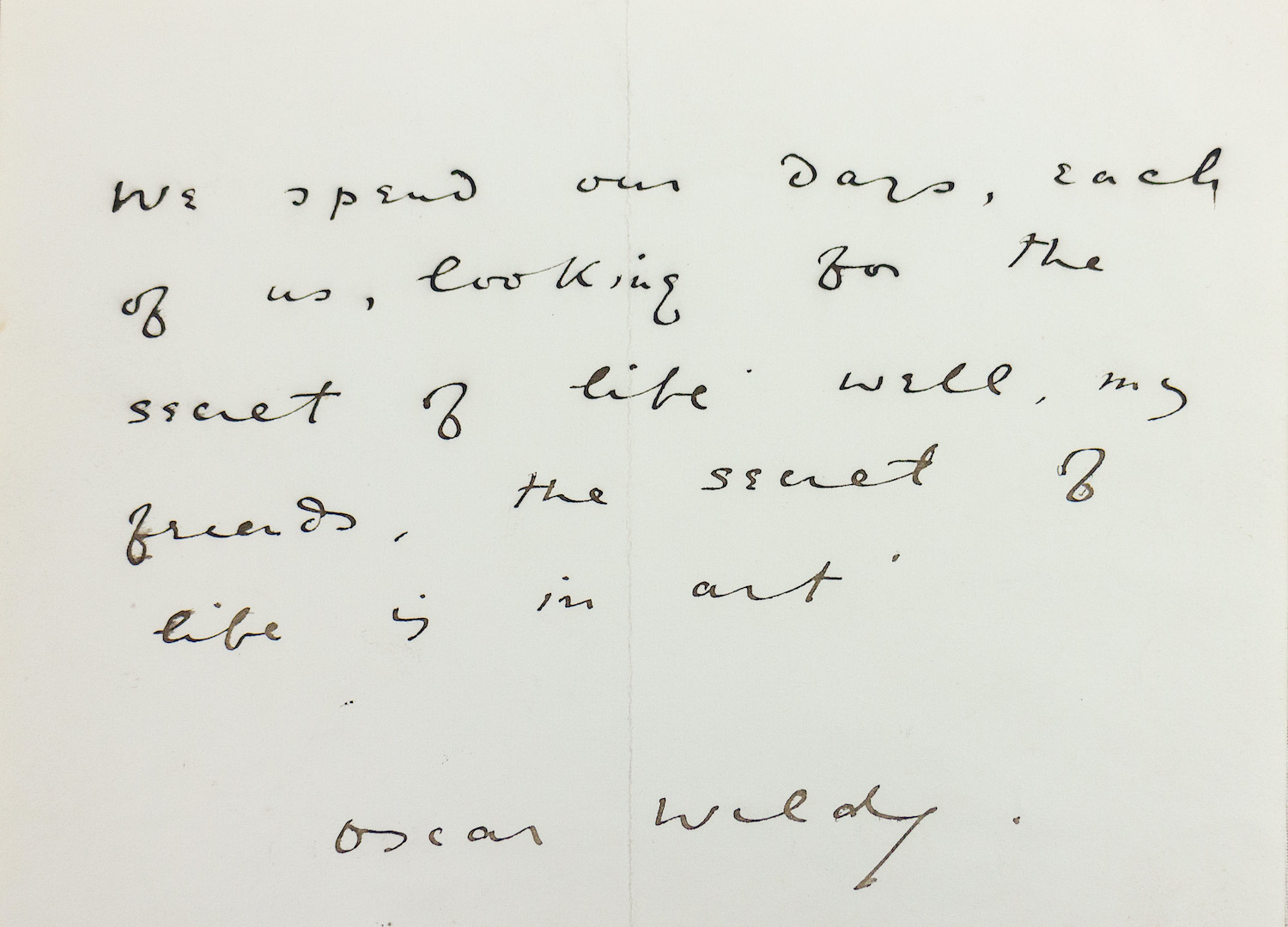
Signed autograph aphorism.
One oblong octavo page. No place or date (United States, 1882)
Wilde's exceptional aphorism, quintessence of his spirit devoted to Art, and concluding phrase of his lectures given in the United States and Canada in 1882, "The English Renaissance of Art".
We spend our days, each of us, looking for the secret of life.
Well, my friends, the secret of life is in art.
Oscar Wilde.
Throughout Wilde's books appear scathing epigrams, definitive pronouncements, and relentless aphorisms. These thoughts from one of the finest minds of the 19th century are now collected in dedicated volumes, where the reader discovers the fundamental importance of Beauty, Art, and the Spirit.
For Wilde, Art and Beauty were a religion; a reason for living: "Beauty is the symbol of symbols. It reveals everything, for it expresses nothing. By showing itself to us, it makes us see in its entirety the world bursting with colors" (The Critic as an Artist).
Invited to give a series of lectures on the theme of Aesthetics and the English Renaissance of Art, Wilde arrived in the United States on January 3, 1882, for a tour scheduled to last four months. This tour ultimately extended to a year, taking him as far as Canada. The present aphorism, the quintessence of Wilde's thought, a summary of his entire life, is in fact the concluding sentence of this series of lectures, "The English Renaissance of Art," delivered on American soil.
Playwright, poet, novelist and critic, Oscar Wilde used all literary forms to worship Beauty, and its manifestations: works of Art.
We know of the fascination that a number of paintings exerted on Wilde, and first and foremost Guido Reni's Saint Sebastian.
Breaking with Aristotelian tradition and classical philosophy, Wilde refutes art as an imitation of life. Art is life, art imitates nature, he insists. And this thought, so clearly expressed in our manuscript, is not merely a dandy's pose: it is a profound conviction, a profession of faith. Who better than Oscar Wilde has been able to demonstrate the living power of a work of art? We all think of the haunting reading of the pages of The Picture of Dorian Gray, when the painted and aging image of Dorian Gray bears the marks of age and vice, only to be stabbed, riddled with suicidal knife blows.
The impact of this new idea will be immense. It is in Marcel Proust that we find the most resounding echo of these words. “The secret of life is in art,” Oscar Wilde affirms. “The supreme truth of life is in art,” the narrator of In Search of Lost Time tells us ! “The greatness of true art (…) was to rediscover, to recapture, to make known to us this reality from which we live (…) this reality which we might very well die without having known, and which is quite simply our life. True life, life finally discovered and illuminated, the only life consequently truly lived, is literature; this life which, in a sense, dwells at every moment in all men as well as in the artist.”
This remarkable dialogue undoubtedly owes its existence to the shared mentor of Wilde and Proust, John Ruskin. Their ideas germinated and nourished the entire 20th century. These few words of Oscar Wilde truly set a precedent. They inspired so many followers who, in his footsteps, found in Art a reason for living, a more complete and profound way of understanding the world.
André Suarès wrote in the opening pages of The Condottiere , " Like everything that matters in life, a beautiful journey is a work of art. "
Closer to home, we find another interpretation of these essential words from the British writer : “To make essential to our sight—and who knows, to our lives—landscapes that until then were nonexistent or invisible to us… that is the paradox and the fabulous privilege of the artist. So let us not hesitate to say it again: it is nature that imitates art, not the other way around. In the fields surrounding my village, I perceive each summer the disarray, the despair of the sunflowers: are we worthy of Him, they murmur in the whispers of the wind, of this Van Gogh who first gave birth to us?” (Jacques Lacarrière)