Max ERNST (1891.1976)
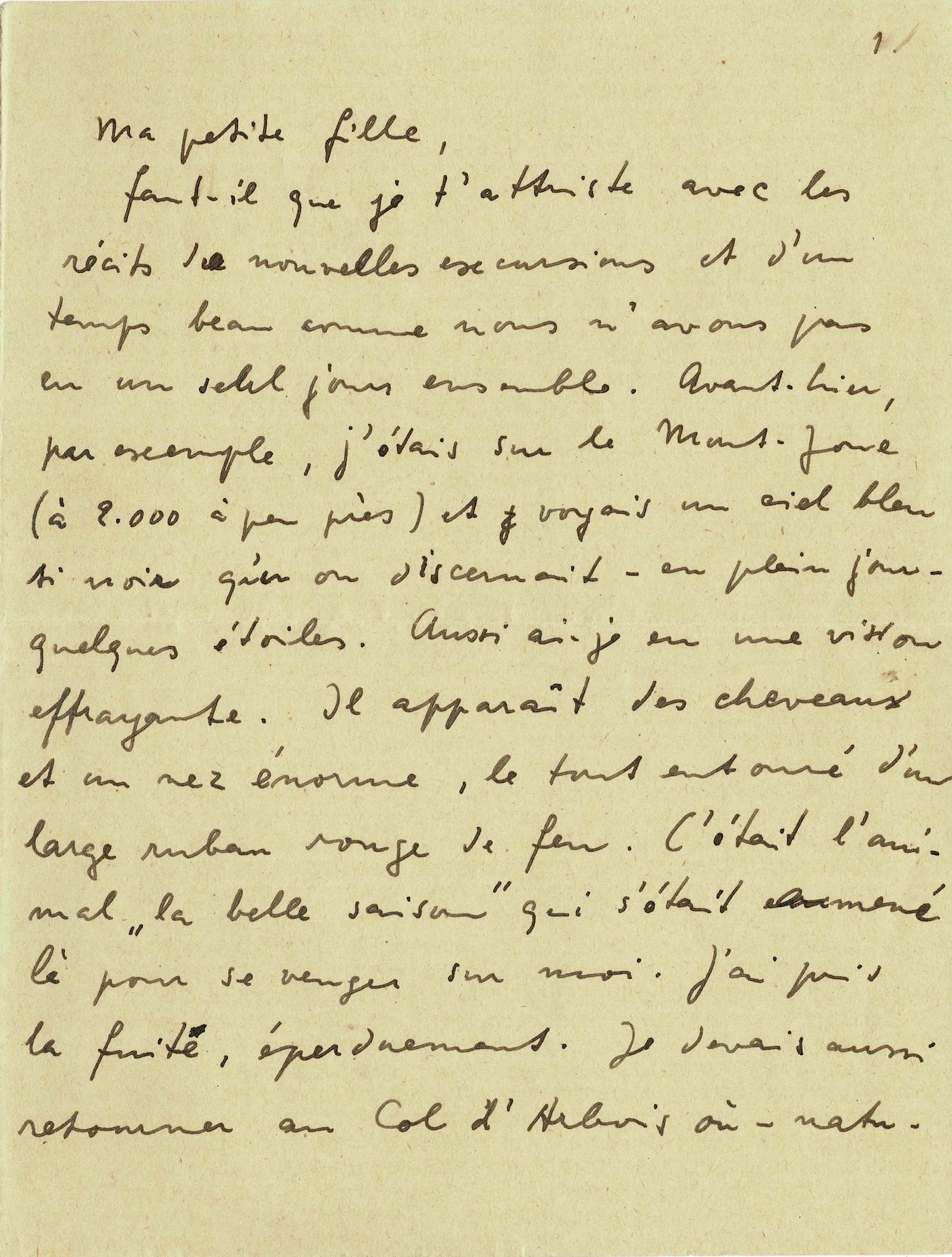
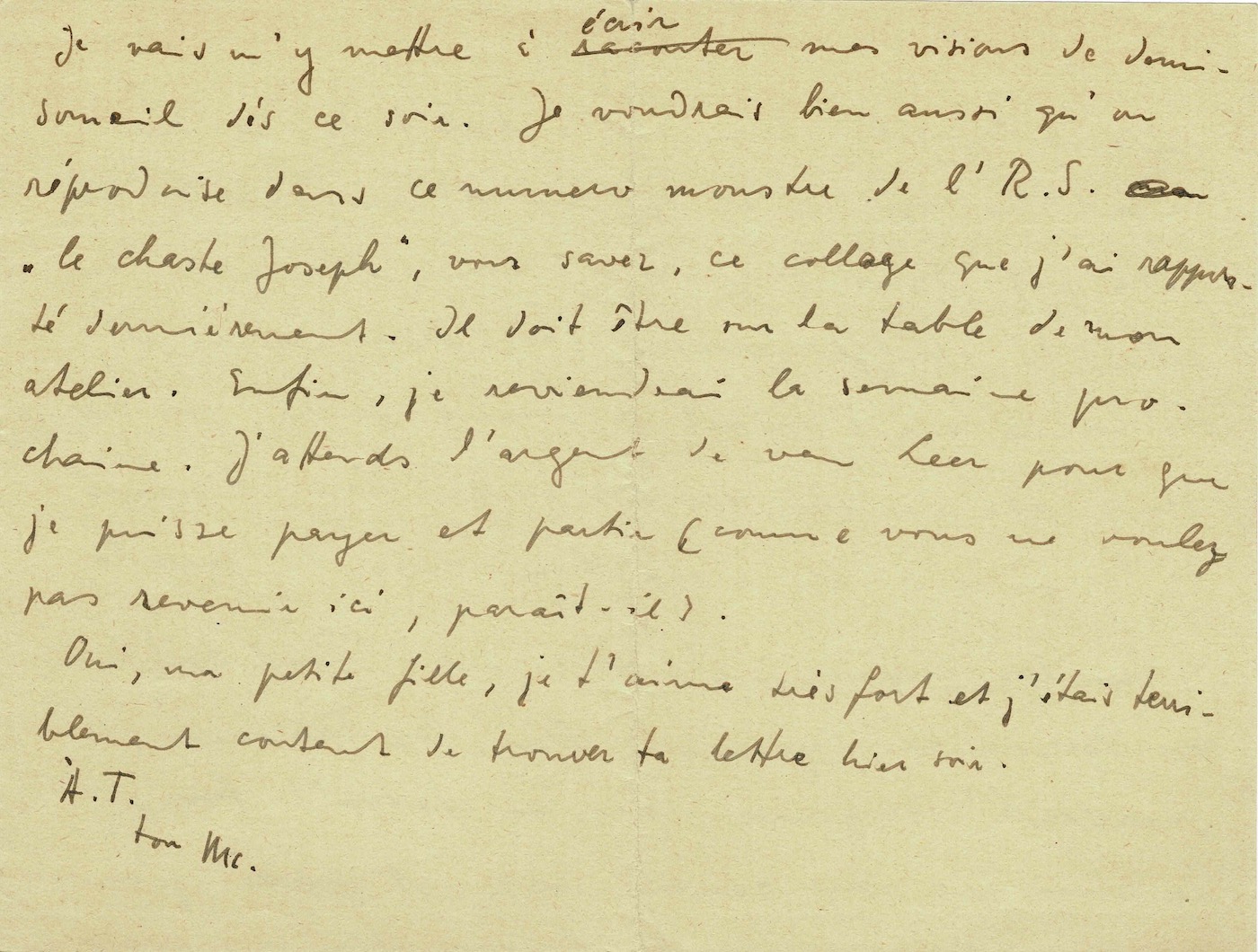
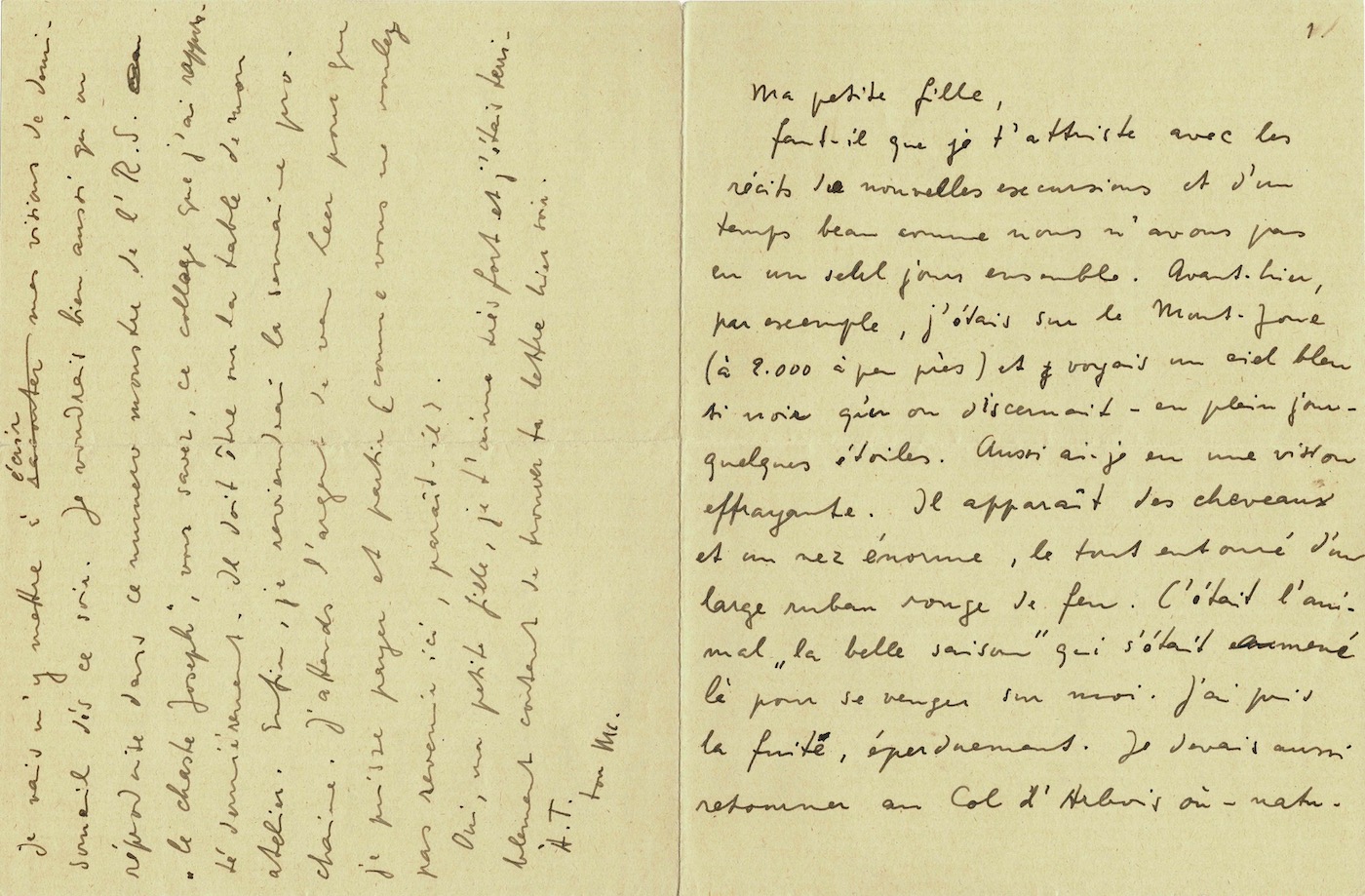
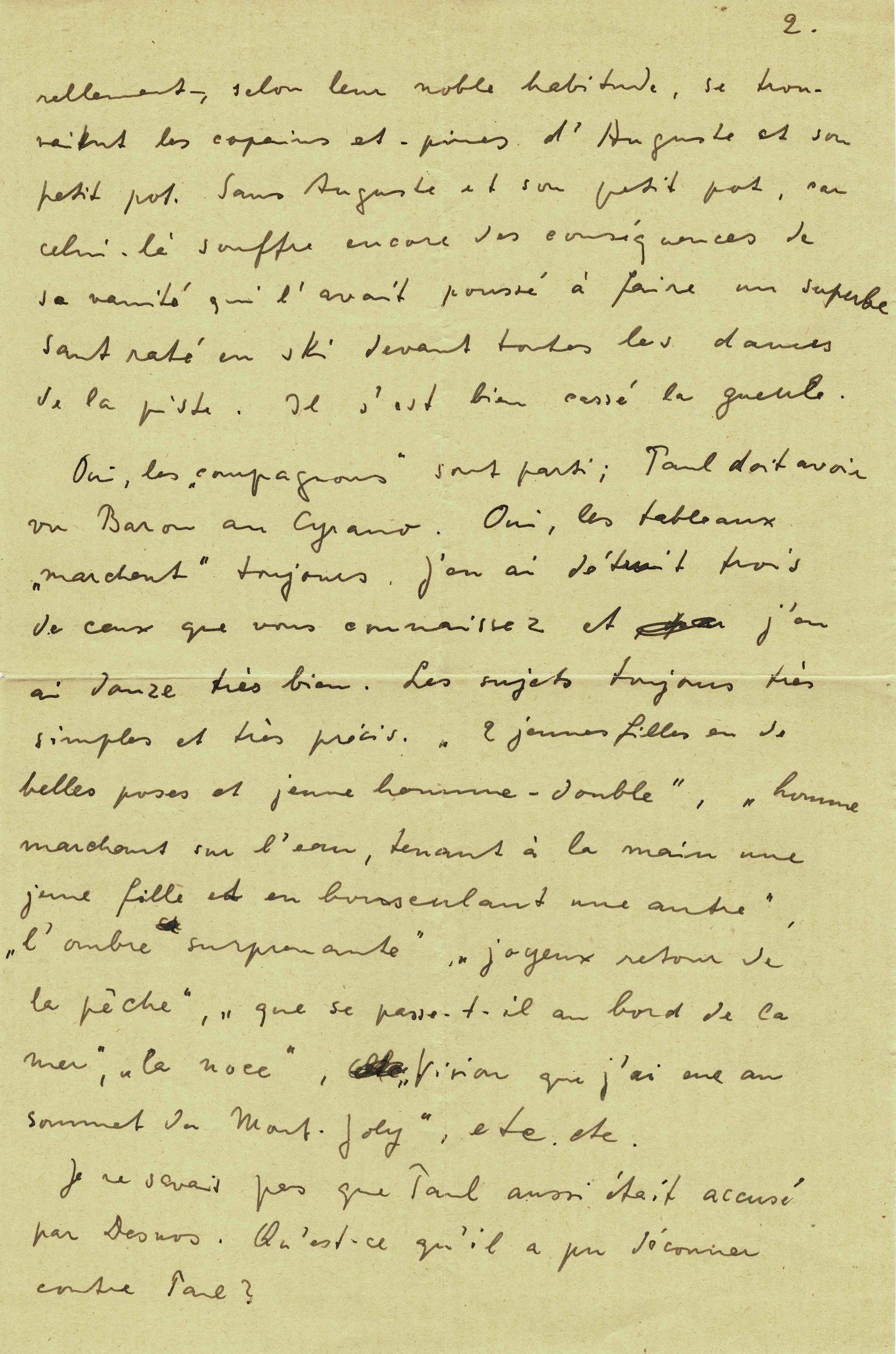
Autographed letter signed to Gala Éluard.
Four pages in-8°.
No place or date. [Megève. 1927]
"Yes, the paintings are still 'working'. I destroyed three of the ones you know and I have twelve very good ones. The subjects are always very simple and very precise."
A beautiful letter from Max Ernst to Gala. After the artist's two memorable exhibitions at the Van Leer Gallery in March 1926 and March 1927, Ernst returns to his lover to discuss his works with "subjects that are always very simple and very precise."
_______________________________________________________
“My dear girl, must I sadden you with tales of our latest excursions and the beautiful weather we haven’t had a single day together? The day before yesterday, for example, I was on Mont-Joue (at about 2,000 meters) and saw a sky so blue and dark that you could make out—in broad daylight—a few stars. And so I had a terrifying vision. Horses and an enormous nose appeared , fiery red ribbon. It was the creature of ‘the beautiful season’ that had come there to take revenge on me. I fled, desperately . I also had to return to the Col d’Arbois where—naturally—according to their noble custom, my friends were … Without Auguste and his little pot, for he is still suffering the consequences of his vanity, which had led him to make a superb, botched jump on skis in front of all the ladies on the slope.” He really fell flat on his face.
Yes, the "companions" have left [sic] ; Paul must have seen Baron at the Cyrano. Yes, the paintings are still "working." I destroyed three of those you know and I have twelve very good ones. The subjects are still very simple and very precise. "2 young girls in beautiful poses and a young man-double," "man walking on water, holding a young girl by the hand and jostling another," "the surprising shadow," "joyful return from fishing," "what is happening by the sea," "the wedding," "vision I had at the summit of Mont-Joly," etc. etc.
I didn't know Paul was also being accused by Desnos. What's his problem with Paul?
I'm going to start writing down my half-asleep visions tonight. I'd also like them to reproduce "The Chaste Joseph" [La Révolution surréaliste] . It should be on my studio table. Anyway, I'll be back next week. I'm waiting for the money from Van Leer [the gallery owner Leonard Van Leer] so I can pay and leave (since you don't seem to want to come back here).
Yes, my little girl, I love you very much and I was so happy to find your letter last night. Love, M
_______________________________________________________
At the beginning of 1927, Max Ernst explored all the possibilities of frottage and grattage, techniques he had invented in 1925, in a series of paintings: “All these paintings […] were executed during the winter in Megève […]. They were the first examples of a new technique related to frottage. It consists of creating transparent lines on a pre-prepared canvas, using a mason's spatula coated with darker colors, by applying light colors to an uneven surface (a piece of string, for example). Simplicity itself! Yet, one must know how to find signs in this optical illusion that lead to unexpected interpretations” (Max Ernst, Writings , 1970). Several of these works evoked couples and love, borrowing their imagery from Christian iconography.