Jean Jaurès (1859.1914)
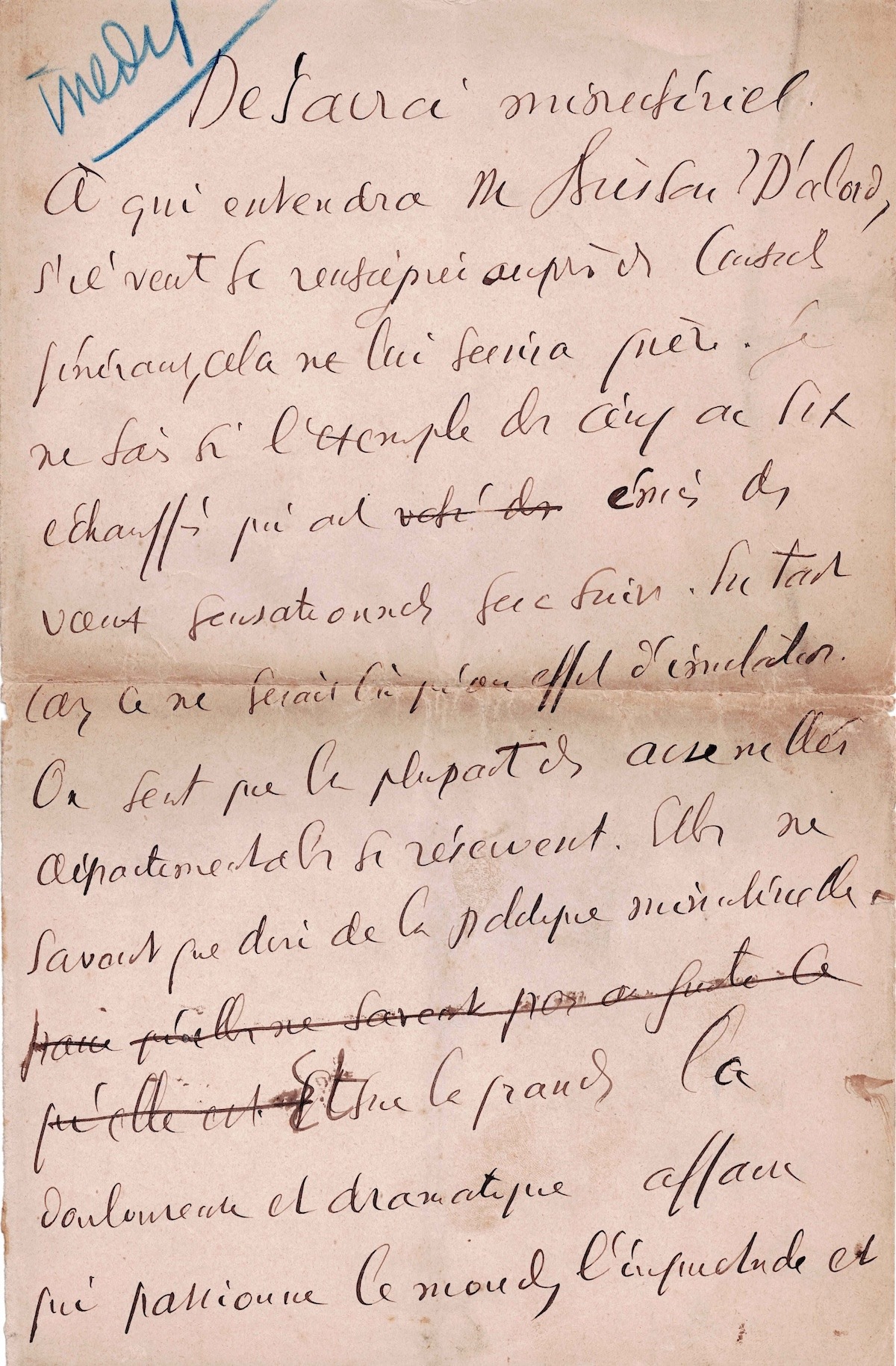
Autograph manuscript signed – Ministerial disarray.
Seventeen folio pages (31 x 20 cm) on paper with frayed edges.
Annotations in grease pencil.
No place or date [Paris, August 29 or 30, 1898].
« Concern and doubt are beginning to spread regarding this major, painful, and dramatic affair that has captivated the world. »
A precious and lengthy unpublished manuscript by Jean Jaurès on the Dreyfus Affair, written just hours before Colonel Henry's confession. Jaurès denounces the indecision of the Brisson government in the face of mounting evidence in favor of Captain Dreyfus. Intended for La Petite République, the article remained unpublished.
_____________________________________________
For weeks, Jean Jaurès has been denouncing the inconsistencies of the Dreyfus affair, both in the Chamber and in La Petite République. His articles often occupy the six columns of the front page, with titles in large capitals denouncing “Dreyfus’s innocence” (August 13, 1898), “The True Traitor” (August 18), “The Bordereau is from Esterhazy” (August 19), “The Secret Documents” (August 25), “The False Document” (August 28), etc.
This attack against the “Ministerial Disarray” was undoubtedly written on August 29 or 30, in order to appear on the front page of the newspaper on August 31 or September 1 : political instability, the temptation of a coup by the army and the so-called “patriots” were at their peak. And, Jaurès wrote, “ concerning the great, painful, and dramatic affair that is captivating the world, anxiety and doubt are beginning to spread”…
A dramatic turn of events occurred on August 30th: Colonel Henry confessed, admitting to being the author of the forgery, and that same evening committed suicide. This marked a turning point in the Affair, paving the way for a retrial. Jaurès's article on "Ministerial Disarray" became irrelevant, and on September 1st and 2nd, La Petite République ran headlines such as "The Arrest of Colonel Henry" and then "The Debacle of the General Staff."
Jaurès' article reads like his speeches; his implacable logic is served by an elegance of style which fortunately does not moderate either the scalpel of the idea or the irony.
Doubts are mounting and the Radical government is stalling: its most anti-Dreyfusard elements – like the Minister of War, Cavaignac – are making their voices heard, supported by the press: “Mr. Rochefort is beginning to think the government is lukewarm. The fact that they haven't replaced all the professors who still dare to have an opinion and express it on this sensitive issue means that Mr. Bourgeois and perhaps Mr. Brisson are not the irreproachable patriots they want to be at L'Intransigeant. They should hurry up and dip the whole ministerial soup into Mr. Cavaignac's big tureen, or Mr. Rochefort will spill the beans.”
The army and the anti-Semites in the government believe it is "time to act," increasingly leaning towards radical solutions. They would readily resort to "a good little coup d'état and deport without trial those troublemakers who know the truth and speak it." But, Jaurès remarks ironically, "that would be a breach of decency, and Mr. Brisson wants to be treated with a little restraint. He is quite willing to witness or preside over the violation of all republican freedoms and legal . He is quite willing to ignore whether or not a man has been tried outside of any legal process. He is quite willing to deliver to the servility of civilian judges, to the hatred of military judges, the soldier who committed the crime of denouncing Esterhazy's treason. He is quite willing to wrest from the light of public debate, through the most cumbersome procedural tricks, the forgeries of Esterhazy and Du Paty de Clam." But he still wants, even to this ultimate downfall, to maintain some semblance of appearances, and it would be cruel to force him into the blatant brutality of a coup d'état. To dishonor himself in broad daylight—what a disgrace! Let us spare Mr. Brisson's republican virtue the cup.
Despite the "ministerial disarray" and the increasingly violent campaign of the anti-Dreyfusards, Jean Jaurès believed in a resurgence: "Those who today believe, know, and say that a crime has been committed are too numerous to be silenced by force. And if the nationalists and Boulangists imagine they can frighten us, what foolishness! Boulanger and Rochefort crossed the border; that's no reason for us to flee. And perhaps, finally, the country will awaken. Perhaps it will be ashamed to leave a handful of men to fight alone against the violence of militarism and the retrograde insolence of the General Staff. [...]
Clericalism, capitalism, militarism are the three chains of the past: whether one is attached by one or the other, it matters little whether one marches behind Mr. de Mun the preacher or behind Mr. de Mun the cuirassier, whether Catholic infallibility or military infallibility remains, it is to the right that one is riveted?
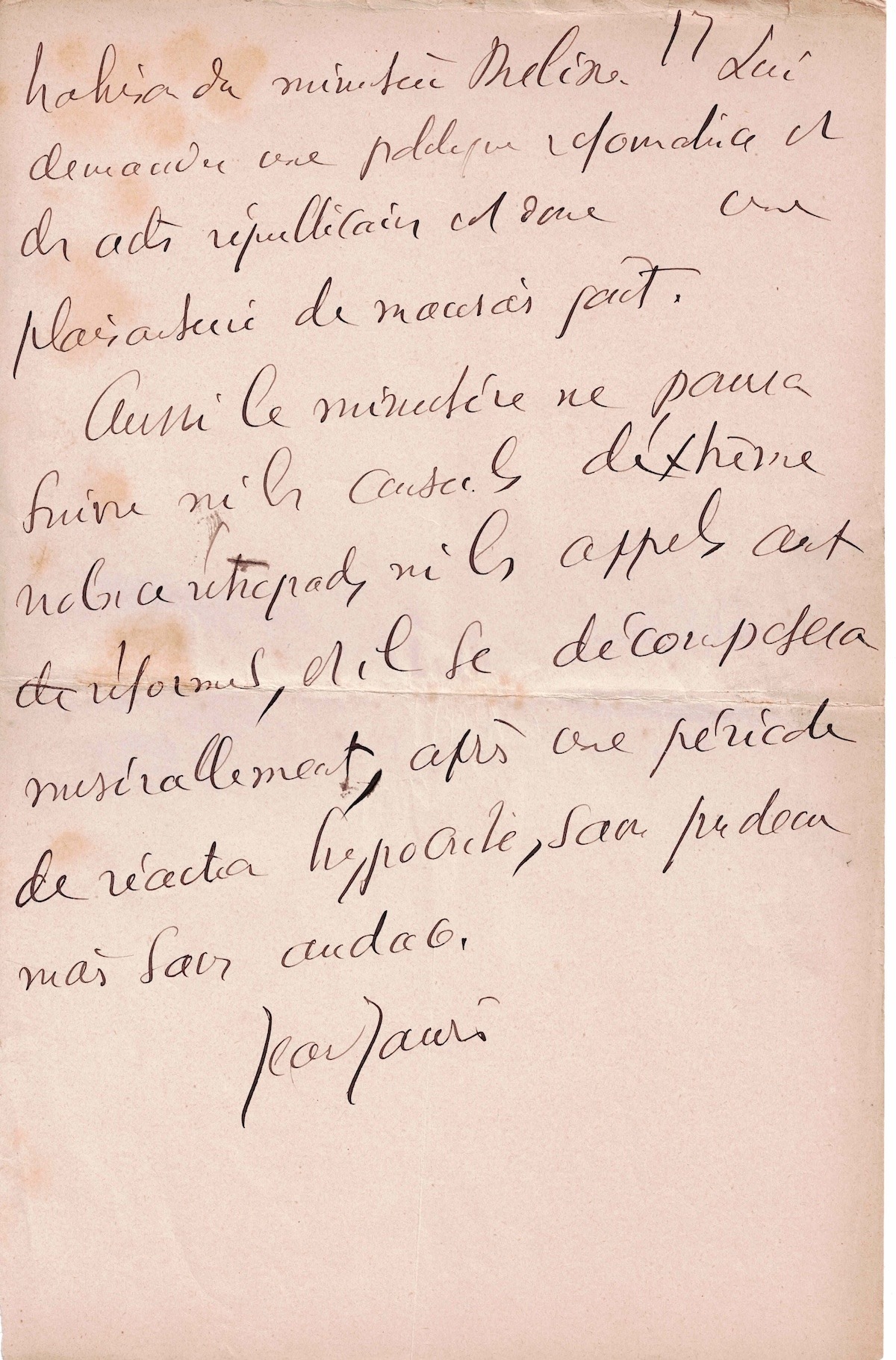
The Republic is not liberated: it has merely changed its tune. Or rather, since all the forces of the past are united, the Brisson ministry is continuing the exact same betrayal as the Méline ministry! Asking it for reformist policies and republican actions is therefore a bad joke.
Therefore, the ministry will be unable to heed either the advice of extreme retrograde violence or the calls for reform, and it will disintegrate miserably after a period of hypocritical reaction, lacking both prudence and boldness
_____________________________________________
Full text:
Ministerial disarray. And who will listen to Mr. Brisson [Deputy Henri Brisson (1835-1912)]? First of all, if he tries to consult the departmental councils, it will be of little use to him. I don't know if the example of five or six hotheads who voted for and issued sensational resolutions will be followed. In any case, it would only be a matter of emulation. One senses that most of the departmental assemblies are keeping their cards close to their chest. They didn't know what to say about ministerial policy because they didn't really know what it was .
And on this great, painful, and dramatic affair that has captivated the world, anxiety and doubt are beginning to spread. Consequently, politicians in the departments generally deem it wiser to remain silent; or if they decide to speak, it will be only half-heartedly, so as not to compromise themselves by directly opposing the motions of the "patriots."
Judging by the attitude of the first week, hesitation, discretion, and silence seem to be the almost universal watchword. Indeed, when newspapers or politicians do speak out, it doesn't do much to help Mr. Brisson. The advisors agree on demanding "action" from the ministry. The problem is that they aren't all asking for the same things. On one side, there are the reactionaries and radical nationalists (they're one and the same) who are urging Mr. Brisson to put a stop, through decisive measures, to the campaign waged by those who believe in the unfortunate error of the court-martial that tried Dreyfus.
It seems that by attacking the reactionary and treacherous general staffs who are protecting the true traitor Esterhazy, one is attacking the army itself: and Mr. Déroulède cannot tolerate this. "The bugle sounds the charge. The Zouaves march on singing."
Were the ministers like the Zouaves, led by Mr. Déroulède's bugle? He's not entirely alone. Mr. Rochefort is beginning to find the government lukewarm. The fact that all the professors who still dare to have an opinion on this sensitive issue haven't been replaced suggests that Mr. Bourgeois, and perhaps Mr. Brisson as well, aren't the irreproachable patriots they're expected to be at L'Intransigeant. They'd better hurry up and dip the whole ministerial soup into Mr. Cavaignac's great tureen, or Mr. Rochefort will spill the beans. With Déroulède and Rochefort, the royalists of the Southwest march valiantly. Their major newspaper, Le Nouvelliste of Bordeaux, considers it imprudent, even sacrilegious, to touch Esterhazy. In a feature article on Wednesday, August 24th, it writes that referring Esterhazy to a Board of Inquiry is a grave mistake.
“Commander Esterhazy is hardly a likeable private man… but in this case, it’s not about the man himself: in the unfolding drama, this officer plays such a crucial role that if he succumbs to the attacks of the Dreyfusards, all our staff officers will be implicated personally . Therefore, whatever his faults, he must be treated as an inviolable and sacred figure ! Reasons of state demand it… so no weakness, no failing. In the higher interest of national defense, it is essential that Esterhazy remain untouched, whatever his faults may be. A word to the wise for the Boards of Inquiry and to all French citizens who defend the army!”
It is undoubtedly under the impression of these words that the General Council of the Gironde requested the gag, and even better if necessary, by the sacrileges which do not embody the fatherland in the sacred character of the falsifying and traitorous uhlan.
But it is clear that within the General Staff, the Ministry is beginning to be seen as somewhat weak. It seems that its actions are not entirely consistent with Mr. Cavaignac's forceful words. Mr. Rochefort believes that his denunciations are not claiming enough victims. After striking Mr. Stapfer, Mr. Bourgeois seems hesitant to strike the university again. He mistakenly imagines, as the imperious friend of the Uhlan informs him, that one can appease both Dreyfusard and patriotism. And for the staunch Esterhaz supporters, Mr. Cavaignac himself, by playing the charade of the Council of Inquiry, is making a dangerous and foolish .
In truth, it is time to act. Yes, but what to do? Resort to a good old-fashioned coup d'état and deport without trial those troublemakers who know the truth and speak it? That would be an affront to decency, and Mr. Brisson wishes to be treated with some leniency. He is quite willing to witness or preside over the violation of all republican liberties and legal . He is quite willing to ignore whether or not a man has been tried outside of any legal process. He is quite willing to deliver to the servility of civilian judges, to the hatred of military judges, the soldier who committed the crime of denouncing Esterhazy's treason. He is quite willing to wrest from the light of public debate, through the most cumbersome procedural contrivances, the forgeries of Esterhazy and Du Paty de Clam. But he still wants, even to this ultimate downfall, to save some semblance of appearances, and it would be cruel to drive him to the obvious brutality of a coup d'état. To dishonor oneself in broad daylight, what a disgrace! Let us spare Mr. Brisson's republican virtue the cup. So what?
Are we going to hold trials for the press? Drag those who denounce Esterhazy, Du Paty de Clam and the General Staff before the Assize Court? Dangerous tactic: because discussion is allowed, witnesses can be called, and neither Esterhazy nor Du Paty seem to have a very keen taste for this kind of spectacle.
To call for a change in the press law, to consider trying in criminal court and behind closed doors those imprudent individuals who question the decisions of the high army? It will undoubtedly happen, and for the radicalism of Mr. Brisson, Mr. Sarrien, and Mr. Bourgeois, it will be a fitting end to their careers. Mr. Brisson is no doubt resigned to it. What does one more step matter in his downfall? A few months ago, the day after I posed this very serious question to Mr. Méline [Jules Méline, President of the Council from April 1896 to June 1898], before the Chamber: yes or no, were documents communicated to the judges that the accused could not have seen?
A man who was and still is very close to Mr. Brisson told me this: "Do you know what Mr. Brisson told me last night after the meeting? I will never forgive my party for having allowed Mr. Jaurès the honor of asking that question."
And since becoming chairman of the council, Mr. Brisson has jealously and carefully left the honor of asking it to others. He can therefore certainly go down further.
But who would benefit from these prosecutions? Those who today believe, know, and say that a crime has been committed are too numerous to be silenced by force. And if the nationalists and Boulangists imagine they can frighten us, what foolishness! Boulanger and Rochefort crossed the border; that's no reason for us to flee. And perhaps, finally, the country will awaken. Perhaps it will be ashamed to leave a handful of men to fight alone against the violence of militarism and the retrograde insolence of the General Staff.
Therefore, the ministry will be very difficult to give Mr. Déroulède, Mr. Rochefort and the royalists of Bordeaux all the satisfactions they demand.
But what can he do on the other hand for the old-school radicals who are demanding reforms from him? Income tax? Revision? All of that has been solemnly abandoned; how will it be taken up again? By understanding patriotism as understood by the descendants of émigrés and coup d'état generals, the Brisson ministry is as closely linked to the right wing as the Méline ministry was.
Clericalism, capitalism, militarism are the three chains of the past: whether one is attached by one or the other, it matters little whether one marches behind Mr. de Mun the preacher or behind Mr. de Mun the cuirassier, whether Catholic infallibility or military infallibility remains, it is to the right that one is riveted?
The Republic is not liberated: it has merely changed its tune. Or rather, since all the forces of the past are united, the Brisson ministry is continuing the exact same betrayal as the Méline ministry! Asking it for reformist policies and republican actions is therefore a bad joke.
Therefore, the ministry will be unable to follow either the advice of extreme retrograde violence or the calls for reforms, and it will disintegrate miserably, after a period of hypocritical reaction, without prudence but without boldness.
Jean Jaurès.