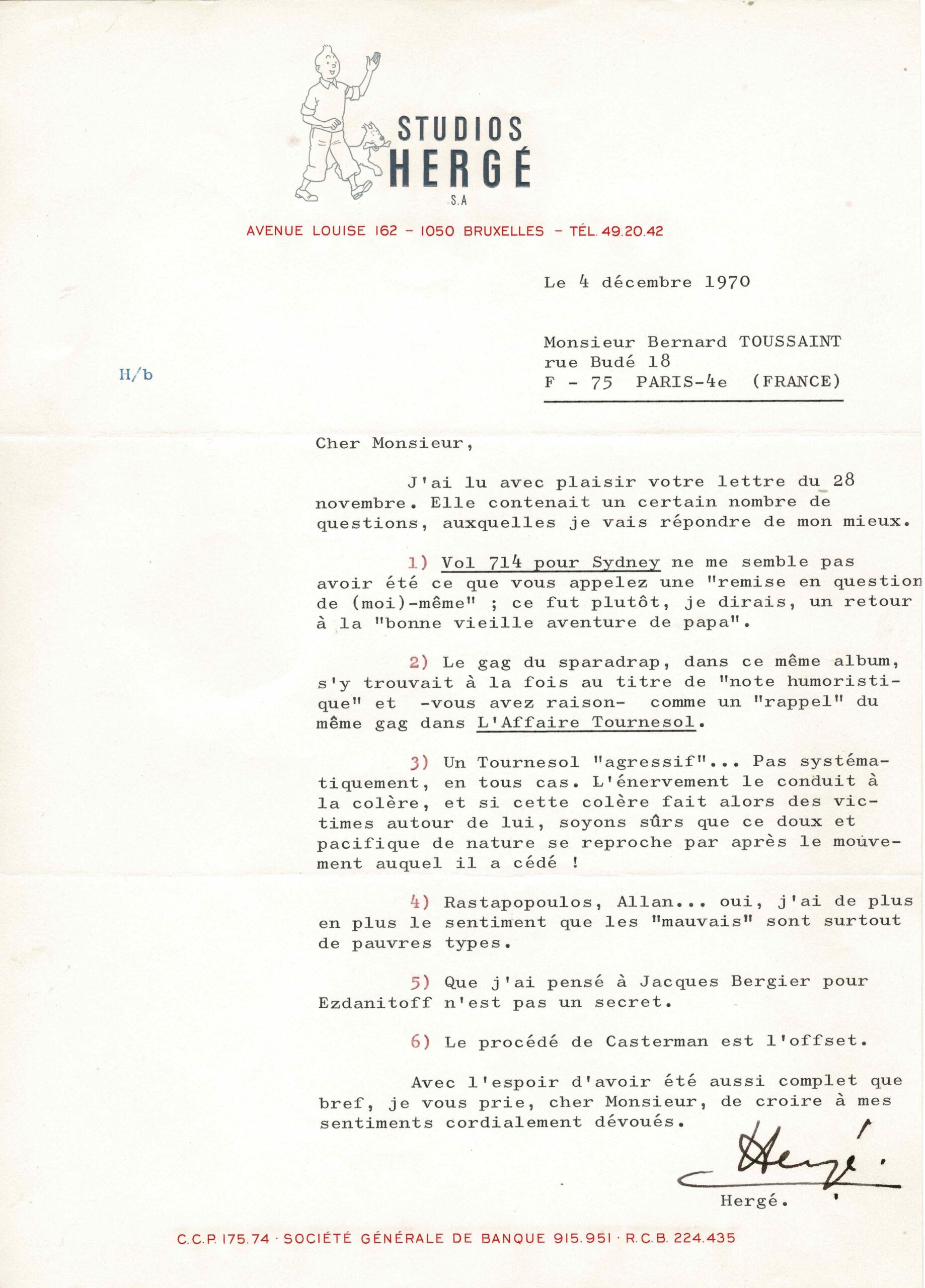

" Flight 714 to Sydney doesn't seem to have been what you would call a self-questioning."
Sold
Georges RÉMI, known as HERGÉ (1907-1983)
Signed letter to a Parisian reader.
One page in quarto on Hergé Studios letterhead.
Brussels. December 4, 1970.
A wonderful letter from the father of Tintin, retrospectively analyzing, for a reader, certain elements and characters of Flight 714 to Sydney.
Referring to the bad Allan and Rastapopoulos as well as Professor Calculus's passing tempers, Hergé also revisits one of the most famous gags from all of Tintin's adventures: the plaster gag.
______________________________________________________________________
"Dear Sir, I read with pleasure your letter of November 28th. It contained a number of questions, which I will answer to the best of my ability.
1) Flight 714 to Sydney , does not seem to me to have been what you call a "questioning of (myself)" ; it was rather, I would say, a return to the "good old adventure of dad".
2) The plaster gag, in this same album, was there both as a "humorous note" and – you are right – as a reminder of the same gag in The Calculus Affair.
3) An "aggressive" Sunflower… Not systematically, in any case. Irritation leads to anger, and if this anger then causes harm to those around him, we can be sure that this gentle and peaceful creature will later regret the impulse to which he gave in!
4) Rastapopoulos, Allan… yes, I increasingly feel that the “bad guys” are mostly just poor guys.
5) It's no secret that I thought of Jacques Bergier for Ezdanitoff.
6) Casterman's process is offset printing.
Hoping that I have been as thorough as I am brief, I remain, dear Sir, yours sincerely. Hergé
______________________________________________________________________
Flight 714 to Sydney is the twenty-second album in The Adventures of Tintin. Originally published from September 27, 1966 to November 28, 1967 in Tintin magazine, the adventure was released as an album by Casterman in 1968.