Gustave GEFFROY (1855.1926)
A set of two autograph letters signed to François Thiébault Sisson.
Five octavo pages on letterhead of the Manufacture Nationale des Gobelins.
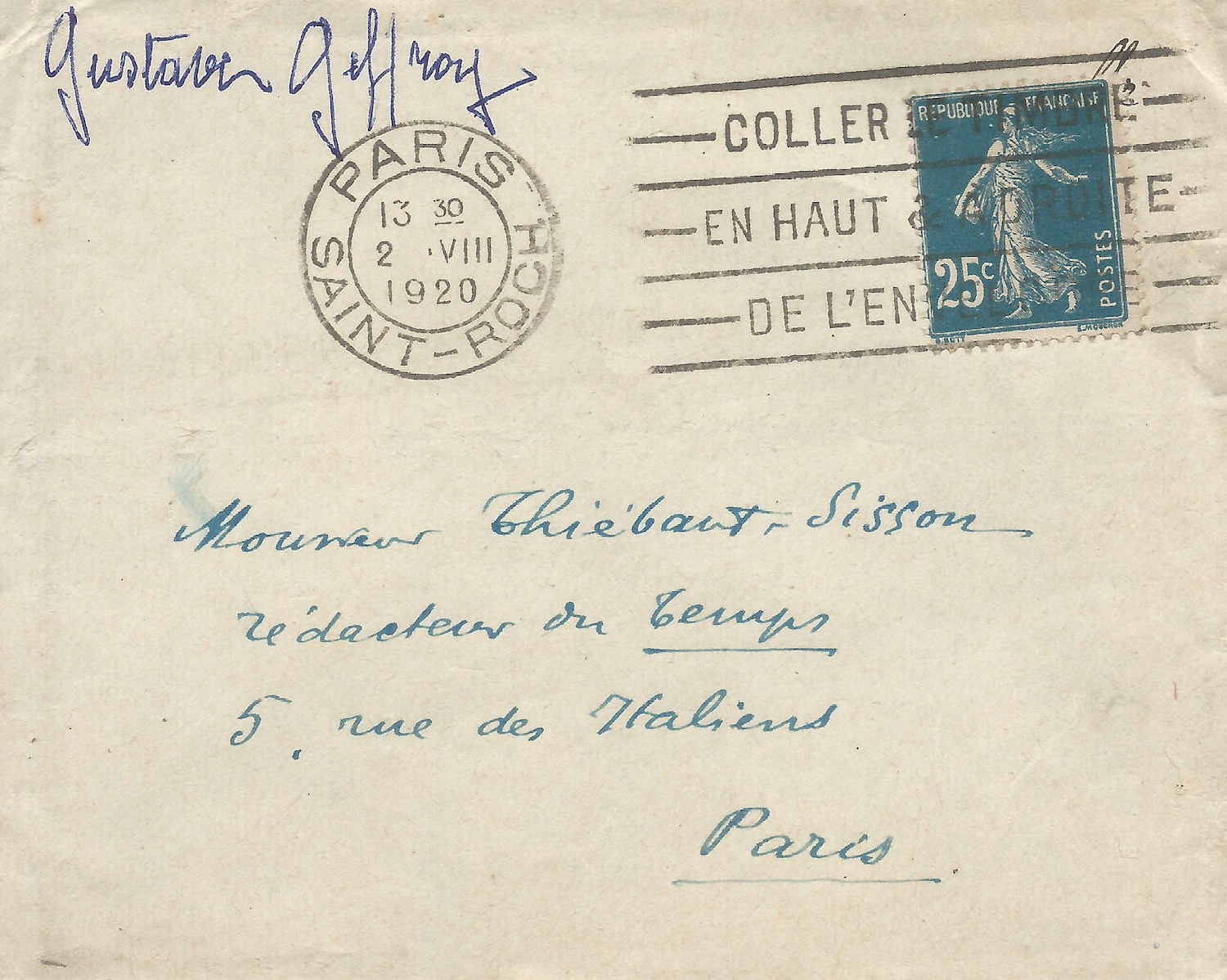
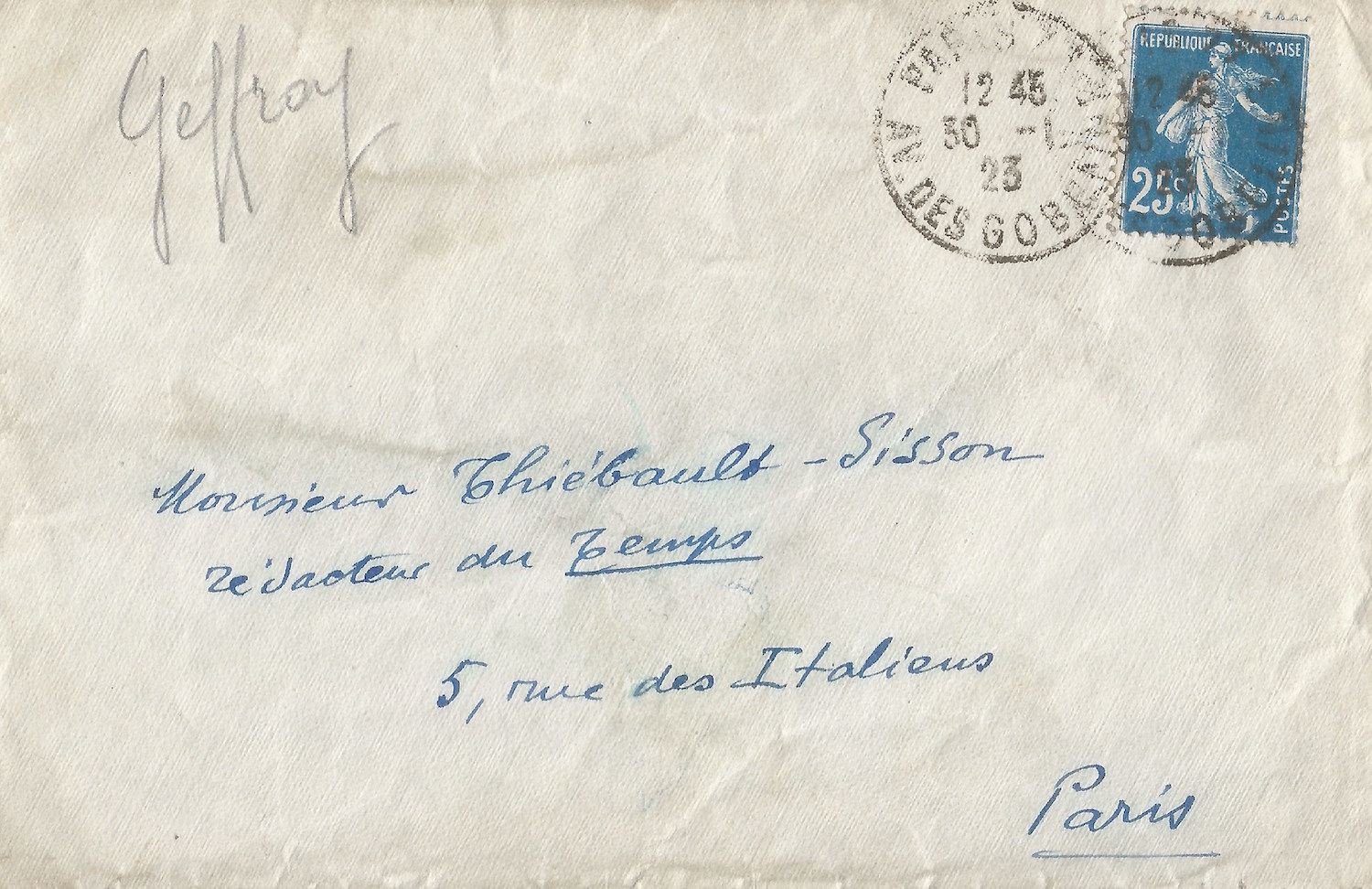
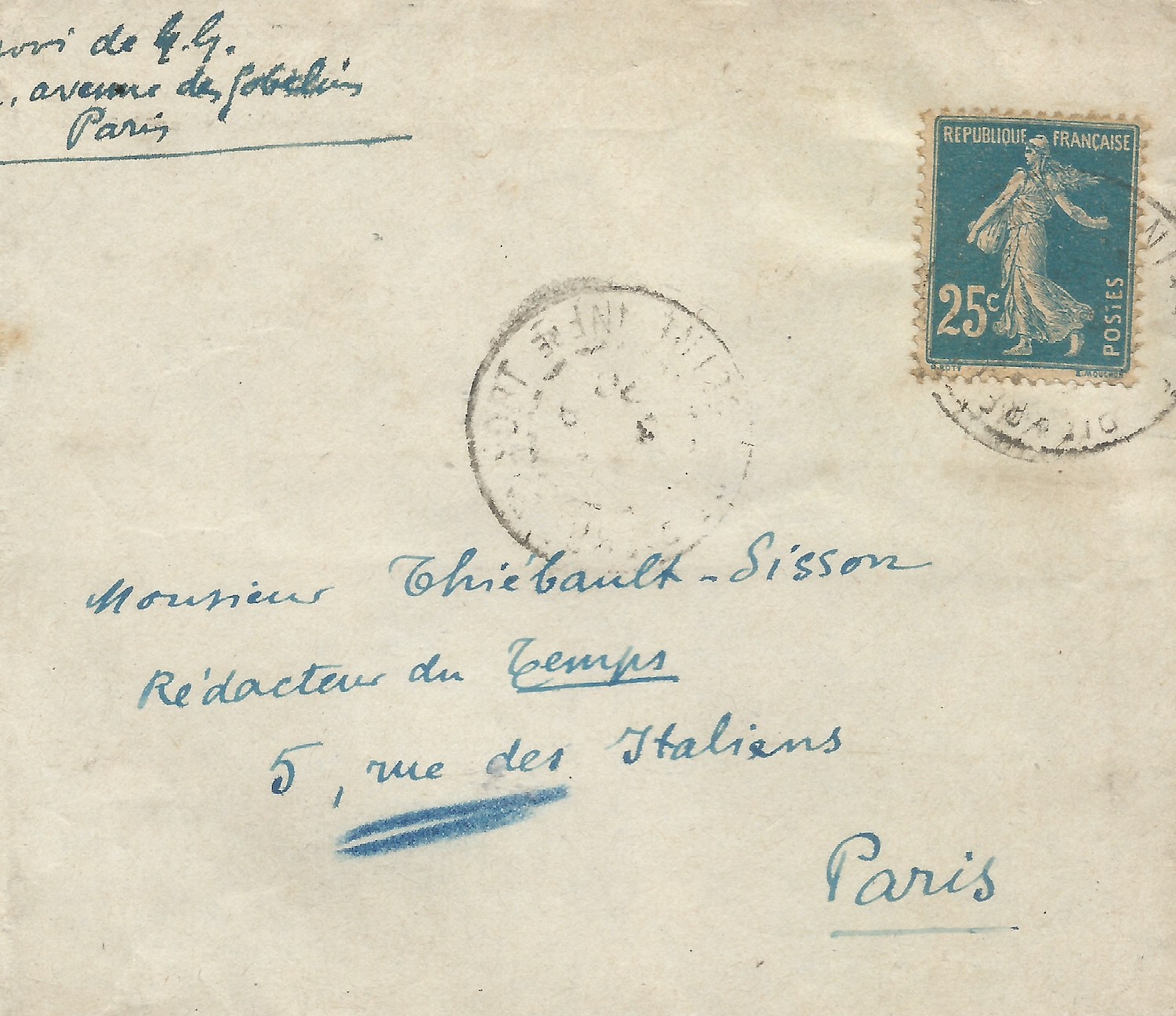
Paris. July 31 and August 5, 1920. Envelopes.
We are enclosing two autographed letters and a business card from the same Geffroy.
"You will have something more explicit to say about the work I attempted at the Gobelins."
Geffroy defends the work of the Manufacture Nationale des Gobelins, of which he is the Director, in response to an article which he considers defamatory and published in Le Temps .
_____________________________________________
I. LAS to François Thiébault Sisson, editor at Le Temps.
“Paris. Saturday, July 31, 1920.”.
My dear friend, I read in yesterday's Le Temps (July 30th) a note, signed with your initials TS, concerning the Fine Arts administration before the Senate, in which Mr. Chastenet's statement is taken, finding it "unacceptable that the administrators of our tapestry workshops place orders on their own authority." It is added that " the Fine Arts administration must be able to control orders and examine their appropriateness. " I wish to reply that the directors of the workshops have never placed orders on their own authority. They receive ready-made orders, or they submit proposals to the Fine Arts administration, which has always made the final decision.
Do we want to challenge the right of "proposal" held by the managers of the manufactories, and should they, when an artist presents them with a cartoon and requests its execution in tapestry, refuse to pass on this request? Must they also be so completely devoid of ideas and preferences that they never indicate the works they believe are likely to be executed?
As for Mr. Chastenet's opinion that the artists at the national tapestry manufactories produce "horrors," I will leave it to him. Likewise, I would like to know from you what works of "irremediable poverty" have been commissioned but never approved by the administrators. The works translated from designs by Chéret, Bracquemond, Madame Cazin, Claude Monet, Odilon Redon, Willette, Anquetin, Raffaëlli, and others will, I hope, be exhibited soon, and the public and critics will be able to judge the collection of tapestries and furnishings produced over the past twelve years at the Gobelins Manufactory. I believe, my dear friend, that on that day, with all your intellectual freedom, you will have something more explicit to say about the work I have undertaken at the Gobelins under the direction and with the collaboration of the Fine Arts administration. Gustave Geffroy. I am simply requesting that you include this letter. GG.
_______________________
II. LAS to François Thiébault Sisson, editor at Le Temps.
Paris. Thursday, August 5, 1920.
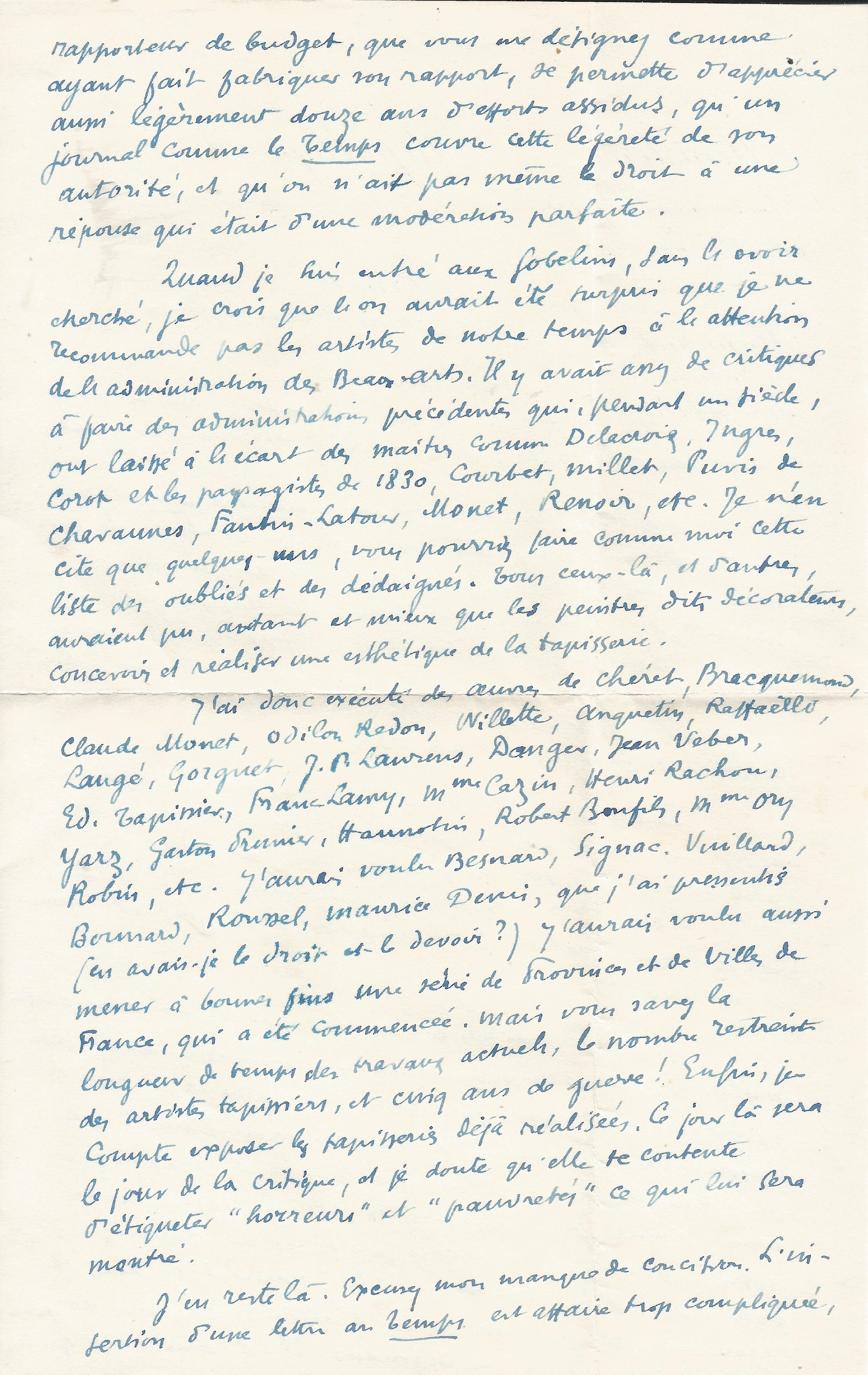
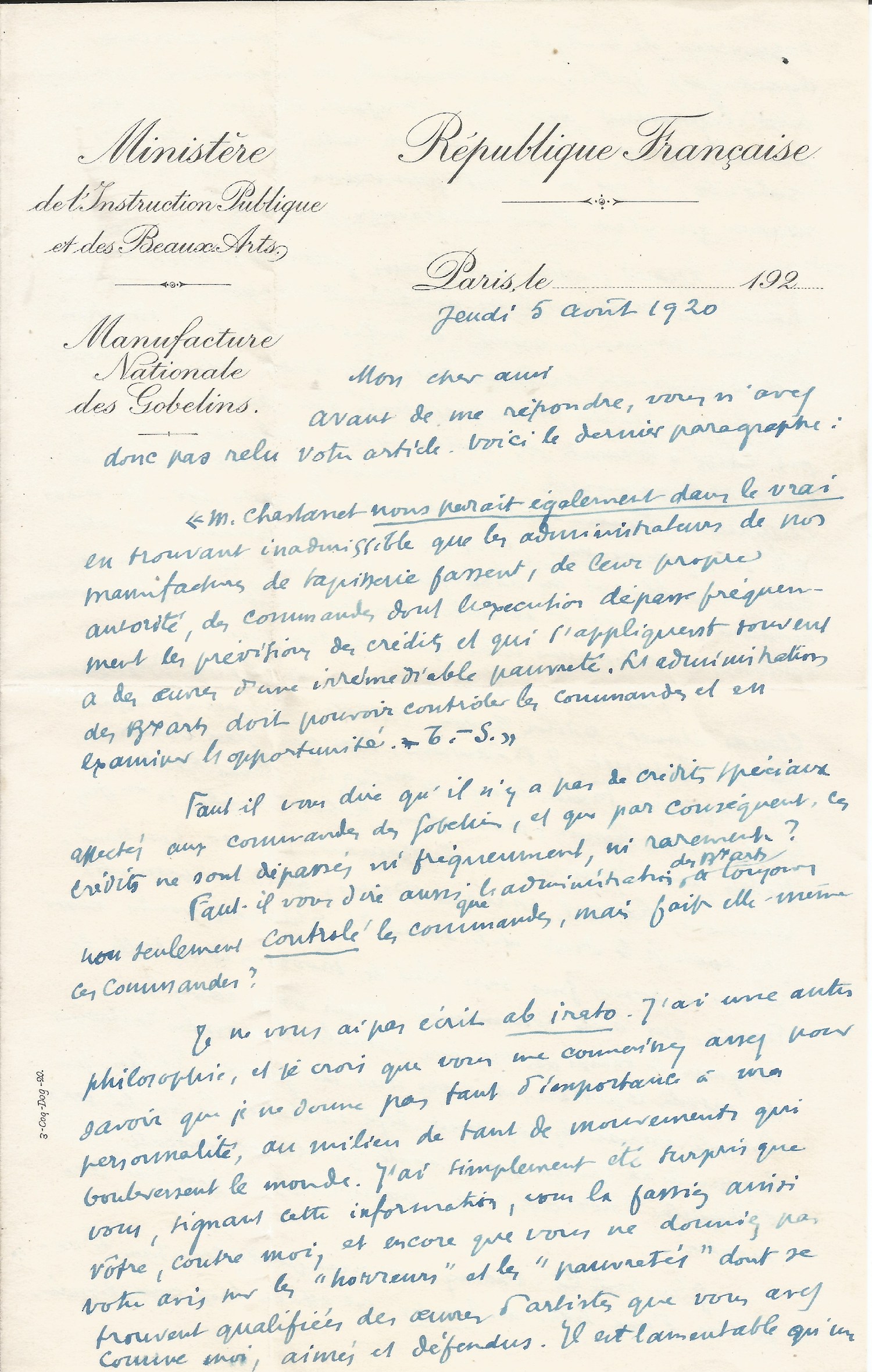
My dear friend, before replying, you clearly didn't reread your article. Here is the last paragraph: "Mr. Chastenet also seems to us to be correct in finding it unacceptable that the administrators of our tapestry workshops place orders on their own authority, the execution of which frequently exceeds the budgeted amounts and which often result in works of irredeemable poverty. The Fine Arts administration must be able to control orders and examine their suitability. TS"
Need I tell you that there are no special funds allocated to Gobelins commissions, and that consequently, the budget is neither frequently nor rarely exceeded? Need I also tell you that the administration of the Fine Arts has always not only controlled the commissions, but also placed them itself?
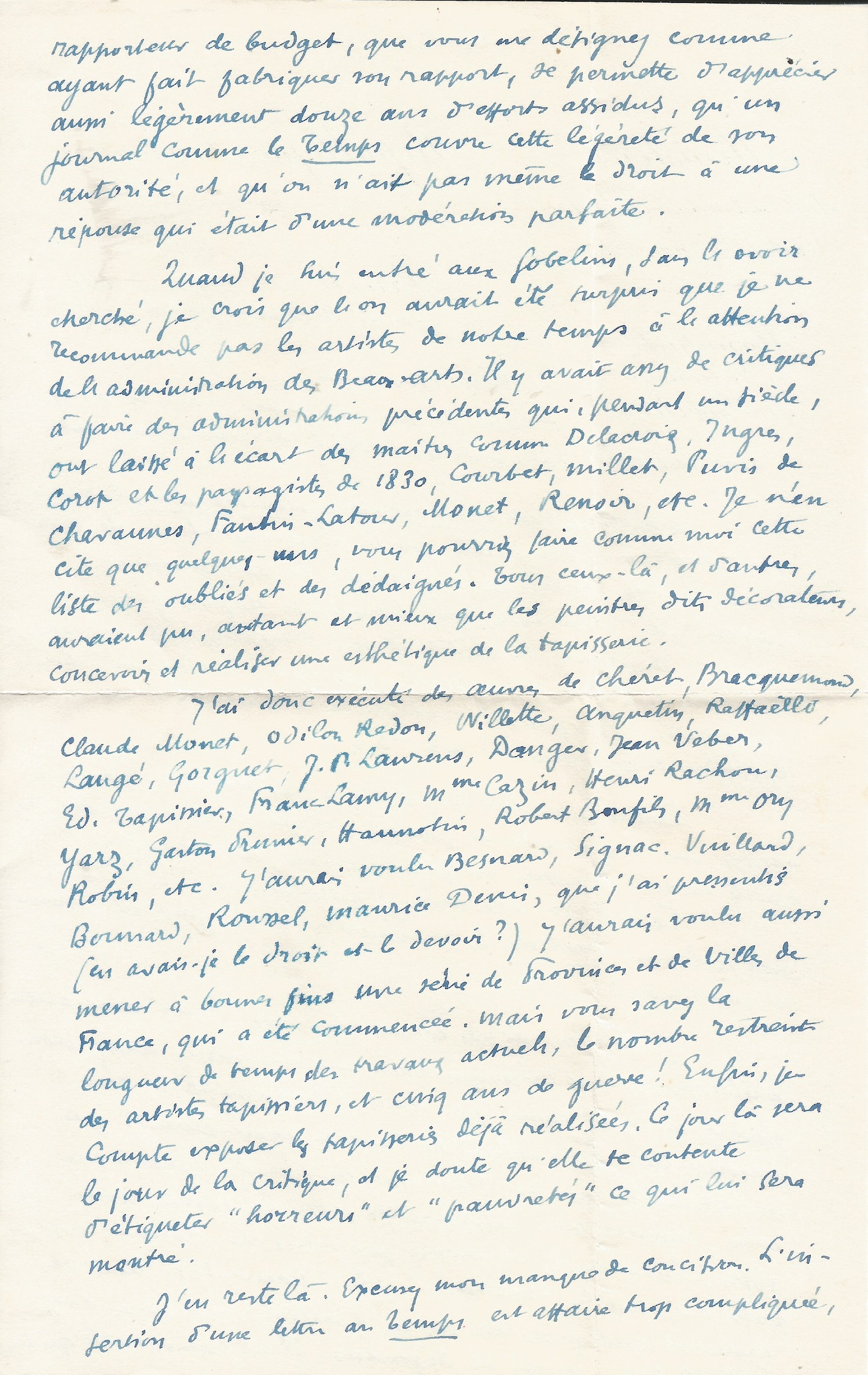
I did not write to you in a fit of anger . I have a different philosophy , and I believe you know me well enough to know that I don't place so much importance on my own personality amidst so many movements that are shaking the world. I was simply surprised that you, in signing this report, made it your own, against me, and furthermore, that you didn't offer your opinion on the "horrors" and "poverty" with which works by artists whom you, like me, have loved and defended are being described. It is lamentable that a budget rapporteur, whom you accuse me of having fabricated his report, should so lightly judge twelve years of assiduous effort , that a newspaper like Le Temps should endorse this flippancy with its authority, and that I am not even entitled to a perfectly moderate response.
When I joined the Gobelins Manufactory, without having sought it out, I think people would have been surprised if I hadn't recommended contemporary artists to the attention of the Fine Arts administration. There was enough criticism to be made of previous administrations which, for a century, neglected masters like Delacroix, Ingres, Corot, and the landscape painters of 1830, Courbet, Millet, Puvis de Chavannes, Fantin-Latour, Monet, Renoir, and others. I'm only mentioning a few; you could, like me, make your own list of the forgotten and scorned. All of them, and others, could have conceived and realized an aesthetic of tapestry, just as much as, and perhaps even better than, the so-called decorative painters.
So I executed works by Chéret, Bracquemond, Claude Monet, Odilon Redon, Willette, Anquetin, Raffaëlli, Langé, Gorguet, JB Laurens, Danger, Jean Veber, Ed. Tapissier, Franc Lamy, and others I would have liked to work with Besnard, Signac, Vuillard, Bernard, Roussel, and Maurice Denis, whom I sensed might be suitable (did I have the right and the duty to do so?). I would also have liked to complete a series of tapestries depicting the Provinces and Cities of France, which I had begun. But you know how time-consuming current projects are, the limited number of tapestry artists, and five years of war! Finally, I intend to exhibit the tapestries already completed. That day will be the day of criticism, and I doubt that it will simply label what is shown as "horrors" and "poverty."
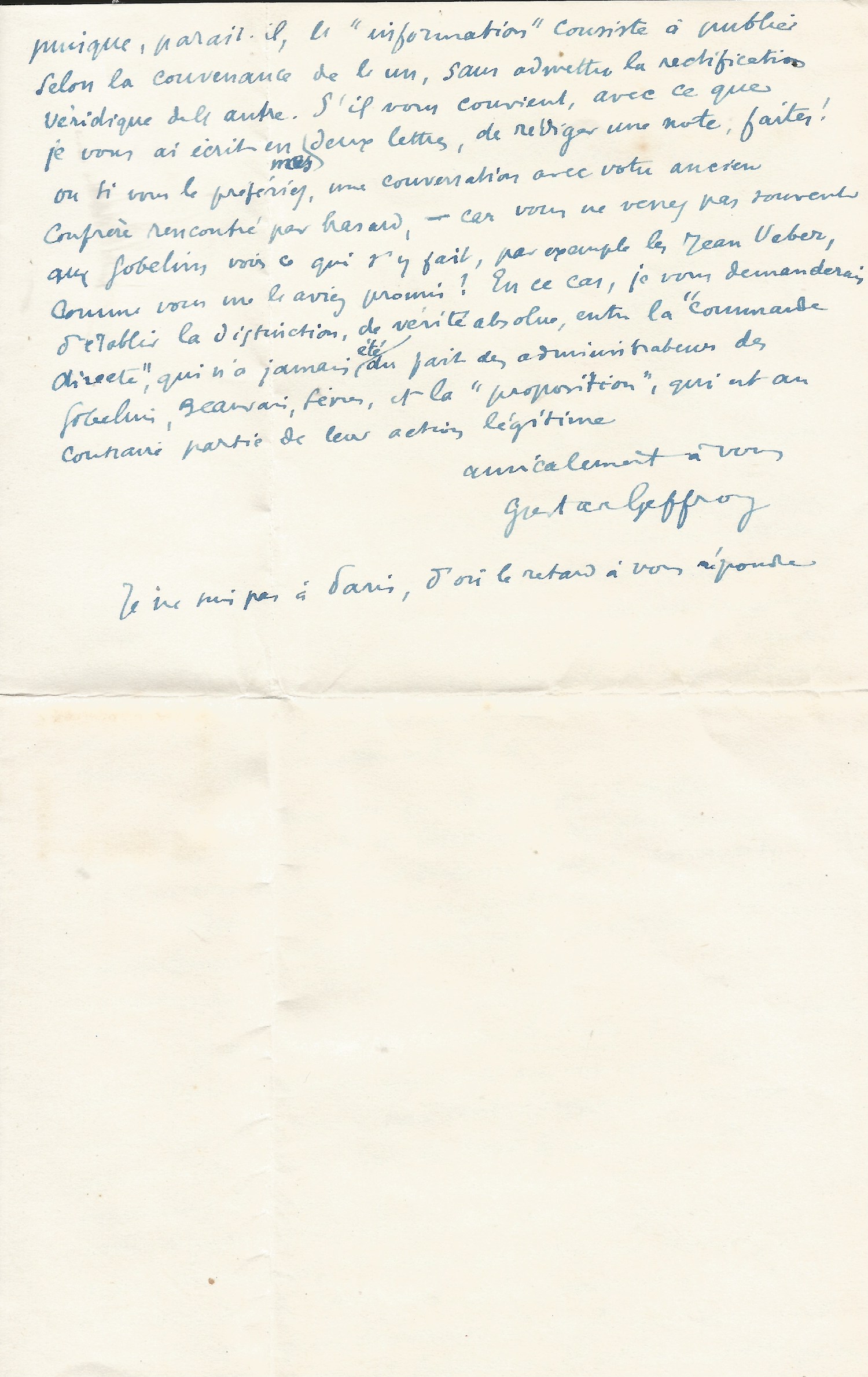
I'll leave it at that. Please excuse my lack of conciseness. Publishing a letter in Le Temps is too complicated a matter, since, it seems, "information" consists of publishing according to one party's convenience, without allowing for the truthful correction of another. If, based on what I've written in my two letters, you wish to draft a note, please do so! Or, if you prefer, have a conversation with your former colleague whom you've met by chance—for you don't often come to the Gobelins to see what's being done there, for example, the Jean Veber works, as you promised? In that case, I would ask you to establish the absolute truth between "direct commission," which was never the doing of the administrators of the Gobelins, Beauvais, and Sèvres factories, and "proposal," which, on the contrary, was part of their legitimate actions. Yours sincerely, Gustave Geffroy. I am not in Paris, hence the delay in replying.
_______________________
III. ALS to a colleague. [one page in-12°]
"Paris. December 19, 1904. My dear colleague, You need only send your book to Messrs. Huysmans, Descaves, Léon Daudet, J. and H. Rosny , Hennique, and Mirbeau. But you must hurry, as the vote will take place in a few days. Please accept my sincere sympathy, and my heartfelt thanks once again for your research. Gustave Geffroy. 210 Boulevard Péreire, Paris."
_______________________
IV . LAS to François Thiébault Sisson [one page in-8°]
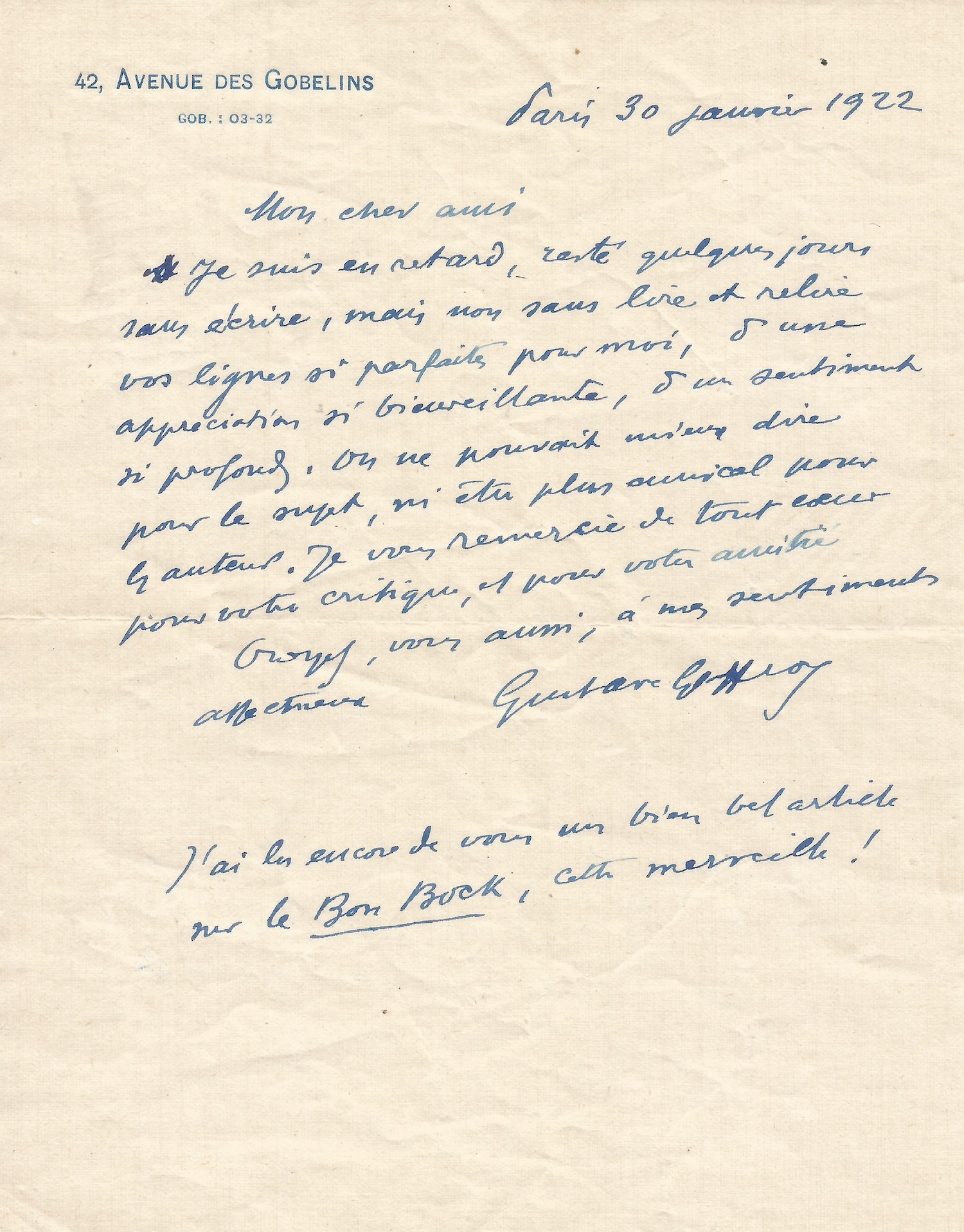
“Paris. January 30, 1922. My dear friend, I am late, having gone a few days without writing, but not without reading and rereading your lines, so perfect for me, so kindly appreciative, so deeply felt. One could not have said it better on the subject, nor been more friendly to the author. I thank you from the bottom of my heart for your criticism , and for your friendship. Believe, too, in my affectionate sentiments. Gustave Geffroy.”
_______________________
V. Autographed business card to Gustave Hire. (Envelope preserved).
Paris, August 10, 1904 " Gustave Geffroy – My sincere thanks."
_______________________
Appointed director of the National Gobelins Manufactory in 1908, Gustave Geffroy, particularly attentive to 19th-century art, thus became an actor in the history of art and its place in the society of his time.
It is this conviction that explains his commissioning policy for the National Gobelins Manufactory, when he asks contemporary artists for cartoons, notably his friends Bracquemond, Monet, Raffaëlli or Redon, and the space he reserves for them in the rooms of the brand new Gobelins museum.