Georges GUYNEMER (1894.1917)
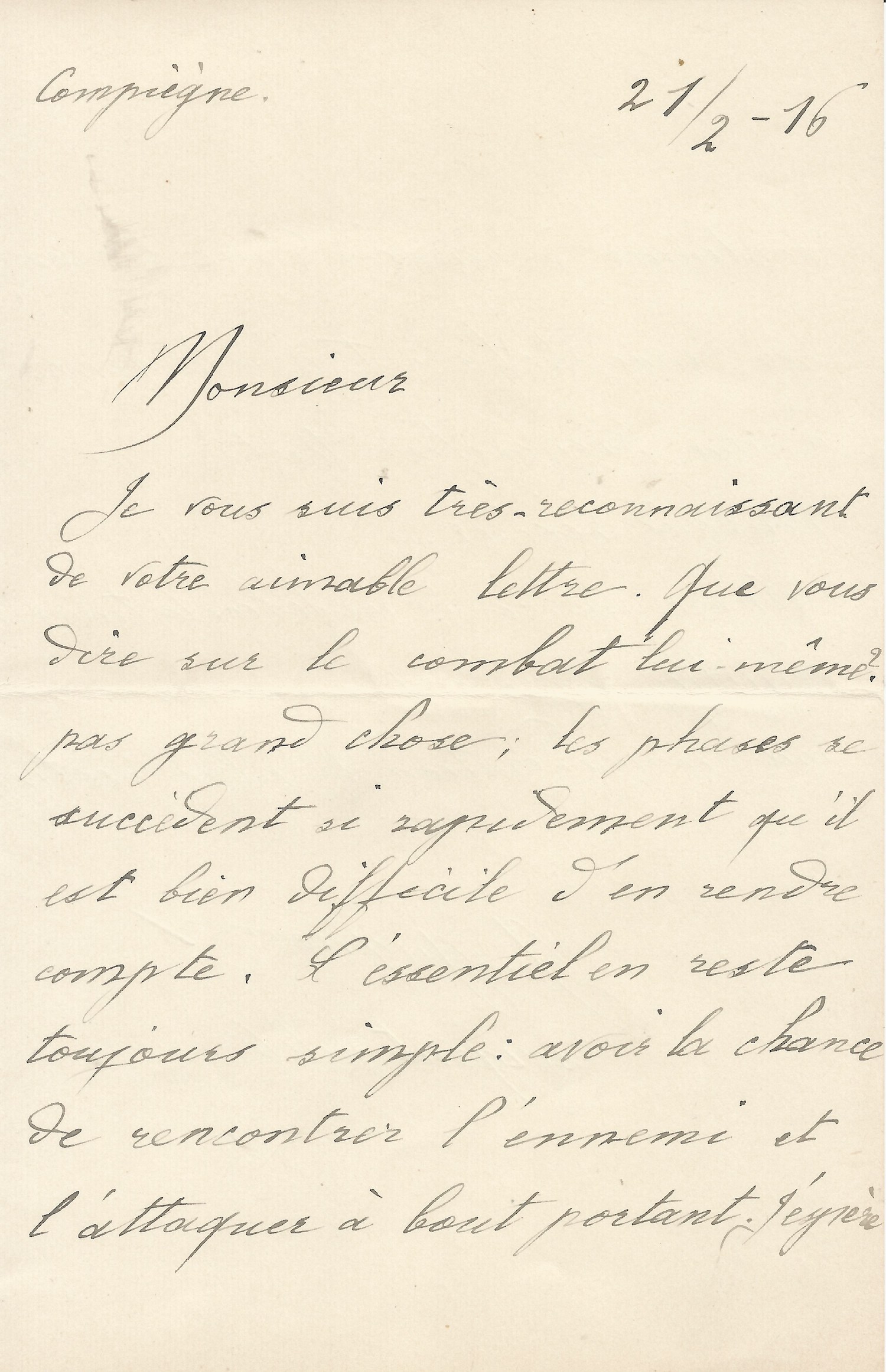
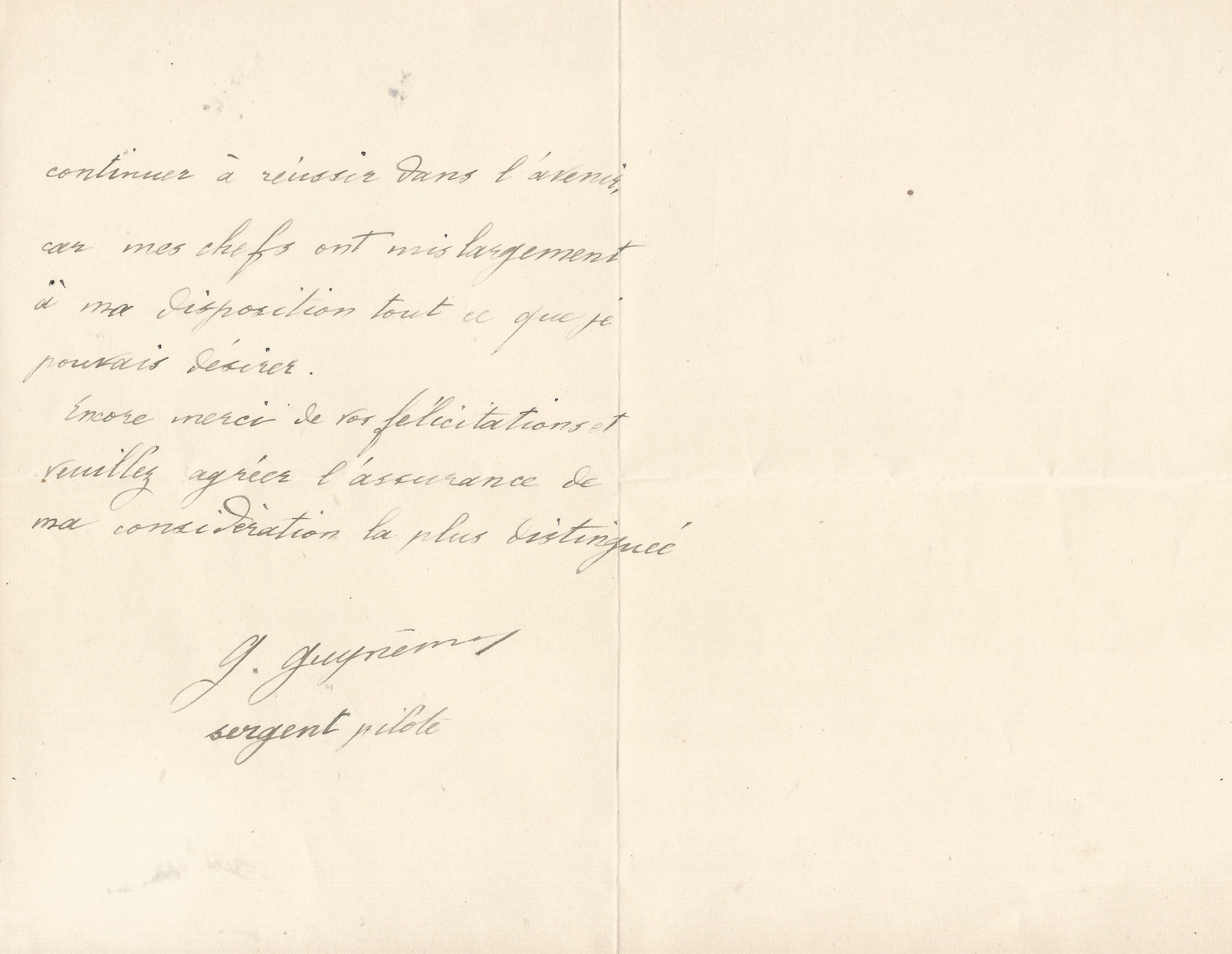
Autographed letter signed.
Two octavo pages. Compiègne. February 21, 1916
"The essential thing remains simple: to have the chance to encounter the enemy and attack them at close quarters."
A very rare letter from the French pilot, written a few days after he obtained his flying ace status, testifying to his fierce determination to fight the enemy in the skies of the First World War.
_________________________________________
Sir, I am very grateful for your kind letter. What can I tell you about the fight itself? Not much; the phases followed one another so quickly that it is very difficult to describe.
The essential thing remains simple: to have the chance to encounter the enemy and attack them at close range. I hope to continue to succeed in the future because my superiors have provided me with everything I could possibly want.
Thank you again for your congratulations and please accept the assurance of my highest consideration. G. Guynemer, Sergeant Pilot.
_________________________________________
When war broke out in August 1914, Georges Guynemer, a brilliant nineteen-year-old student, was twice refused enlistment by military medicine due to his weak constitution.
His tenacity paid off on November 23, 1914, when he managed to enter the Pau aviation school, first as a mechanic's assistant, then as a student pilot, enlisting for the duration of the war. Having earned his pilot's license in April 1915, he was assigned in June to Squadron No. 3, the Storks , where he initially carried out reconnaissance missions before achieving his first victorious aerial combat on July 19.
Promoted to sergeant and decorated with the military medal, Guynemer racked up victories from December 1915. His successes at Verdun, on the Somme, or during the Chemin des Dames offensive led him, at less than twenty-three years old, to the rank of captain.
Having remained relatively unknown during his first year of combat, Guynemer rose to prominence on February 6, 1916 (a few days before this letter), the date of his fifth victory, which earned him the title of flying ace. He was the first to benefit from the decision by General Headquarters to release the names of victorious aviators to the press. In the following weeks, the pilot's portrait graced the covers of numerous newspapers: L'Illustration , Le Petit Journal , L'Excelsior , Le Pays de France , and others.
On September 11, 1917, at 8:30 a.m., Guynemer took off for another combat mission. Around 9:25 a.m., near Poelkapelle, Belgium, he spotted a German observation plane and headed towards it. His wingman, Lieutenant Jean Bozon-Verduraz, noticed several German Fokker aircraft approaching and flew to intercept them. After dispersing them, he returned to the spot where he had last seen his commander. He flew back to base alone. Guynemer was gone. Neither the wreckage of his plane nor his body was ever found.
On October 19, 1917, the Chamber of Deputies gave a new dimension to the hero, by unanimously adopting a resolution to perpetuate Guynemer's memory in the Pantheon.
The French Air Force Academy in Salon-de-Provence has adopted Guynemer's motto: "Face the Challenge," and the Air Force commemorates him every September 11th with a military ceremony at its air bases. On this occasion, the hero's last citation is read: "Died on the field of honor on September 11, 1917. Legendary hero, fallen in the very sky of glory, after three years of ardent struggle. He will remain the purest symbol of the qualities of the French people: indomitable tenacity, fierce energy, sublime courage. Animated by the most unwavering faith in victory, he bequeaths to the French soldier an imperishable memory that will exalt the spirit of sacrifice and inspire the noblest emulation ."
_________________________________________
Bibliography: Agnès Chablat-Beylot – Archives of France.