
"You will soon receive the exam papers for the Studies, which I hope you will not be dissatisfied with either."
20.000€
Franz Liszt (1811.1886)
Autographed letter signed to his music publisher in Paris, Maurice Schlesinger.
Four pages, large quarto. Unpublished letter. Genoa. July 2, 1838.
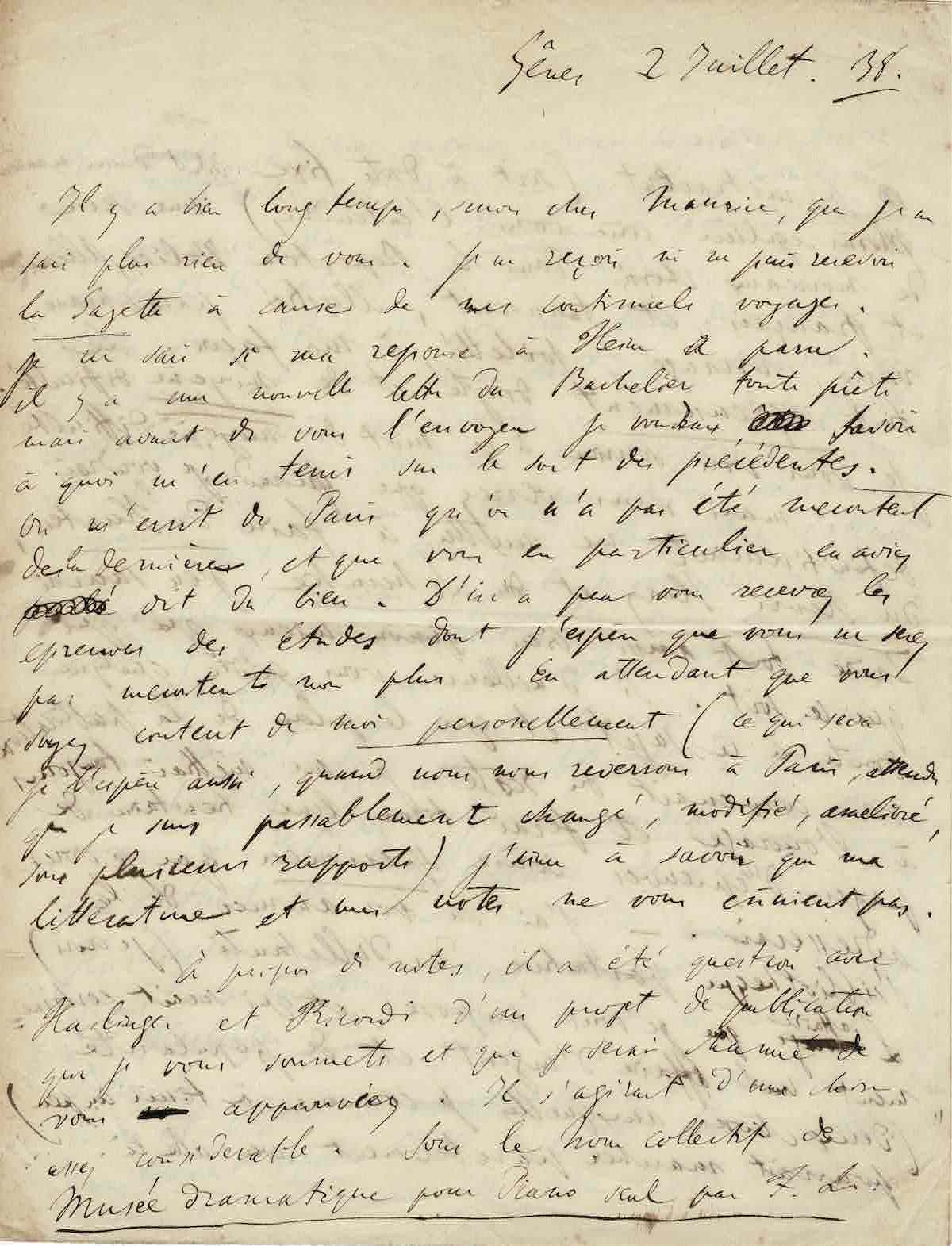
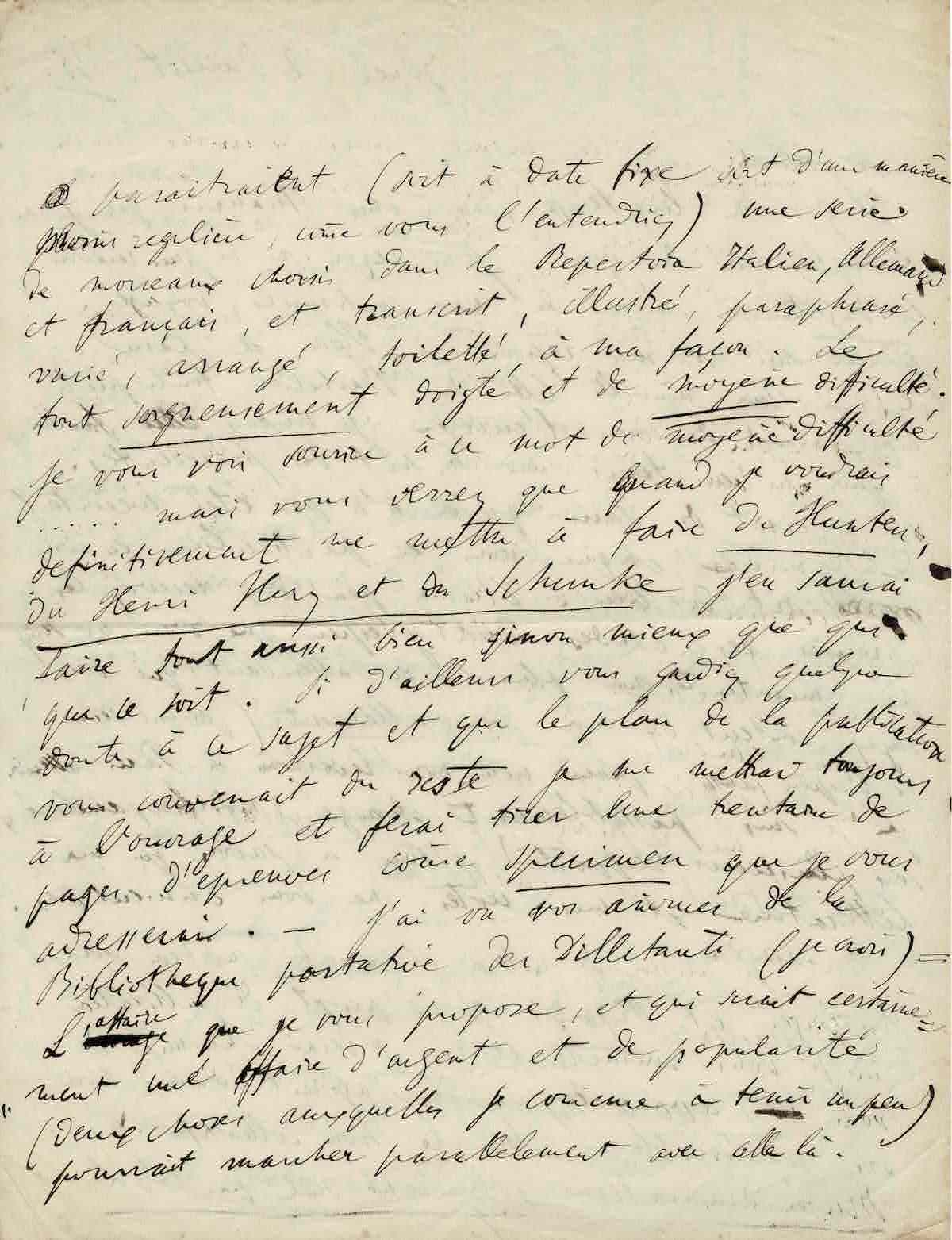
"Under the collective title ' Dramatic Museum for Solo Piano by FL' would appear (...) a series of pieces selected from the Italian, German and French repertoire, transcribed, illustrated, paraphrased, varied, arranged, and polished, in my own way ."
After his dazzling Viennese success at the concerts given for the benefit of the victims of the Pest floods, and at the dawn of his period of splendor ( Glanz Periode ), Liszt reluctantly returned to Italy to be with the tortured Marie d'Agoult.
Evoking his fellow students Berlioz, Thalberg, Meyerbeer, Moscheles, the Hungarian composer, considerably changed, modified, improved, in several respects , (re)launches himself into work and new projects, proposing to Maurice Schlesinger – publisher and founder of the Gazette Musicale – something quite considerable.
A long and superb, unpublished letter, testifying to the intellectual and musical abundance in Liszt's mind.
________________________________________________________________________________________
“It has been a very long time, my dear Maurice, since I have heard anything from you. I neither receive nor can receive the Gazette because of my constant travels. I don't know if my reply to [Heinrich] Heine has been published. There is a new letter from the Bachelor all ready, but before sending it to you, I would like to know what has become of the previous ones. I am told from Paris that the last one was well received, and that you in particular spoke highly of it. You will soon receive the proofs of the Studies [second version of his twelve Transcendental Studies], which I hope you will also be pleased with. Until you are personally (which I also hope will be the case when we meet again in Paris, given that I have changed, modified, and improved considerably in several respects ), I am pleased to know that my writing and notes do not bore you.”
Speaking of notes, Haslinger, Ricordi, and I discussed a publication project, which I am submitting to you and which I would be delighted to see approved. It would be quite a substantial undertaking. Under the collective title "Musée dramatique pour Piano seul" ( Dramatic Museum for Solo Piano by FL) would be published (either on a fixed date or more regularly, as you prefer) , transcribed, illustrated, paraphrased, varied, arranged, and polished in my own style . All of them carefully fingered and of medium difficulty. I can see you smiling at the phrase "medium difficulty," but you will see that when I finally decide to return to playing Hünten, Henry Herz, and Schunke , I will be able to do it just as well, if not better, than anyone else. If, moreover, you still had some doubts about this and the publication plan suited you otherwise, I will still get to work and have about thirty pages of proofs printed as a specimen which I will send to you (…).
The project I'm proposing, which would certainly involve money and popularity (two things I'm beginning to value somewhat), could run parallel to that one. If you wished, we could even follow the order of your publication—although I'd rather start with Norma because of its immense popularity in Italy. [Reminiscences of Norma, composed in the early 1930s after Bellini's opera].
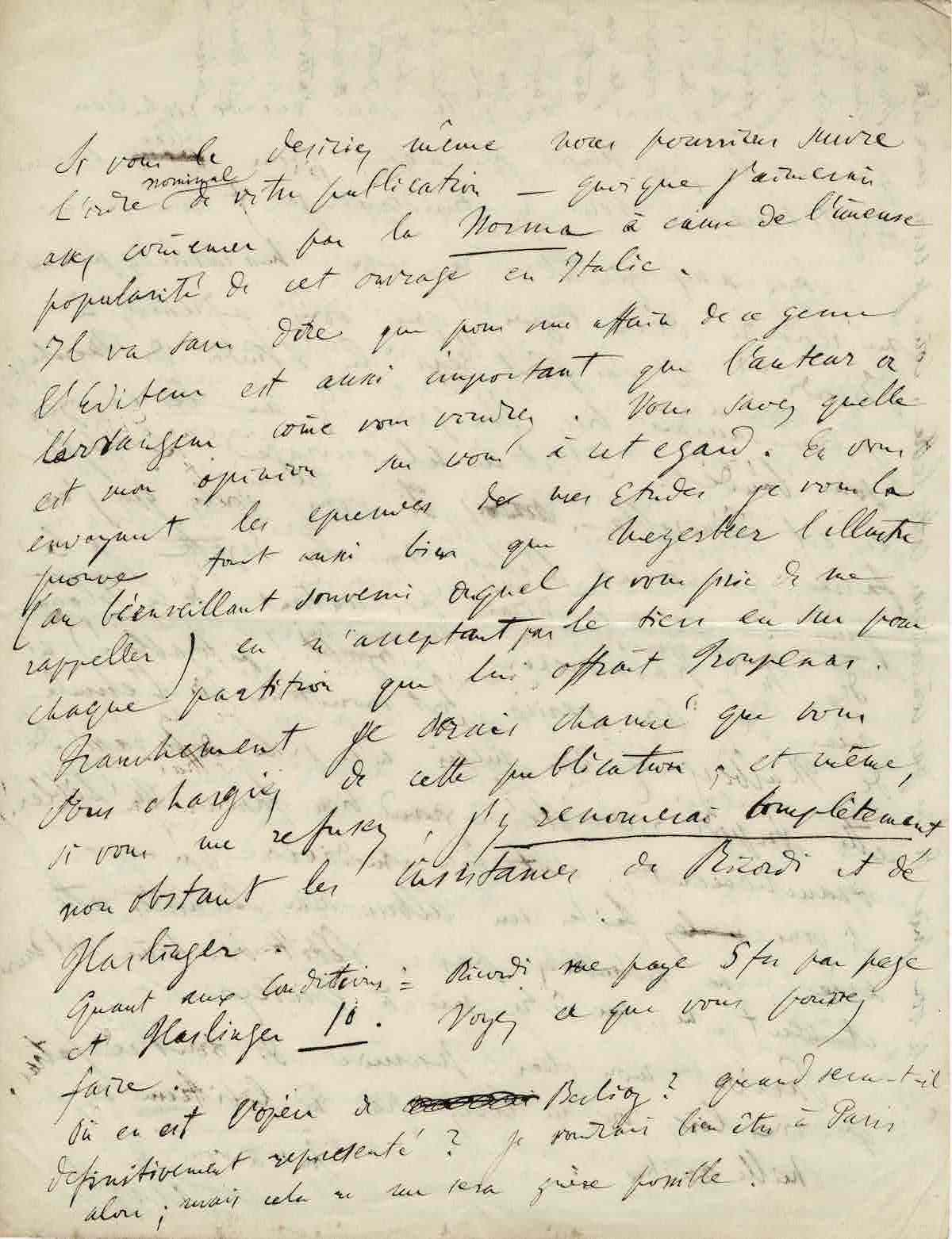
It goes without saying that in a matter of this kind, the publisher is as important as the author and arranger, if you will. You know my opinion of you on this matter. By sending you the proofs of my Études, I prove it to you just as clearly as Meyerbeer (whose kind memory I beg you to remind me of) did by refusing the additional third for each score that [Eugène] Troupenas offered him. Frankly, I would be delighted if you undertook this publication, and indeed, if you refuse me, I will abandon it entirely , notwithstanding the insistence of Ricordi and Haslinger . As for the terms: Ricordi pays me 5 francs per page and Haslinger 10. See what you could do.
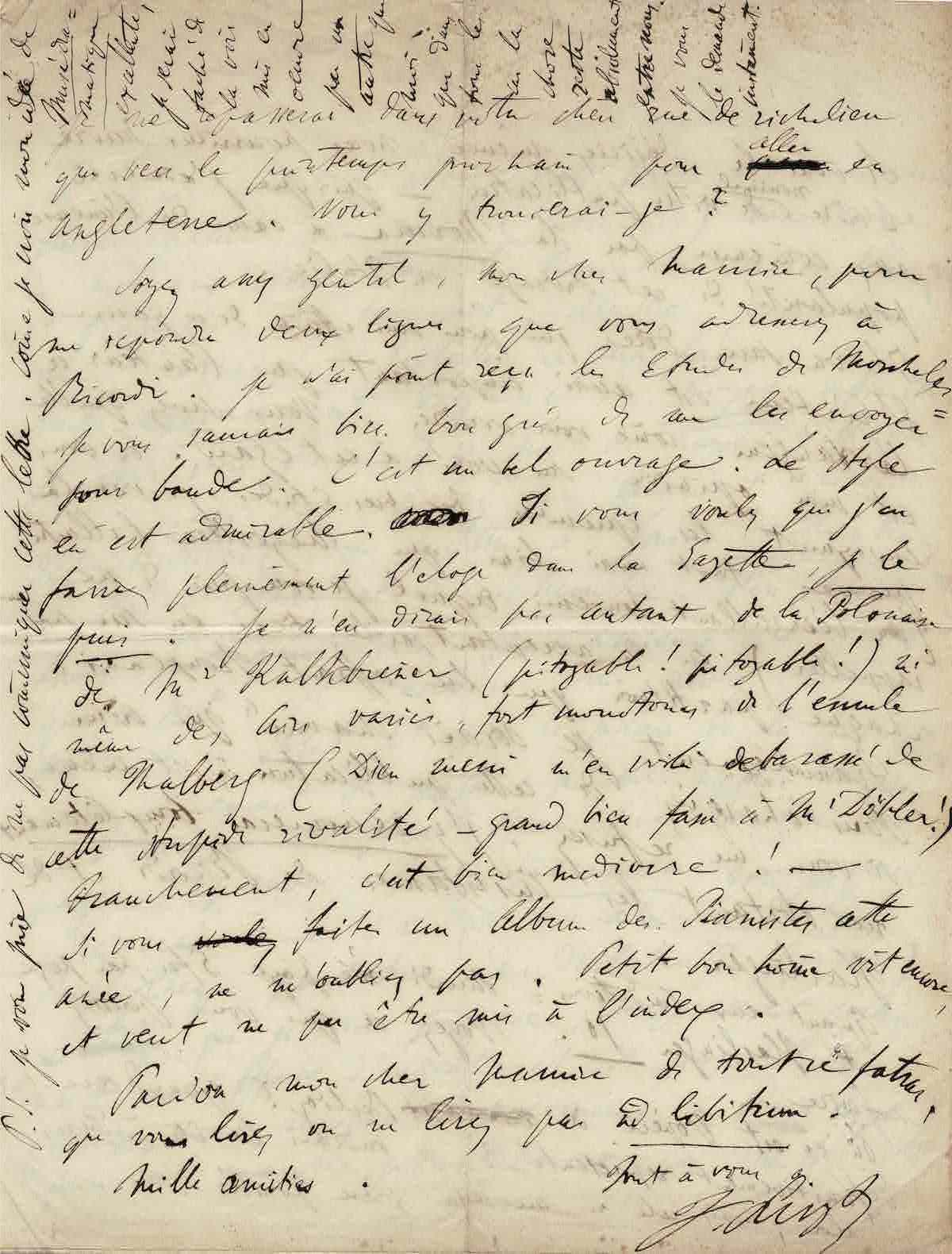
What is the status of Berlioz's opera? [The opera Benvenuto Cellini, which premiered on September 10, 1838] When will it finally be performed? I would very much like to be in Paris then ; but that will hardly be possible. I will not be passing through your dear rue de Richelieu again until next spring, on my way to England. Will I find you there? Please be so kind, my dear Maurice, as to reply with a few lines addressed to Ricordi. I have not received the Études by Moscheles [the Bohemian pianist Ignaz Moscheles]. I would be most grateful if you would send them to me in a sealed envelope. It is such a work. The style is admirable. If you wish me to sing its praises in full in the Gazette, I can. [Friedrich] 's Polonaise (pitiful! pitiful!), nor even of the varied, very monotonous airs of Thalberg's imitator (Thank God I'm rid of this stupid rivalry – good for Mr. Döhler.) Frankly, it's quite mediocre!
If you make a Pianists album this year, don't forget me. Little fellow is still alive and doesn't want to be blacklisted. Forgive me, my dear Maurice, for all this nonsense, which you may or may not read as you please . A thousand regards. Yours truly, F. Liszt.
P.S. I beg you not to share this letter. As I believe my idea for a Dramatic Museum is excellent, I would be displeased to see it implemented by someone other than myself. In any case, this matter must remain strictly between us. I urge you to do so.
________________________________________________________________________________________
Bibliography:
Franz Liszt. Biography. Frédéric Martinez, Gallimard, 2011.
The Tumultuous Friendship of Franz Liszt and Maurice Schlesinger. Jacqueline Bellas.