Categories: New Releases , François-Vincent Raspail
François-Vincent RASPAIL, imprisoned, fights for his release.
« All documents relating to the illegality of my arrest are located in the registry of the royal court
Sold

« All documents relating to the illegality of my arrest are located in the registry of the royal court
Sold
François-Vincent RASPAIL (1794-1878)
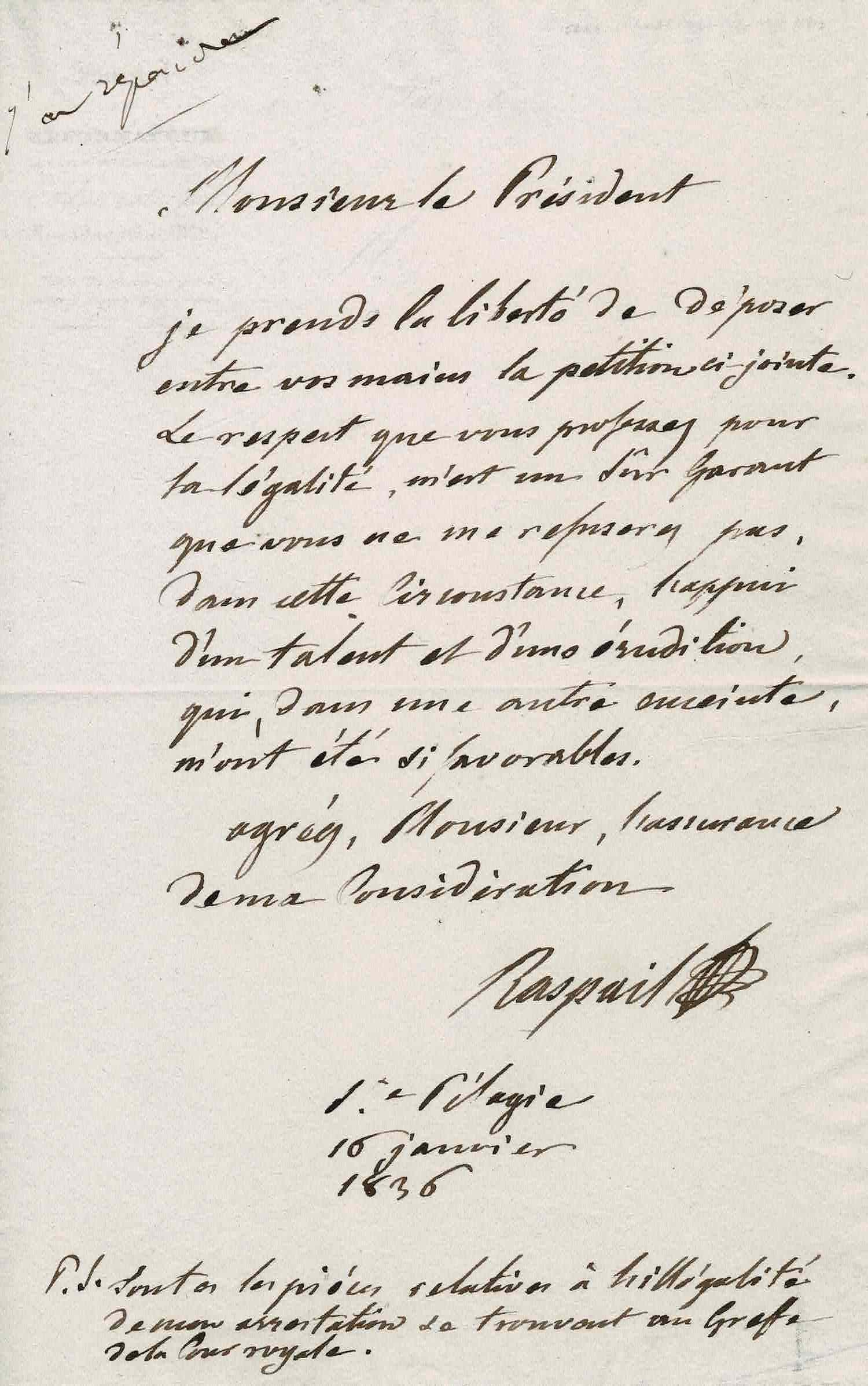
Autographed letter signed to Judge André Dupin.
One page in-8°. Ste Pélagie. January 16, 1836.
Note at the top from the recipient: "I have replied".
Beautiful letter from Raspail, imprisoned in Sainte-Pélagie and fighting for his release.
___________________________
"Mr. President, I take the liberty of submitting the enclosed petition to you. The respect you profess for legality is a sure guarantee that you will not refuse me. In this circumstance, I have the support of a talent and erudition that, in another setting, have been so favorable to me. Please accept, Sir, the assurance of my highest consideration. Raspail. P.S. All documents relating to the illegality of my arrest are held at the registry of the Royal Court ."
___________________________
A chemist and botanist by profession, François Raspail was involved in all social and political movements. In 1830, he joined the Parisian people in their uprising during the Three Glorious Days , which led to the fall and exile of Charles X.
He then founded a republican opposition newspaper, Le Réformateur , and presided over the Society of the Friends of the People. This society was definitively dissolved in 1832 by the new government, which sentenced him to fifteen months in prison and a 500-franc fine for insulting the King. At Sainte-Pélagie prison, where political prisoners were incarcerated, Raspail took the helm of the Republican Association for the Defense of Freedom of the Press.
On July 28, 1835, Giuseppe Fieschi attempted to assassinate King Louis-Philippe. The king, unharmed, retaliated by attacking the republicans. Raspail was arrested again and sentenced to two years in prison and five years of "surveillance.".
Drawing on his experience of imprisonment, he became interested in life in prisons (his "second home") by writing Penitentiary Reform. Letters on Prisons (1839).