
"Just tell me specifically who I should put pressure on."
Sold
Joseph Stalin (1878.1953)
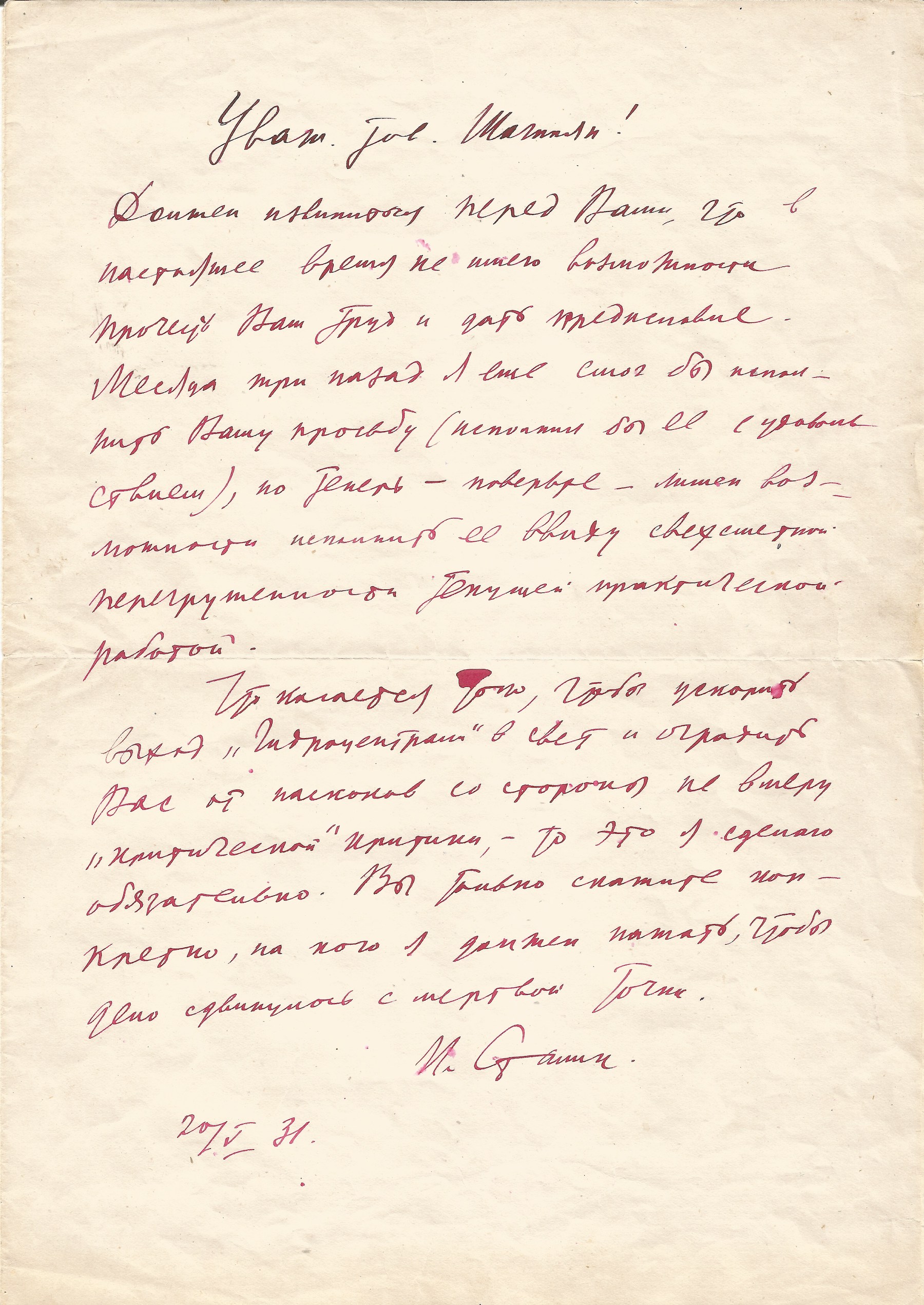
Autographed letter signed to Marietta Sergeevna Shaginyan.
One folio page (210 x 298 mm), in purple ink, in Russian.
No location. May 20, 1931.
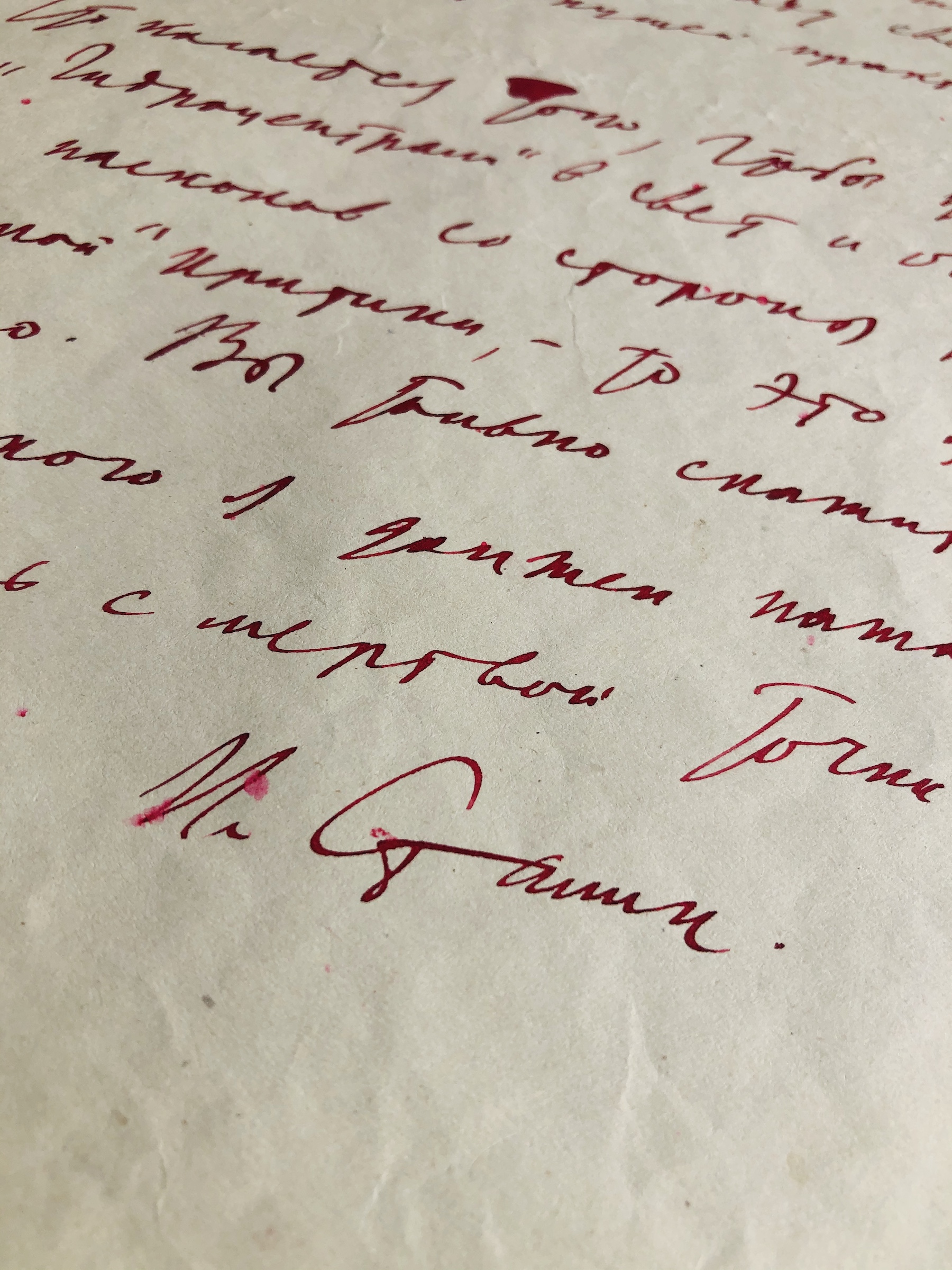
"Just tell me specifically who I should put pressure on."
Extremely rare letter from the Russian tyrant, in his capacity as General Secretary of the Communist Party, coming to the aid of the communist activist Shaginyan.
___________________________________
“Dear Comrade Chaguinian! I must apologize to you for not being able, at present, to read your work, or even to write a preface for it. Three months ago I could still have fulfilled your request (I would have done so with pleasure), but now – believe me – I am deprived of the possibility of doing so due to a daily overload of practical work that exceeds all expectations.”
Regarding accelerating the release of "Hydrocentale" and protecting you from the excessive attacks of a "critical" critic – I will do it without fail. Just tell me specifically who I should pressure to get the matter moving. J. Stalin. 20/V/31
“Уваж. тов. Шагинян!
Please note that before you know it, you will find it before you follow it. возможности прочесть Ваш труд и дать предисловие. Месяца три назад я еще смог бы исполнить Вашу просьбу (исполнил бы ее с удовольствием), но теперь – поверьте – лишен возможности исполнить This is a highly practical translation. работой. This is what we mean by “Hydrocentric” in the light. оградить Вас от наскоков со стороны не в меру “критической” criticism, – This is what you need to know. This is a concrete bag, and it's the next one, it's here. сдвинулось с мертвой точки. И. Stalin 20/V/31″
___________________________________
At the beginning of Russia's mass industrialization, Stalin wrote to propaganda author Marietta Shaginyan: he offered to ensure the release of her book and to suppress any hostile reaction to it! This signed autograph letter, of exceptional rarity, is further evidence of the omnipotence of the Soviet tyrant.
The Western perspective, undoubtedly biased by the Soviet contribution to the Allied victory in 1945, has likely minimized the appalling dictatorship Stalin inflicted on Russia and the Soviet bloc. Let us therefore recall the trajectory of Iosif Vissarionovich Dzhugashvili, better known as Joseph Stalin. From an anonymous Bolshevik insurgent of the October Revolution, Stalin became, in just a few years, the despotic leader of the USSR. Establishing a regime of terror and the most complete personal dictatorship of the modern era, he is considered by historians to be the greatest mass murderer of all time, responsible to varying degrees for the deportation and death of nearly twenty million people.
To rise to the head of this empire, Stalin displayed exceptional political acumen: scheming, maneuvering, and relying on the all-powerful bureaucracy of the Party and its police apparatus. Installed at the top of the state, he established an unprecedented climate of terror, eliminating all opposition, rigging trials, resorting relentlessly to propaganda, and encouraging a frenzy of denunciations of all kinds.
In 1931, the year this letter was written, Stalin had just begun what he called the "collectivization" of land, five-year plans that in reality abolished private property and starved his people. The peasant revolts that followed were brutally suppressed.
This is precisely the subject of the novel Hydrocentral , which is discussed in this letter. Marietta Sergeevna Shaginyan (1888-1982), the recipient of this missive, was a Soviet writer and activist of Armenian origin. She was one of the "Traveling Companions" of the 1920s, led by the Serapion Brothers, and became one of the most prolific communist writers of the time, experimenting with satirical and fantastical fiction. The content of Hydrocentral was directly linked to Stalin's economic and political objectives at the time. Marietta Shaginyan was one of the most valuable Soviet authors for the Stalinist system: she was widely read and adhered to the Communist Party line.
Behind the words, and beyond their primary meaning, several ideas appear, and subtly, the personality of their author, the all-powerful Stalin.
"Just tell me specifically who I should put pressure on.".
What is very clear in this letter is the propaganda campaign waged by Stalin to serve himself and his regime. By offering his support to an official message, and by proposing, as we can read, the suppression of any opposing person and any dissenting voice: "Regarding the acceleration of the 'Hydrocentale' project and your protection against the excessive attacks of 'critical' criticism – then I will do it without fail ." "Critical criticism" must not exist in the USSR! This letter perfectly illustrates the organization established and controlled by Stalin for the suppression of fundamental freedoms in Russia, and freedom of expression above all.
Even more terrifying to note is the underlying character trait of Joseph Stalin in this letter: his absolute and constant need to control EVERYTHING, his meticulous attention to the smallest details. Consider that he was then one of the most influential men on the planet. Despite this, he intervened directly in a seemingly minor matter, taking up his pen to personally respond to a request from a novelist and directly offer his services . "I must apologize to you for not being able, at present, to read your work, or even to write a preface for it."
His biographers, and Montefiore in particular, have emphasized this behavior and leadership style. Endowed with a prodigious intellect, capable of working twenty-five hours a day, the Little Father of the Peoples sought to cultivate close relationships with every writer, every general, every factory manager—all with a single aim: to maintain his influence, control, and exert an infernal deterrent pressure on any potential opponent. This impressive daily workload is also the subject of this letter. "I am unable to satisfy [you] due to a daily workload that exceeds expectations," Stalin apologizes.
His involvement in literary publications also speaks volumes about the Soviet system. The distortion of truth into an official message truly reflects a desire for brainwashing. To paraphrase Andrei Zhdanov, " Writers must become engineers of souls. "
Paranoid and driven by a quest for absolute power, Stalin managed to control everything. Alerted to any plots against him as soon as they began to take shape, Stalin understood, even before Adolf Hitler, the necessity of a state police force—the GPU—enabling him to control collaborators and leaders. Hitler copied Stalin, and the Gestapo drew heavily on the GPU model.
___________________________________
Joseph Stalin's letters are rare, exceptionally rare.
Those written in ink, as is the case here, are even more so, since from 1933 onwards, Stalin wrote only in pencil. We are thus presented with one of the last letters written in ink.
Indeed, as Yves Cohen explains in his article "Letters as Action: Stalin in the Early 1930s ," published in 1997 in Les Cahiers du Monde Russe, a clear break occurred in Stalin's handwriting between 1931/1932 and 1933. Before this shift, Stalin's letters were written in ink (variously green, black, or purple) and in a consistent, compact script. Afterward, Stalin systematically wrote his letters in pencil, giving the impression of heavy handwriting, and sometimes writing only a single word per line. This change in handwriting is the undeniable sign of a mental shift in the mind of the Soviet tyrant.
The suicide of his wife Nadezhda Alliluyeva in the Kremlin on November 8, 1932, drove Stalin to endless and constant paranoid delusions.
He died on March 5, 1953, leaving behind the legacy of the most absolute tyrant of the 20th century.