
"I'm anxiously awaiting the drinks promised for Friday."
Sold
Claude MONET (1840.1926)
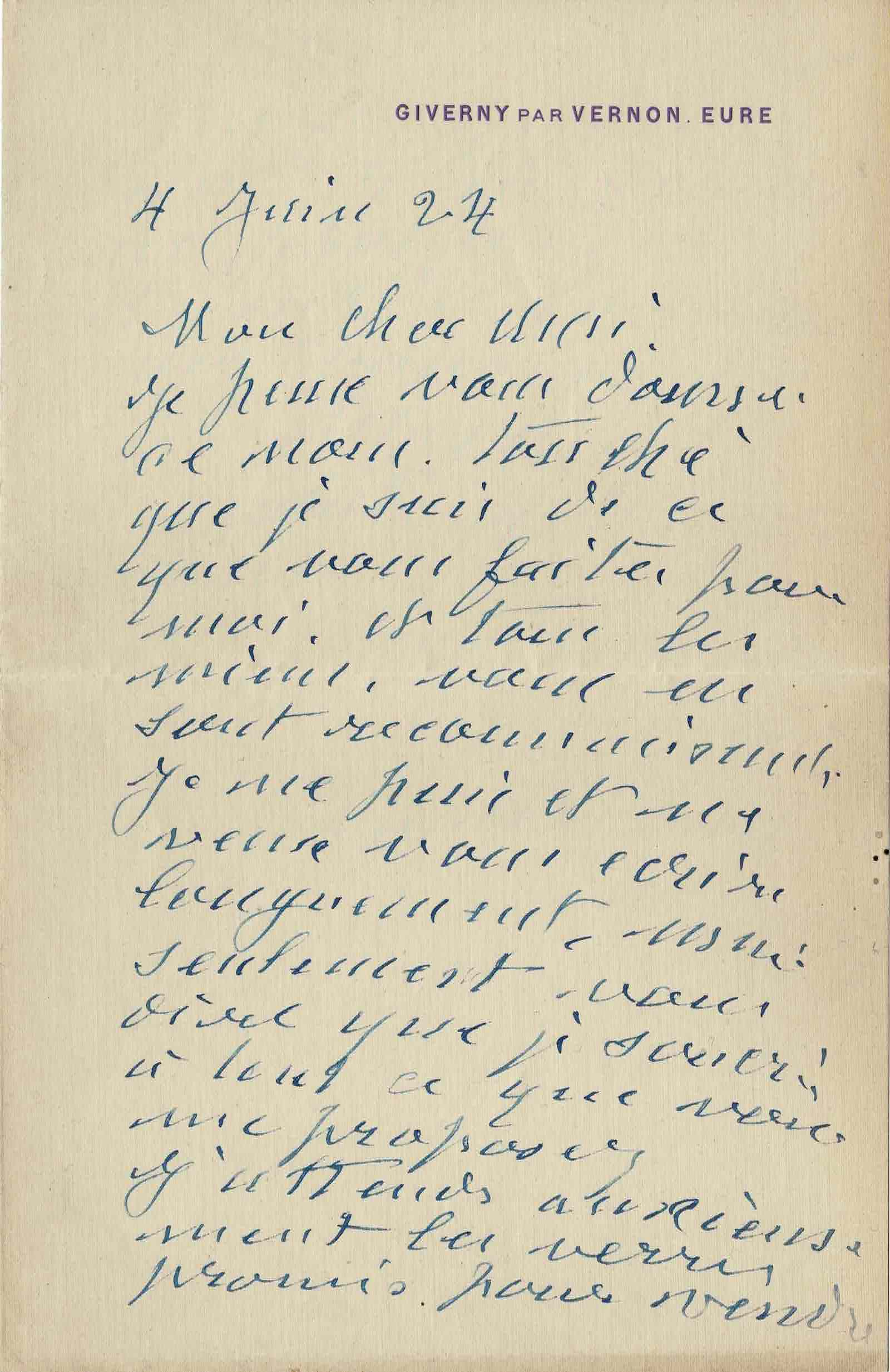
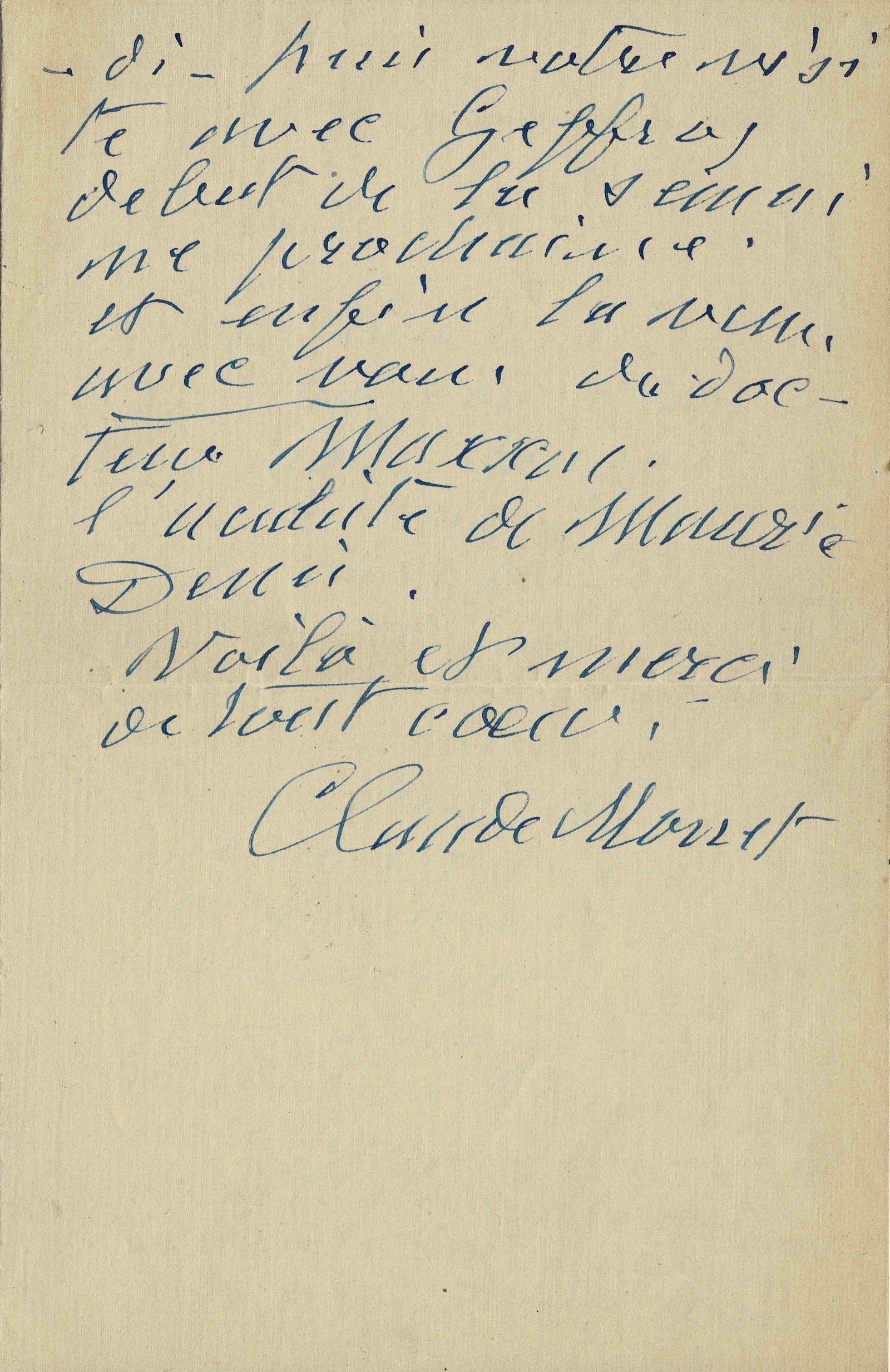
Autographed letter signed, probably to Doctor Charles Coutela.
Two octavo pages in blue ink, on Giverny letterhead paper by Vernon.
Giverny. June 4, 1924.
"I'm anxiously awaiting the drinks promised for Friday."
A moving letter from the end of life by the Master of Impressionism, written in difficult handwriting, lamenting his deteriorating eyesight following eye surgery in January 1923.
____________________________________________________
“My dear friend, I am thinking of giving you this month’s salary, touched as I am by what you are doing for me, and all my family are grateful. I cannot and do not wish to write at length, but only to tell you that I agree with everything you propose. I am anxiously awaiting the glasses promised for Friday – then your visit with Geffroy at the beginning of next week, and finally the arrival with you of Dr. Maxxas [sic, Dr. Jacques Mawas, eye specialist], Maurice Denis’s ophthalmologist . That is all, and thank you from the bottom of my heart. Claude Monet.”
____________________________________________________
The first signs of visual deterioration in Monet appeared around 1910. Hindered in his work and worried, Monet, after consulting many specialists, did not want to have an operation, remembering the blindness of Mary Cassatt and that of Honoré Daumier which occurred after the same intervention.
For nearly ten years, Monet continued his work despite the inexorable deterioration of his eyesight. In 1922, a sudden loss of visual acuity in his left eye forced him to undergo surgery; he could no longer paint. Encouraged by Georges Clemenceau, Monet had surgery (on his right eye) in January 1923, performed by Dr. Charles Coutela at the Neuilly-sur-Seine clinic.
The aftermath of the procedure was difficult for the artist, who was disturbed in his vision of colors: "I see blue, I no longer see red, I no longer see yellow; it bothers me terribly because I know that these colors exist." Tinted corrective lenses, prescribed by Dr. Jacques Mawas – the subject of this letter – were therefore necessary for the artist to correct his perception of colors and to once again grasp the extent of his palette.