Claude Lévi-Strauss
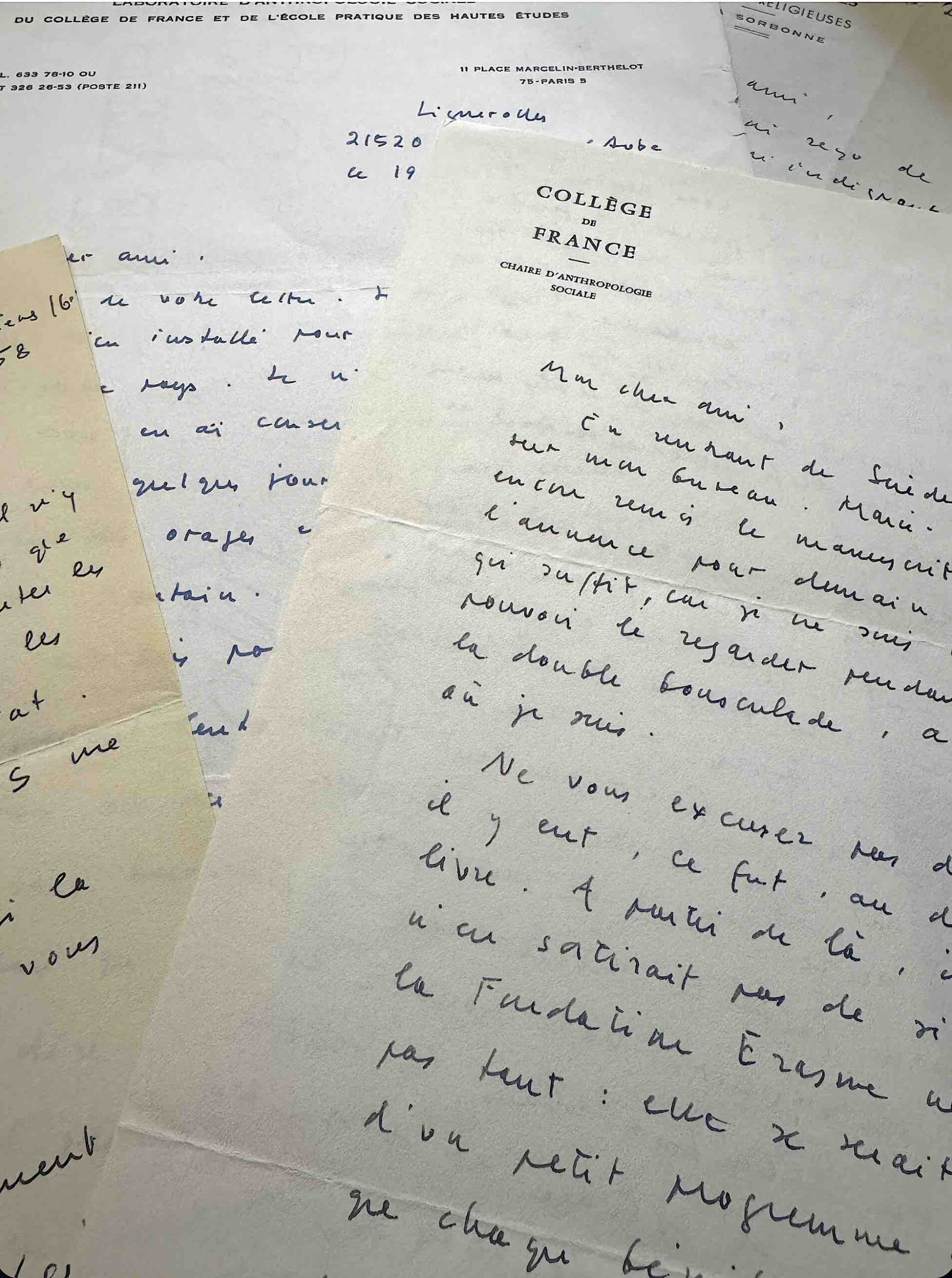
A collection of 109 autograph letters signed and 3 typed letters signed, addressed to the Romanian-born anthropologist Isac Chiva.
Paris , Valleraugue or Lignerolles, 1952-2007 .
180 pages of various formats, including an illustrated postcard, mostly on sheets or cards with printed letterheads, sometimes partially crossed out: International Social Science Council (3), École Pratique des Hautes Études – Religious Sciences (1), Collège de France (6), Laboratory of Social Anthropology of the Collège de France (68), French Academy (8).
Very important correspondence covering fifty years of friendship and active collaboration, mainly within the Laboratory of Social Anthropology (LAS), founded in 1960 by Lévi-Strauss and of which Chiva was the deputy director.
________________________________________________________
The vast majority of these letters were written during the summer months when Lévi-Strauss discussed the administrative and scientific affairs of the Laboratory with Chiva, even after his retirement in 1982, as the anthropologist remained very active and concerned about the future of the Laboratory.
Until 1964, Lévi-Strauss spent his months off in Valleraugue, in the Gard [where he had taken refuge at the beginning of the war before leaving for the United States], later acquiring a house in Lignerolles in Côte-d'Or (where he died on October 30, 2009).
Although in the first letter of this collection, dated September 20 [1952], Chiva is referred to as " Dear Sir ", all the other letters begin with " Dear friend " and many of them echo warm moments spent in his company, including one illustrated by a small diagram showing the road bordering the Hérault leading to his house in Valleraugue (August 14, 1963).
In 1955, when Chiva applied for naturalization, Lévi-Strauss suggested his friend write directly to Jacques Soustelle, the governor of Algeria, who had been one of his supporters. From 1960 onward, the discussions focused primarily on the organization of the LAS (Laboratory for Scientific Analysis), which was under the auspices of the CNRS (National Center for Scientific Research) and the Collège de France, responses to letters that Chiva forwarded to Lévi-Strauss, research positions, budgetary matters, and so on.
Among the people cited by Lévi-Strauss, we find the names of the administrative and scientific team of the LAS such as those of his secretary Evelyne Guedj, the administrator Jeanine Kevonian, the librarian Florence Neveux, the editors of the journal Études rurales such as Françoise Zonabend, Marie-Claude Pingaud, Marie-Élisabeth Handman, Danielle Daho or Eva Kempinski, and many other ethnologists or sociologists:
Edna Lemay, Clemens Heller, Mihai Pop (who could organize conferences at the Museum of Popular Arts and Traditions), Bernard Saladin d'Anglure, René Bureau (with the letter he addressed to Chiva on August 26, 1965, seeking to benefit from a leave of absence from the CNRS to accept a temporary position at the EPHE), the Polish sociologist Julian Hochfeld, Maurice Godelier (who had just been hospitalized following a car accident: " We really don't have any luck with our missions! "), Pierre Clastres, specializing in the study of the Guayak Indians, whose premature death saddened Lévi-Strauss: " It is always distressing when a young man, still full of talent, despite his digressions and a very fine writer, dies foolishly. But we had become too far apart for me to feel this death as a personal loss " (August 3, 1977, Clastres having just died in a car accident on July 27 of the previous year), Jean Cuisenier, the statistician Georges Kutukdjian (then 24 years old whom Lévi-Strauss wanted to see in charge of a "programmer" position but who seems not to keep his commitments according to two letters dated July 1970), Françoise Héritier-Izard, Pierre Monbeig, Anne Chapman, the American Sidney Mintz, etc.
On August 18 [1965], Lévi-Strauss tasked Chiva with handling a manuscript by Georges Dumézil intended for the Works and Memoirs of the Institute of Ethnology [ Anatolian Documents on the Languages and Traditions of the Caucasus , III], due to a grant application to be submitted soon to the CNRS.
During his months off, Lévi-Strauss enjoyed the attractions of the Burgundian countryside, particularly mushroom picking, but he also worked, correcting proofs and revising English translations of his works ( Structural Anthropology in 1972, The Origin of Table Manners in 1977, The Naked Man in 1980, etc.). He took advantage of a rainy August " to read the Saussure microfilm: surprising notes, full of profound insights mixed with adventurous fixed ideas: the entire Nibelungen cycle appeared to him as a roman à clef, reproducing the chronicle of the first Burgundian kingdom – which is hardly structuralist. " (August 14, 1967).
" I read a lot – the various manuscripts that had been sent to me from all over the year, but apart from Lorrain's book, which I don't understand anyway, nothing that I couldn't have done without. And I sweated blood and tears to produce eight pages for the special issue of L'Arc on Merleau-Ponty. They cost me at least 15 days of work, plus even if I include three successive readings of The Visible and the Invisible " (August 11, 1970).
A letter, dated August 29, alludes to the events of May 1968, in connection with correspondence which he would later deal with: " From the student revolt, I also drew my conclusions, namely that I am not at everyone's disposal, at any time... "
During the summer of 1973, after his election to the French Academy to the seat of Henri de Montherlant, he read and reread the writer's works, " but the inspiration has not yet come " [Lévi-Strauss delivered his acceptance speech on June 27, 1974].
On August 3, 1977, he questioned the future of the LAS: “ As for the ‘perpetuation’ of the lab, it doesn’t interest me personally, of course, but for a possible successor to whom I will hand over the reins, happy if I am accepted to remain a member of the lab like any other. What is currently being discussed at the CEV is not restricting the CNRS – humanities, but rather abolishing it and distributing the increased budget, they claim, between the universities and the major institutions. In this scenario, maintaining the lab would obviously be vital for research .” And in the same letter, there is mention of a disagreement that arose between Jacques Lizot and the American Napoleon Chagnon [both specialists in the Yanomami Indians], who had nevertheless planned a joint book project.
His sons, Laurent and Mathieu, are mentioned several times, the former wishing to join the EHESS, but Lévi-Strauss hesitating to intervene on his behalf with the president François Furet (letter of August 7, 1981, in which Lévi-Strauss also mentions for himself a possible proposal to be administrator of the National Library, a position which he fears will be a terrible chore.
A year before his retirement, he was preparing his last lecture at the Collège de France, " but Africa repels me ." Furthermore, " this last year of teaching will be anything but solemn; I won't give a final lecture, it will be an ordinary lecture, like all the others, and nothing will mark the end of exactly half a century of teaching " (August 18, 1981). François Furet invited him to give the next Marc Bloch lecture in honor of his retirement: " I couldn't have been offered a crueler punishment, but it was impossible to say no. So I accepted, with words of gratitude on my lips and a heavy heart, thinking of this chore that comes on top of so many others... " (June 16, 1982).
In the following years, a very busy retiree, Lévi-Strauss continued to lecture, supervised translations, wrote prefaces and articles, and conducted preliminary research for a forthcoming book. And even though he no longer directed the Laboratory, he was kept informed through letters forwarded to him by Chiva. In 1987, he agreed to give a speech at the presentation of the academician's sword to Georges Duby, to whom he wrote in September 1988 to recommend his son Laurent, who was eager to work at La Sept [the television channel chaired by Duby from its creation in 1986 until 1989], sending Chiva a photocopy of the letter for his records.
He responds to a question from Chiva about a work in progress: “ Have I written on the notion of cultural area? I no longer know, and where? Even less so… It seems to me in any case that this notion is subject to the same criticism as that of race: different traits do not all have the same boundary, just as race has been replaced by the notion of genetic stock, which admits that traits, some visible, others hidden, do not have the same extent and that their respective areas of diffusion partially overlap, spill over, or intertwine; similarly, what is defined as a cultural area for one trait will not necessarily be so for another. I seem to recall that Leroi-Gourhan saw this clearly in different language in Archaeology of the North Pacific ” (March 17, 1989).
In December 1989, at the time of the fall of the communist regimes, a few days after the execution of the Ceausescu couple, he evokes the situation in Romania: " There is a degree of concern in the way things are going there and also in the neighboring countries. I wonder if Eastern Europe is not going to experience a return to a Balkan era of the kind experienced at the end of the nineteenth century and the very beginning of this one ," then he goes on to acknowledge his fears for the somewhat compromised future of the National Museum of Arts and Popular Traditions [future MuCEM, Museum of European and Mediterranean Civilisations].
In April 1990, there was talk of the international symposium organized by UNESCO, " The Presence of Alfred Métraux, " which Michel Leiris and he himself, without having consulted each other, refused to attend. And that same year: " I'm putting the finishing touches on the book I've been dragging around for two years now, but the manuscript is so crossed out and cut-and-pasted, so overloaded, that I can no longer read it " (July 28, 1990).
In July 1991, he was appointed Grand Cross of the Legion of Honour: “ I don’t know what earned me this favour from the Power: no warning signs. […] As for your ‘ecomuseum’ sufferings, if it can console you, I share them, yielding to pressure from Augé, I had to agree to write a postface for a collective volume (of which you yourself are writing, I believe, the preface?), even though I have never visited an ecomuseum, know nothing of the texts that will make up this volume, and, with all the provisions I have, a selection of poor photocopies of photographs intended for illustration [ Territories of Memory: The Collections of Ethnological Heritage in Ecomuseums , published under the direction of Marc Augé].
The following summer, he led a studious existence, still in Lignerolles: " I write 3 or 4 hours a day the 'last book' and very much outside of anthropology " [ Regarder, écouter, lire , which will be published by Plon in 1993].
He participated in the television program presented by Michel Field [ Le Cercle de Minuit ]: " I didn't see Field's show. After midnight I'm asleep! But during the recording, I was very unhappy with myself and with the weariness I betrayed at having to answer the same questions all the time. So much the better if it wasn't too noticeable " (June 18, 1993).
Among his readings, the works of Chiva of course, including Ethnologies en miroir or Mots et choses de l'ethnographie en France which made him realize the extent of his ignorance: " in reading you, as well as your collaborators, I also reflected that if we took the trouble to deepen our knowledge of our great predecessors, we would hardly write anymore, because we are only rediscovering what they said before us... " (October 2, 1997).
As for Paul Celan, I confess to having read nothing and knowing nothing about him. On the other hand, I knew Daniel Guérin in the United States and it was his wife […] who, when I was a cultural advisor, typed the first draft of Elementary Structures [ of Kinship , his first major work published in 1949]” (September 14, 2001).
At 97, Lévi-Strauss considered the future of his archives, indicating that negotiations with the National Library were formally underway, with a librarian from the manuscripts department having come to his home to inventory them in June 2005.
“ I rarely go out and spend my time reading the typescript of a book in preparation by Boris Wiseman on my aesthetics; not bad [ Lévi-Strauss, anthropology and aesthetics , Cambridge University Press ]. And another by Bruce Albert [ The Falling Sky ], stories collected from the mouth of his famous Yanomami shaman. Hoping for a preface, I imagine. But these shamanic testimonies, so fashionable, seem to me in the end to be of little use ” (July 21, 2006).
Numerous letters attest to the close friendship and professional bond that united the two anthropologists for five decades. " Your presence at my side is by no means symbolic, for I would never have embarked on the adventure of the laboratory if I hadn't known you were ready to accompany me. During these twenty-odd years, I often reproached myself for leaving you with the brunt of it. I remain deeply grateful to you " (January 2, 2003). And right up to the last letter in this collection, dated July 16, 2007: " The dedication is a ritual that our long friendship makes unnecessary. It doesn't need testing and is quite sufficient in itself. Thank you for your article. It taught me a great deal about a field in which you are an expert and which I know little about ."
________________________________________________________
Born in Romania, Isac Chiva (1925-2012) was one of Claude Lévi-Strauss's closest collaborators. A Jew, a victim of persecution during the war, he fled the Stalinist regime in his country and arrived in France in 1948. A graduate in social sciences, he joined the CNRS (French National Centre for Scientific Research) in 1951, sponsored by Lévi-Strauss, and worked for the Museum of Popular Arts and Traditions (ATP), specializing in rural ethnology. In 1960, Lévi-Strauss, newly elected to the Collège de France, asked him to join him in directing the Laboratory of Social Anthropology (LAS), which he had just founded. Deputy Director of the Chair of Anthropology, Chiva directed the multidisciplinary journal Études rurales from 1961 to 1982. He was Director of Studies at the École Pratique des Hautes Études and then at the EHESS (École des Hautes Études en Sciences Sociales).
SEAL :
– 2 letters signed by the Minister of Public Health and Population Bernard Lafay, November 20, 1955, giving a favorable response to Chiva's application for naturalization, the first to Jacques Soustelle, then Governor of Algeria (with his business card), and the second to the Member of Parliament, Robert Verdier.
– Typed text (3 p. in-4 on 2 sheets) relating to signs of protection against evil spells, in particular the gesture of the “fig”, and to the works of the magistrate Pierre de Lancre, known for the witch hunt he organised on royal order in 1609 in the Basque Country.