Charles Baudelaire (1821.1867)
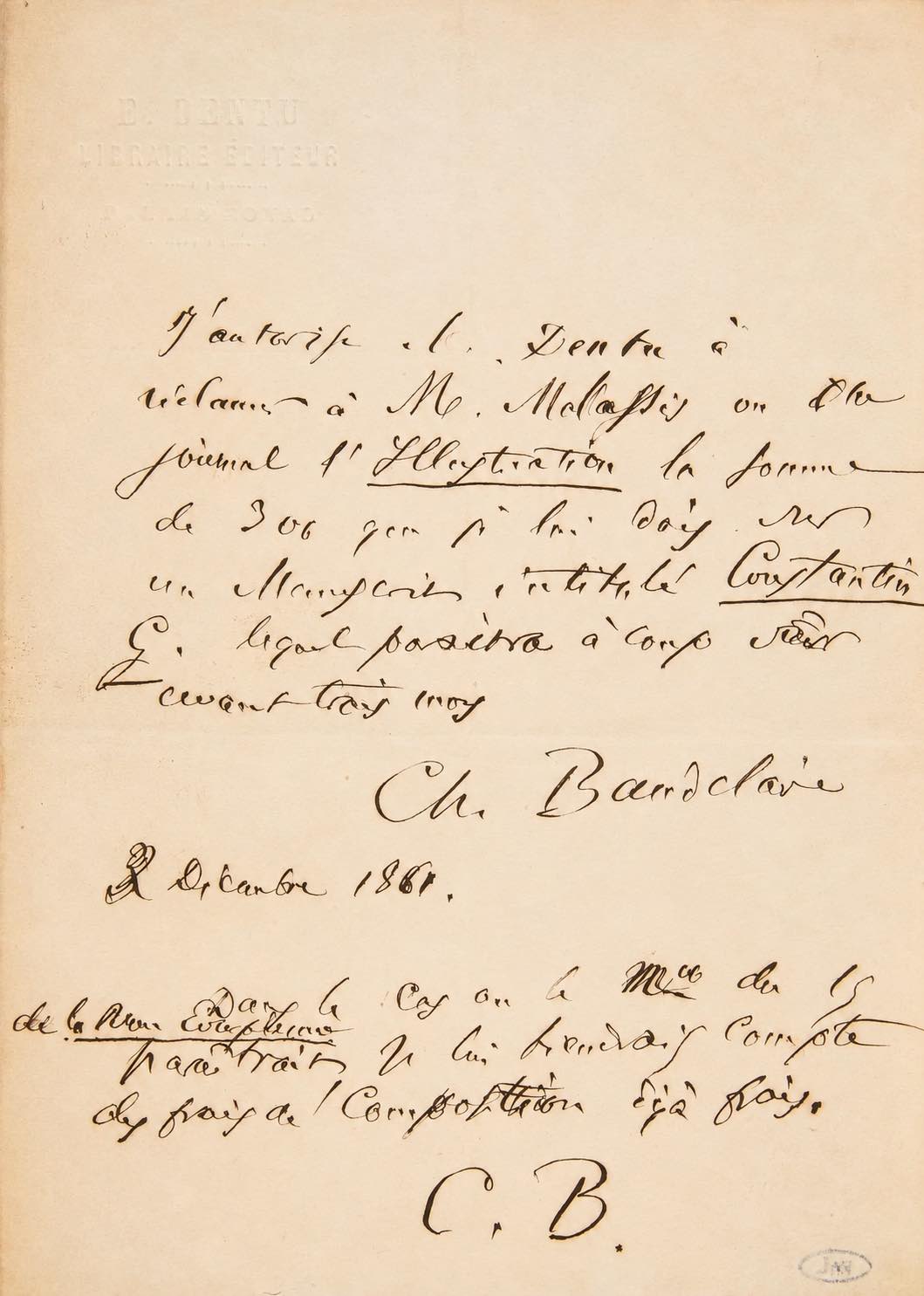
Autograph letter signed (twice) to the bookseller-publisher Edouard Dentu.
One page in-12° on embossed paper with the monogram E. Dentu. Bookseller-Publisher.
Collector's stamp on the back.
[Paris] December 2, 1861.
Pléiade Correspondence. Volume II, pp. 192-193.
Charles Baudelaire, desperate, pawns his manuscript on Constantin Guys.
_________________________________________________________
I authorize Mr. Dentu to claim from Mr. Malassis or the newspaper L'Illustration the sum of 300 francs that I owe him for a manuscript entitled Constantin G., which will certainly be published within three months. Ch. Baudelaire. December 2, 1861.
Should issue number 15 of the Revue Européenne be published, I will reimburse the typesetting costs already incurred. CB
_________________________________________________________
In December 1861, Baudelaire was, as usual, in dire financial straits. Placed under judicial supervision since 1844, he received only a meager monthly allowance from his inheritance, far from sufficient to cover his accumulated debts. The near-bankruptcy of his publisher, Poulet-Malassis, and the abrupt closure of La Revue européenne left him without liquidity; he was forced to pledge his articles in advance.
Baudelaire is referring here to his important essay and aesthetic manifesto, which was published in 1863 under the title The Painter of Modern Life and which takes as its model the draftsman Constantin Guys (1802-1892). In it, he theorizes his aesthetic of modernity: striving to extract the eternal beauty hidden in the transient, the fleeting, and the spectacle of urban life.
The optimism shown here by the poet will be contradicted by the facts: the essay on Constantin Guys will ultimately not appear in L'Illustration but only in November 1863, in Le Figaro.
_________________________________________________________
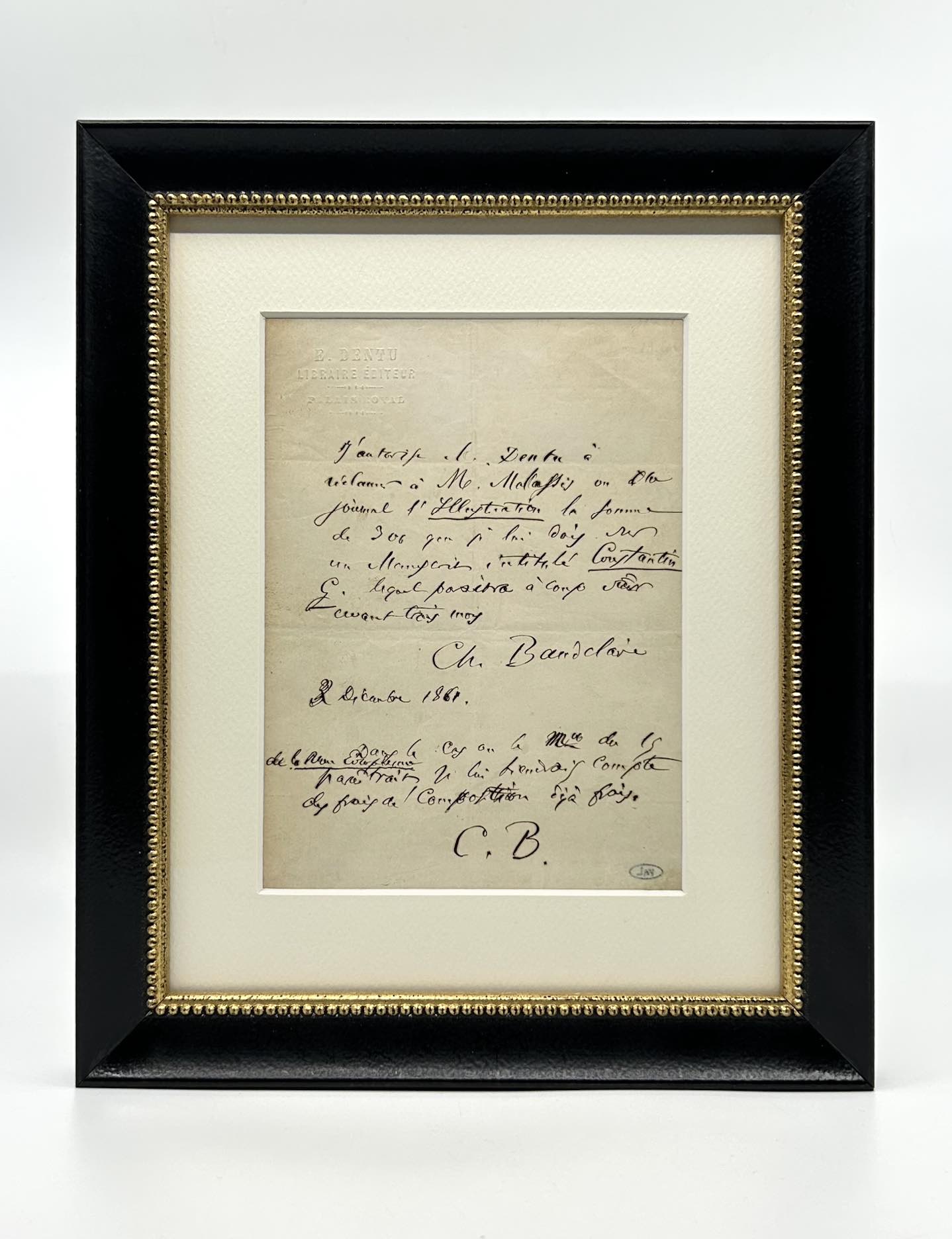
Document presented in a black and gold frame (UV and anti-reflective glass) measuring 30 x 24 cm.