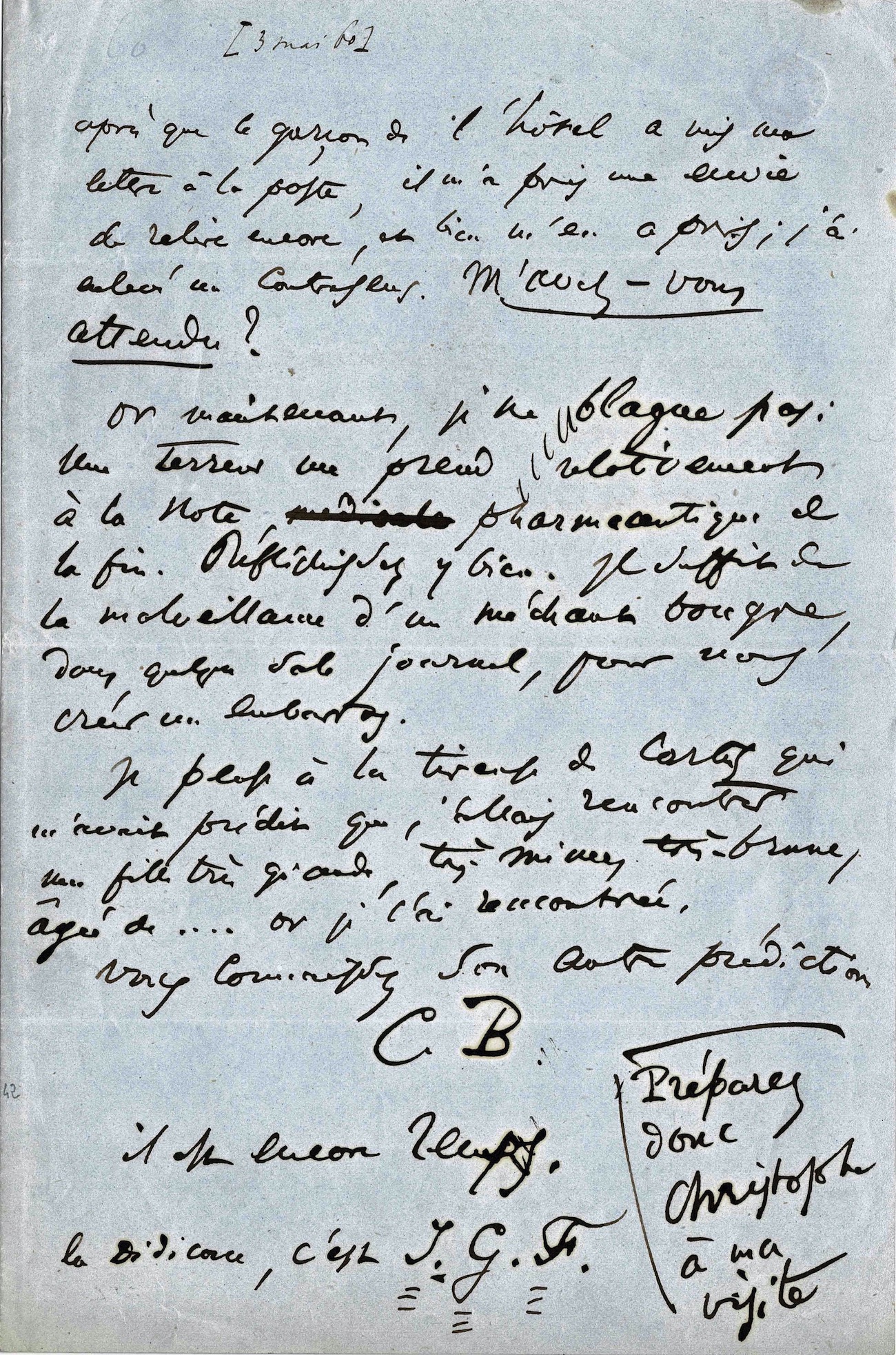
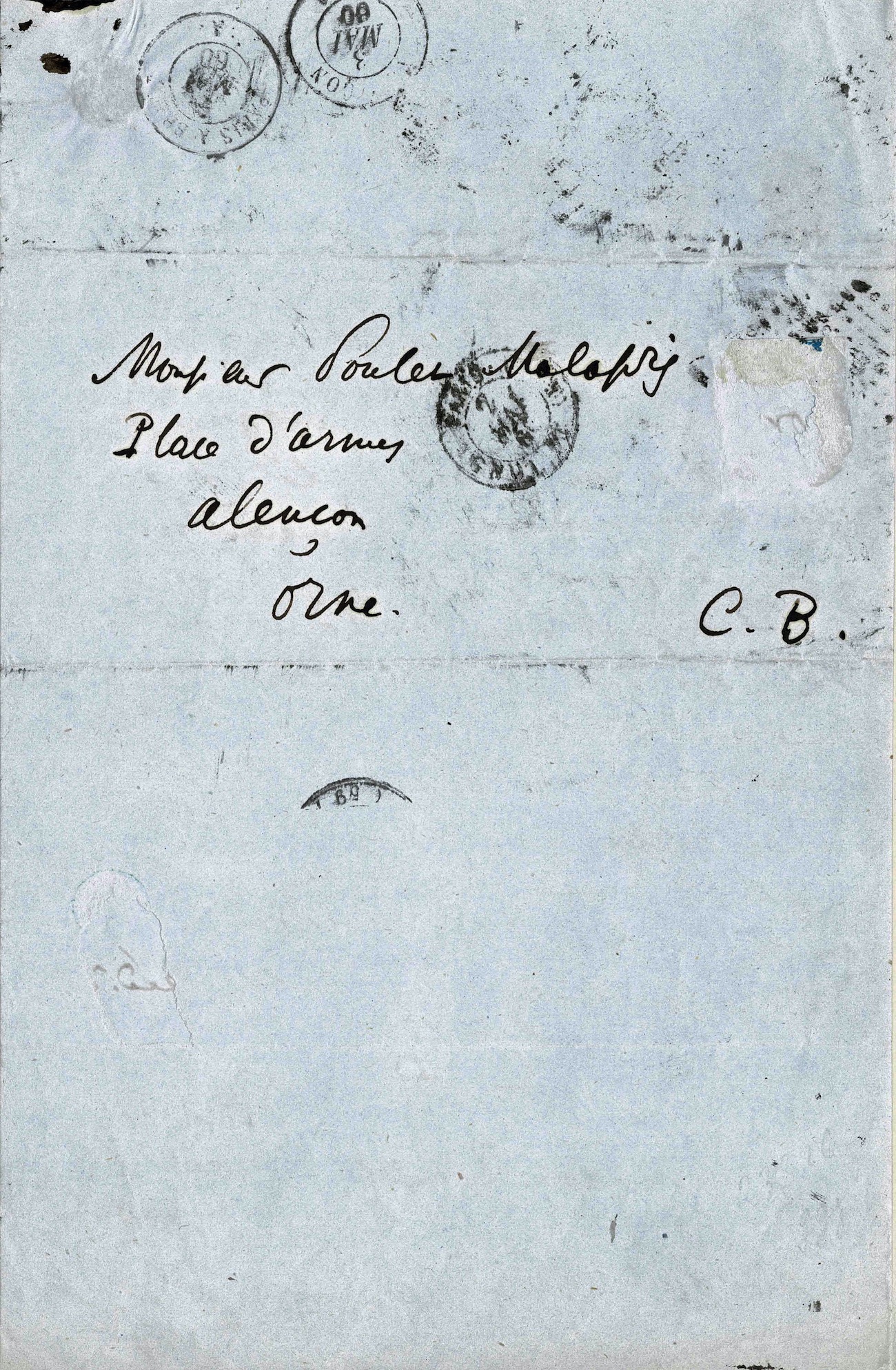

Autographed letter signed to Auguste Poulet Malassis.
Sold
Charles Baudelaire (1821.1867)
Autographed letter signed to Auguste Poulet Malassis.
One octavo page on blue paper.
Autograph address on the 4th sheet , also signed with Baudelaire's initials.
[Paris – May 2, 1860]
"But now, I'm not joking: I'm gripped by terror."
Baudelaire constantly resumed his work on Artificial Paradises.
“After the hotel boy [Hôtel de Dieppe] mailed my letter, I felt like rereading it, and I'm glad I did; I corrected a mistranslation. ' Were you waiting for me?' Now, I'm not joking : I'm terrified by the pharmaceutical note at the end. Think about it carefully. All it takes is the malice of some nasty fellow, in some sleazy newspaper, to create an embarrassment for us. I'm thinking of the fortune teller who predicted I would meet a very tall, very thin, very dark-haired girl, aged… well, I did meet her. You know her other prediction. CB. There's still time. The dedication is JGF. So, prepare Christophe for my visit.”
The day before this letter, Baudelaire had sent Poulet Malassis the eleventh corrected sheet of Artificial Paradises . He fears here that it may have already been printed with the mistranslation he discovered.
The fortune teller mentioned in this letter may be – according to the editors of La Pléiade – Miss Lenormant, a famous fortune teller whom Baudelaire had seen at least once, as he confided to Ste Beuve in January 1862.
The dedication " to JGF " appears twice in Baudelaire's work: the first time at the beginning of Artificial Paradises ; the second time in the 1861 edition of Flowers of Evil, where the poem entitled The Self-Tormentor . To whom do these initials refer, which have, until now, kept their secret?
The name Juliette Gex-Fagon was put forward, but without providing the slightest proof of any connection the poet might have had with this Juliette, whose whereabouts, moreover, have never been discovered. In 1972, in Baudelaire, les poisons et l'inconnu (Baudelaire, Poisons and the Unknown ), Christian Moncel suggested that "JGF" referred to an imaginary woman: this hypothesis, however, hardly fits with the tone of the preface-letter to Paradis artificiels (Artificial Paradises).
These lines from 1860, in particular, seem to allude to Jeanne Duval, who suffered a stroke in 1859 and whom Baudelaire cared for for three years. But if the young woman is indeed the "dear friend" mentioned at the beginning of the collection Artificial Paradises —and it seems hardly possible to doubt it—why then did Baudelaire choose to refer to her by initials that do not correspond to any of the different known names of Jeanne?
Formerly in the Daniel Sickles collection.