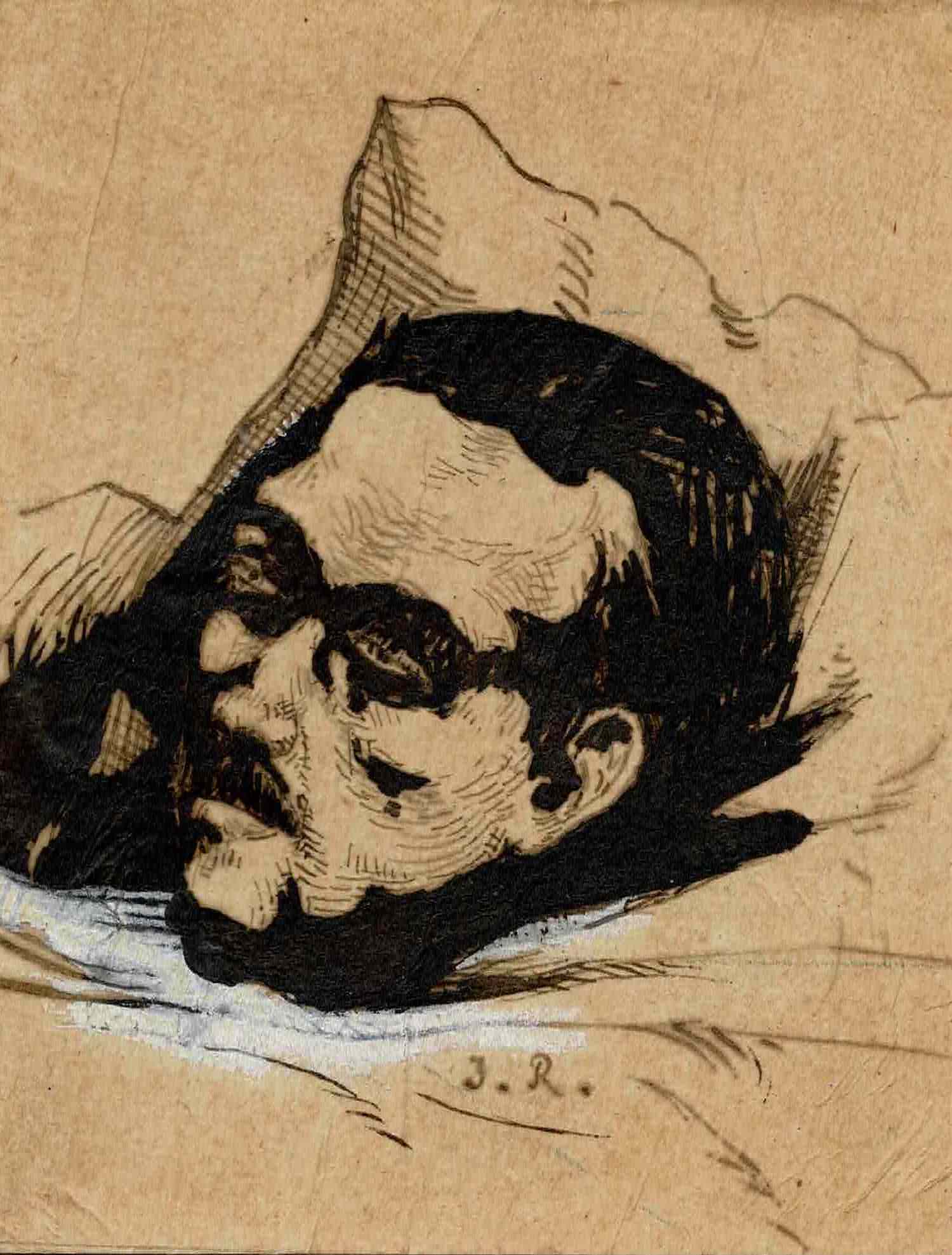
Arthur Rimbaud on his deathbed.
Original pen drawing by his sister Isabelle, signed IR in the lower margin.
Precious portrait of Arthur, made from memory, in 1895, by Isabelle Rimbaud and addressed to her future husband Paterne Berrichon (see letter of October 27, 1896).
Brown ink and white gouache on heavy paper.
Format 9 x 7 cm.
_________________________________________
This drawing, a poignant testimony of the poet's last moments, constitutes the frontispiece of volume I of Jean-Jacques Lefrère's Rimbaud correspondence, published by Fayard in 2007.
Isabelle Rimbaud was a privileged witness to the final months of suffering of her older brother, in Roche and Marseille: “ I supported his faltering body. I carried in my arms this suffering and failing body. I guided his outings, I watched his every step; I led and accompanied him wherever he wished; I always helped him to come in, to go up, to go down; I cleared away with his one foot every ambush and obstacle. I prepared his seat, his bed, his table. Bite by bite, I fed him some food. I placed cups of drink at his lips, so that he might quench his thirst… ”
We are familiar with the work of remembrance—often criticized—undertaken by Isabelle immediately after her brother's death on November 10, 1891. Her marriage to Paterne Berrichon in 1897 reinforced the distortion of Arthur Rimbaud's destiny. Indeed, driven by their ideological quest, the Rimbaud-Berrichon couple dedicated themselves to perpetuating the poet's cult solely under the auspices of Morality.
The Rimbaldian exegetes of the 20th century were able to deconstruct the sacred temple initially erected by Isabelle in order to define the more exact contours of the life of the man with soles of wind.
In any case, Isabelle Rimbaud played a part in Rimbaud's legacy and legend. As the sole witness to his final moments, her writings and drawings hold a "sacred" importance.
Bibliography:
Arthur Rimbaud. Correspondence. Jean-Jacques Lefrère. Fayard. 2007.
My brother Arthur. Rimbaud dying. Mercure de France. 1921.
Facing Rimbaud. Jean -Jacques Lefrère. Phébus. 2006.