[Alfred JARRY] – Louis LORMEL (1869.1922)
Autograph manuscript signed.
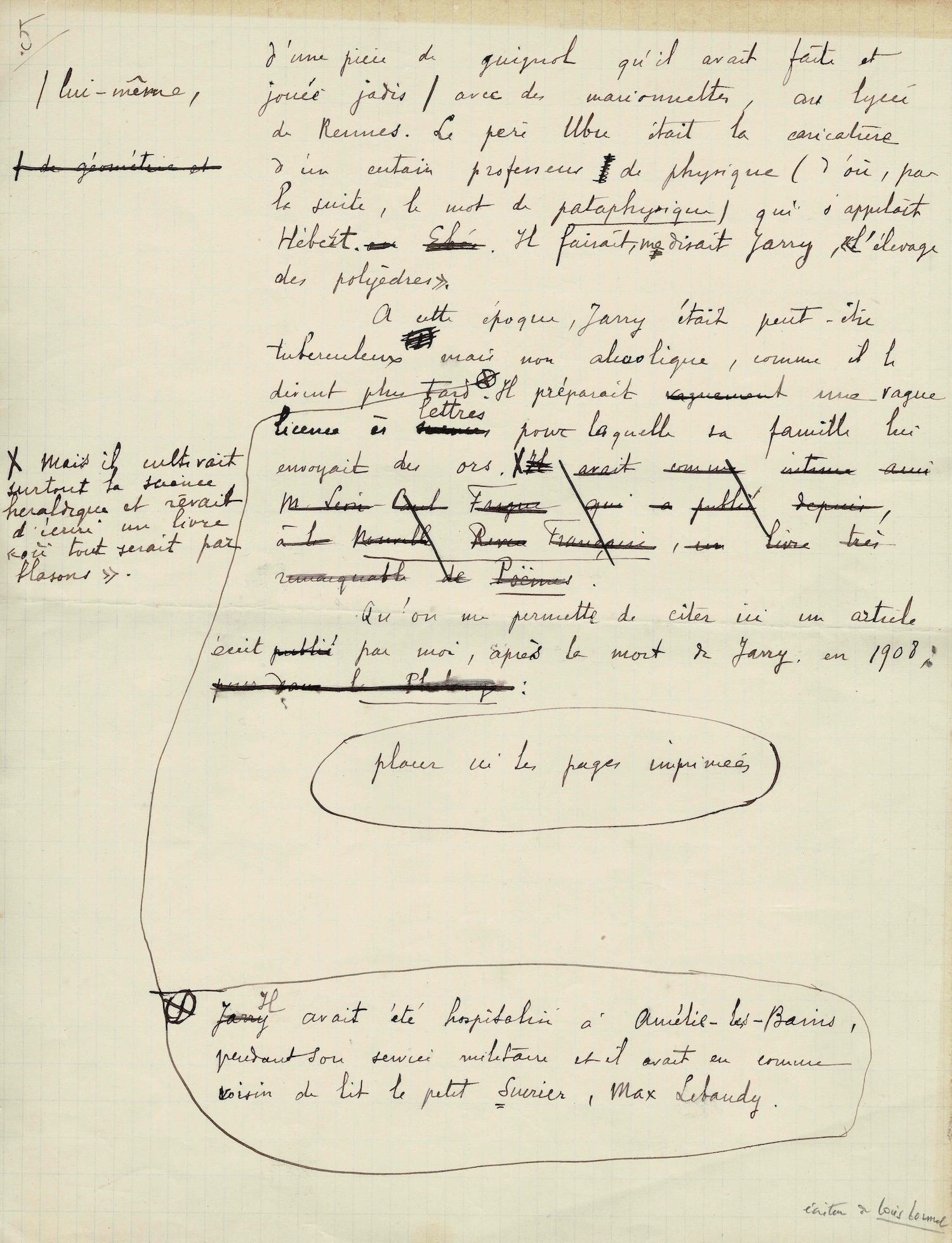
Five quarto pages on graph paper.
Slnd [1921]
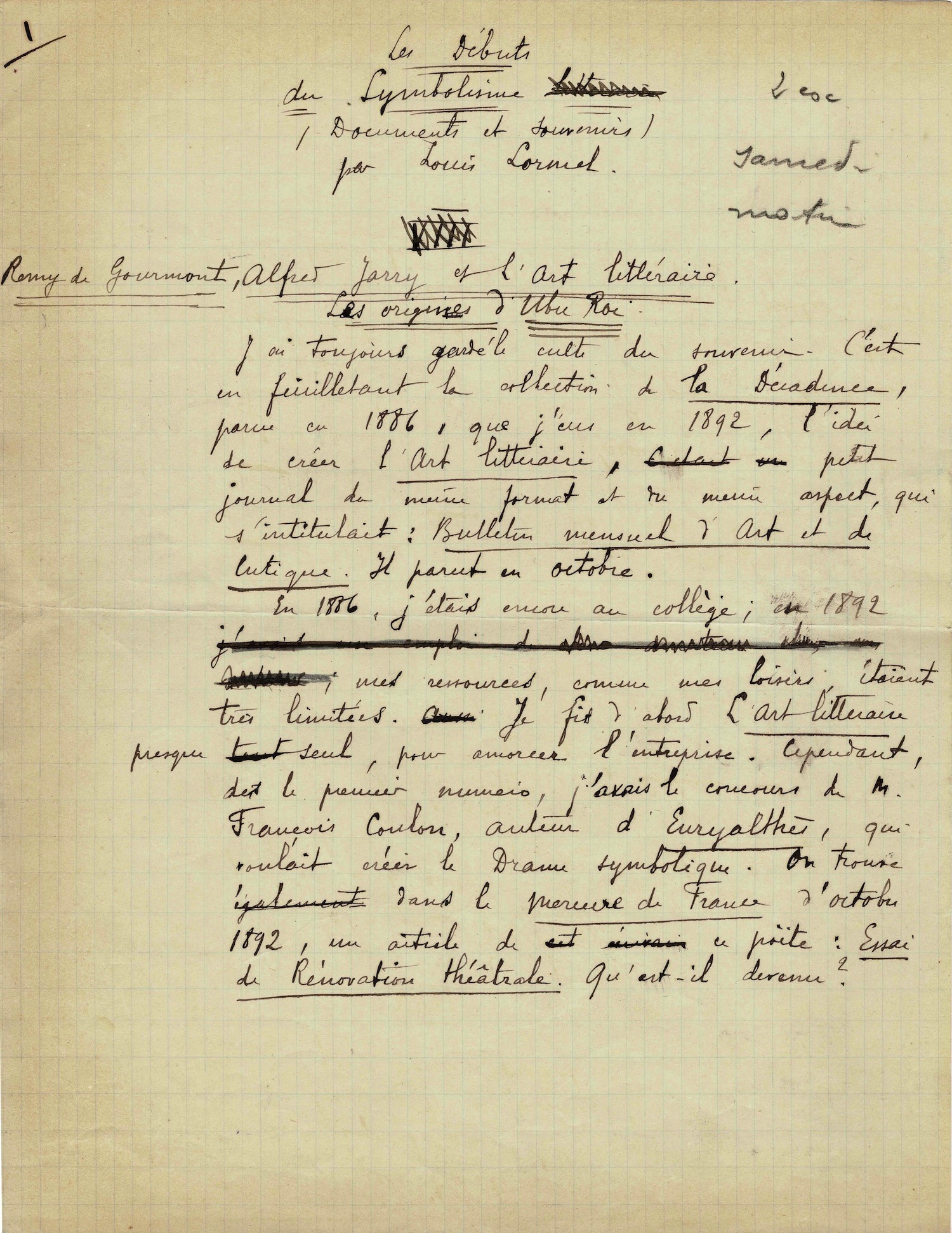
The beginnings of symbolism. Rémy de Gourmont, Alfred Jarry and literary art. The origins of Ubu Roi.
"He often spoke to me about Ubu Roi , as if it were a puppet show he himself had written and performed in the past."
A valuable working manuscript, in its first draft, constituting the first part of his article devoted to Jarry published in Le Gaulois du dimanche , on December 3, 1921.
Louis Lormel (Louis Libaude, known as) launched his magazine L'Art littéraire . In December 1893, it was in this magazine that Alfred Jarry published his first text: the poem Berceuse pour endormir le mort , signed "Alfred-Henry Jarry" (later included in Les Minutes de sable mémorial) .
Relations between Lormel and Jarry cooled when the latter became a shareholder of the Mercure de France and thereafter reserved his work for it. However, they reconciled at the end of Alfred Jarry's life. Upon his death in 1907, Louis Lormel published an article in La Phalange describing Jarry's style as "the infinite variety of images clashing and intertwining in a sometimes obscure pattern."
______________________________________________________________
“I have always cherished the memory. It was while leafing through the collection of La Décadence , published in 1886, that I had the idea in 1892 of creating L'Art littéraire , a small journal of the same format and appearance, which was entitled: Bulletin mensuel d'Art et de Critique . It appeared in October.
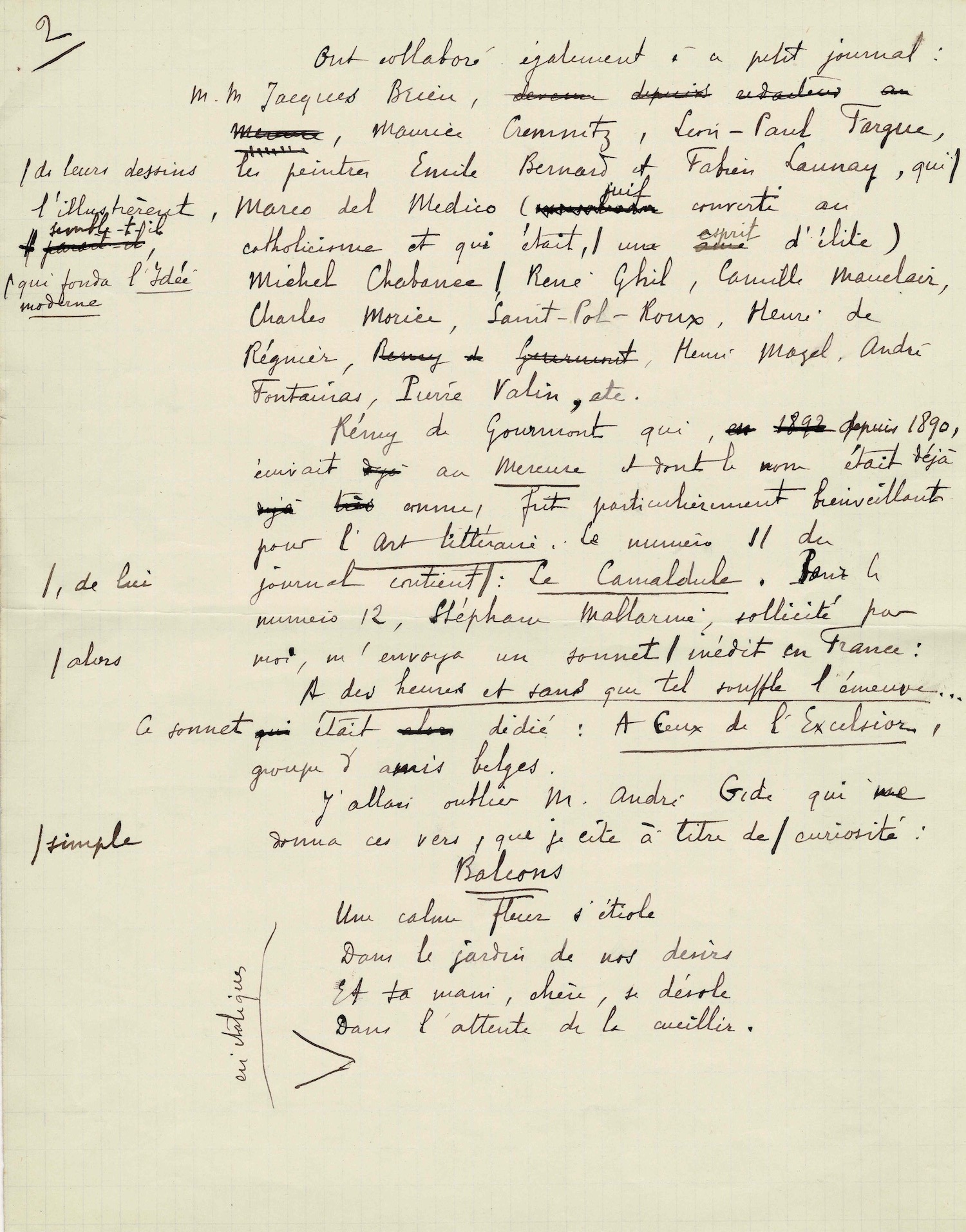
In 1886, I was still in college; by 1892, my resources, like my leisure time, were very limited. I initially produced *L'Art littéraire* almost entirely on my own, to get the project off the ground. However, from the very first issue, I had the support of Mr. François Coulon, author of * Euryalthès Essai de Rénovation théâtrale" (Essay on Theatrical Renovation , can be found in the October 1892 issue of * Mercure de France* What became of it?[…]
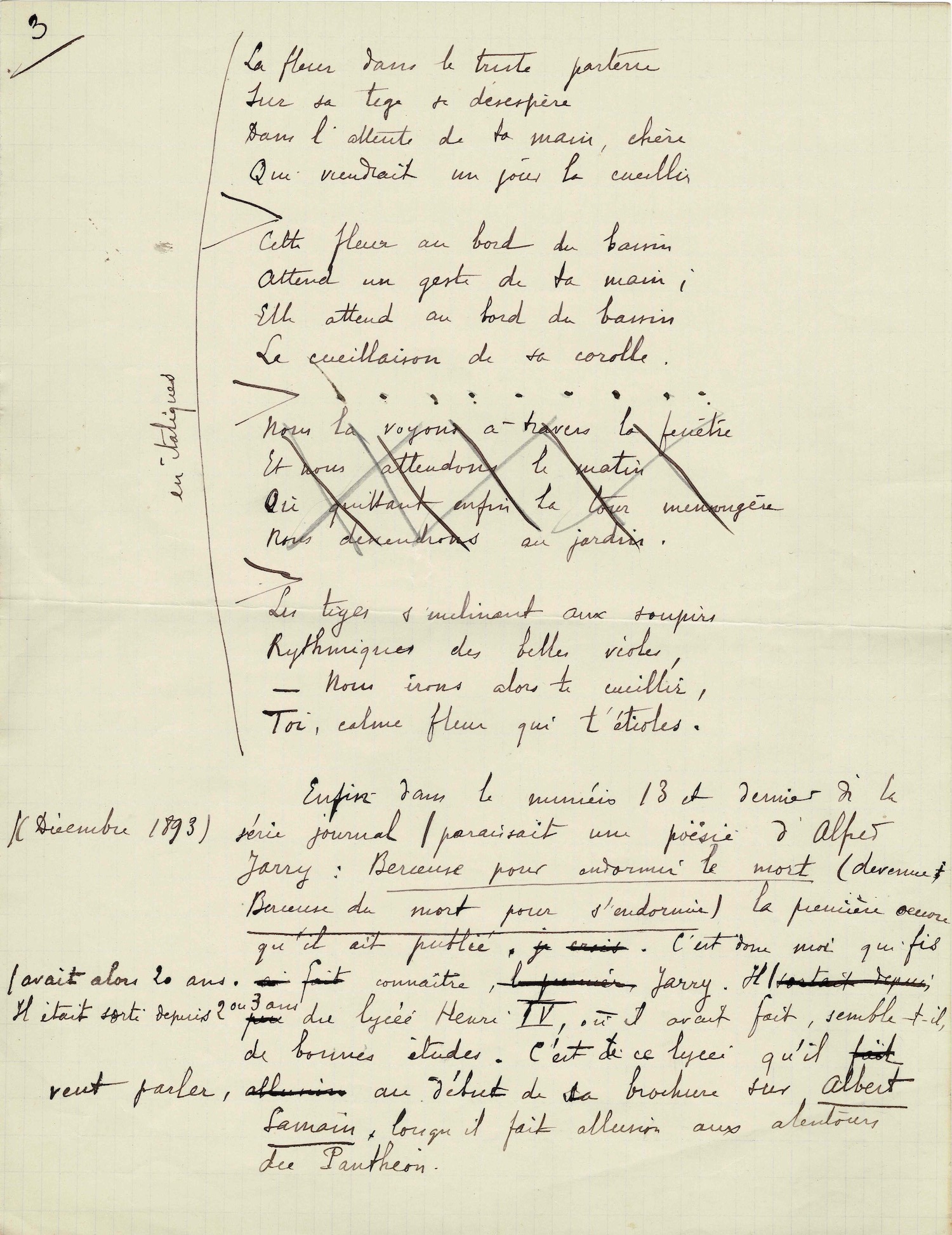
Mercure since 1890 and whose name was already well-known, was particularly kind to L'Art littéraire . Issue number 11 of the journal contains one of his prose pieces: Le Camaldule . For issue number 12, Stéphane Mallarmé, at my request, sent me a sonnet then unpublished in France: A des heures et sans que tel souffle l'émeuve … This sonnet was dedicated: To Those of the Excelsior , a group of Belgian friends. I almost forgot Mr. André Gide, who gave me these verses, which I quote simply out of curiosity. […]
Finally, in issue number 13, the last in the journal series, appeared a poem by Alfred Jarry: " Lullaby to Lull the Dead Man to Sleep" (later renamed "Lullaby of the Dead Man to Fall Asleep "), the first work he published. It was I, therefore, who introduced Jarry to the public. He was 20 years old at the time. He had left the Lycée Henri IV two or three years earlier, where he had apparently done well academically. It is this lycée he refers to at the beginning of his pamphlet on Albert Samain when he alludes to the area around the Panthéon.
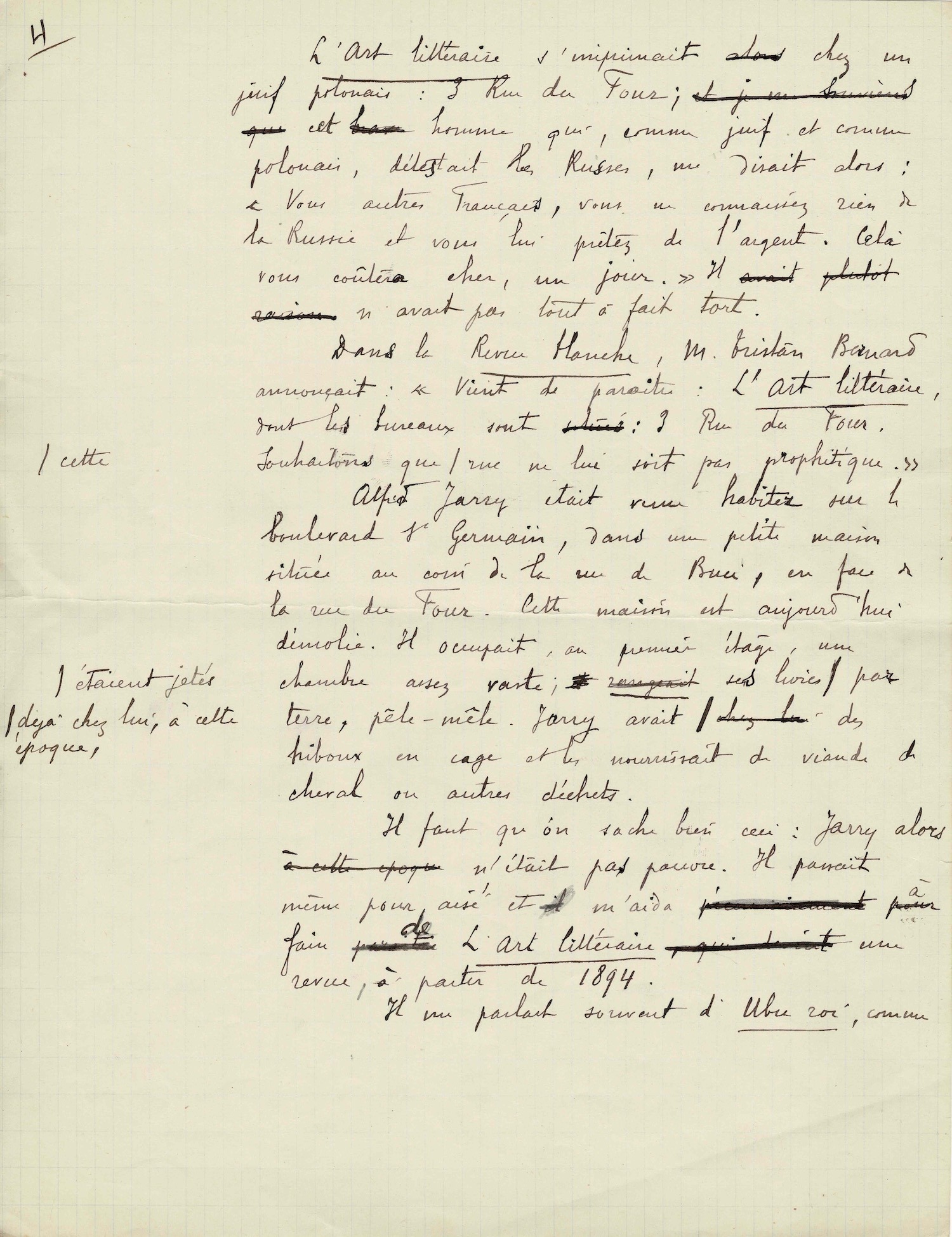
Literary Art was printed by a Polish Jew at 3, rue du Four; this man, who, as a Jew and as a Pole, hated the Russians, told me then: "You French know nothing about Russia and you lend it money. That will cost you dearly one day." He wasn't entirely wrong.
In the Revue blanche , Mr. Tristan Bernard announced: "Just published: L'Art littéraire , whose offices are at 3 rue du Four. Let us hope that this street will not prove prophetic for him."
Alfred Jarry had come to live on Boulevard Saint-Germain , in a small house located on the corner of Rue de Buci, opposite Rue du Four. This house has since been demolished. He occupied a fairly large room on the first floor; his books were scattered haphazardly on the floor. Jarry already kept caged owls at home at that time and fed them horse meat and other scraps.
It's important to understand this: Jarry wasn't poor at the time. He was even considered well-off and helped me launch L'Art littéraire as a journal in 1894. He often spoke to me about Ubu Roi , as if it were a puppet show he himself had written and performed with marionettes at the Rennes high school. Father Ubu was a caricature of a certain physics professor (hence, consequently, the word pataphysics) named Hébert. He was, Jarry told me, "raising polyhedra."
At that time, Jarry may have had tuberculosis but was not yet an alcoholic, as he later became . He had been hospitalized in Amélie-les-Bains during his military service, and his bed had been shared with the young Sucrier, Max Lebaudy. He was working on a vague degree in literature, for which his family sent him gifts. But above all, he cultivated the science of heraldry and dreamed of writing a book "where everything would be based on coats of arms" […]