Alexis de TOCQUEVILLE – Set of three autograph letters signed.
"You understand that there is nothing more honorable, and therefore more desirable, than to represent the city of Paris in the Chamber."
Sold

"You understand that there is nothing more honorable, and therefore more desirable, than to represent the city of Paris in the Chamber."
Sold
Alexis de Tocqueville (1805.1859)
A set of three autograph letters signed to his friend Jules Taschereau.
Four octavo pages in total.
Tocqueville, September 27, 1837 , Paris, August 17, 1842, No place or date [1844?]
"You understand that there is nothing more honorable, and therefore more desirable, than to represent the city of Paris in the Chamber."
For his entry into politics, the future member of parliament for Manche accepted the offer to be the candidate for the 10th arrondissement of Paris.
________________________________________________________
I. “ Tocqueville this September 27, 1837
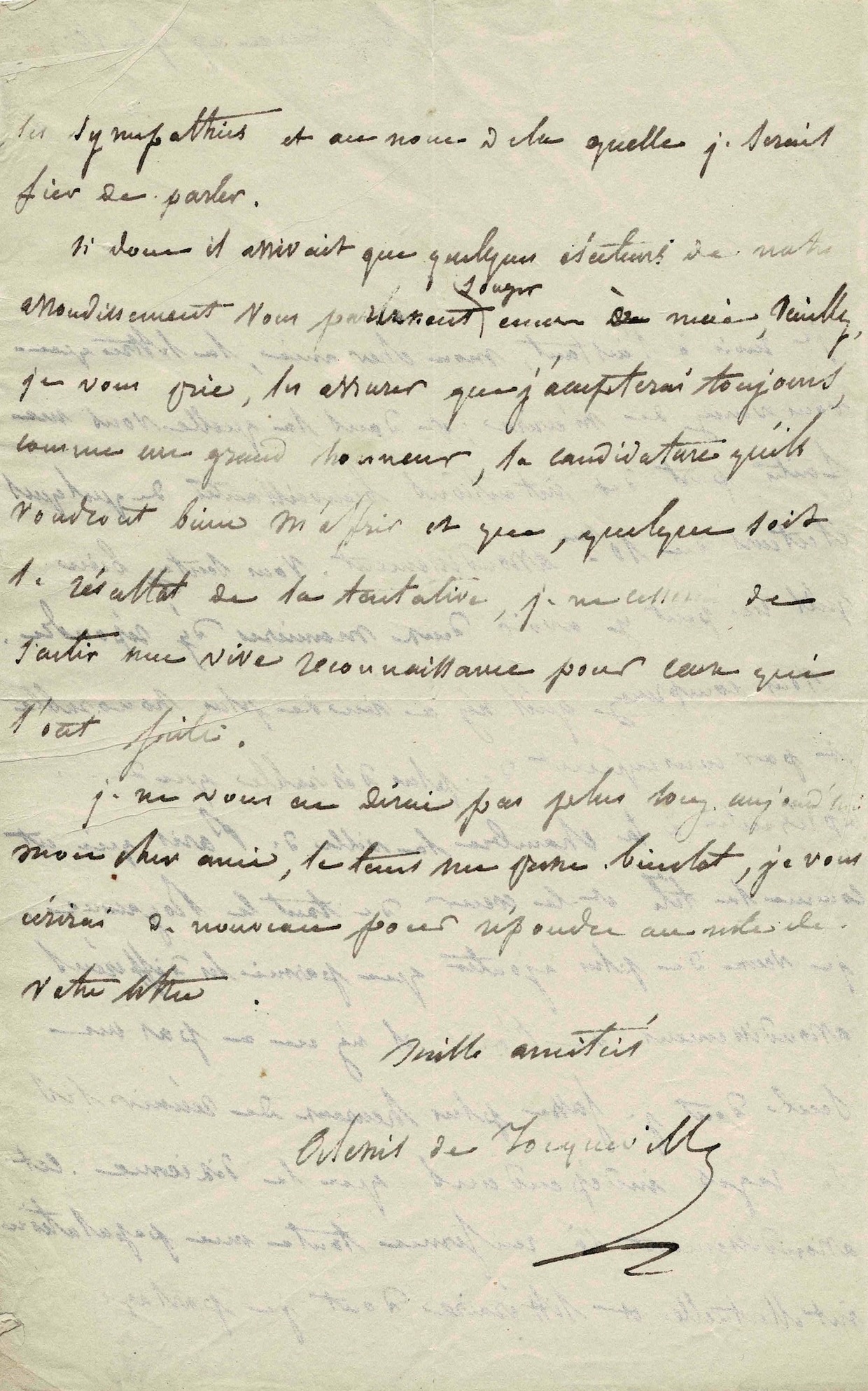
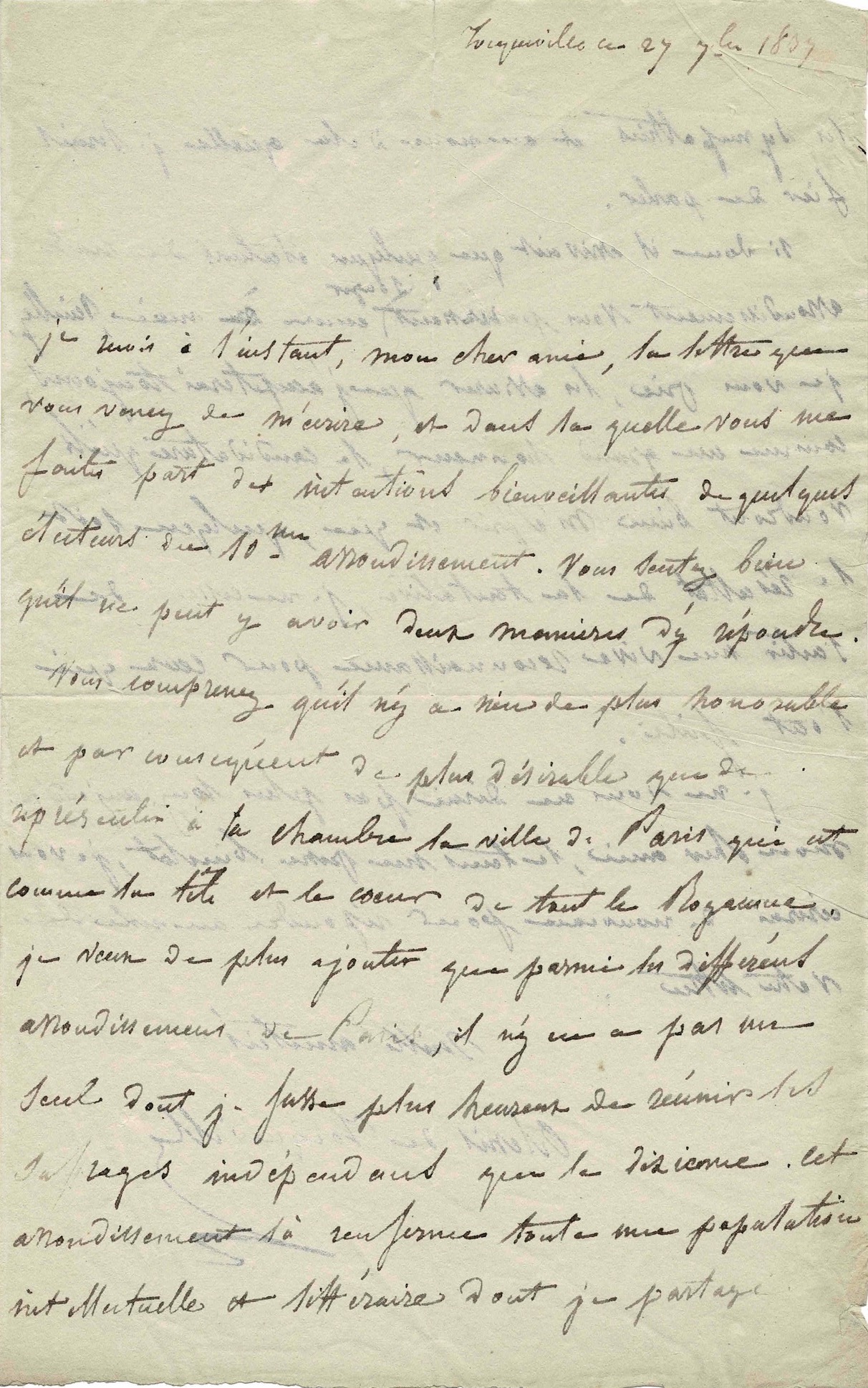
I have just received, my dear friend, the letter you have written to me, in which you convey the benevolent intentions of some voters in the 10th arrondissement . You surely understand that there can be no two ways to respond. You understand that there is nothing more honorable, and consequently more desirable, than to represent in the Chamber the city of Paris, which is like the head and heart of the entire Kingdom. I would also like to add that among the various arrondissements of Paris, there is not one whose independent votes I would be more pleased to secure than the tenth. This arrondissement contains a whole intellectual and literary population whose sympathies I share and in whose name I would be proud to speak . If, therefore, it should happen that some voters in our district still think of me, please assure them that I will always accept, as a great honor, any nomination they may wish to offer me, and that, whatever the outcome of the attempt, I will never cease to feel a deep gratitude for those who made it. I will say no more today, my dear friend, time is pressing. Soon, I will write to you again to reply to the rest of your letter. With warmest regards, Alexis de Tocqueville .
The project fizzled out, and it was in the Valognes constituency (Manche) that Tocqueville ran in the elections of November 4, 1837, where he was defeated by the incumbent deputy, Jules-Polydore Le Marois. Thanks to the early elections that followed, Alexis de Tocqueville was finally elected to the Chamber of Deputies on March 2, 1839, as an Independent. Re-elected four times, he served continuously until the coup d'état of December 2, 1851. He remained opposed to the Second Empire until his death.
Two years before this letter, Tocqueville had published the first two volumes of his magnum opus: Democracy in America (the last two appeared in 1840). This publishing success secured him a prominent place.
_______________________
II. Paris, August 17, 1842
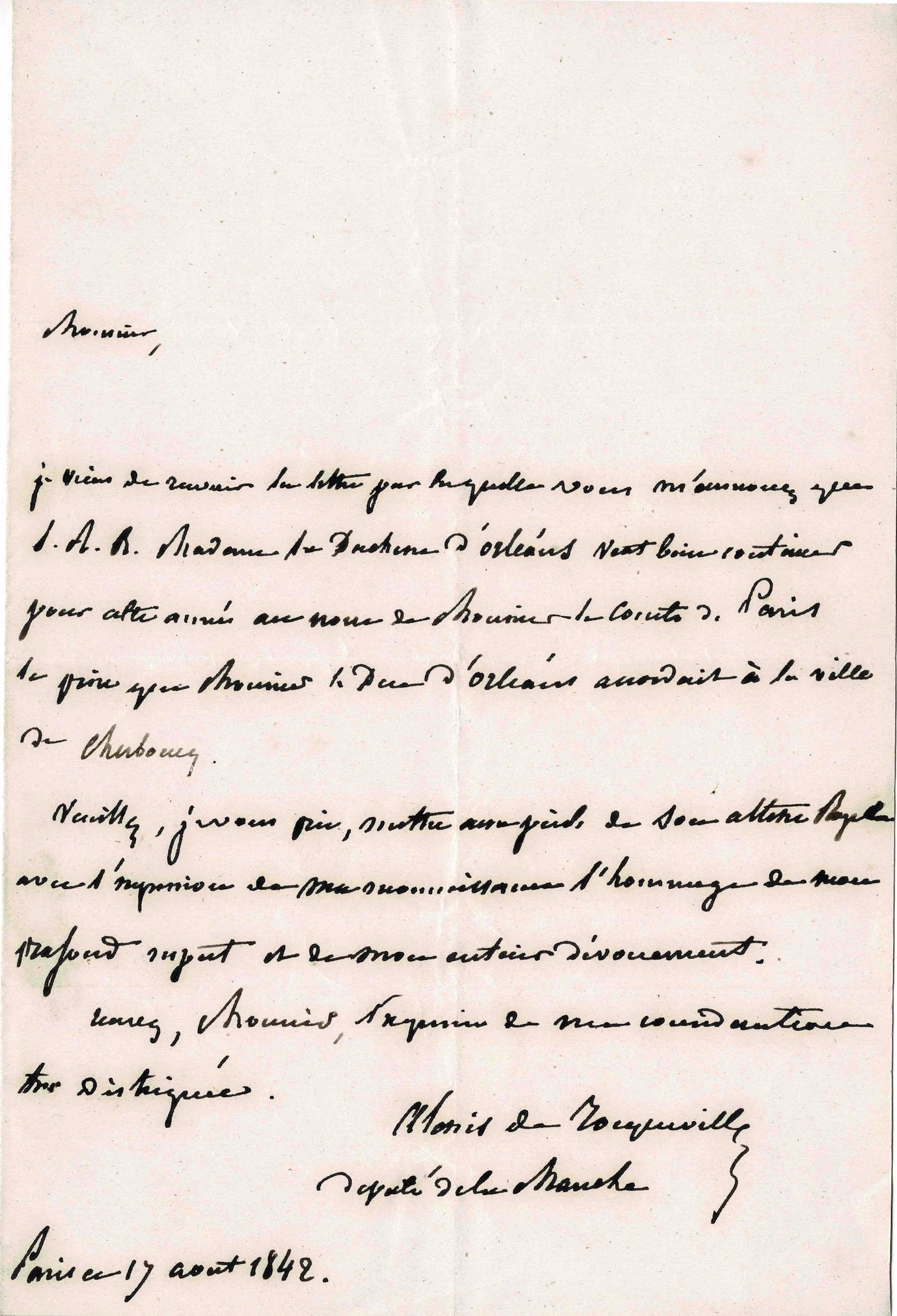
" Sir, I have just received your letter informing me that HRH the Duchess of Orléans has kindly agreed to continue for this year, on behalf of the Count of Paris, the prize that the Duke of Orléans previously awarded to the city of Cherbourg. Please convey to Her Royal Highness, along with an expression of my gratitude, the homage of my profound respect and complete devotion. Please accept, Sir, the expression of my highest consideration. Alexis de Tocqueville, Deputy for Manche. "
_______________________
III. No place or date [1844?]
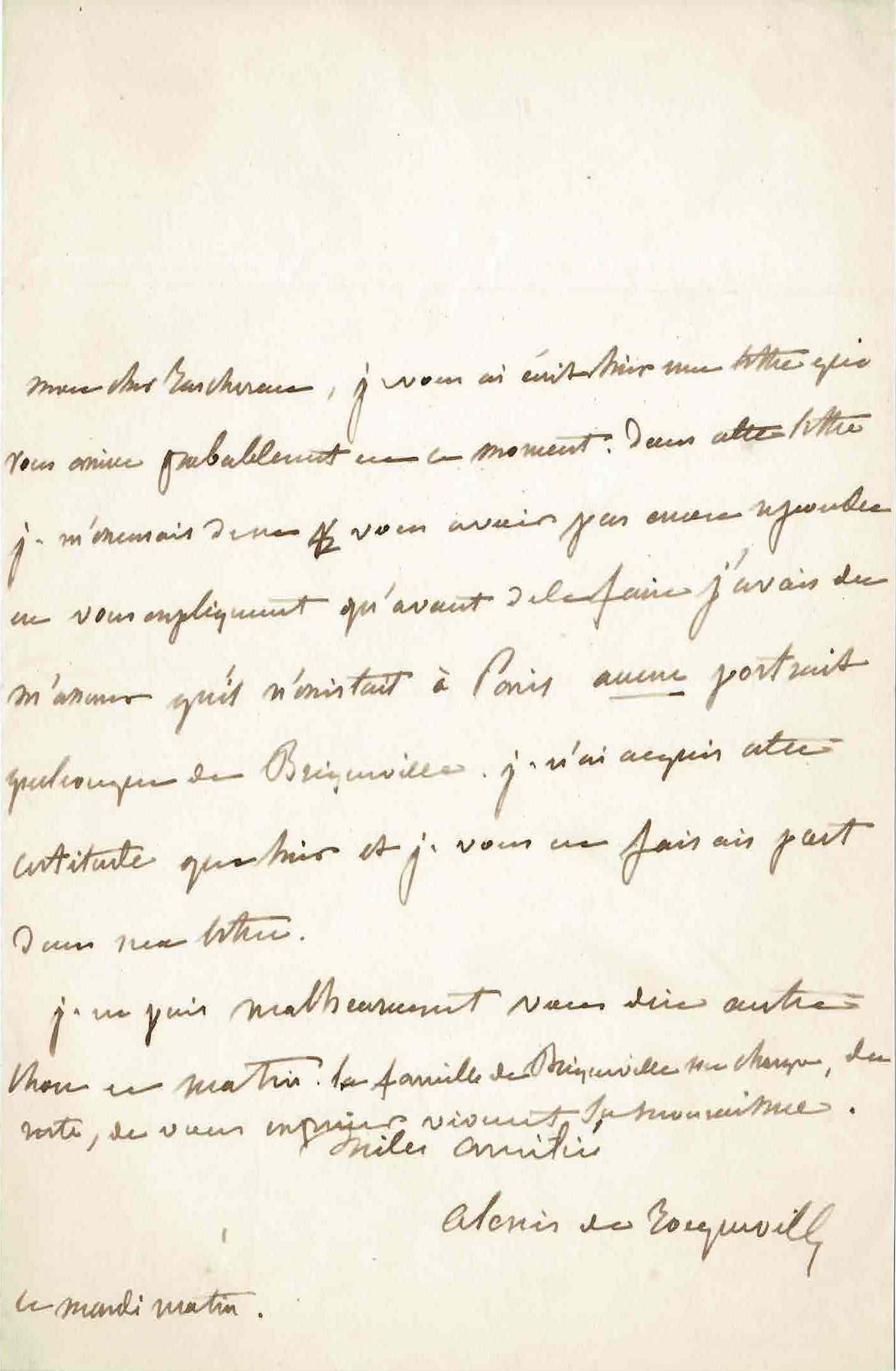
" My dear Taschereau, I wrote you a letter yesterday which is probably reaching you now. In it, I apologized for not having replied yet, explaining that before doing so no portrait of Briqueville existed in Paris I only became certain of this yesterday, and I mentioned it to you in my letter. Unfortunately, I cannot tell you anything more this morning. The Briqueville family has asked me to express their sincere gratitude. With warmest regards, Alexis de Tocqueville. This Tuesday morning. "
A friend of Tocqueville, to whom he was related by marriage, and a deputy for Cherbourg, Count de Bricqueville was a brilliant cavalry colonel in Napoleon's army. Elected in 1827, a fervent Bonapartist, he was a determined opponent of the Bourbons and the July Monarchy. He died in Paris on March 19, 1844, and was buried in Cherbourg. An independent committee organized a subscription to erect a monument in his memory. The bust design chosen was that submitted by David d'Angers. It was not inaugurated until May 1850. Tocqueville's mention of searching for a "portrait of Bricqueville" is undoubtedly linked to this monument project.