Louis-Ferdinand Céline (1894.1961)
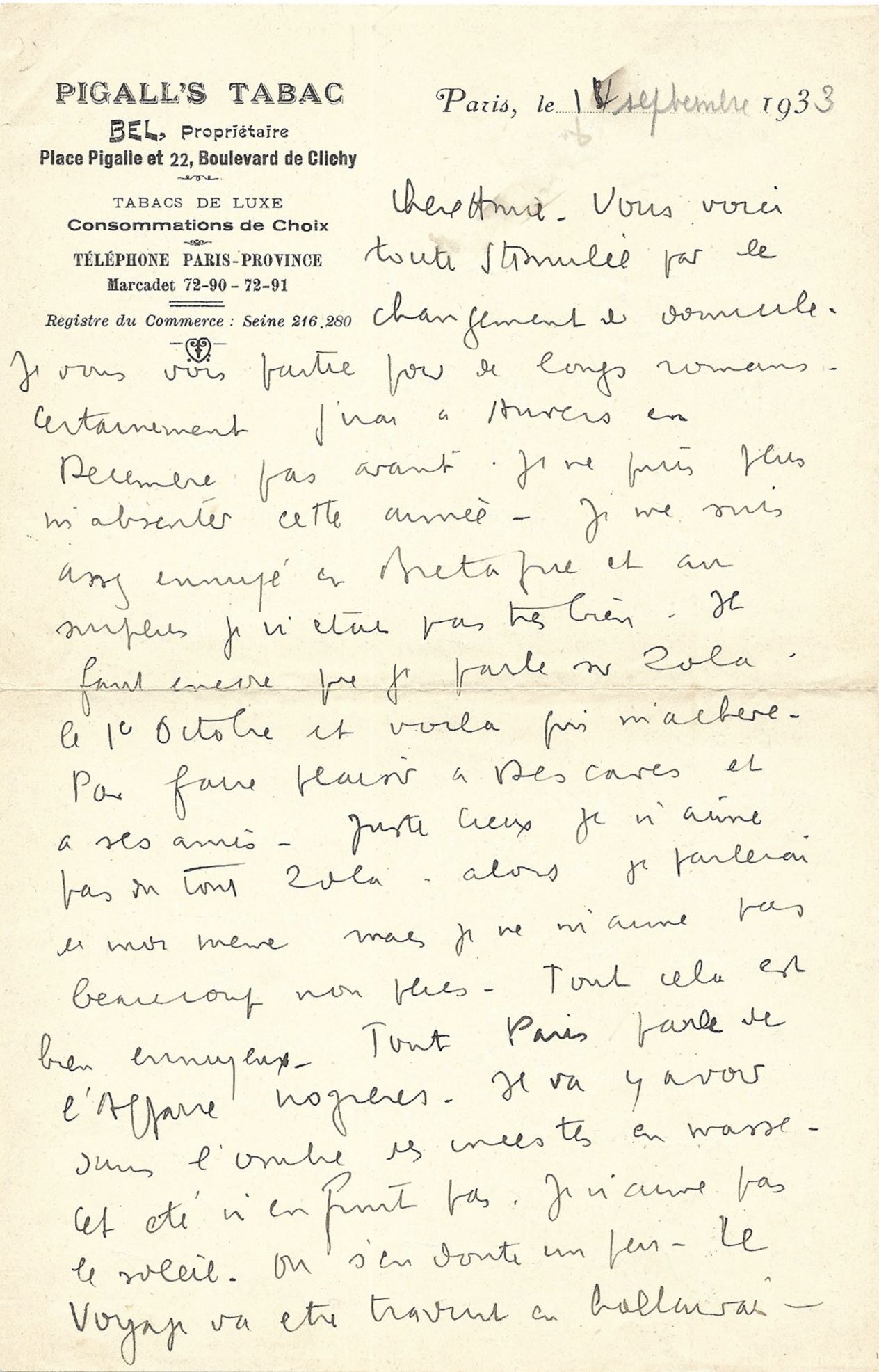
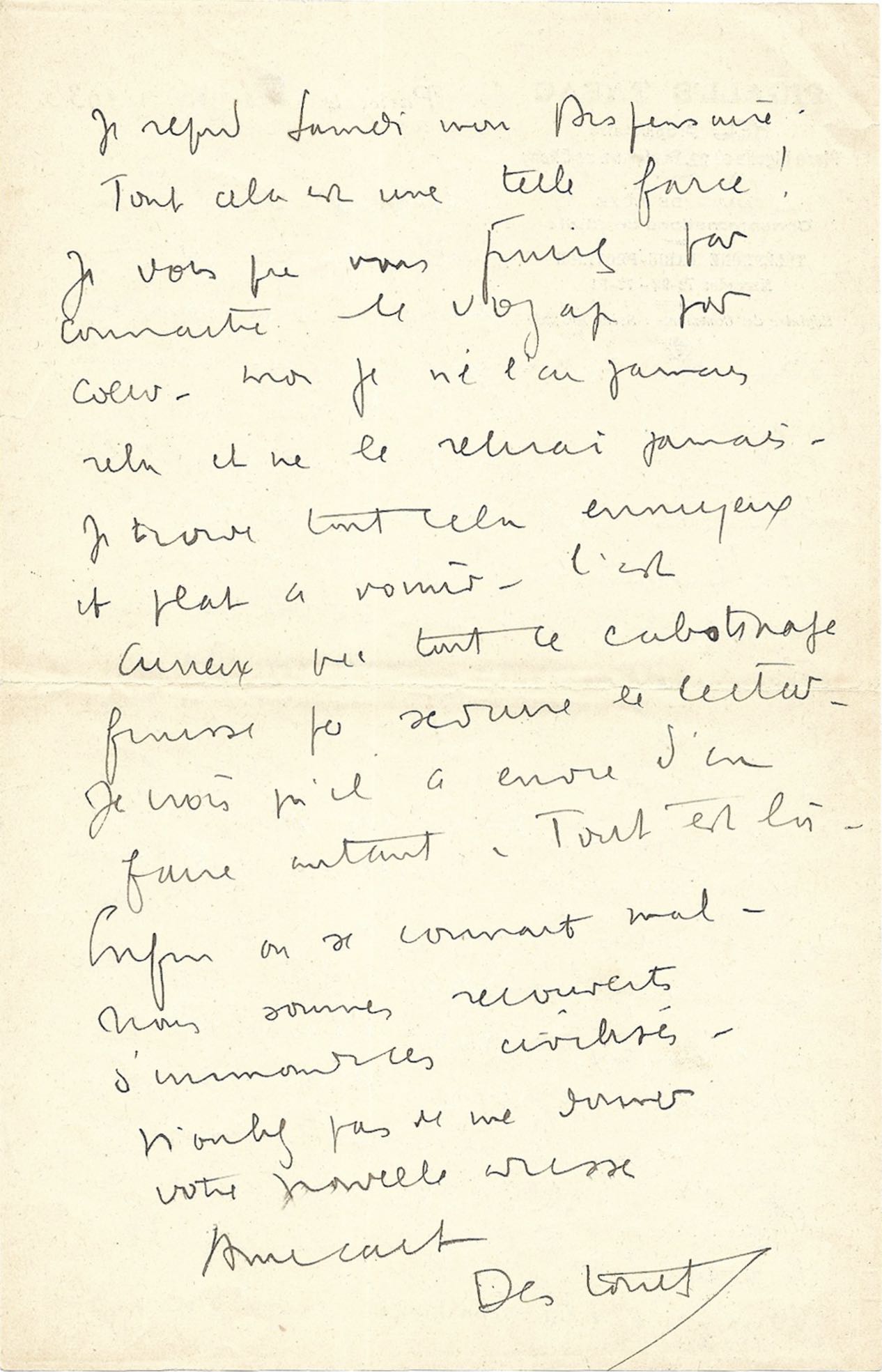
Autographed letter signed "Destouches" to Evelyne Pollet.
Two octavo pages on Pigall's Tabac letterhead.
Paris. September 14, 1933.
"I see you'll end up knowing Journey by heart. I've never reread it and never will. I find it all boring and nauseatingly flat."
Louis-Ferdinand Céline admits he "never wants to reread" his Journey to the End of the Night , one of the greatest texts of 20th-century French literature, which he finds "boring and sickeningly flat".
______________________________________________
"Dear Friend, You seem all fired up by the change of address. I see you're embarking on some long novels. I'll certainly go to Antwerp in December, not before. I can't be away any longer this year. I was quite bored in Brittany, and besides, I wasn't feeling very well. I also have to speak about Zola on October 1st, and that's the last straw. To please Descaves and his friends. Good heavens, I don't like Zola at all, so I'll talk about myself, but I don't much like him either . It's all very tedious."
All of Paris is talking about the Nozières Affair . There will be mass incest in the shadows. This summer never ends. I don't like the sun. You can probably guess that. The Journey is going to be translated into Dutch. I'm reopening my clinic on Saturday . It's all such a farce! I see you'll end up knowing The Journey by heart. I've never reread it and never will. I find it all boring and sickeningly flat. It's curious that all this posturing ends up seducing the reader . I think he wants to do the same. That's the crux of it. Well, we don't really know each other. We're covered in civilized filth . Don't forget to give me your new address. Yours truly,
Destouches.
______________________________________________
The discourse of rupture:
In the summer of 1933, Lucien Descaves approached his friend Céline about a speech he would give in homage to Zola at the annual pilgrimage to Médan. Céline did not express great admiration for the naturalist writer, and it was out of friendship for Descaves that he agreed. Thus, on October 1, 1933, the writer addressed an audience composed of the entire Parisian literary scene and other notables. While the speeches delivered up to that point remained within the expected framework of tribute, Céline's intervention was radically different and caused a scandal. The audience knew nothing of the content of his address. The writer, already perfectly mastering the staging of his public persona, chose the opposite approach and gave the floor to Ferdinand Bardamu, the hero of Journey . He also hinted at this when he said: "Good heavens, I don't like Zola at all, so I'll talk about myself." Through Bardamu, Céline delivers a dark and profoundly critical vision of contemporary French society. While the narrative begins with a genuine homage to the father of the Rougon-Macquart series, it quickly reveals the disillusionment characteristic of Céline's world. The writer marks a definitive break with Zola's naturalism, the Great War having discredited the modernist hopes based on scientific progress and the advent of a more just society. Céline buries the end of the naturalist legacy carried by Zola.
The translation of the Journey :
Published the previous year, Journey to the End of the Night had caused a sensation and propelled Céline to the forefront of the Parisian literary scene. Already translated into several languages, he gave assurances to his Dutch translator JA Sandfort in a letter of September 10, demanding that his text be translated in full : "at no price a reduction of the Journey. I don't want it, not a quarter, not a page, not a line [...]", and adding "There are already 10 foreign translations of this book all absolutely complete" ( Letters , no. 3393).
______________________________________________
1- Violette Nozière (1915-1966), barely 18 years old, was arrested, accused of poisoning her parents. While her mother was revived, her father did not survive. Although she initially filed a civil suit, her mother eventually forgave her daughter. Sentenced to death on October 12, 1934 – a sentence commuted to life imprisonment on August 29, 1945 – Violette Nozière was granted early release on August 29, 1945.
2- Céline tried his hand at private medical practice, opening an office in Clichy in November 1927, which he quickly closed due to a lack of patients. He eventually found employment as a suburban doctor at the Clichy dispensary, run by Grégoire Ichok. Dr. Destouches submitted his resignation to the communist municipality of Clichy on December 10, 1937.
Born in Antwerp in 1905, Évelyne Pollet took the initiative to write to Céline after reading Journey to the End of the Night, eventually becoming intimately familiar with it . They met in May 1933 and became lovers. She would go on to write eight novels and short story collections, including a fictionalized account of her relationship with Céline, written in 1942 and published in 1956 under the title Escaliers (La Renaissance du livre). Évelyne is also the name of the heroine in The Birth of a Fairy , the first of three ballets in Bagatelles for a Massacre.
Provenance:
Private collection
Bibliography:
Letters , ed. Henri Godard and Jean-Paul Louis, Pléiade, 2009, no. 33-94 (erroneous transcription of one word)