Jean BRULLER, known as VERCORS (1902-1991)
Original drawings.
Ink and pencil on paper. 1930.
Sheet in 28 x 21 cm format.
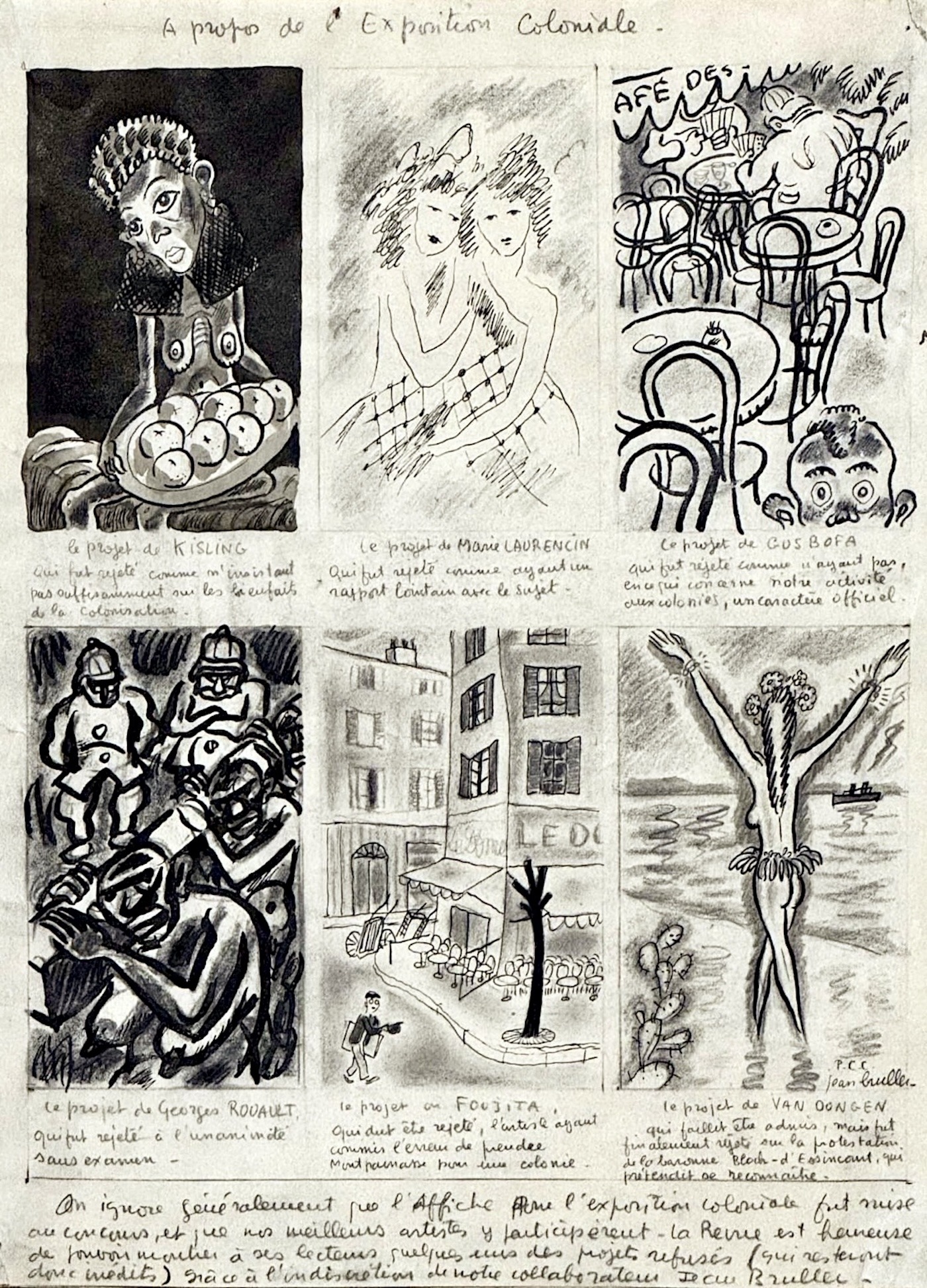
Regarding the Colonial Exhibition.
_______________________________________
Dummy poster designs for the 1930 Colonial Exhibition in Paris, consisting of a series of six satirical anti-colonialist drawings, brought together on one sheet and pastiching Van Dongen, Kisling, Foujita, Rouault, Laurencin and Bofa.
Vercors's formidable and scathing studies, borrowing the style of some of the most famous artists of his time, offer six mock poster designs for the Colonial Exhibition. The biting captions emphasize the iniquitous nature of French colonization in Africa, according to Vercors.
The "Moïse Kisling" project features a gaunt and visibly starving woman presenting a tray of oranges. The subtext condemns the exploitation of African land, which goes hand in hand with the exploitation of its people.
Laurencin's project is lighter and makes you smile, bringing a little sweetness to a work of uncompromising denunciation.
Bofa's project depicts French people from mainland France, wearing colonial helmets, sitting on the terrace of a bistro.
Georges Rouault's project is the most challenging. The explicit violence of the colonized condition is shown as it truly is. Obviously, these are not the images that one would want to show in metropolitan France.
Foujita's humorous project depicts the most famous of Japanese artists in Montparnasse, portfolio under his arm, passing in front of the Dome; Montparnasse is his colony!
Van Dongen's project punctuates this sequel in the funniest way. A young woman seen from behind, wearing Josephine Baker's banana belt, would have made an ideal advertisement for the colonies.
VERCORS: THE JOURNEY OF A FREETHINKER, RESISTANCE FIGHTER, AND ANTICOLONIALIST
Jean Bruller, born on February 26, 1902, in Paris, is a prominent figure in 20th-century French literature. Known by the pseudonym Vercors, which he adopted during the Second World War, he was a writer, illustrator, clandestine publisher, and committed thinker. His work and life were profoundly marked by the major struggles of his century: the fight against Nazism and an early and courageous stance against colonialism.
Before becoming a writer, Jean Bruller first made a name for himself as a satirical cartoonist. He contributed to publications such as Le Crapouillot , La Gazette des Lettres , and L'Illustration . His sharp wit and humor attracted the attention of intellectuals, including Pierre de Lescure, a writer and critic, with whom he forged a lasting friendship. It was with Lescure that he founded Éditions de Minuit in 1941, during the German occupation, a clandestine publishing house for the French literary Resistance. Together, they anonymously published Le Silence de la mer (1942), a poignant short story that became a symbol of intellectual resistance.
An anti-colonial voice from the interwar period: Bruller was one of the few intellectuals of his generation to openly oppose colonization as early as the 1930s, in little-known but insightful texts. He denounced the abuses of French imperialism and the contempt shown for colonized peoples. This stance, running counter to the dominant discourse, was rooted in a profoundly universalist philosophy: "Colonialism is not the light brought to peoples, it is the shadow cast by our interests." (Jean Bruller, letter to André Gide, 1938)