Gustave Flaubert (1821.1880)
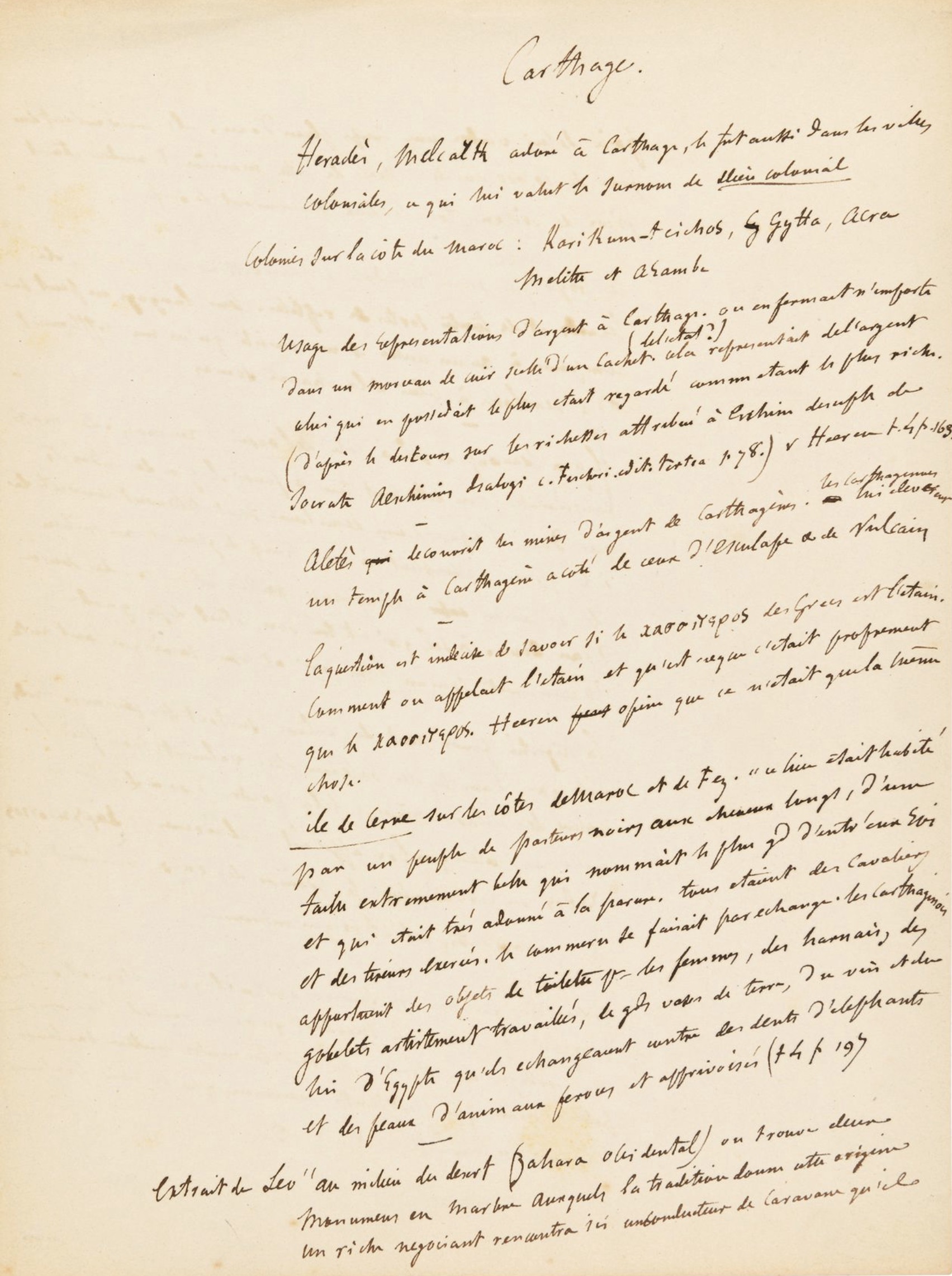
Autograph manuscript – Carthage.
Two folio pages.
Slnd [April or May 1857]
"I slept under the golden olive tree of Malkarth, patron of the Tyrian colonies."
Magnificent and precious preparatory notes for Salammbô , concerning Punic civilization, taken from reading volume IV of the work devoted to Carthage by Arnold Hermann Ludwig Heeren, De la Politique et du commerce des peuples de l'Antiquité .
Immediately after the emotional anguish of the trial against Madame Bovary in January 1857, Flaubert embarked on extensive research in Carthage, the setting for his novel in progress. " I need to cleanse myself of all the contemporary depravities in which I was made to wallow this winter [the Bovary trial], and to stop thinking about the bourgeoisie, stop painting them, and stop seeing them. I thirst for a higher milieu ."
Heeren's book was one of Flaubert's first readings, as evidenced by his letter to Jules Michelet dated March 1, 1857 .
The notes presented here were used directly in the writing of Flaubert's historical novel, published – more than five years after the first drafts – on November 24, 1862 by Michel Lévy, and offer a fascinating glimpse into the creative process and rigor of the French writer.
____________________________
Carthage.
Heracles, Melcarth worshipped in Carthage, was also venerated in the colonial cities, earning him the nickname "Colonial God ." [In Chapter III, we find the passage where Salammbô says: "I slept under the golden olive tree of Malkarth, patron of the Tyrian colonies."]
Colonies on the coast of Morocco: (…) Gytta, Acra, Melitre and Aramba.
The use of silver tokens in Carthage. Anything could be enclosed in a piece of leather sealed with a seal. This represented money. The person who possessed the most was considered the richest. (from the discourse on wealth attributed to Aeschines, disciple of Socrates…) see Heeren vol. 4 p. 163. [ This practice, reported in the Dialogues of Aeschines, is mentioned in chapter II of Salammbô: “As for the Mercenaries’ pay, it filled, roughly, two esparto grass baskets; one could even see, in one of them, those leather discs that the Republic used to conserve currency.”]
Aletes discovered the silver mines of Cartagena. The Carthaginians erected a temple to him in Cartagena next to those of Asclepius and Vulcan. [This figure is alluded to in Chapter VII of Salammbô: "Brass scales covered the walls; in the middle, on a granite pedestal, stood the statue of a Kabyrian with the name of Aletes, discoverer of the mines in Celtiberia." ]
The question remains unresolved as to whether the κασσίτερος of the Greeks is tin. What was tin called, and what exactly was κασσίτερος? Heeren opines that it was simply the same thing. [This matter is mentioned in the same Chapter VII: "Bronze plates, silver ingots, and iron bars alternated with the tin salmon brought from the Cassiterides via the Dark Sea. "]
Cerne Island on the coasts of Morocco and Fez. “This place was inhabited by a people of long-haired black pastoralists (…) who named the greatest among them Soi and who were very prone to laziness. All were skilled horsemen and marksmen. Trade was conducted by barter. The Carthaginians brought toiletries for the women, harnesses, artistically crafted goblets, large earthenware vases, wine and linen from Egypt which they traded for elephant teeth and the skins of wild and domesticated animals (t4 p197).”
From Lev: "In the middle of the desert (Western Sahara) there are two marble monuments to which tradition attributes this origin. A wealthy merchant met a caravan leader here and urged him to sell him a cup full of water. They agreed on a price of 10,000 ducats; but in this way, the leader was deprived of drink, and both died of thirst.".
According to Herodotus, the troglodytes feed on snakes, lizards, and all sorts of reptiles. Their language is unlike any other and consists only of a hissing sound quite similar to that of a bat.
____________________________
Gustave Flaubert continues his notes by noting details about the salt from the oasis of Ammon, precious goods originating from Black Africa, and mules in Africa.
Magnificent document in perfect condition.
Bibliography:
On the Politics and Commerce of the Peoples of Antiquity. Arnold Hermann Ludwig Heeren. (Paris, Firmin Didot frères, 1832).
Flaubert's Correspondence. Pléiade Edition. Volume III.