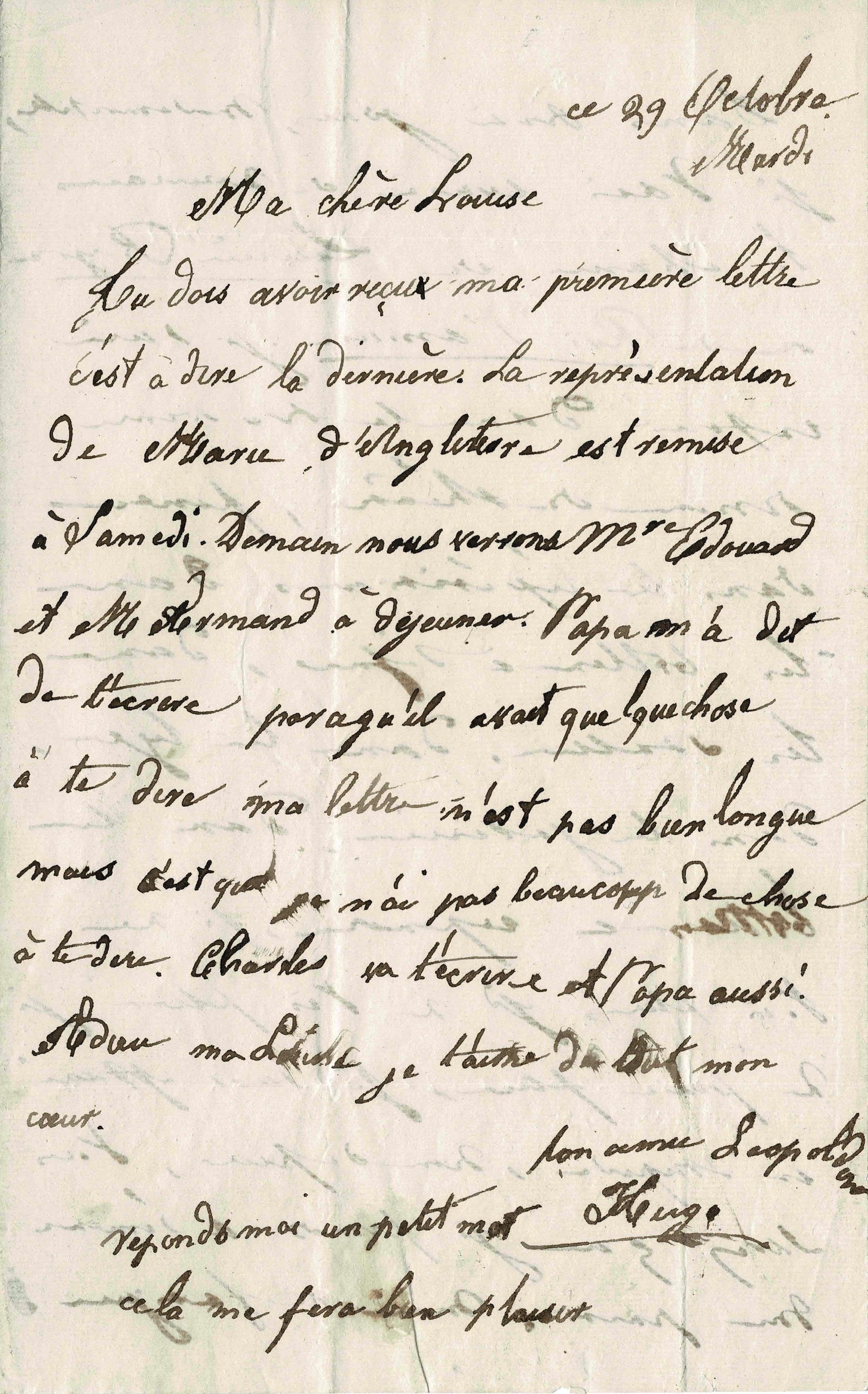
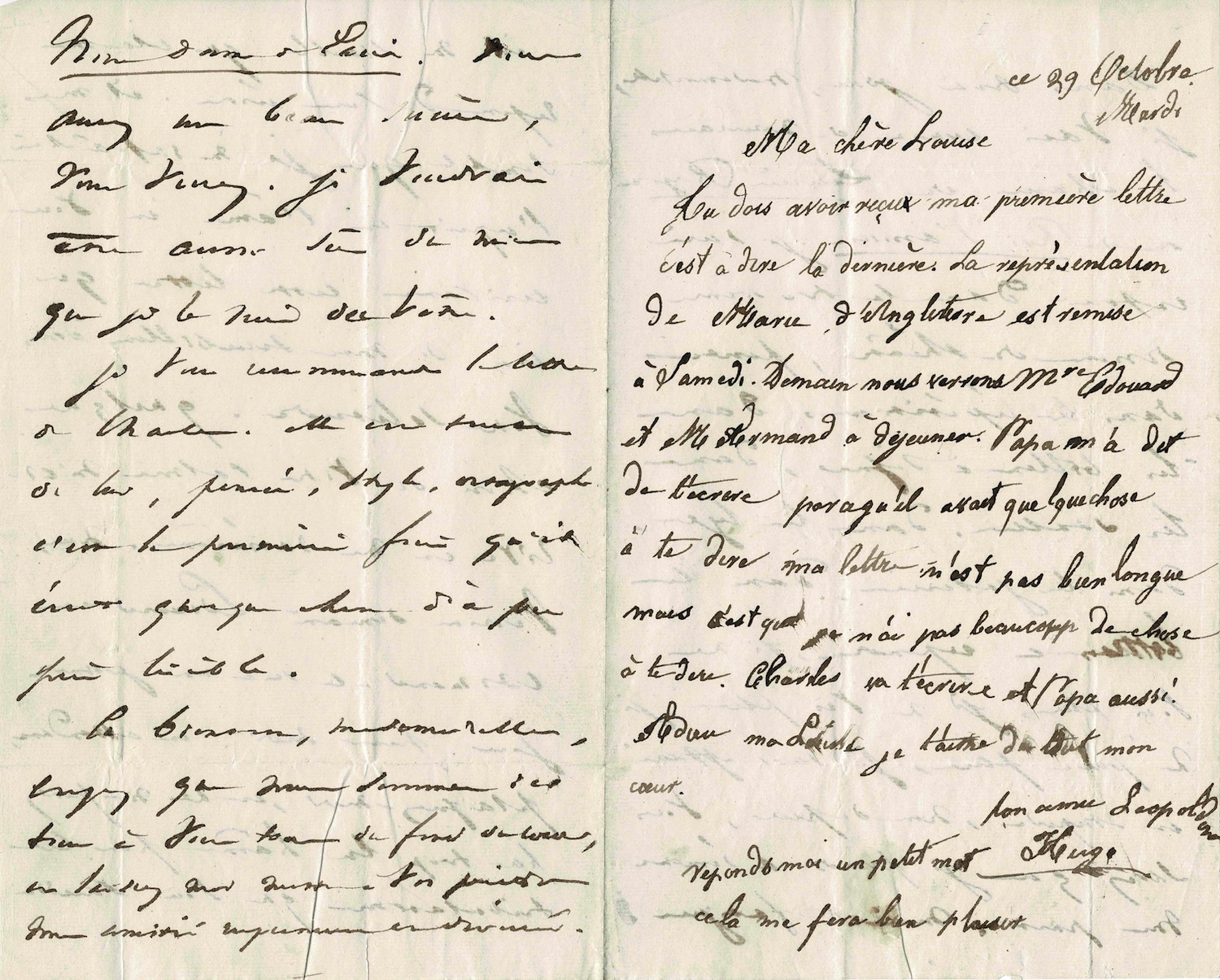

"Dad told me to write to you because he had something to tell you..."
9.500€
Léopoldine HUGO & Victor HUGO
Autographed letter signed to Louise Bertin.
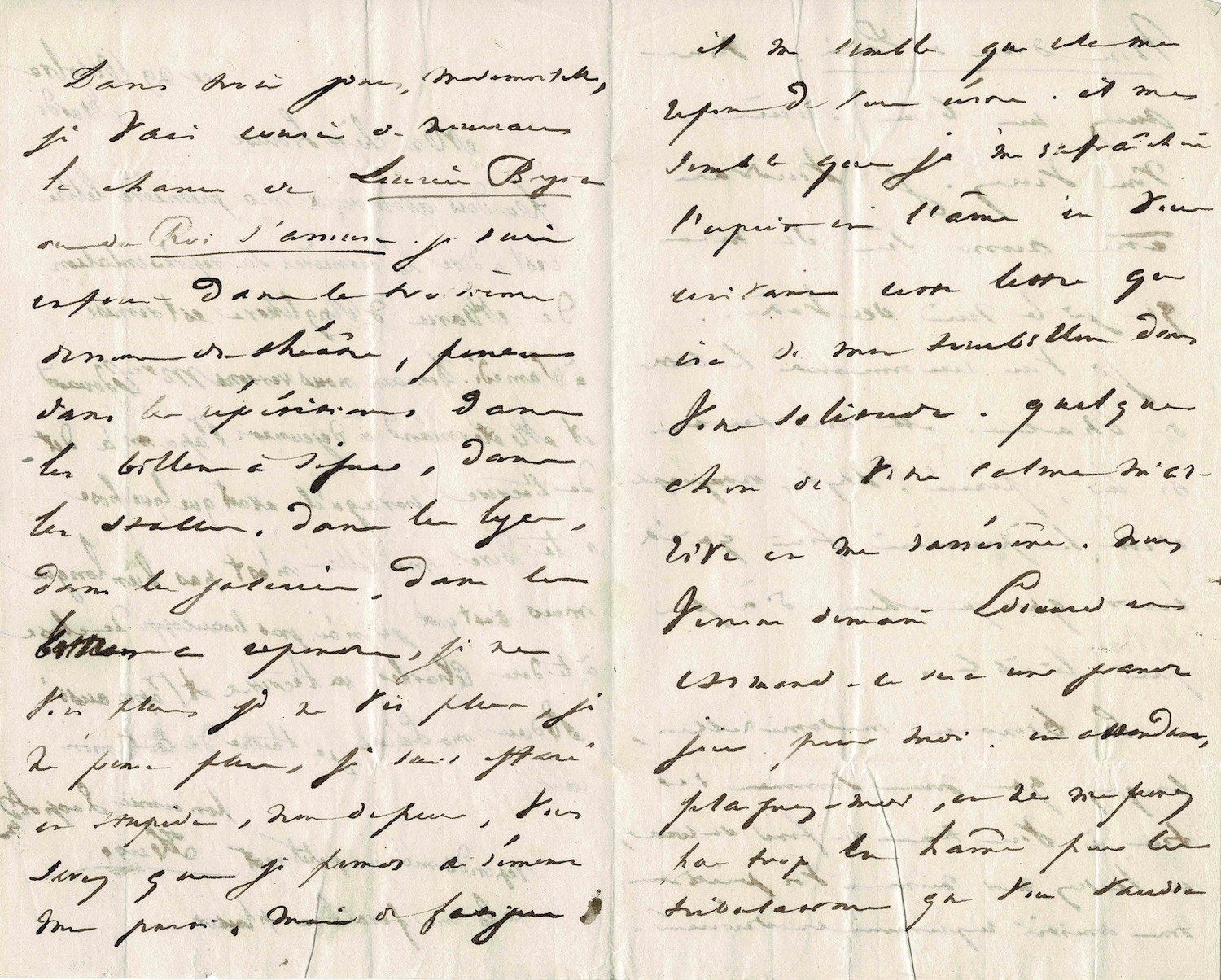
Four octavo pages written jointly by Léopoldine and her father Victor Hugo.
[Paris] Tuesday, October 29, 1833.
"Dad told me to write to you because he had something to tell you..."
A tender and moving letter from Victor Hugo co-written with his beloved daughter, Léopoldine.
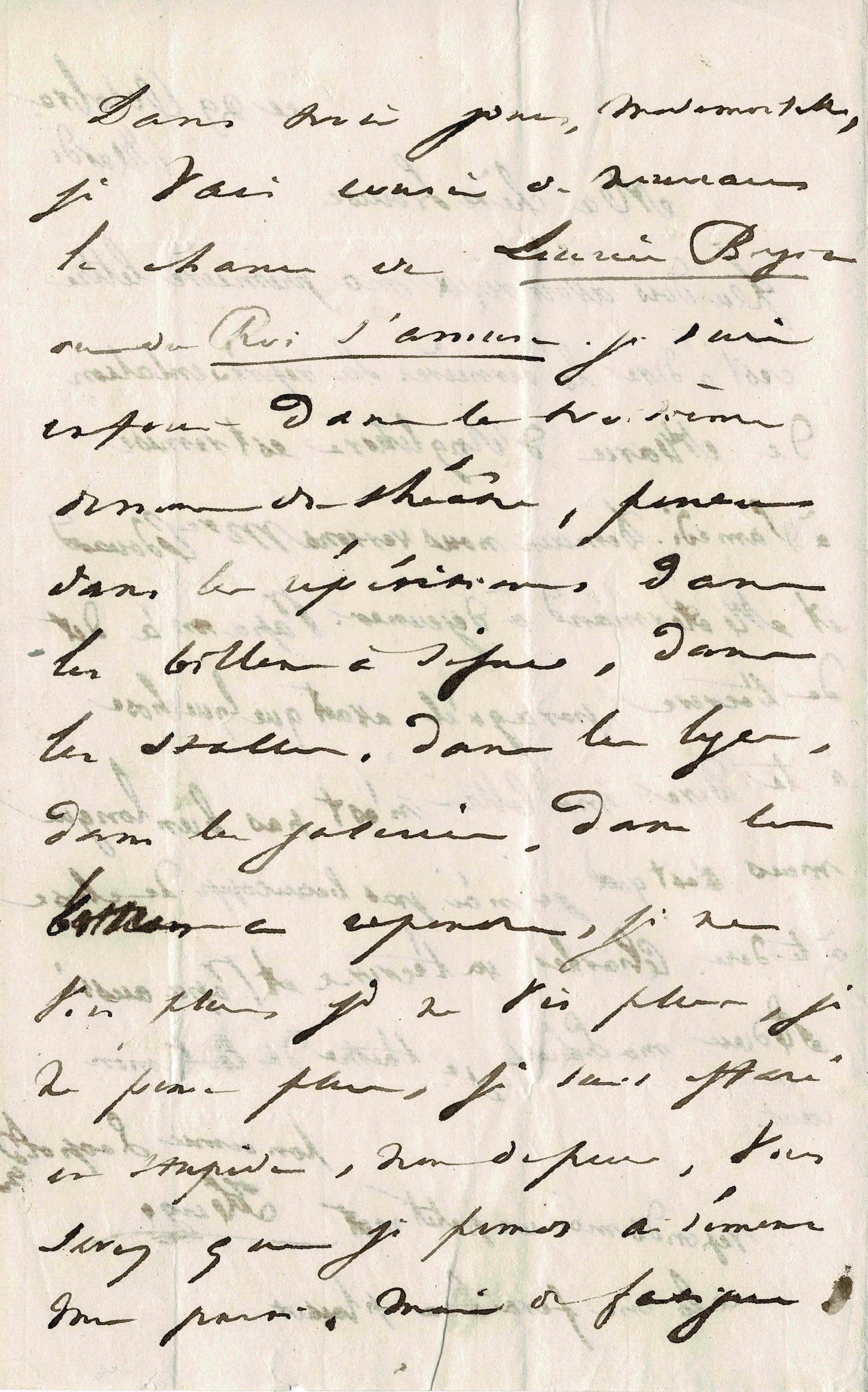
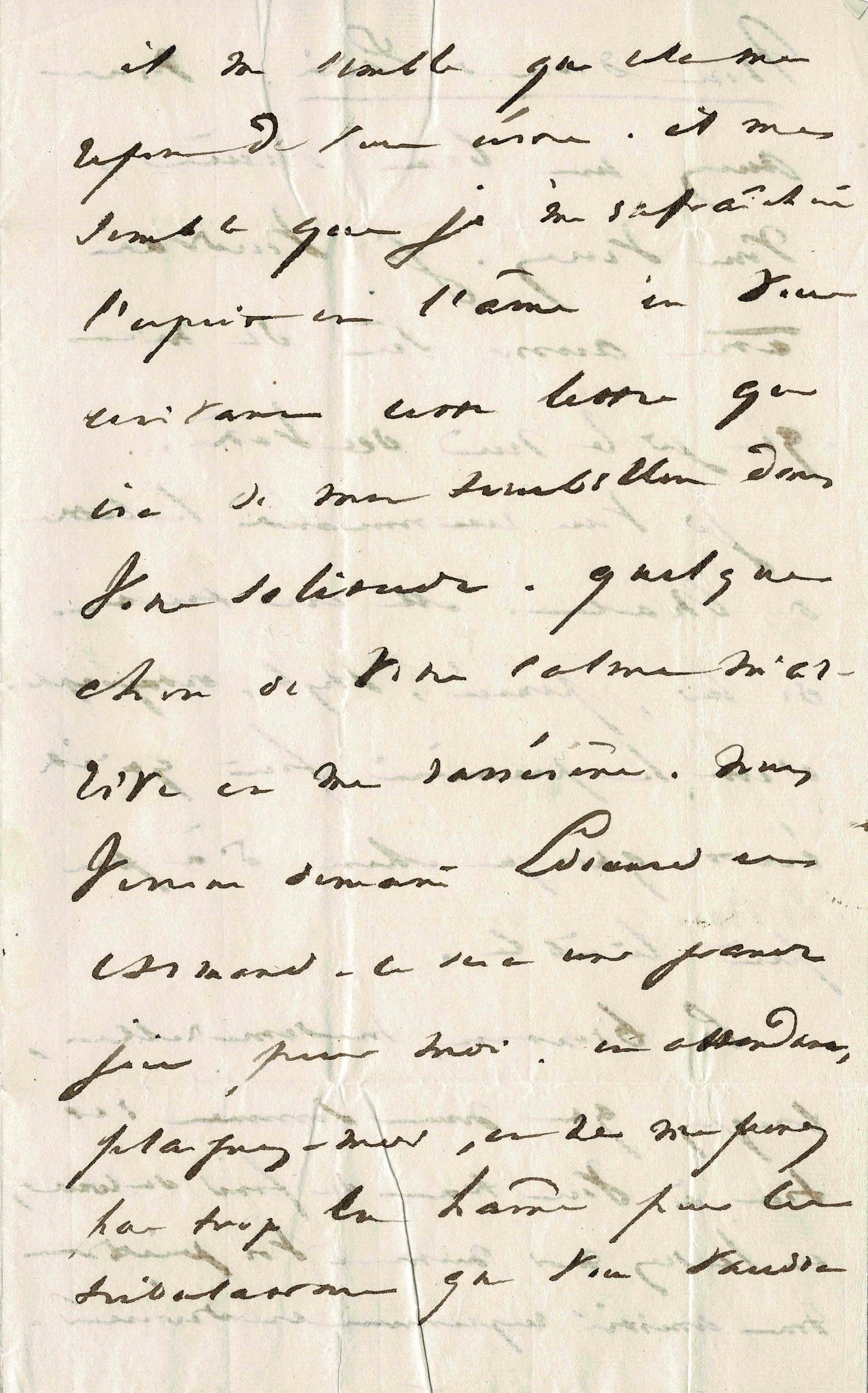
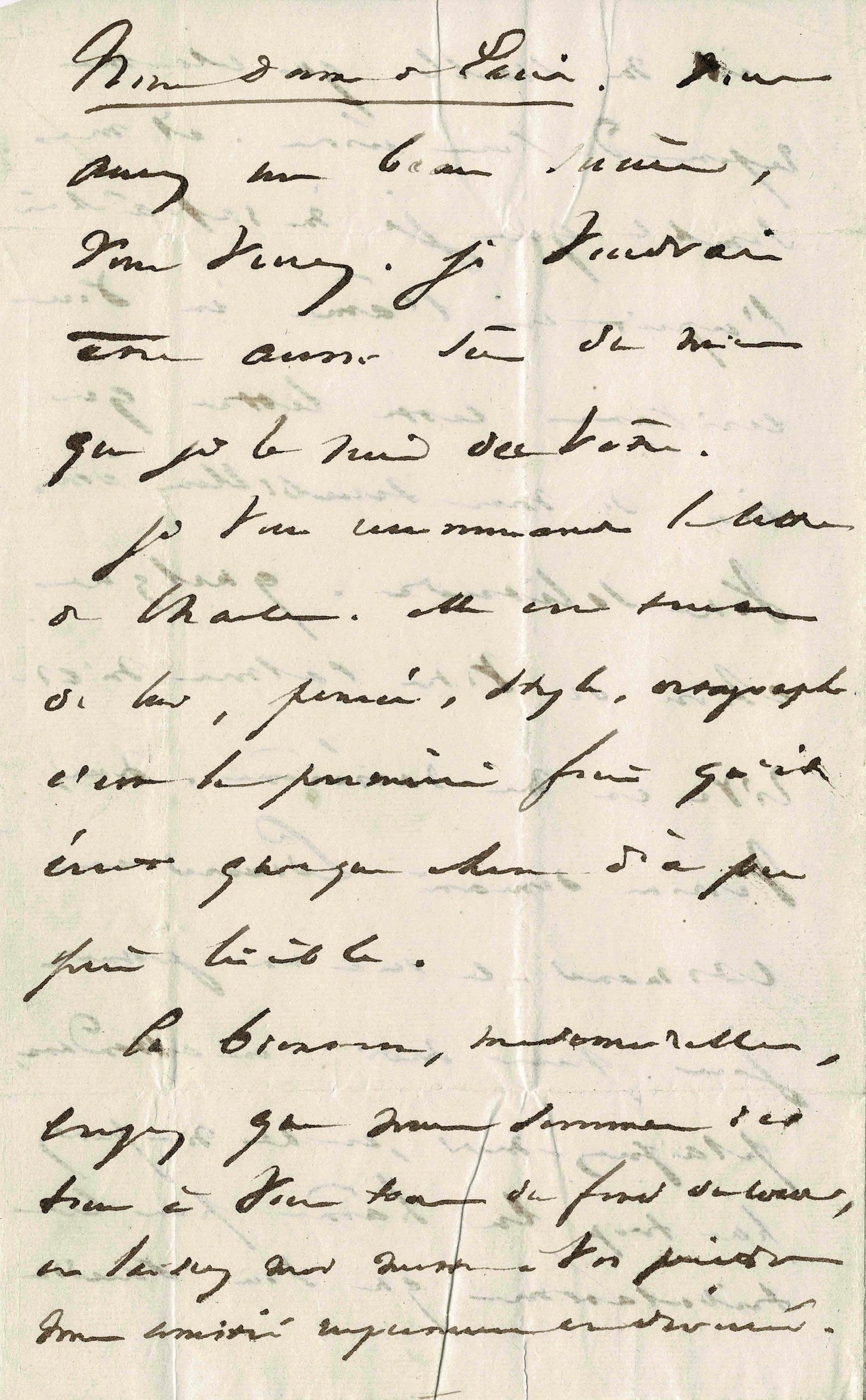
The nine-year-old girl wrote the first page in a childlike manner, then Victor continued the letter on the next three pages, revealing the turmoil he was experiencing due to the upcoming performance of his play, Marie Tudor. Concluding the letter more calmly – “ It seems to me that writing to you is restful. It seems to me that I am refreshing my mind…” – Victor Hugo promised Louise Bertin one of his masterpieces, Notre-Dame de Paris.
Léopoldine Hugo's letters are extremely rare. Obviously, those written jointly by father and daughter are the most precious.
________________________________________________________________________________________
"My dear Louise, You must have received my first letter, which is to say, the last. The performance of Mary of England [Mary Tudor, which premiered on November 6th at the Théâtre de la Porte-Saint-Martin] has been postponed until Saturday. Tomorrow we will see Mr. Edouard and Mr. Armand [Edouard and Armand Bertin, Louise's brothers] for lunch. Papa told me to write to you because he had something to tell you; my letter isn't very long, but that's because I don't have much to say. Charles will write to you, and Papa too. Well, my Louise, I love you with all my heart. Your friend, Léopoldine Hugo. Please write me a short note; it would make me very happy."
" In three days, mademoiselle, I will once again encounter the charm of Lucrezia Borgia and The King Amuses Himself. I am buried in the third basement of the theatre, lost in rehearsals, in tickets to distribute, in the stalls, in the boxes, in the galleries, in tickets to reply to, I can no longer see, I can no longer live, I can no longer think, I am bewildered and stupid, not from fear, you know that I am making my decision in advance, but from fatigue.
It seems to me that writing to you is restful. It seems that I refresh my mind and soul by writing this letter, which will carry me from my turmoil into your solitude. Something of your calm reaches me and soothes me. We will see Edouard and Armand tomorrow; it will be a great joy for me. In the meantime, pity me, and don't be too hasty in your pursuit of the tribulation that will bring you Notre-Dame de Paris. You will have a great success, you'll see. I wish I could be as certain of my own success as I am of yours.
I recommend to you Charles's letter [Charles Hugo, Victor's second son, born in 1826]. It is entirely his own—thought, style, spelling—it is the first time he has written anything even remotely legible (…) Believe me, we are all here for you, all of us from the bottom of our hearts, and allow me to offer you my respectful and devoted friendship.
________________________________________________________________________________________
Poet and composer, close friend of Victor Hugo, Louise Bertin (1805-1877) was introduced to music from a very young age by her pianist mother. Her father, Louis François Bertin, director of the newspaper Les Débats, recognized his daughter's musical talent and encouraged her by providing her with lessons from the greatest teachers.
Suffering from polio and battling the misogynistic prejudices of the time, Louise, with unwavering determination, embarked on a career in composition. By the age of twenty, she had composed two comic operas and an opera based on Goethe's Faust. Esmeralda, composed in 1836 for the Royal Academy of Music, based on Notre-Dame de Paris, remains her most significant work; Victor Hugo himself wrote the libretto for it.
A woman of wit and courage, she was praised by the greatest, such as Berlioz, who admired her talents and perseverance: "Mademoiselle Bertin is one of the strongest female minds of our time."
***
Léopoldine Hugo (1824-1843) was the eldest daughter of the great man. Nicknamed Didine, she was adored by her father. Married in February 1843 to Charles Vacquerie, fate intervened six months later: on September 4th, in Villequier, the couple embarked on a sailing trip. A gust of wind capsized the boat; Léopoldine, who could not swim, was swept overboard, as was Charles. She had just celebrated her 19th birthday.
Hugo, traveling with Juliette Drouet, only learned of his daughter's death on September 9th in Rochefort. Waiting for the stagecoach to La Rochelle in a café, he read the September 6th edition of the newspaper Le Siècle , which reported the event: " They brought me beer and a newspaper, Le Siècle. I read it. That's how I learned that half of my life and my heart had died ."
In her diary, Juliette Drouet poignantly recounts the event: “In a sort of large square, we see written in large letters: Café de l’Europe. We go in. The café is deserted at this time of day. There is only one young man, at the first table on the right, reading a newspaper and smoking, opposite the woman behind the counter, on the left. We go and sit at the very back, almost under a small spiral staircase decorated with a red calico railing. The waiter brings a bottle of beer and leaves. Under a table, opposite us, there are several newspapers. Toto takes one at random, and I take Le Charivari. I had barely had time to look at the title when my poor beloved suddenly leans over me and says in a strangled voice, showing me the newspaper he is holding: ‘This is horrible!’” “I look up at him: never, as long as I live, will I forget the nameless expression of despair on his noble face. I had just seen him smiling and happy, and in less than a second, without warning, I found him struck down. His poor lips were white; his beautiful eyes stared without seeing. His face and hair were wet with tears. His poor hand was pressed against his heart, as if to keep it from leaving his breast. I pick up the dreadful newspaper and I read… ”
Hugo never recovered from this tragic fate, and the memory of Léopoldine remained in his heart every day: "Tomorrow at dawn, when the countryside is bathed in light, I will leave. You see, I know you are waiting for me. I will go through the forest, I will go over the mountain. I cannot stay away from you any longer…."